AN ENTERPRISING PHOTOGRAPHER.
Reading edition
The recent war between China and Japan, which now seems to be practically over, fortunately, was watched by all the military and naval men in the world with a great deal of interest, for it was the first real war in which many of the modern inventions in war-ships and army accoutrements were given a fair trial. To be sure, China had little that was modern in her army and navy, though some of the ships of her navy were of recent European build, and were manned by capable seamen and good fighting-men. But the Japanese certainly did have many of the modern inventions in their cruisers, and they made most effective use of them.
The correspondents of the great papers of the world, however, seem to have suffered, and whether this is a development of modern warfare, or because the Japanese and Chinese did not understand and appreciate their position, does not appear to have been settled. At all events, the correspondents from Japan and China, as well as those from European and American countries, went about their always dangerous business at their peril, and were in constant danger of being captured and hung or murdered by either party. Some of these bright and daring men did lose their lives there, and no one takes the trouble to sing a requiem over them in verse or prose, but others, in spite of all the opposition, got to and remained at the front, and succeeded in sending out accurate news to their papers.
PHOTOGRAPHER AT WORK.
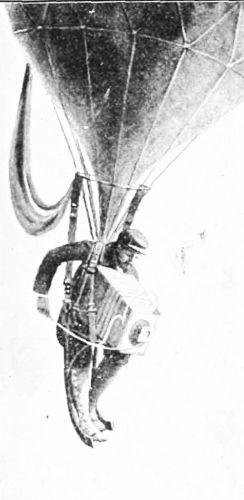
It was one of these successful newspaper men, and a Japanese at that, who originated the idea of using a balloon to help him get to the front, as well as to keep him safely out of the reach of both contestants. He procured a balloon, several, in fact—and had a peculiar metal frame-work constructed, which held him firmly in place under the balloon, and left his arms free, so that he could use them to write, or to work a huge camera that was also attached and supported by the same iron frame. By means of straps over his shoulders and about his body he could keep himself moderately firm in his position, and his camera reasonably stationary, except, of course, for the movements of the balloon itself, which he could not regulate.
Several times this correspondent was sent up in his balloon, and held by an assistant with the help of a long rope far above houses, and even hills, so that he could take photographs on his huge lens of the general view of a battle, while he himself was either too far away or too unimportant at the moment to the combatants to tempt them to fire upon him. In this way he succeeded in securing some astonishing views. They were, of course, very far removed from the scene of action, too far to give much of the small details, but they presented a bird's-eye view of the whole battle, which proved of great interest. Occasionally, because of a sudden movement of the balloon, he "took" the sky or a distant landscape instead of the raging battle beneath him, but these little mistakes were insignificant when on being hauled down, he discovered two or three views that showed charges of cavalry here, repulses of infantry there, and smoke and strife, bursting shells and burning houses, everywhere.
Sometimes the photographer would go up in his camera-balloon without being held to the earth by a rope, and then he might drift with the wind over the battle-field, or quietly drift away without getting a chance to "shoot." As a rule, however, calculations were pretty well made before the rope was dropped, and then the balloon was allowed to float where it would, with the comparative certainty that it would pass over, or nearly over, the scene of action.
Here is a chance for photographers who want to take new scenes and original things with their cameras. The earth at a few hundred feet distance would look like a big bowl covered with many little roofs, laced with white roads, along which funny little animals would be seen crawling along at a snail's pace.