THAT SLEIGHT-OF-HAND PERFORMANCE.
Reading edition
BY CHARLES M. SHELDON.
It had been a very dull winter at Colby, and when we college boys came home for our Christmas vacation we determined we would liven it up for the village.
As it happened, curiously enough, a funeral was the cause of the lively time that followed our determination.
Old Father Colby, one of the original settlers, had died the week before, leaving a wife and three orphaned grandchildren in the old homestead, and, as it turned out, very destitute. So the idea occurred to us to get up a benefit entertainment, and turn over the proceeds to the widow Colby and her family of grandchildren.
The idea took with the neighborhood. And we at once rented the Town-hall, and proceeded to bill the village and every barn in the township with the notices of our performance.
There were three of us: Tom Chandler, Jonas Willitts, and myself, Peter Samuels. We were the only village boys who had ever been to college, and we were the envy of all the farmers' boys and the admiration of all the village girls. So we made the most of our brief vacations to get into public notice.
We determined to give a sleight-of-hand performance. Tom sent down to Boston for materials, and we all practised diligently, keeping everything as secret as if we were in a conspiracy against the United States.
Our announcements, which were scattered all over the township, were certainly very attractive. They read as follows:
"Extraordinary Performance to be given at the Town-hall, Colby, December 20, 18—. Marvellous Feats of Prestidigitatorism! The Egg and the Handkerchief! The Watch Mortar and Magic Pistol!
"The Handkerchief that will not Burn! The Pudding in the Hat! The Inexhaustible Bottle! And Numerous other Marvels and Mysteries lately Imported from India and the East!
"The above Unrivalled Performance will be given for only 25 cents admission. Proceeds to be devoted to Benevolent Cause. Doors open at 7.30. Performance to begin at 8. Come early and avoid being turned away. No reserved seats. Carriages may be ordered for ten o'clock."
We debated some over the last line on the handbills, but finally decided to let it go in. It made the bills look more cosmopolitan and did no harm.
Tom and Jonas were to be the principal performers. I was general ticket agent and business and stage manager. We all had our dress suits with us, and, of course, we wore them when the time came.
Well, that was the largest crowd that ever came to an entertainment in Colby. There hadn't been anything going on all winter. Most of the young people had never seen any sleight-of-hand tricks, and all the old people turned out to help Grandma Colby. Before eight o'clock the hall was jammed. Every seat was taken, and people crowded into the broad aisle and sat on the platform, and stood up all around in a black fringe against the wall.
We had rigged up a curtain in front of the narrow platform, and at eight o'clock, when the hall was so full that no more people could get into it, the curtain was pulled aside by Peter Samuels, the stage director, and revealed the Magician's Home.
The first trick on the programme was "The Egg and the Handkerchief." Jonas was behind the table acting as Tom's assistant, while I was stationed just out of sight behind a fold of the curtain, ready to step in at the right moment, for the trick required the use of three persons.
It was simple enough, and yet Tom's blunder at the start led to the ridiculous accident which was the first of a series that made that sleight-of-hand performance a thing for Colby people to reckon time from.
The trick was, first, for Tom to produce an egg from Jonas's month by rapping him on the back of his head, Jonas already having been provided with a guinea-hen's egg secreted in his mouth for the purpose. Then, when the egg appeared, Tom was to pretend to place it in a handkerchief, really substituting for it a china egg of the same size, and slipping the real egg into a little pochette of his dress-coat. What he did, however, was to drop the real egg into the handkerchief, because, as he afterwards said, the china egg stuck in his pochette, and he could not get it out. The next part of the trick was to gather up the four corners of the handkerchief and whirl it around rapidly, saying, "Ladies and gentlemen, keep your eyes on my assistant yonder." At that point I stepped out, holding on a plate a very nice-looking sponge-cake previously prepared. Then Tom was to say: "I will now cause the egg in the handkerchief to pass into the cake. Watch closely, ladies and gentlemen."
At that point Tom should have brought the handkerchief around in such a way as to slip the china egg out into his other hand. Then I was to come forward and cut open the cake, displaying an egg (also china), previously placed within. And then Tom was to have produced the real egg, and in order to prove that it was a real egg within the cake (exchanging the two by palming one of them), he was to break the real one into a dish.
All this, which sounds so complex to describe, was simple enough as we had rehearsed it, and even with Tom's blunder of dropping the real egg in the handkerchief, might have turned out all right if he had not let go one of the corners of the handkerchief as he whirled it around his head. I, Peter Samuels, stage manager and director of that extraordinary performance of "Marvellous Feats of Prestidigitatorism," will never forget my sensations when, as I advanced solemnly with the cake, a white body whizzed through the air and struck me full on my expansive shirt bosom, breaking with a splash, and running down over my vest and trousers in a yellow stream.
I remember the scared look on Jonas's face, the perfectly horrified expression that Tom wore, and also remember dimly wondering if a guinea-fowl's egg would make as large an omlet as that of an ostrich. For it seemed to me as if I was swimming in egg batter.
The next instant the audience broke into a perfect roar of laughter. I threw the cake down on the table and rushed back of the curtain again, leaving Tom and Jonas to get out of the blunder as best they could, while I wiped off the egg as best I could with my handkerchief.
How that audience did roar! Tom stood with a knife in his hand waiting to cut the cake. He said afterwards he felt mad enough to jump down off the platform and pummel half a dozen big boys on the front seat. But he kept his temper, and when the laugh died down he cut the cake open and showed the egg, saying something about its being a small-sized egg on account of spilling a part of it on the way. So that mystified the people a little and restored the reputation of the performance, at least for a while.
The next trick was an easy one, and went off without any slip, and was applauded. Tom and Jonas had the stage to themselves for a while, and I staid out of sight and scrubbed at the egg. But do what I could, my shirt bosom was ruined.
Then came the "Watch Mortar" trick, and to my dying day I shall never forget how that turned out. Neither will Tom.
We had an apparatus made to resemble an old-fashioned druggists' mortar. It was really made of tin, in two compartments, so that any heavy object dropped into it would depress a false bottom and drop through on a shelf back of the magician's table, at the same time letting into the upper part of the mortar the fragments of an old watch previously pounded into bits. Then Tom was to pretend to smash the borrowed watch, and afterwards fire a pistol at me and take the real watch from my vest pocket, where he would place it when he went back of the scenes for his pistol.
He described his intentions and asked for a watch from the audience. Uncle Job Cavendish, the village barber, handed up an old silver-case time-piece that was worth perhaps $3.
Tom took it, and after a good deal of talk, dropped it down into the mortar, picked up the ridiculous club used for a pestle, and began to pound away. There was a great smashing sound, and poor Uncle Job looked serious. But he did not begin to look half so serious as Tom did, and I saw in a minute that something was wrong.
He dropped the pestle, and said hurriedly to the audience, "Ladies and gentlemen, I find I have left my pistol in the other room. Excuse me while I run after it."
Then Tom came into the wing where I stood, and jerking his own gold watch out of his pocket, thrust it into mine, and whispered to me fiercely, "That mortar stuck in some way, and I smashed Uncle Job's watch into chicken-feed! Here is mine! I'll have to give him something back, or we'll be mobbed out of the village!"
Then he grabbed up the stage pistol and hurried back. He rammed the remains of Uncle Job's poor watch down the big mouth of the pistol, and I stepped forth, baring my egg-stained bosom to the pistol shot. Bang! went the powder from the false chamber of the pistol, and Tom, with a ghastly smile, stepped up to me and pulled his watch out of my pocket, and with the utmost courage leaned out over the edge of the platform and handed the watch to Uncle Job, saying, "Here you are, sir! Not only as good as new, but changed from silver to gold!"
Uncle Job was so taken by surprise that he sat with open mouth. He took the watch and looked at it in dumb astonishment. The audience was taken as much by surprise as he was.
Tom and Jonas held a hurried consultation, and at once announced the next trick. There was a great deal of confusion in the hall. Several voices shouted out, "Show the silver watch!" Tom paid no attention, and the next half-dozen tricks were so well done that the people applauded, and we began to gain fresh courage.
But alas! The next on the programme was the "Handkerchief that will not burn."
Almost any one with a little practice can pass a handkerchief obliquely through the flame of a candle without burning it. All that is needed is the proper dexterity. And this caution must be heeded. The handkerchief must be free from cologne or perfumery, which contains spirits, and is very inflammable.
This was Jonas's trick. He called for a lady's handkerchief, and who should hand one up but Sally Conners, the prettiest girl in the village, and the one of all with whom Jonas was smitten.
But to the grief of Jonas, Sally was very much addicted to perfumery, and had that evening drenched her handkerchief with it. Jonas lighted the candle, keeping up a running talk about making the handkerchief enchanted, and then he passed it through the flame.
The effect could not have been more certain if he had poured kerosene on the candle. Poor Sally's delicate perfume-drenched handkerchief blazed up in an instant like a display of fireworks. Jonas squeezed his hands around the fragments that were left, and danced around the stage, howling at the sudden pain of the burn. And the audience went wild. I thought it never would stop laughing. Tom was desperate. I could see he meant to conclude the performance before we had ruined our reputations forever.
With becoming modesty he addressed himself to the audience when it had tired of laughing, and announced that the entertainment would close with the startling trick, "The pudding in the hat."
He and Jonas had practised this until they felt sure of it. Like all sleight-of-hand tricks, it is easy enough if properly done.
First Jonas prepared a dish of batter made of eggs broken in, shells and all, a little flour, milk, raisins, and molasses. A ridiculous mixture, from which, he assured the audience, would come forth a beautiful pudding, nicely baked in a stovepipe hat, which he would wear on his own head to prove that there was nothing in it. A sentence which had a double meaning, and to which Jonas fully assented in every particular before the evening was over.
Well, the dish that held the batter was poured into the hat, apparently. Of course it was really poured into a tin which exactly fitted into the hat, and which contained also a second tin concealing the pudding, tipped into it by Tom at the proper moment. Then the next part of the trick consisted in placing the hat on Jonas's head, while he was to strut about the stage jauntily. Then the hat would be removed, and lo! in the centre of it would be found the pudding nicely baked.
THEN THE WHOLE HAT SEEMED TO LET GO LIKE A BROKEN RESERVOIR.
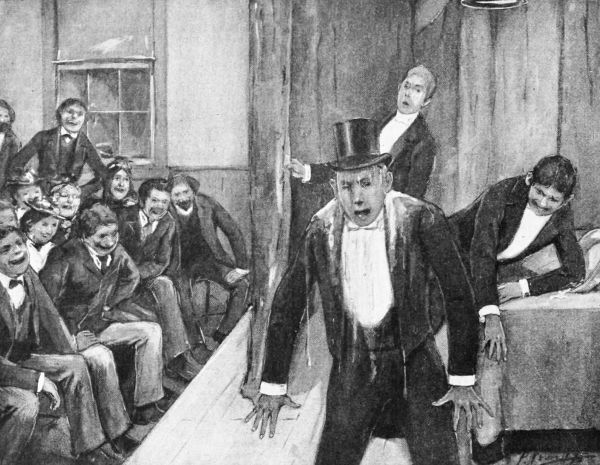
Now, whether Tom made some mistake in getting those tins canted into the hat properly or not will never be known. Perhaps he pulled the hat down too hard over Jonas's brows when he put it on him, and so loosened something. At any rate, Jonas had not taken two steps before a streak of batter was seen running down over his face. Then the whole hat seemed to let go like a broken reservoir, and the milk and molasses and egg and flour streamed down in a shower over the miserable Jonas.
He tried to pull the hat off, and did so, leaving on his head, however, the tins, which gave him the most astonishing appearance possible. Tom fell back on the table in an agony of laughter, and in doing so sat down on the dish that had contained the batter. The audience simply cried itself hoarse with laughter. Sally Conners screamed with all her might, and all the farmers' boys, who were present for miles around, haw-hawed, and the old folks almost died looking at poor Jonas. In the midst of it all, I, Peter Samuels, stage director, drew the curtain, and with the other two performers stole down the back stairs, and made a run for home, and so the great sleight-of-hand performance came to an end.
The Colby people never forgot that performance. We never did, either. Uncle Job kept Tom's watch until he left for college, and then gave it back to him, and Tom bought him a new silver time-piece. The widow Colby and her grandchildren realized a good sum from the entertainment, and the next vacation we three boys spent in the city. I am afraid Jonas has lost the favor of Sally Conners, for she never can speak of him without laughing. But then Sally always did laugh on almost any provocation.

So far as is known, no schedule of interscholastic track and field records has ever before been printed, and although the table published in this issue is as accurate as can be made under the circumstances, still there are doubtless a few errors scattered around in it somewhere that will be discovered by sharp-eyed readers in the very near future. If the latter will inform this Department of the mistakes as soon as they are found out, the table may be depended upon to be absolutely exact the next time it is printed—and it certainly will be offered in better form. To-day I have been obliged to put two bicycle events and two hammer and shot events on the list, because the interscholastic associations in the various parts of the country are about evenly divided in the choice of distances and the use of weights. I have left out entirely such acrobatic events as the hop, step, and jump, and throwing the baseball, because they are not athletic, and do not deserve to be recognized on any interscholastic programme. Perhaps a year from now the school associations will have come to the conclusion that, take it all in all, it is really better to have a uniform measure of efficiency in sport as well as in anything else, and then a comparative table will be of more value.
INTERSCHOLASTIC RECORDS OF THE UNITED STATES, 1895.
Event.Maker.School.Time and place.
100-yard dash10-1/5sec.F. H. Bigelow.Worcester H.-S.N.E.I.S.A.A. games, 1894.
220-yard run22-2/5"F. H. Bigelow.Worcester H.-S.N.E.I.S.A.A. games, 1894.
440-yard run50-3/5"T. E. Burke.Boston English H.-S.N.E.I S.A.A. games, 1894.
Half-mile inn2m.4-1/5"J. A. Meehan.Condon, N.Y.N.Y.I.S.A.A. games, May 11, 1895.
Mile run4"34-2/5"W. T. Laing.Phillips Academy, Andover.N.E.I.S.A.A. games, 1894
Mile walk7"17-3/5"A. N. Butler.Hillhouse H.-S., New Haven.Conn. H.-S.A.A. games, June 8, 1895
120-yard hurdle15-3/5"A. F. Beers.De La Salle, N.Y.N.Y.I.S.A.A. games, May 11, 1895.
220-yard hurdle26-1/2"Field.Hartford H.-S.Conn. H.-S.A.A. games, June 8, 1895.
Mile bicycle2"34-1/5"I. A. Powell.Cutler, N.Y.N.Y.I.S.A.A. games, May 11, 1895.
Two-mile bicycle5"18-2/5"Baker.Hotchkiss, Lakeville, Conn.Conn. H.-S.A.A. games, June 8, 1895.
Running high jump5ft.11in.S. A. W. Baltazzi.Harvard, N.Y.N.Y.I.S.A.A. games, May 11, 1895.
Running broad jump21"6"C. Brewer.Hopkinson, Boston.N.E.I.S.A.A. games, 1890.
Pole vault10"7"B. Johnson.Worcester Academy.N.E.I.S.A.A. games, June 15, 1895.
Throwing 12-lb. hammer125"R. F. Johnson.Brookline H.-S.N.E.I.S.A.A. games, 1894.
Throwing 16-lb. hammer111"10"F. G. Beck.Hillhouse H.-S.Conn. H.-S.A.A. games, June 8, 1895.
Putting 12-lb. shot40"3/4"A. C. Ayres.Condon, N.Y.N.Y.I.S.A.A. games, May 11, 1895.
Putting 16-lb. shot39"3"M. O'Brien.Boston English H.-S.N.E.I.S.A.A. games, 1894.
INTER-COLLEGIATE RECORDS OF THE UNITED STATES, 1895.
Event.Made by.
{ E. J. Wendell, Harvard; W.
{ Baker, Harvard; C. H.
100-yard dash10sec.{ Sherrill, Yale; L. Cary,
{ Princeton; E. S. Ramsdell,
{ Penn.
220-yard dash21-4/5"L. H. Cary, Princeton.
Quarter-mile run47-3/4"W. Baker, Harvard.
Half-mile run1m.55-1/4"W. C. Dohm, Princeton.
Mile run4"23-2/5"G. W. Orton, Penn.
Mile walk6"42-4/5"F. A. Borcheling, Princeton.
120-yard hurdle15-4/5"H. L. Williams, Yale.
220-yard hurdle24-3/5"J. L. Bremer, Harvard.
Two-mile bicycle4"10"W. D. Osgood, Penn.
Running high jump6ft.4in.W. B. Page, Penn.
Running broad jump23"L. P. Sheldon, Yale.
Pole vault11"2-3/4"C. T. Buckholz, Penn.
Throwing 16-lb. ham'r135"7-1/2"W. O. Hickok, Yale.
Putting 16-lb. shot44"1-1/2"W. O. Hickok, Yale.
How is it possible to gauge the performances of school champions with those of others—college-men and athletic club amateurs—when we have no common ratio? We cannot, of course. For instance, take Beers's record of 15-3/5 sec. in the high hurdles, made at the New York Interscholastics last May. On paper this looks very well. It apparently beats the inter-collegiate record made by Harry Williams in 1891, by one-fifth of a second. But it really does not. Beers ran his race over lower hurdles, and so it is not possible to make a comparison. The hurdles used by the N.Y.I.S.A.A. are only 3 feet high, whereas the inter-collegiate sticks are 3 ft. 6 in. Some of the interscholastic associations use the standard 3 ft. 6 in. hurdles, but as it was impossible to ascertain exactly what the records were that had been made over these at school meetings in the past, I took the fastest time over the dwarfed hurdles, and let it go in as a fit companion for the 12-lb. shot and hammer and the mile bicycle-race.
In the future, however, I shall give little attention to these one-eyed records. The college associations have set up a standard of distance and weight which experience has shown to be a good one. A sufficient number of interscholastic associations have adopted the same standard, thereby making it clearly evident that it is none too high for school-boy athletes. Therefore, in making out a comparative table of college and school records, this Department will accept the standard established by the I.C.A.A.A. and adopted by the majority of the interscholastic associations. If in the near future a general interscholastic league is formed, I feel sure that its legislators will agree with me in this, and will adopt the same course when they lay out their programme.
It is to be regretted that the Oakland, Cal., High-School athletic team was unable to accept the Stockton High-School's challenge for dual games to be held on June 15th last, but unless something unforeseen turns up the meeting will be held soon after the next school term begins, which is in August. The California schools open about five weeks earlier than our Eastern institutions, and the football season with them, therefore, starts in the closing days of summer. There will also be the semi-annual field day of the Academic Athletic League at about that time, or in September, and bicycle road races, in which teams from the several schools of the A.A.L. will be matched against one another. At the field day there will be a contest for the all 'round championship of the Pacific Coast Association. Five or six events will be selected from the programme, and every competitor for the championship will have to compete in each one, the champion to be the winner of the greatest number of points.
The object of this athletic Department in Harper's Round Table is not only to criticise and comment upon the various sports of the calender, but also to explain any intricate points of these games, to answer questions on matters of sport and athletics, and to give all such information as shall justly come under the head of Interscholastic Sport. A number of correspondents have requested that some space be devoted to an explanation of the "100-up" method of scoring in tennis, and to give the rules for odds. This "100-up" method, sometimes called the "Pastime" system, was devised a few years ago to meet the defects of the old system of scoring, which had been handed down to us from the ancient English game of tennis. The latter has a good many disadvantages in spite of its universal use, the chief objection being that it frequently happens in a match that a player scores more strokes, or even more games, than his antagonist, and yet is beaten. This, of course, is manifestly unfair; and as for handicaps, in which more than two players are competing, the complex and unsatisfactory system of adjusting the odds according to the old way is unnecessarily complicated.
The rules for the "100-up" method are comparatively simple and very easily remembered after having been used once or twice. The player who serves first must serve six times in succession, and then his opponent does the same, the service changing always after each one has served six consecutive times. One fault and one good service; two faults; or one good service counts as a service. After the first, third, fifth, or, in other words, every alternate series of service, the players change courts, thus making each six successive services one series of services. The first player to score one hundred points wins the game; but the match can be played for any number of points—more or less than a hundred—as the contestants may agree upon beforehand. The usual figure, however, is one hundred. If the score comes to be 99-all, play goes on as before, until one of the players has a majority of two points. He then wins; but no game can be won by a lesser majority than two points.
The odds in the regular old-fashioned method of counting are, briefly, thus: A "bisque" is one point that can be taken by the receiver of the odds at any time during the set except after a service is delivered, or, if he is serving, after a fault. "Half fifteen" is one stroke given at the beginning of the second, fourth, and every alternate game of a set, and "fifteen" is one stroke given at the beginning of every game. In the same way "thirty" is two strokes given at the beginning of every game, whereas "half thirty" is one stroke given at the beginning of the first game, two at the beginning of the second, one at the beginning of the third, and so on, two and one, alternately, until the end of the set. "Forty" is three strokes before every game, "half forty" three and two, alternately, as before. "Owed odds" signifies that the giver of the odds starts behind scratch. Thus "owe half fifteen" means that one stroke is owed at the beginning of the first, third, fifth, and every alternate game of the set. Other "owed odds" are reckoned inversely in the same manner as given odds. If a player gives odds of "half court," he agrees to play in a certain half of the court, either the right or the left, and he loses a stroke whenever he returns a ball outside any of the lines that bound that half court.
But the newest of all the systems of odds, and the one now most generally used by experts, is called the "quarter" system. In this method fifteen is divided into four quarters, and thus a closer handicap may be obtained. "One quarter" of fifteen is one stroke given at the beginning of the second, sixth, and every fourth game thereafter in the set. "Two quarters" (the "half fifteen" spoken of above) is one stroke at the beginning of the second, fourth, sixth, etc., games. "Three quarters" is one stroke at the beginning of the second, third, fourth, sixth, seventh, and eighth games, and so on. When it is "odds owed," as before, "one quarter" is one stroke in the first and fifth games; "two quarters" is one stroke in the first and third; and "three quarters" is one stroke in the first, third, and fourth games, and so on to the end of the set. In order to get odds at a similar ratio when the match is being scored on the "100-up" system, the following table of equivalents has been adopted:
1quarter of15=5points per100
2quarters"11""
3""16""
15""22""
15.1""27""
15.2""32""
15.3""38""
30""43""
30.1""49""
30.2""54""
30.3""59""
40""65""
The principal difficulty about this new system of odds, except for experts and for those who play constantly, is the difficulty of remembering it. It certainly takes more study to become familiar with it than with the old half-point system. In that the odds change at every game, and change directly back again even when most complicated, so that really all there is to remember is which odds came with the service. The chief advantage of the "quarter" system is that it affords greater accuracy, and to experts this is a sufficient compensation for its intricacy. I should not advise the average player, however, to bother with it, for, unless he intends to try for a national championship, life is too short to devote many hours of study to the "quarter" system.
Another correspondent asks for information as to the best way to get up a tennis tournament, and now that we are on the subject of tennis, his query might just as well be disposed of. A tournament, like anything else, demands time and care in preparation if it is to be a success. Don't put off everything until the last moment, or the day will surely be a failure; whereas, if thought is given to all the small details that go to make such an occasion enjoyable, everything will go as easily as rolling off a log. In the first place, those who want to arrange a tournament, or the committee which has been chosen to make the arrangements, should get together and discuss the situation and decide what they want to do and how they want to do it. In this preliminary talk a calculation of expenses should first be made. Find out how much money will probably be required, and then, as a measure of safety, add about ten per cent. to that, for expenses are usually underestimated. Having determined how much money will be needed, make arrangements for securing that amount either by subscription, entrance fees, or sale of tickets. If the tournament is to be conducted by a club, there will probably be some money in the treasury that can be used. It is not usually advisable, and seldom practicable at an impromptu summer tennis tournament, to demand admission fees of the spectators.
The financial part of the enterprise having now been attended to, a treasurer should be appointed to take charge of the funds, and to keep an account of all receipts and expenditures. Of course, if, as I have said before, the tournament is being held by a club, many of these details are already fulfilled by previous organization. The date should be the next thing decided. In each instance there will be many circumstances affecting this date. If the idea of having a tournament is being discussed with a view to holding it later in the summer, find out what players will be in the neighborhood at that time, and try to invite players to visit the locality at about that period. If you only have a week or ten days in which to make your preparations (for a small tournament), try to fix on a day when there will be nothing else of importance going on near by. The chief object of the managers or of the committee should be to secure as large an attendance as possible, for a crowd will encourage the players to better effort.
The date having been settled upon, send out notices. State clearly all the facts. Say at what place, on what date, and at what time of day the tournament is to be held; and also under whose auspices. Give a list of the events—such as men's singles, doubles, women's singles, mixed doubles, or whatever there is to be; state the requirements for entrances, and give the date when entries close. Be sure to give the name and address of the person who has been assigned to receive these entries. State also in the notice the hours of play, the number of sets to the match, the kind of balls that are to be used, and announce any special regulations that it may have been found necessary to adopt. Finally, enumerate the prizes; but remember that it is always in better taste to make these inexpensive and more in the nature of souvenirs of the occasion than trophies.
The notices disposed of and sent out, the managers should now see that the courts are rolled and otherwise put in order, so that they may be in the best possible condition on the day set for the tournament. There should be a plentiful supply of balls, for sometimes an entire box is used in a match. In large tournaments I have seen the players dispose of a box every set. At each end of the net put up a couple of chairs on boxes for the umpires, and arrange seats about the court for the spectators. If there are not enough chairs and benches handy, lay boards on boxes, and so produce impromptu settees. Don't fail to hire a couple of boys to pick up the balls.
All these details are necessary ones; there are a few others that might be termed luxuries, such as having printed tickets and programmes, and an awning stretched along one side of the court to shelter the ladies from the sun. One more necessary point, however, is to secure competent judges and umpires, otherwise something might occur during play that would mar the pleasure of the day. Of course it would be a misunderstanding, but this can be easily avoided by having officials fully conversant with the game and familiar with the duties required of them.
After all the entries have been received, make the drawings, and, if possible, post them somewhere where all those interested in the coming tournament will be able to see them. When, on the day set, the hour to begin play arrives, start promptly. Delay is always fatal to the success of any sporting event. People don't like to sit around and wait. But all that I have said here is merely in the line of suggestion. Many little matters crop up as soon as any enterprise of this kind is entered into, and these questions have to be settled according to the emergency. Let the central idea be to anticipate anything that might happen; then, as a rule, nothing will happen.
The Graduate.
This Department is conducted in the interest of stamp and coin collectors, and the Editor will be pleased to answer any question on these subjects so far as possible. Correspondents should address Editor Stamp Department.
HOW TO CATCH CLOUDS.
7th.About
11th.this
14th.time
17th.look
21st.out
28th.for
31st.storms.
This was usually the weather warning in the old-time almanacs which the farmer was in the habit of consulting nightly, in order to make his plans for his haying or harvesting, his sowing or reaping, the success of which depended on the state of the weather.
The amateur photographer who makes a specialty of landscapes should put this warning in his note-book, substituting the word clouds for that of storms, changing it to read, "About this time look out for clouds."
A picture of a landscape with clouds in the sky is much finer than where the sky is perfectly white, and cloud pictures themselves are very interesting.
It is not an easy matter to catch the clouds even when the sky is full of them. If they are obtained in the negative, they are usually lost in the printing, as the landscape portion of the negative, being less dense than the sky, prints much more quickly, and to obtain a print of the clouds the lines of the landscape would be almost black from over-printing.
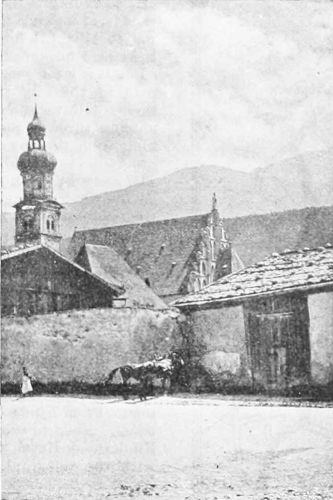
PHOTOGRAPH TAKEN IN THE TYROL, SHOWING CLOUD EFFECT.
There is a device called a "cloud-catcher," which is a shutter so arranged with adjustable disks that the foreground or landscape part of the picture is given a time exposure, while the sky is taken instantaneously. This is supposed to give the proper time of exposure for each part of the picture.
The amateur cannot always afford such an attachment, and, in order to obtain clouds in his landscapes, must resort to various devices of developing and printing.
The most common method is to take two pictures, one exposed for the sky, and the other for the landscape, and print from both negatives. In printing from a "sky"-and-"landscape" negative, print the sky first, covering the part of the sensitive paper on which the landscape is to be printed. After printing the sky, place the other negative in the frame and print the landscape. It does not matter if the opaque paper which covers the landscape does not follow the horizon lines exactly, as the darker tones of the landscape will blot out the outlines of the clouds if they lap on the horizon.
If one has a negative where the clouds are good but will not print out unless the rest of the picture is over-printed, a good print may be obtained by this simple device: Take an empty tin-can a little longer than the printing-frame. Cut off the top and bottom, and cut the can in two the long way. This will give you a piece of rolled tin. Flatten one edge, leaving the other curved. Attach the flat edge to the side of the printing-frame so as to shield the landscape part of the negative. This will make a shade for this part of the negative, which prints the fastest, and thus retard the printing, allowing the denser portions a longer time to print. A shaded negative should always be printed in diffused light, not in the direct rays of the sun.
Pictures of clouds, or rather, false clouds, are made by holding the negative over the flame of a candle and letting the glass side become covered with lamp-black. Then, with a soft tuft of cotton, wipe off the smoke in places, leaving the outlines of clouds on the glass. Very good clouds can be made by this method with a little practice. Another way is to attach a piece of fine tissue-paper to the negative and sketch clouds in the sky portion, unless the sky is very dense. A thin sky is often improved by these sham clouds.
The picture which we reproduce here was taken by Sir Knight Sidney Stearns, of Cleveland, Ohio. It was taken at Halle in the Tyrol, time nearly sunset. The sun, as may be seen by looking at the picture, is at the left of the camera and well toward the front. This is usually the best direction from which the strongest light should fall, either from the left or right and near the front of the camera. One should seldom or never take a picture with the sun directly behind the camera.