Chapter III
Reading edition
When Cynthia asked at Mrs. Parker's door if that lady were at home it was not necessary for her to give her name. The maid recognized Miss Trinkett at once.
"Yes, she's at home, ma'am. And won't you please step into the parlor, Miss Trinkett? Mrs. Parker'll be glad to see you."
Mrs. Parker came hurrying down.
"Dear Miss Trinkett, how are you? Why, I should scarcely have known you! What have you done to yourself?"
Cynthia laughed her great-aunt's high staccato laugh.
"Well, now, I want to know, Mrs. Parker! Don't you see what it is? Why, my nieces at Oakleigh, they saw right away what the difference was. I thought 'twas about time I was keeping up with the fashions, and so I bought me a fine new piece of hair for my front. I was growing somewhat gray, and I thought 'twas best to keep young on Silas's account. It isn't that I care for myself, but you have to be particular about men-folks, as you'll know when you've seen as much of them as I have."
Cynthia was a good actress, and she carried herself precisely as Miss Betsey did, and imitated her voice to perfection.
She repeated some of her aunt's best-known tales, and good Mrs. Parker never dreamed of the possibility of her caller being any one but worthy Miss Betsey Trinkett, of Wayborough, whom she had known for years.
Mrs. Parker was a great talker, and usually she was obliged to fight hard to surpass Miss Trinkett in that respect. During the first part of the call to-day it was as difficult as usual, but Mrs. Parker presently made a remark which reduced her visitor to a state of alarming silence.
"I suppose you have come to announce the news," said the hostess, smiling sympathetically.
"Now I don't know a bit of news. Why, my dear Mrs. Parker, Silas and I we never—"
"Ah, but this has nothing to do with Silas, though it may affect you, more or less. Surely you know what I am alluding to?"
"I haven't the least idea."
And Cynthia bridled with curiosity on her own account as well as Aunt Betsey's. She thought something interesting must be coming.
"Well, now, to think of my being the one to tell you something about your own family! I don't know whether I ought to, but I think it must be true, and you'll hear it in other ways soon enough. You know I have relatives in Albany, where she lives."
"Where who lives?"
"Miss Gordon, Hester Gordon. They say—but, of course, I don't know that it's true, it may be just report, but they do say— I don't know whether I ought to tell you, I declare! that it won't be long before she's Mrs. Franklin."
"Mrs. Franklin!"
"Yes, Mrs. John Franklin. Hasn't your nephew told you? Well, well, these men! They do beat all for keeping things quiet."
"Is it true?"
It was Cynthia's natural voice that asked this question. She quite forgot that she was supposed to be Miss Betsey Trinkett.
"YOUR VOICE SOUNDS SORT OF UNNATURAL, TOO," ADDED MRS. PARKER.
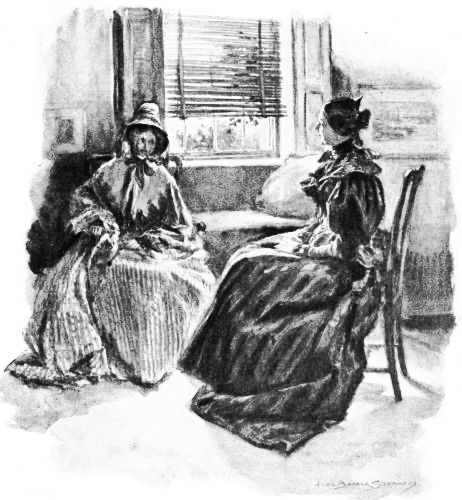
"I suppose it is. But, dear me, Miss Trinkett, don't be worried! Seems to me you look very queer, though I can't see your face very well through that veil, and you with your back to the light. Your voice sounds sort of unnatural, too," added Mrs. Parker. "Let me get you some water."
"Oh no, it is nothing," said Cynthia, who had quickly recovered herself, and was now summoning all her energy to finish the call in a proper manner. "You surprised me, that's all, and I never did care much for surprises. But I think there's not much truth in that, Mrs. Parker. I don't believe my fa—nephew is going to be married again. In fact, I'm very sure he is not." And she nodded her head emphatically.
"Ah, my dear Miss Trinkett, you never can tell. Sometimes a man's family is the last to hear those things. And it will be a good match, too. She comes of an old family, and she has a great deal of money. The Gordons are all rich."
"Do you suppose he'd care for that?" exclaimed her visitor, wrathfully.
"Well, well, one never knows! And think how much better it would be for the children. Edith is too young to have so much care, and they say Cynthia runs wild most of the time, just like a boy. Indeed, I call it a very good thing. Though I must say she is a pretty brave woman to take on herself the care of that family."
Here "Miss Betsey" suddenly darted for the door. It could be endured no longer. Mrs. Parker bade her farewell, and then went back to tell her daughters that Miss Trinkett was sadly changed. Though she was still so young in appearance, she was evidently very much broken.
For some time Jack could obtain no reply to his questions, but at last Cynthia's resolution broke down, and she burst into tears. They had turned into a shady lane instead of going directly home, and there was no danger of meeting any one.
"Jack, Jack!" she moaned, "I'll have to tell you. Mrs. Parker says papa is going to be married again! What shall we do! What shall we do!"
For answer Jack indulged in a prolonged whistle.
"Isn't it the most dreadful thing you ever heard of? Jack, how shall we ever endure it?"
"Well, it mayn't be as bad as you think. If she's nice—"
"Oh, Jack, she won't be! Stepmothers are never nice. I never in my life heard of one that was. She'll be horrid to us all."
"Oh, I say, that's nonsense. If you were to marry a widower with a lot of children you'd be nice to them."
"Jack, the very idea! I marry a widower with a lot of children! I'd like to see myself doing such a thing!"
Cynthia almost forgot her present troubles in her wrath at her brother's suggestion.
"Well, after all it may not be true. Because Mrs. Parker says so, doesn't prove it. Where did she hear it?"
"From some of her Albany relations, I suppose. The—the lady lives there. But, oh, Jack! Do you think there is any chance of its not being true?" cried Cynthia, catching at the least straw of hope.
"Why, of course! Father hasn't told us, and you can't believe all the gossip you hear," said Jack, loftily.
"Perhaps it isn't true, after all," exclaimed Cynthia, drying her eyes and smiling once more, "and I've been boo-hooing all for nothing! I sha'n't say a word about it to Edith, and don't you either, Jack. It isn't worth while to worry her, and Mrs. Parker is a terrible gossip."
They went home, and Cynthia gave her sister a gay account of her visit, carefully omitting all exciting items, and then she helped Edith put away some of the things, and finally was free to go on the river in the afternoon. Jack, boylike, had forgotten all about Mrs. Parker's news. He did not believe it, and therefore it was not worth thinking of. But Cynthia's mind was not so easily diverted. She did not believe it, either, but then it might be true, and if it were, what was to be done? It seemed as if a worse calamity could not happen.
Jack, her usual companion on the river, was busy with some carpentry. He was making a "brooder" like one he had bought, to serve as a home for the little chicks when they should be hatched. He used the "barn chamber" for a workshop, and the sound of his saw and his hammer could be heard through the open window.
Cynthia was deeply interested in poultry-raising, but she wished it did not consume so much of her brother's time and attention.
Edith was going to the village to an afternoon tea at the Morgans'. Gertrude Morgan was her most intimate friend, and all the nicest girls and boys would be there to talk over a tennis tournament. Cynthia was rather sorry that she had not been asked. She said to herself that she would be of more value in the discussion than Edith, for she really played tennis, while Edith merely stood about looking graceful and pretty. However, she had not been invited, and, after all, the river was more fun than any afternoon tea.
One of the men put the canoe in the water for her, and, with a huge stone to act as ballast, she paddled up stream, browsing along the banks looking for wild flowers, or steering her way through the rocks, of which the river was very full just at this point.
Cynthia, fond as she was of companionship, being of an extremely sociable disposition, was never lonely on her beloved river.
Edith dressed herself carefully and drove off to the tea. She looked very attractive in her spring gown of gray and her large black hat, and as she studied herself in the small old-fashioned mirror that hung in her room she felt quite pleased with her appearance.
"If I only had more nice gloves I should be satisfied," she thought. "It is so horrid to be saving up one pair, and having to wear such old things for driving and whisk them off just before I get to a place and put on the good ones. And a handsome parasol would be so nice. I don't think I'll take this old thing. I don't really need one to-day. I wonder where the children are. I ought to look them up, I suppose, but they are all right, somewhere, and it is getting late. After all, why should I always be the one to run after those children?"
And then she drove away to Brenton, leaving housekeeping cares behind her, and prepared for a pleasant afternoon.
About half a dozen boys and girls had already arrived at the Morgans' when Edith drove in. It was a fine old house standing far back from the road, and surrounded with shady grounds. The river was at the back. A smooth and well-kept tennis-court was on the left of the drive as one approached the house, and here the guests were assembled.
"Oh, here's Edith Franklin at last!" cried Gertrude Morgan, while her brother went forward, and, after helping Edith to alight, took her horse and drove down to the stable.
Presently all the tongues were buzzing, each one suggesting what he or she considered the very best plan for holding a tournament. It was finally arranged to have it at the tennis club rather than at the Morgans', as had at first been thought best, and it would be open to all the comers who had reached the age of fourteen.
"That is very young," said Gertrude, "but we really ought to have it open to Cynthia Franklin. She is one of the best players in Brenton."
"By all means," said her brother, who was always on the side of the Franklins, "and, Edith, you'll play with me, won't you, in mixed doubles?"
"Oh, I don't play well enough!" exclaimed Edith. "Thank you ever so much, Dennis, but you had better ask some one else. I don't think I'll play."
Every one objected to this, but it was finally settled that Edith should act as one of the hostesses for the important occasion, which was greatly to her satisfaction. She rather enjoyed moving slowly and gracefully about, pouring tea and lemonade, and handing it to the poor, heated players, who were obliged to work so hard for their fun.
They were startled by the sound of the clock on the church across the road. It struck six, and Edith rose in haste.
"I must go," she said. "I had no idea it was so late! Those children have probably gotten into all kinds of mischief while I've been away, and papa will not be home until late, so I am not to wait in the village for him."
The others looked after her as she drove away.
"Isn't she the sweetest, dearest girl?" cried Gertrude. "And won't it be hard for her if her father marries again, as every one says he is going to do? But, after all, it may be a good thing, for then Edith wouldn't have to do so much for the children. I wonder if she knows about it? She hasn't breathed a word of it, even to me."
Janet and Willy, the inseparable but ever-fighting pair, came in at the side door, not very long after Edith went to the village. They found the house empty and the coast clear, and their active brains immediately set to work to solve the question of what mischief they could do.
They wandered into the big silent kitchen. The servants were upstairs, and beyond the buzzing of a fly on the window-pane and the singing of the kettle on the range perfect quiet reigned.
"Let's go down and see the inkerbaker," suggested Willy.
"All right," returned Janet, affably, and down they pattered as fast as their sturdy little legs could carry them.
They peered in through the glass front at the eggs, which lay so peacefully within.
"It must be turrible stupid in there," said Janet, pityingly. "Shouldn't you think those chickens would be tired of waiting to come out?"
"Yes. We might crack a lot and help 'em out."
"Oh, no. Jack says they won't be ready for two days. But I'll tell you what we might do. We might see whether it's hot enough for 'em in there. I guess Jack's forgotten all about 'em. I don't believe he's been near 'em to-day, nor Martha, either."
"How d'yer find out whever it's hot enough?"
"I don't know. Guess you open the door, and put your hand in and feel."
For Janet had never been taught the significance of the thermometer inside, and knew nothing of the proper means of ventilating the machine.
No sooner said than done. One of the doors was promptly opened, and two fat hands were thrust into the chamber.
"My goodies, it's hot there!" cried Janet. "We ought to cool it off. Let's leave the door open and turn down the lamp, and open the cellar window."
Mounted on an old barrel, Janet, at the risk of her life, struggled in vain with the window. She chose one that was never used, and it refused to respond to her efforts. Then she descended, and returned to the incubator.
"Can't do it," she said. "But I'll tell you what we'll do."
"What?" asked the ever-ready Willy.
"Pour some ice water over 'em. That'll cool 'em nicely."
They travelled up the cellar stairs to the "cooler," which stood in the hall.
"Wish we had a pitcher," said Janet. "You take the tum'ler, and I'll get a dipper."
It required several journeys to and fro to sufficiently cool the eggs, according to their way of thinking, but at last it was accomplished, with much dripping of water and splashing of clean clothes.
The water-cooler was left empty, and the incubator was in a state of dampness alarming to behold.
"There; I guess it's cool enough now!" said Janet, when the last trip had been taken.
Alas, the mercury, which should have remained at 103°, had dropped quietly down to 70°.
"I'd like to see what's in those eggs," said Willy, meditatively. "D'yer s'pose they're chickies yet?"
"I guess so. I'd like to see, too. I'll tell you what, Willy? Let's take one, and carry it off and see."
"All right. I'll be the one to take it. What'll Jack say?"
"He won't mind. Just one egg, and he has such a lot. And we've been helping him lots this afternoon, cooling 'em off so nicely. But I'll be the one to take it."
"No, me!"
"Let's both do it," said Janet, for once anxious to avoid a quarrel. "I speak for that big one over there," and she abstracted one from the "thermometer row," the row that was most important and precious in the eyes of the owner of the machine.
"And I'll take dis one. It's awful heavy, and I guess de dear little chicken'll he glad to get out and have some nice fresh air."
"Let's go down behind the carriage-house and look at 'em."
They fastened the door of the incubator, and departed with their treasures.
Half an hour later, Jack, having finished his work, came whistling into the house. He would go down and have a look at the machine, and then walk up the river-bank to meet Cynthia, whom he had seen as she paddled off early in the afternoon.
His first glance at the thermometer gave him a shock—75° it registered. What had happened? He looked at the lamp which heated the chambers, and found that it had been turned down very low. What could Martha have been thinking of, when he told her it was so important to keep up the temperature this last day or so? The day after to-morrow he expected the hatching to begin, and he had closed the door of the incubator that morning. It was not to be opened again until the chicks were out.
Jack was on tiptoe with excitement. If they came out well, what a triumph it would be! If they failed, what would his father say?
He looked again, and a most unexpected sight met his eyes. Water was dripping from the trays, and the fine gravel beneath had become mud.
And there was a vacant space in the tray. An egg had gone—and it was from the third row, the row which he had been so careful about, which contained the best eggs.
And, yes, surely there was another hole. Another egg gone! What could have happened?
He ran up stairs three steps at a time, shouting for Martha.
"What have you been doing, Martha?" he cried. "Two eggs are gone, and the thermometer way below 80°, and all that water!"
"Sure, Mr. Jack, I haven't been there at all! You were at home yourself to-day, and I never go near the place of a Saturday."
"Well, some one has been at it. Where's Cynthia? Where's Edith? Why isn't somebody at home to attend to things?"
No one could be found. Jack rushed frantically about, and at last heard the sound of wheels. Edith was returning from the tea. And at the same moment, around the corner of the house came Cynthia, leading two crying children.
They all met on the front porch.
"They've been up to mischief, Jack," said Cynthia; "I hope they haven't done much harm. I found them on the bank behind the carriage-house. They must have been at the incubator, for they had two eggs and the chickens are dead. And they are two bad, naughty children!"
Even Cynthia the peacemaker had been stirred to righteous wrath by the sight on the river-bank.
"You rascals!" cried Jack, in a fury, shaking them each in turn; "I'd like to lick you to pieces! You've ruined the whole hatch."
"Go straight to bed," said Edith, sternly; "you are the very worst children I ever knew. I ought not to leave the house a minute. You can't be trusted at all."
They all went in, scolding, storming, and crying. In the midst of the confusion Mr. Franklin arrived, earlier than he had been expected. It was some minutes before he could understand the meaning of the uproar.
He looked about from one to the other.
"It only serves to justify me in a conclusion that I have reached," he said. "You are all too young to be without some one to look after you. Take the children to bed, Edith, and then come to me. I have something to tell you."
Edith, wondering, did as she was told. Cynthia gave Jack one despairing look and fled from the room. Her worst fears were on the point of being realized.
And after tea, when they were sitting as usual in the long parlor, Mr. Franklin, with some hesitation and much embarrassment, informed them that he was engaged to be married to Miss Hester Gordon, of Albany.
[to be continued.]
BY WILLIAM HAMILTON GIBSON.
he pretty works of my fairy and his companions in mischief are seen on every hand from spring until winter, but few of us have ever seen the fay, for Puck is no myth nor Ariel a creature of the poet's fancy. Their prototype existed in entomological entity and demoralizing mischievousness ages before the traditional fay, in diminutive human form, had been dreamt of. The quaint bow-legged little "brownies" which have brought our entire land beneath the witching spell of their drollery can scarce claim prestige in the ingenuity of their mischief, nor can the droll doings of imps and elves chronicled in the folk-lore of many an ancient people begin to match the actual doings of the real, live, busy little fairy whose works abound in meadow, wood, and copse, and which any of us may discover if we can once be brought to realize that our imp is visible. Then we must not forget that ideal type of the true "fairy"—a paragon of beauty and goodness, with golden hair and dazzling crown of brilliants, with her airy costume of gossamer begemmed and spangled, her dainty twinkling feet and gorgeously painted butterfly wings. And we all remember that wonderful wand which she carried so gracefully, and whose simple touch could evoke such a train of surprising consequences.
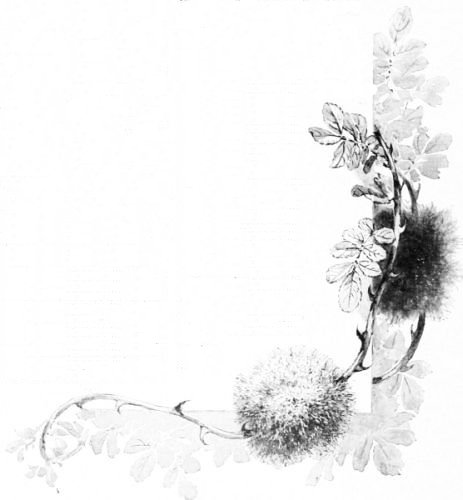
THE INHABITED ROSE SPONGE.
And who shall say that our pretty fay is a myth, or her magic wand a wild creation of the fancy? May we not see the wonder-workings of that potent wand on every hand, even though our fairy has eluded us while she cast the spell? There are a host of these wee fairies continually flitting about among the trees plotting all sorts of mischief, and leaving an astonishing witness of their visitation in their trail as they pass from leaf to leaf or twig to twig. But these fairies, like those of Grimm and Laboulaye, are agile little atoms, and are not to be caught in their pranks if they know it, and even though our eye chanced to rest on one of them, it is doubtful whether we would recognize him, so different is the guise of these real fairies from those invented Creatures of the books. Once, when a mere boy, I caught one of the little imps at work, and watched her for several minutes without dreaming that I had been looking at a real fairy all this time. What did I see? I was sitting in a clearing, partly in the shade of a sapling growth of oak which sprang from the trunk of a felled tree. While thus half reclining I noticed a diminutive black wasplike insect upon one of the oak leaves close to my face.
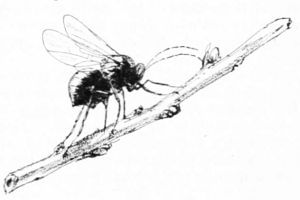
The insect seemed almost stationary and not inclined to resent my intrusion, so I observed her closely. I soon discovered that she was inserting her sting into the midstem of the leaf, or, perhaps, withdrawing it therefrom, for in a few moments the midge flew away. I remember wondering what the insect was trying to do, and not until years later did I realize that I had been witnessing the secret arts of the magician of the insect world—a very Puck or Ariel, as I have said—a fairy with a magic wand which any sprite in elfindom might covet.
THE ELFIN SPONGE OF THE BRIER ROSE.
The wand of Hermann never wrought such a wonder as did this magic touch of the little black fly upon the oak leaf. Had I chanced to visit the spot a few weeks later, what a beautiful red-cheeked apple could I have plucked from that hemstitched leaf!
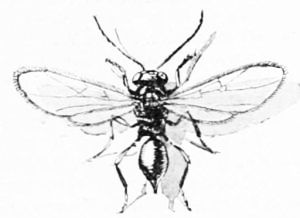
This was but one of a veritable swarm of mischief-making midges everywhere flitting among the trees; and while they are quite as various in their shapes as the traditional forms of fairies—the ouphes and imps, the gnomes and elves of quaintest mien, as well as the dainty fays and sylphs and sprites—there is one feature common to them all which annihilates the ideal of all the pictorial authorities on fairydom. Neither Grimm, nor Laboulaye, nor any of the masters of fairy lore seems to have discovered that a fairy has no right to those butterfly wings which the pages of books show us. Those of the real fairy are quite different, being narrow and glassy, and bear the magician's peculiar sign in their crisscross veins.
What a world of mischief is going on here in the fields! Here is one of the witching sprites among the drooping blossoms of the oak. "You would fain be an acorn," she says, as she pierces the tender blossoms with her wand, "but I charge thee bring forth a string of currants"; and immediately the blossoms begin to obey the behest, and erelong a mimic string of currants droops upon the stem. Upon another tender branch near by a jet-black gauze-winged elf is casting a similar spell, which is this time followed by a tiny downy pink-cheeked peach. And here alights a tiny sprite, whose magic touch evokes even from the same leaf a cherry, or a coral bead, perhaps a huge green apple! How many of us have seen the little elf that spends her life among the tangles of creeping cinque-foil, and decks its stems with those brilliant scarlet beads which we may always find upon them, looking verily like tempting berries.
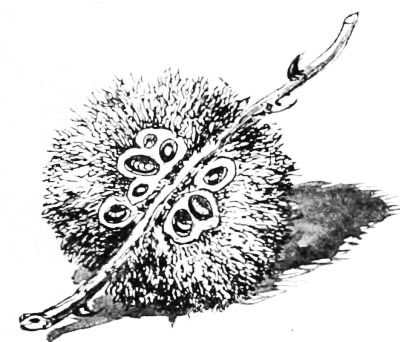
THE ELFIN SPONGE OF THE OAK.
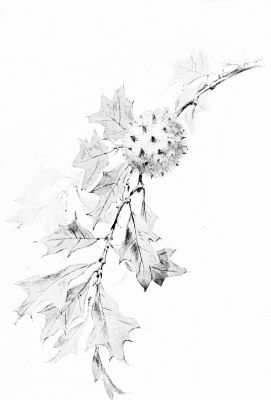
We see here about us swarms of these busy elves in obedience to their own peculiar mischievous promptings. What whispers this glittering midge to the oak twig here to which she clings so closely? We may not guess; but if we pass this way a month or so hence what a beautiful response in the glistening rosy-clouded sponge which encircles the stem! "But this sponge is not pretty enough by half," exclaims a rival fairy. "Wait until you see what yonder sweet-brier rose will do for me." Hovering thither among its thorns she imparts her spell, and, lo! within a month the stem is clothed in emerald fringe, which grows apace, until it has become a dense pompon of deep crimson—a sponge worthy the toilet of the fairy queen herself!
THE ROSE MISCHIEF-MAKER.
Who shall still say that the fairy is a myth! These two fairy sponges are familiar to us all, at least to those of us who dwell for even a small part of the year in the country and use our eyes. Indeed, we need go no further than our city parks, or even our "back-yard" gardens to find at least one of them, for the sweet-brier is rarely neglected by this particular fairy.
So many specimens of both of these sponges have been sent to me by Round Table correspondents and others, that I have begun to wonder how many of those other young people who have seen them and kept silence have wondered at their secret.
The two fairies which are responsible for these sponges have been captured by the inquisitive scientist, and have had their portraits taken for the rogues' gallery, and now we see them stuck upon tiny little three-cornered pieces of paper, and pinned in the specimen case as mere insects—gall-flies. The one is labelled Cynips seminator, the other, Cynips rosæ.
THE FAIRY USING HER MAGIC WAND.
THE REAL FAIRY OF THE OAK SPONGE. A. One of the points detached. B. Section of the base. C, D. Cynips emerging.
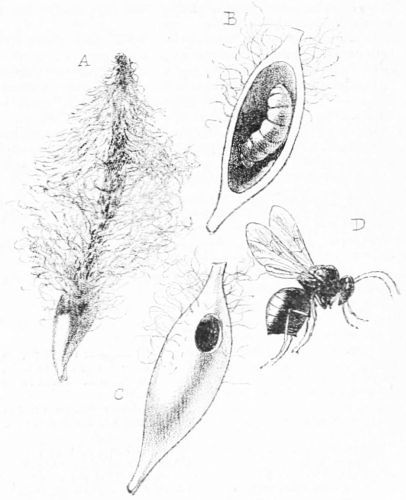
And now the prosaic entomologist proceeds to supplant fact for fancy. This gall-fly is a sort of cousin to the wasps, but what we would call its sting is more than a mere sting. Like a sting, it seems to puncture the bark or leaf, and at the same time probably to inject its drop of venom; but at the same time it conveys to the depths of the wound a tiny egg, or perhaps a host of them. One gall-fly is thus a magician in chemistry, at least, for no sooner are these eggs deposited than the wounded branch begins to swell and form a cellular growth or tumor about them, the character of this abnormal growth depending upon the peculiar charm of the venomous touch—to one a tiny coral globe, to another a cluster of spines, to another a curved horn, and to our cynips of the white or scrub oak a peculiar globular spongy growth which completely envelops the stem, sometimes to the size of a small apple. In its prime it is a beautiful object, with its fibrous glistening texture studded with pink points. But this condition lasts but a few days, when the entire mass becomes brownish and woolly, which fact has given this insect the common name of "wool-sower."
And now we must lose no time if we would follow its history to its complete cycle. If we put one of these faded sponges in a tight-closed box, we shall in a few days learn the secret of its being. For this singular mimic fruit, which has sprung at the behest of the gall-fly, like other fruits, has its seeds—seeds which are animated with peculiar life, and which sprout in a way we would hardly expect. Within a fortnight after gathering, perhaps, we find our box swarming with tiny black flies, while if we dissect the sponge we find its long-beaked seeds entirely empty, and each with a clean round hole gnawed through its shell, explaining this host of gall-flies, all similar to the parent of a few weeks since, and all bent on the same mischief when you shall let them loose at the window.
The beautiful sponge of the sweet-brier has been called into being by exactly similar means. And its hard woody centre is packed full of cells, at first each with its tiny egg, and then with its plump larva, followed by the chrysalis, and at length by the emergence of the full-fledged Cynips rosæ.
This sponge-gall of the rose is commonly known as the Bedegnar, and like all other members of its tribe, as with the familiar oak-apple, was long supposed to be a regular accessory fruit of its parent stalk. Among early students were many superstitions connected with the Bedegnar, the nature of which may readily be inferred from its other common name of "Robin's Pin-cushion."
This Department is conducted in the interest of Stamp and Coin Collectors, and the Editor will be pleased to answer any question on these subjects so far as possible. Correspondents should address Editor Stamp Department.
A LIST OF DON'TS FOR STAMP COLLECTORS.
Don't paste your stamps into your albums, but use "stickers" or "hinges."
Don't use any old copy-book if you can afford to buy an album. Dealers can supply albums at any price from twenty-five cents upward.
Don't trim your stamps. Many valuable stamps have been ruined by this process.
Don't cut envelope stamps to shape. Cut them out square, leaving a good margin on all sides.
Don't handle your stamps any more than you can help.
Don't buy rare stamps from any but responsible dealers. Some counterfeits resemble the genuine stamps marvellously. No one not an expert could tell them apart.
Don't buy Chinese locals, "Seebecks," and other philatelic trash, which is made purposely for sale to stamp collectors.
Don't expect to get something for nothing.
Frank P. Helsel.—The U. S. 12c. 1872 issue is worth 15 cents. The 50c. green Mauritius 1880 issue is worth 60 cents, unused; 85 cents, used. The "U.S. Post" is the 1864 issue; worth 15 cents.
W. L. L. P.—Most of the Heligoland stamps sold are reprints. They are worth 3 cents each. Originals are worth from 15 cents to $5 each.
James H. Creighton.—The two stamps are the 3c. 1861 and 1872. They are sold by stamp-dealers at 1 cent each.
J. A.M.—There is no premium on the 1872 U. S. 1c. coin.
R. F. B.—The U. S. 2c. stamp bearing a representation of a horseman is the 1869 issue, worth 8 cents used, 25 cents unused.
J. Duff.—The coin-dealers ask $1.50 for good copies of the 1877 trade dollar. There are several varieties of the 1801 and 1797 copper cents worth from 25 cents to $3 each, according to condition. There is no premium on the Canadian coin.
G. G. Beattie.—Write to any stamp-dealer whose address you find in our advertising columns. We cannot give addresses in this Department. The German coin mentioned has no premium.
Harry Riley, Brunswick, Maine, wants to correspond with some members of the Round Table living in Central or South America. Most of the Hamburg stamps in albums are reprints. When the word "cancelled" is printed on a stamp it cannot be used for postage. It is simply a "specimen" or fac-simile. The Hong-Kong stamps mentioned by you have not yet been catalogued.
G. Knauff.—Many thanks for calling my attention to the three varieties of the present 2c. U. S. (1) The variety in which the horizontal lines run across the triangular ornaments in uniform thickness. (2) That in which the horizontal lines between the outer and inner lines of the ornaments are deepened. (3) That in which the lines are entirely missing between the outer and inner lines of the ornaments. All three were known, and in addition there is the variety showing a flaw in the forehead. This is sometimes found strongly marked; in others it is more or less distinct. I advise philatelists to collect all these varieties, as well as all the shades of color, which are almost innumerable.
Laura Welch.—Both the stamp and the embossed envelope were used by the War Department for several years. This use has been discontinued many years. The stamp is worth 5 cents, the 1c. envelope, if on white paper, is worth $2.50, if on amber paper $35, if on manila paper 5 cents
L. P. Dodge.—The stamp you describe is one of the German locals which are not collected in this country. There are many counterfeits of the New Orleans Confederate local. It is impossible to say whether your copy is genuine or counterfeit without examination.
H. R. C.—The present blue Special Delivery is collected as a new variety. The Sedang stamps are worthless. Your complaint will be investigated if you will send the Stamp Editor your full name and address.
F. E. Welsh, Jun.—"Regular" perforations cut out little circles of white paper between each stamp on the sheet. "Pin" perforations are simply holes punched into the spaces between the stamps without removing the little circles of white paper. Saw-tooth perforations are simply cuts into the spaces between the stamps somewhat like this—v v v v v v. When the stamps are torn apart the margins look just like the teeth on a saw. The Columbian stamps are rapidly advancing in value. The 8c. Sherman has dropped in value during the past year from 4 cents to a 1/2 cent each.
James F. Anderson.—The stamp you describe is the New Orleans local. It is worth at least $1.50.
A. W. Duncan.—The 1830 half-dollar is not at a premium.
R. B.H.—The 3c. green U.S. is worth 1 cent.
F. Locke.—The 1853 dime is worth face value only.
Geo. H.—We cannot answer questions regarding dealers in this column.
B. W. Leavitt.—The 50c. revenue-stamps mentioned are sold by dealers at 2 cents each.
C. C. Cooner.—The 1c. blue 1861 is worth 3 cents; the others are worth 1 cent each.
Philatus.