ADVERTISEMENTS.
Reading edition
Highest of all in Leavening Power.—Latest U. S. Gov't Report.


WONDER CABINET FREE. Missing Link Puzzle, Devil's Bottle, Pocket Camera, Latest Wire Puzzle, Spook Photos, Book of Sleight of Hand. Total Value 60c. Sent free with immense catalogue of 1000 Bargains for 10c. for postage.
INGERSOLL & BRO., 65 Cortlandt Street N. Y.

This Department is conducted in the interest of Bicyclers, and the Editor will be pleased to answer any question on the subject. Our maps and tours contain much valuable data kindly supplied from the official maps and road-books of the League of American Wheelmen. Recognizing the value of the work being done by the L. A. W., the Editor will be pleased to furnish subscribers with membership blanks and information so far as possible.
Copyright, 1895, by Harper & Brothers
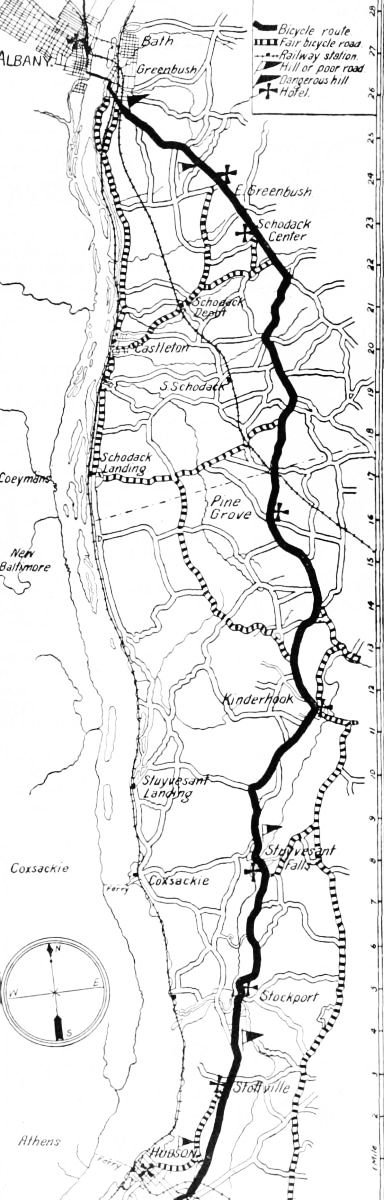
The final run into Albany on the road from New York, according to the plan which we have been following—that is, of making the journey in four days—is from Hudson to Albany, a distance of twenty-eight to thirty miles. Leaving Hudson, which was the northernmost point reached on last week's map, the rider goes out on to the main road by the way of Fourth Street and Pond Road, and thence follows the telegraph poles direct to Stockport, passing through Stottville. The road is hilly while running from the town of Hudson, and about half-way from Stottville to Stockport there is another rather stiff hill. The distance is a little over five miles, and the road is poor, on the whole, owing to its rolling nature and the fact that the road-bottom is largely clay. From Stockport to Stuyvesant Falls it improves a little, though it is somewhat hilly. The rider should follow the telegraph poles all the way, and keep a sharp lookout for L.A.W. signs, which will be of great assistance wherever they are found. This run is about three and three-quarters or four miles, and the next stage, from Stuyvesant Falls to Kinderhook, is four miles. There is no difficulty in following the road, with the possible exception of an abrupt fork about one and one-half or two miles out of Stuyvesant Falls. Here, of course, the rider should keep to the right on the main road. From Kinderhook to Pine Grove is a little under five miles. Keep to the left at Kinderhook after leaving the Kinderhook Hotel, keeping always to the Albany Post Road with the telegraph poles. Thence continue from Pine Grove to Schodack Centre, and when you have made four and one-half miles, and crossed two small bridges, turn to the right at Willow Trees, whence the run to Schodack Centre is clearly marked, a distance, in all, of a little over eight miles. From here the run to the Hudson, opposite Albany, passes through East Greenbush, three miles away, and finally brings up at the Hudson at South Bridge, a little less than five miles further. This last stage of the journey is somewhat hilly again, and there is a bad descent just before reaching Greenbush, where the rider should take the utmost care, owing to the fact that the hill itself is bad, and the difficulty complicated by a railroad crossing. On reaching the Hudson the rider should cross on South Bridge, and running into Albany turn into Broadway, thence to State Street, thence to North Pearl Street, and finally put up at the Kenmore Hotel.
While this run from New York to Albany is in parts hilly, and while occasionally the rider will strike a bit of difficult road, it is nevertheless one of the best bicycle trips in the United States, not only on account of the condition of the roads, but on account of its picturesque and historical interest. As was said last week, any one who intends to take the trip, or who can give the time to it, is strongly advised to take a week to do it in, to cross the Hudson several times on the way, and make short runs into the country on the other side. It is possible in this way for a rider of reasonable experience to see practically the whole of the Hudson River valley between these two points, and to have a fine outing without doing too much "scorching," or, on the other hand, taking the journey too slowly. The distance from New York to Albany, or rather from Central Park and 110th Street to the Kenmore Hotel, is one hundred and fifty-three and three-quarter miles, and by taking seven or eight days to the trip, the rider can easily cover three to four hundred miles in his excursions off the main route.
Note.—Map of New York city asphalted streets in No. 809. Map of route from New York to Tarrytown in No. 810. New York to Stamford, Connecticut, in No. 811. New York to Staten Island in No. 812. New Jersey from Hoboken to Pine Brook in No. 813. Brooklyn in No. 814. Brooklyn to Babylon in No. 815. Brooklyn to Northport in No. 816. Tarrytown to Poughkeepsie in No. 817. Poughkeepsie to Hudson in No. 818.
This Department is conducted in the interest of Girls and Young Women, and the Editor will be pleased to answer any question on the subject so far as possible. Correspondents should address Editor.
I have talked to you about notes and letters in a previous number of the paper, but some of my Round Table readers ask to have the subject treated again, with special attention to correspondence of a ceremonious character.
A note of invitation should be very cordial, affectionate, and explicit. You should state clearly in such a note the day and train which you would like your friend to take, and the length of time you expect her to stay with you. Formerly it was regarded as inhospitable to limit in any way the duration of a friend's visit, but we understand now that it is more convenient and comfortable for all concerned to have the precise number of days or weeks indicated. This arrangement enables your friends to make other engagements, and leaves you free to invite other friends if, as often happens, you can have the pleasure of entertaining successive guests during a summer. Let me give you some examples.
Mary Hills wishes to ask Abby Lewis to spend a week with her at Dove's Nest in the Catskills, Mary's country home. Her letter of invitation might be written as follows:
Dove's Nest, Tannersville P.O., New York.
Dearest Abby,—It seems very long since I saw you. Mamma and I were talking last night about the delightful visit we had at your home just before the Van Blarcoms went abroad. It is very lovely at Dove's Nest now, and we are anxious to have you see the place while our sweet-pease and nasturtiums are in bloom. Won't you come on Thursday, the twentieth, by the ten-o'clock train (West Shore), and stay with me till Monday, the thirty-first? I will meet you at the station on Thursday afternoon. We have a new golf course, and all sorts of pleasant things are going on.
Hoping soon to see you, I am, dear Abby,
Yours lovingly, Mary Hills. July fifteenth, eighteen—
Abby's reply would probably be somewhat like this:
182 Seventy-eighth Street, New York.
Dear, dear Mary,—How good you are to ask me for so charming a visit! It will give me the greatest pleasure to go to you on the twentieth and to stay for ten days, as you suggest. You may expect to see me flying down the station to meet you when the ten-o'clock train reaches the mountains on that afternoon. I can hardly wait for the blissful time to arrive. Mamma sends her love, and I am, as ever,
Devotedly yours, Abby Lewis.
A household critic suggests to me at this point that "Dearest Abby" and "Dear, dear Mary," are rather gushing, and not quite in the approved literary style which ought to be shown to girls. But I am talking to real girls, and I know how they write, and I don't mind in the least a little effervescence in the way of adjectives. I like girls to call me "Dearest" when they write to me, and I don't mind their saying "Dear" to one another over and over again.
How much luggage you must take when going on a visit depends on the length of the visit and the number of engagements it will include. As a rule, in our changeable climate you will need, in going away from home, something thick and something thin. A trunk is a great comfort, though one can manage with a large bag or a telescope, while a man's suit-case lends itself finely to the folding of a girl's gown.
With two or three pretty shirt-waists and a nice skirt, a simple dress for evenings, and a warm stuff costume of serge or flannel for cool or rainy mornings, a girl will be supplied for every needful requirement. One's own dainty home wardrobe is sufficient for a visit, and if the sailor hat be trim, the shoes and gloves in order, and the girl carry herself gracefully, nobody will think a second time about her dress.
As soon as possible after a journey lay aside your travelling dress, and make a fresh toilette before joining the family. Try to ascertain the family habits, and conform to them.
I heard not long ago of a girl, said to be very clever and bright, who exclaimed: "Make my own bed! Why, I wouldn't know how to begin! I couldn't get the sheets on straight!" She wasn't a Pudding Stick girl of mine, I'm happy to say. More on this subject next time.
SICKNESS AMONG CHILDREN
is prevalent at all seasons of the year, but can be avoided largely when they are properly cared for. Infant Health is the title of a valuable pamphlet accessible to all who will send address to the New York Condensed Milk Co., N. Y. City.—[Adv.]