WHEN ROYALTY TRAVELS.
Reading edition
BY WILLIAM HEMMINGWAY.
To live like a king is all very well, but to travel like one—may we all be delivered from such a fate! The modern monarch flits from his palace like the pheasant from his covert. True, the hunter may not pot him this time, but the danger of being killed is very great, and the king, like the golden-hued bird, knows that many of his brothers have fallen before the destroyer, who is constantly on the alert. Pheasants may be shot only during certain weeks, but anarchists never cease devising and trying new ways of king-killing.
Whenever a monarch starts on a journey he is haunted by the belief that the anarchists must have found out all about it beforehand in their usual way, and that they are busy with plots for his destruction. Even Queen Victoria, that best-beloved wearer of a crown, is bound to use almost as many precautions as the Czar of Russia. No common traveller has so much to be thankful for at the end of a journey as a safely arrived monarch. It is much pleasanter to be a President of the United States, pay your own fare, and feel afraid of nobody.
"THERE GOES THE QUEEN."
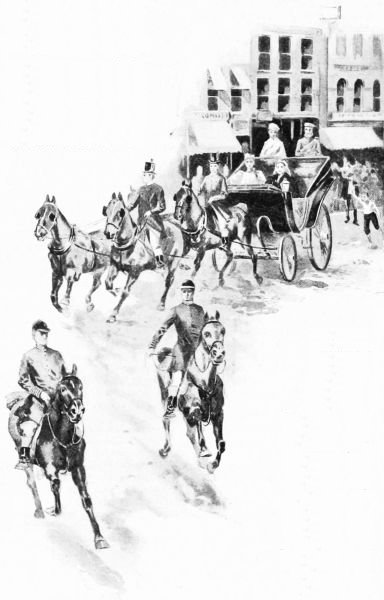
When the Queen of Great Britain starts for Windsor or Balmoral, or on any other railway journey, a time is chosen that will cause the least inconvenience to traffic; for the invariable rule is that no other trains may run over the road the Queen is using. All the switches are locked. Preceded and followed by galloping troopers of the Household Guard, the Queen's carriage is driven to the railway station at a furious pace. No one—I mean no ordinary person—knows the hour at which she will start or the streets through which she will go. The special royal train is waiting at the platform, and the royal carriage goes whirling toward it through the most unexpected streets. Every loyal Briton loves to show his love for her Majesty by a hearty roar, but no one has a chance to cheer her on her travels. There is a distant clatter of hoofs; it comes nearer, and you hear the rattling of sabres and whir of wheels. A blur of redcoats and nodding plumes shoots past, and the hoof-beats are dying in the distance before you can say, "There goes the Queen."
Of course the royal coach goes at a sedate pace during a royal progress or parade. Then there are more soldiers along the streets than you or I could count, and the Queen appears bowing in her open carriage of state, with all her outriders and officers and guards and the burly English footmen and Scotch gillies necessary for display.
When the Queen of Great Britain and Ireland and Empress of India travels she occupies her own special car. A special locomotive is reserved for her, and it is run by a special engineer, always the most experienced man in the company's service. On the London and Southwestern Railway, for example, engine No. 575 draws the Queen's car. Thomas Higgs, a fine, keen-eyed old Briton, an engineer for nearly forty years, holds the lever and the throttle. It is his boast that during this long period of service not one of his millions of passengers has ever been killed. Not one even has been injured. He is more careful than ever when her Majesty is aboard. Between Windsor and Gosport alone there are fifteen junctions, and every one of these is a possible danger-spot. A pilot train runs a short distance in advance of the Queen's special to make sure that the way is clear, and that the track has not been put out of order.
The interior of the Queen's car is furnished after the fashion of the white drawing-room at Windsor Castle. There are white silk cushions, embroidered with the initials V.R. (Victoria Regina), and the Garter and its motto, all in gold thread. The carpet is of velvet. The curtains at the windows are hung on silver poles, and the door-handles are plated with gold. The Queen's own comfortable arm-chair is at the rear of the saloon and faces the engine, and there are three other arm-chairs. The walls of the car (Englishmen call it a "carriage") are of polished satin-wood. The whole car cost about $35,000. The Queen and her suite are furnished with special time-tables printed in purple ink on white satin, adorned with the royal arms and an embossed border of gold. In winter the car is heated with hot-water pipes, and in summer it is cooled by an extra rooting of wet cloths, which are frequently soaked with very cold water, and by blocks of ice placed in the interior of the car.
If by any chance the railroad journey includes a night of travel, her Majesty sleeps in her own bed in her car. The Prince of Wales has a private car too, but he often travels in an ordinary first-class coach. Whenever it becomes known—such things will leak out at times—that the Queen or the Prince is travelling over the line, great crowds gather at the stations and hurl cheer after cheer at the royal train. This is much nicer than the Russian style of hurling something explosive.
The King and Queen of Portugal have a train of three special cars that were built for them in France upon American plans. This shows what wide-awake, intelligent persons the King and Queen of Portugal are. They are not particularly afraid of dynamiters or any other kind of assassins, and although poor—among kings—they manage to have a fairly good time on wheels.
In planning the royal train King Charles of Portugal went so far in his Americanism as to demand vestibuled platforms. Of course, any one may ride in a vestibuled train in our country by simply paying a few dollars, but in Europe it takes a king of strong will power to obtain such luxury.
The royal train of Portugal consists of a dining-car, a car for the royal ministers, etc., and the car especially reserved for the King and Queen. All three are of the size and general appearance of high-class American cars. Outside their color is a dark rich green, relieved with tracings of gold and red. The escutcheon of the royal arms of Portugal is painted in the middle of each side. The dining-car is fitted up in the style of Louis XV. The table can be folded and put away when not in use. The interior ornamentation of carved oak, amaranth, citron-wood, etc., is very rich indeed. Next to the dining-room is the smoking salon, where the King, or even Queen Amelia, may relieve the monotony of travel with a cigarette.
There are four sleeping-rooms in the royal car besides rooms for the attendants. The most remarkable thing about this car is the dais and divan at one end of the salon. No one may sit on this raised divan but the King or the Queen. A drapery of silk velvet forms the background. Above the back of the divan the royal arms are carved. Probably it diverts his Majesty's mind to sit here on high now and then while journeying and call his ministers around him and ask them questions and make wise comments, as Kings always do—in certain books.
Downright worry drove Czar Alexander III. of Russia to his death. Taller and stronger than any of his subjects, not one of whom could cope with him in wrestling, this imperial giant was actually tormented into his grave by fears of nihilistic plots to destroy him. Nowhere was this fear greater than when on railroad journeys. Again and again Alexander abandoned long trips at the last moment because the nihilists had learned his plans, and there was reason to believe that they had dug mines under the railroad track and were ready to blow him and his train to fragments. His son has not been on the throne long enough, the nihilists say, for them to decide whether or not they shall try to kill him.
Alexander's train was a fort on wheels. It was built in 1889, two years after a terrible underground explosion of dynamite, which wrecked the Czar's train at Borki, when he was on his way from the Crimea to St. Petersburg with the Empress and their family. In that accident twenty-one persons were killed and thirty-six were wounded, but not one of the imperial family was injured. The Czar showed himself a brave man by going to the aid of the wounded as soon as he could climb out of the wreck. All the cars in the train were of wood.
The new train of 1889 was made of wood too, but the cars were armored. The outside of each car was of heavy iron, inside of which was a layer of eight inches of cork. All of the four cars in the train were exactly alike outwardly, so that a nihilist would find it hard to pick out the Czar's car should he by any accident get within shooting distance. When the Czar travelled he often spent his time in a car that was so built and painted as to look like a baggage-car from the outside. When the Czar visited Emperor William III., at Berlin, in October, 1889, six Russian workmen put gratings of wrought-iron at the tops and bottoms of all the chimneys of the old Schloss and palace at Potsdam, which the Czar occupied. This was to keep out nihilists' bombs. Armed sentries patrolled the roofs. When the Czar started for home all the railroad bridges, as well as the streets of Berlin, Marienburg, and Dantzic, were guarded by soldiers, policemen, and detectives. Not until after the Czar left Dantzic was it known whether he had proceeded by train or on the imperial yacht Derjava. When the train started for the border 50,000 Russian troops were placed on guard along the railroad tracks. Every journey the unhappy ruler made was attended by similar precautions.
THE FRENCH PRESIDENT ON THE WAY FROM VERSAILLES.
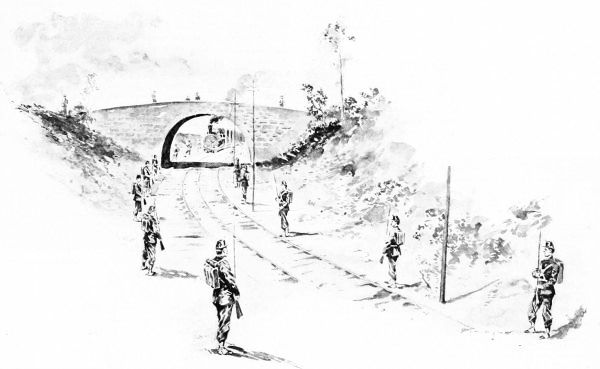
When Français Felix Faure, the newly-elected President of the French Republic, made his first railroad journey after election, he found that being a mere President is almost as unpleasant as playing king. For fear of anarchists a strong force of soldiers and four sappers and miners guarded each of the railway bridges and grade crossings between Versailles and Paris. Extra policemen and a little army of five hundred detectives watched the palace in which the National Assembly sat. A strong battalion of lancers and more foot soldiers than you could count escorted the new President to the special train in waiting at Versailles at 8 o'clock on Friday morning, January 18th. Fortunately no anarchist got a shot at the President as he was whirled along, but as he emerged from the St. Lazare railway station in Paris voices in the crowd yelled at him, "Down with the check-takers!"—a pointed hint that M. Faure was implicated in the Panama Canal scandal.