PERILS OF THE NEWFOUNDLAND BANKS.
Reading edition
BY W. J. HENDERSON.
It was blowing half a gale from the southward and eastward, and the Captain said it would be worse before it was better. The Mohawk was plunging head first over the ragged seas, with a great roaring of thunderous foam under her hawseholes as she fell into the wide hollows, and a sickening upward swirl of her lean stem as she rose again to meet the reeling cliffs of water that swept down upon her out of the windward gloom. The streamer of brown smoke that rushed from her tall black funnel went wreathing and shuddering away to leeward, where it seemed to add a blacker tinge to the gray wall of the hard clouds. The sea was not yet torn to spoon-drift by the wind; but there was a huge under-running sweep of swell that made one think that bad weather lay behind the windward horizon.
Ever and anon the propeller would leap out of the water, and as it revolved in the air, set the ship full of rumbling quivers. Most of the passengers—and they were not many, for it was not one of the big "liners"—lay below decks in the unspeakable agony of early seasickness, for the ship was not long out, and had just reached the edge of the Newfoundland banks. A few of the ocean travellers, however, mostly men who had seen salt spray before, sat huddled in their rugs under the lee of the deck-house, conversing upon such cheering topics as collisions, and icebergs, and leaks. One who had not crossed the sea before, but who was free from sickness, said,
"I am told that we are now on the banks of Newfoundland, where foolish men go in small sailing-vessels to fish."
"Foolish you may well call them," said an old voyager, "for they lie there in thick weather and thin without making a sign of their presence. I remember once, steaming slowly through a dense fog on a great Cunarder, we heard the fog-horn of a single sailing craft, and presently that ceased. A minute later the fog lifted, and there were thirty sail of them within the circumference of a mile. I tell you, those fellows are—"
"Sail ho!" cried the lookout forward, and several passengers sprang to their feet. They knew that it was out of the common order of things on a merchant steamer to make a noise about a passing sail, such fussiness being left to men-of-war that have nothing more to do. They crowded to the rail of the ship, and far ahead they saw what seemed to be a small sloop staggering over the big seas under very scant canvas. The lookout and the officer on the bridge exchanged some words, from which the passengers learned that the sailor made the vessel out to be in distress.
"Call away the whale-boat!" cried the officer, and in a moment the boatswain's pipe was screeching, and three or four seamen trotted aft in their oilskins.
"A rescue!" exclaimed the new voyager. "I had no hope that I should ever be so fortunate as to see such a thing."
"I'm not so certain that you'll regard it as good fortune," said an old voyager. "Sometimes these things are tragic, especially in a rising gale, when your own boat's crew may be lost in the attempt."
"Do you think it may come to that?"
"Ay, man, it may in such a sea; but let us hope for the best. See, we are coming abreast of the cripple. But we must cross to the other side; our ship will go to windward of her." And marvelling at the old voyager's sea lore, the new one went with the others to the weather-rail, where the force of the gale came upon them and beat their breath back into their nostrils.
"Heaven's mercy!" exclaimed the new voyager, "but it is a sad sight."
She was a little schooner of some fifty tons. Her foremast had been carried away about ten feet above the deck, and had taken with it her jib-boom and her maintopmast. The forecastle deck was a litter of broken timbers and tangled cordage that washed pitiably from side to side as the waters rolled over the splintered rail, or sobbed through its gaping seams. The mainboom was lashed amidships, and a jib-headed storm trysail was sheeted aft. A spare jib had been set from the mainmast head to the stump of the foremast, and under these two cloths the poor maimed craft was desperately striving to keep her shattered head to the threatening seas. High up in the main rigging flew the United States flag, union down, poor Jack's red, white, and blue cry for help. There was an ominous heaviness about the fall of her bows into the restless hollows that told the Captain of the Mohawk that she had not long to live.
"We'll send a boat for you," he roared down the wind, as his steamer slipped slowly ahead.
The hapless wretches on the schooner waved their hands and uttered a faint cheer. The whale-boat was lowered away when the Mohawk was half a mile to windward of the wreck. The buoyant little craft leaped over the waves, disappearing between them, and then tossing high in air on their foamy crests.
"It's all a wonder to me that she doesn't capsize," said the new voyager.
"A good whale-boat will outlive a poor ship," said the veteran.
THE PASSENGERS SAW THE WHALE-BOAT SWEEP DOWN UNDER THE STERN OF THE SCHOONER.
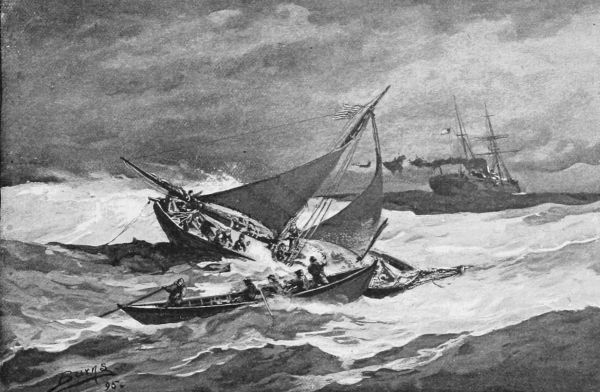
And now watching with their glasses the passengers saw the whale-boat sweep down under the stern of the schooner, and round up under her lee, while the bowman stood up and hurled a line to one of the schooner's people. By the aid of this the whale-boat was dropped under the lee quarter of the cripple, and at each upward swing of the smaller craft one of the shipwrecked marines contrived to tumble into her. Six men and a boy of some fifteen years they were. Meanwhile the steamer was dropped slowly down until she was within a fair pull of the schooner. The whale-boat came leaping and dancing over the seas, the men laying down their broad backs to the oars, and the white smoke of the spray flying on either bow. It was no small task to get the men out of the boat without crushing her like paper against the iron side of the steamer as it swung downward, yet by patience and seamen's skill it was accomplished. The whale-boat was hoisted to her davits, and the Mohawk resumed her voyage, while the shipwrecked men were taken below to be given warm drinks, food, and dry clothing.
"Will not their schooner drift about in the path of passing ships?" asked the new voyager.
"No, I fancy not," said the veteran; "she will—look!" At that instant the little schooner's stem rose high into the air, where it hung poised for a moment. Then she was swiftly absorbed by the pitiless sea, and her fluttering ensign made a bright spot above a patch of angry green for a moment and was gone.
"I never saw a sadder sight," said the new voyager, gazing with humid eyes upon the blank sea.
"There is none sadder," replied the veteran passenger.
They all returned to their snug seats under the lee of the deck-house, and for a long time were lost in meditation. Then the new voyager looked up and said, "I should like to hear their story."
"That is possible," answered the veteran; "come."
The Captain of the Mohawk was found and the request made. He sent for the skipper of the lost schooner, and said: "Do you feel able now to tell me your story? If so, these gentlemen also would like to hear it."
"Well, Captain," began the wrecked skipper, "it's a common enough story, that's a fact, sir, and I reckon it hasn't anything in it that you never heard before, though perhaps some of your passengers here never got nearer to it than a newspaper at a breakfast table. That was the schooner Mary Anthony, from Gloucester, and I'm her master—that is, I was—Joshua Clark by name, and the boy's my son on his first v'yage. That schooner was about all I had in the world, gentlemen, for I owned her myself, and when she went down a little while ago the hard work of seventeen years went down with her. But I s'pose I mustn't complain, because we take our lives and fortunes in our hands whenever we come out to the Banks to fish, and that's a fact. We got under way from Gloucester on as sweet a morning as ever you saw, gentlemen, with a whole-sail breeze from the southwest. The Mary Anthony was a smart sailer, though I do say it, and she wasn't long in getting the land below the horizon, and that's a fact. When we reached the Banks we found a fairly large fleet on the ground, and we were soon at work among the best of them. It isn't worth while trying to describe the mere matter of fishing to you, gentlemen, because, of course, that isn't what you want to hear about. It's enough for me to say that we'd been on the Banks three days and had very good luck before the accident befell us. I s'pose, Captain, you didn't see anything of a fog last night, did you?"
"No; we must have been well outside of it."
"Two steamers passed us before the fog set in, and of course they had no trouble keeping clear of the fleet. Yesterday afternoon I slipped away to the southward of the rest of them, some half a dozen miles, following a school of fish, and all of a sudden I saw the fog coming up. I made up my mind that there wasn't any use of going back, and so I lay to right where I was. The fog came down thicker than cheese, and not long afterward the heavy swell set in from the southward and eastward, and I knew there was weather brewing. So I had all the dories got aboard and stowed amidships. The swell kept on increasing, and the fog was so thick you couldn't see the length of the schooner. It was just after three bells in the midwatch when I heard a yell from my lookout. Before I could tumble out of my bunk there was a tremendous thump that threw me half-way across my cabin. I jumped on deck just in time to see the huge black hull of a steamer towering above us. She slipped away into the fog, and was gone. There were a few shouts from her deck, but we neither saw nor heard any more of her.
"I sprang forward to see what damage had been done. I found my little schooner had been mortally hurt, gentlemen, and that's a fact. The foremast, as you must have noticed, had been snapped off about ten feet above the deck, and had carried a lot of our rig with it. But that was not all. The wreckage from aloft had fallen so that something—the foretopmast, I suppose—had smashed our dories into kindling wood. I sent my mate below, and he came back with the report that we were taking in water through half a dozen seams forward. I set two hands at work to try to stop the leaks, while the rest of us cleared away some of the wreckage. Meanwhile the swell had increased so that we were rolling dreadfully, and there was great danger that some one would be hurt by the loose timbers. I'm thankful, however, that we escaped that misfortune. Toward daylight the wind rose and blew the fog off. I saw that we were in for a blow, and I decided to run toward the land as long as I dared. I set the canvas that you saw, and started her off ahead of the gale. All hands were sent to the pumps, but in spite of our hardest work the water gained on us. The gale increased and the sea rose, and then I found that the schooner was so heavy with the water in her that she was in great danger of being pooped—that is, gentlemen, having a sea break over her stern and sweep her decks. That would have been the end of us, and not a soul would have known what had become of us, for, you see, we had no boats to take to, they being smashed. So there was nothing to do but to heave her to and wait, hoping that some ship might come along and take us off. Gentlemen, it's cruel hard to work at the pumps till your arms are numb and your back feels as if it were being cut with a saw, and still to know that your vessel is settling under you, and that in a short time she must go down. I tell you we cast mighty anxious looks around the horizon every time we rose on a sea; and we felt like cheering when we saw the smoke from your funnel down in the west. Then came another time of anxiety before we were sure you were coming our way, and even after that we weren't positive that you would take us off."
"What!" exclaimed the new voyager; "is it possible that there are men so inhuman as to leave fellow-creatures on a sinking vessel?"
"There are a few such fellows on the sea," said the Captain of the schooner; "but I don't think any of them sail under the flag that your Captain ran up to his peak when he saw our signal of distress."