QUEER MONEY.
Reading edition
Here is an amusing account of a traveller who went many years ago to Mexico, and found the natives using a strange kind of currency. Says he:
"In one of the small towns I bought some limes, and gave the girl one dollar in payment. By way of change, she returned me forty-nine pieces of soap the size of a small biscuit. I looked at her in astonishment, and she returned my look with equal surprise, when a police officer, who had witnessed the incident, hastened to inform me that for small sums soap was legal tender in many portions of the country.
"I examined my change, and found that each cake was stamped with the name of a town and of a manufacture authorized by the government. The cakes of soap were worth three farthings each. Afterwards, in my travel, I frequently received similar change. Many of the cakes showed signs of having been in the wash-tub; but that I discovered was not at all uncommon. Provided the stamp was not obliterated, the soap did not lose any value as currency. Occasionally a man would borrow a cake of a friend, wash his hands, and return it with thanks. I made use of my pieces more than once in my bath, and subsequently spent them."

In looking over the programmes of the different scholastic athletic associations, I find that the Connecticut High-School A.A. is about the only one which has the same list of events as that approved by the I.C.A.A.A. It also uses the same system of scoring—5, 2, and 1—whereas most of the other interscholastic associations award three points to the winner of second place. This, however, is a different question, and one that I hope to treat of later. One thing at a time; and if we can get the card straightened out by next spring I shall be satisfied. If I can persuade all the executive committees to adopt the list of events in use by the colleges I shall consider that this Department has done some good, and has accomplished at least one valuable thing in its own sphere of usefulness. I am optimistic enough to believe that a year from now every association will have adopted the uniform schedule.
The Connecticut Association at one time had the standing high and broad jumps as well as the running high kick on their card; but when Yale offered a silver cup for competition among the schools in 1891, one of the conditions attached to the gift was that the programme must be made to correspond with the inter-collegiate schedule. To the New Haven college, therefore, is largely due the credit for the Connecticut H.-S.A.A.'s present emancipation from acrobatics. The events on their card, like those of the I.C.A.A.A., comprise the 100 and 220-yard dashes; the quarter, the half, and the mile runs; the mile walk; the 120-yard hurdle race over 3 ft. 6 in. hurdles, and the 220-yard hurdle race over 2 ft. 6 in. hurdles; the 2-mile bicycle race; the pole vault; the running high and broad jumps; the shot and hammer, both of sixteen pounds.
It is only natural that a university or college association which takes an active interest in the sports of its preparatory schools should wish to have the athletes who are making ready to enter its ranks familiar with the events on the inter-collegiate card. We all know very well that, no matter how great the college-man's interest may be in sport, as such, he is not going to waste his time and money and energy in training and encouraging young men who do not expect to go to college, or who practise high kicking and standing jumps, or other feats of which he takes no notice. He very justly argues that there are enough young athletes in the country, who want to do what he does, for him to give all his attention to them. Therefore if school associations want the colleges to take a lively interest in their efforts, to send them trainers, and to offer them cups, I would advise them to work along the lines that college athletes have found most suitable for their purposes, and to let other matters alone. No one to whom I have spoken of this matter so far has disagreed with me. If any readers of this Department have any arguments for the other side, I am sure we shall all be glad to hear them.
IOWA STATE HIGH-SCHOOL ATHLETIC ASSOCIATION GAMES, MUSCATINE, MAY 25, 1895.
Event.Winner—5 points.2d—3 points.3d—1 point.
50-yard dashHorsburgh, T.5-3/5sec.Bannister, C.Holbrook, T.
100-yard dashHolbrook, T.11"Booth, I. C.Dean, M.
120-yard hurdleHolbrook, T.20-1/3"C. Hanley, M.J. Hanley, M.
Mile runMorland, T.5m.18"Horsburgh, T.
Half-mile bicycleCole, C.1"16"Riggs, I. C.Mahin, M.
Half-mile runDemorest, M.2"19"Swisher, I. C.Morland, T.
Half-mile walkBrunn, M.4"12"Reed, T.
220-yard hurdleHolbrook, T.28-4/5"Conger, C.Freeman, I. C.
440-yard dashDemorest, M.55-2/5"Hertz, I. C.Bannister, C.
220-yard dashHolbrook, T.24-4/5"Dean, M.Bannister, C.
Standing high kickFlournoy, C.7ft.6in.Brunn, M.Leefers, T.
Running high jumpFlournoy, C.5"3"Booth, I. C.Horton, M.
Running hop, step, and jumpBooth, I. C.39"3"Freeman, I. C.Horton, M.
Baseball throwHalinan, C.314"Conger, C.Dean, M.
Putting 12-lb. shotKeister, C.38"3"Holmes, C.Holbrook, T.
Standing broad jumpFlournoy, C.9"9-3/4"Holbrook, T.Lackmond, C.
Pole-vaultFlournoy, C.9"3"Booth, I. C.Freeman, I. C.
Points Made.
Clinton50
Tipton43
Muscatine30
Iowa City28
—-
Total151
Tipton, T. Clinton, C. Muscatine, M. Iowa City, I. C.
A very good example of what might justly be called a "freak" programme is that of the Iowa State High-School Athletic Association. Their field day was held at Muscatine on May 25th last, and I insert a table showing the results of the games more as an interesting curiosity than as a valuable contribution toward athletic records. Of the seventeen events on the card, only nine appear on the I.C.A.A.A. schedule, and one of these—the 12-lb. shot—ought to be left out. If the hurdles are undersized, then the Iowans have really only six numbers on their list that would admit them to competition with the Interscholastic Association of the United States, which we hope to see in full-fledged running order next spring. Iowa has a claim to recognition in athletics, her university having sent to the Mott Haven games this year the fastest sprinter that has entered for many a year. Let me therefore urge the younger athletes to train themselves for events that they can achieve renown in rather than to waste their time in high kicking. Crum would have received scant attention at Mott Haven even if he could have hopped, stepped, and jumped from one end of the Oval to the other.
CLINTON HIGH-SCHOOL TRACK-ATHLETIC TEAM. Champions of the Iowa State High-School Athletic Association.
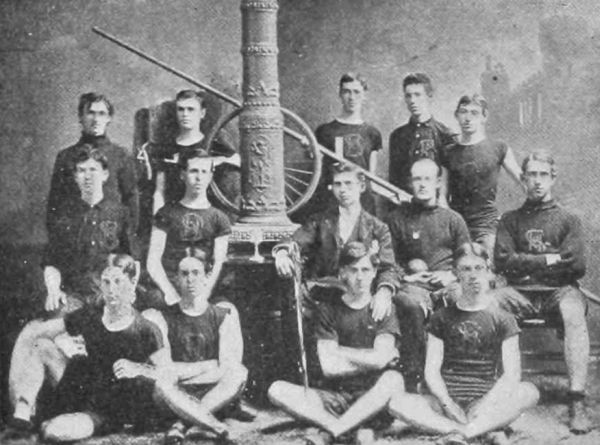
Four schools were represented on the Fair Grounds at Muscatine, and Clinton H.-S. took the cup with 50 points. The Clinton team consisted of fourteen boys only, and as they have trained themselves without any assistance from older athletes, their performances are creditable. While it is true that none of them as yet threaten the Interscholastic records, it must be remembered that our Eastern schools have been in athletics many years longer than the Iowans, and enjoy far greater advantages from trainers and coaches than can be had in the West. In a very few years, however, matters will no longer be thus, and I confidently look to see several of these records held beyond the Mississippi. My young friends on the Pacific coast are going to raise a few of the marks too. Look out for them!
If the plan now proposed in the middle West can be carried out, we shall see next year an Interscholastic Association composed of the principal schools of Iowa, Illinois, Wisconsin, and Minnesota. This organization will be a powerful one, and its meetings, where the entries will be restricted to the firsts and seconds of the State contests, ought to be productive of good records. Such competition cannot fail to elevate sport in that section, and then the East will have to look to its laurels.
At a meeting of the schools represented in the Senior and Junior football leagues, held in Boston early last May, some good changes were made in the manner of running things, and several excellent rules were adopted. The constitution now governs both leagues, which are united under the single title of "The Interscholastic Football Association"—of New England, I suppose. Henceforth the president of the association will practically be elected by goals and touch-downs, because the office goes to the Captain of the winning eleven of the Senior League. The vice-president is similarly chosen, the office going to the Captain of the champion team of the Junior League. There are to be graduates on the executive committee, which is perfectly proper, but that these should be chosen from one college alone is unwise and unfair. The new scheme is to have the executive committee consist of the Captain of the Harvard football team, three undergraduates of the schools in the league, with the president ex officio, and two graduates of Harvard.
The objection I make to this arrangement is that it is hardly right to look upon the Interscholastic Football Association as a feeder for Harvard alone. It is probably true that Harvard has done more for football in the Boston schools than has any other college, and even more than any other college ever will do; but still men do go from Boston schools to other places than Cambridge, and these men might feel that there is a little too much crimson ink on those regulations. It would be better to have it set down in the constitution that certain members of the committee shall be graduates of the schools that are members of the leagues (college graduates, too, if you like, and even ex-members of 'varsity teams, if practical football knowledge is wanted), but let the eligibility to committee membership depend upon the candidate's school relations rather than upon his college connection. It might happen some year, or for several years in succession, that the football men of the Boston schools would go to Tufts College or to the Massachusetts Institute of Technology. Then both those institutions would feel that their interest in the welfare of the Interscholastic League entitled them to an eye in its supervision. I remember that in 1888, the year the Interscholastic League was formed by Harvard to train players for the Cambridge eleven, several of the best players of one of the strongest teams went to Yale.
The teams in the Senior League are now limited to six, and before the series of games begins in the fall each school must hand in its list of players for the year. It is also required that each player shall have at least twelve hours a week at his school, and be not over twenty-one years of age. The Seniors get considerable advantage over the Juniors in the matter of voting, they being allowed two votes to the latter's single ballot.
It is almost impossible to avoid typographical errors, especially in matter consisting largely of numerals, like the tabulated records so frequently printed in this Department. I remember once of a publisher in London who made up his mind to publish a book that should have no typographical errors whatever. He had his proofs corrected by his own proof-readers, until they all assured him that there were no longer any errors in the text. Then he sent proofs to the universities and to other publishing houses offering a prize of several pounds sterling in cash for every typographical mistake that could be found. Hundreds of proofs were sent out in this way, and many skilled proof-readers examined the pages in the hope of earning a prize. A few errors were discovered. Then all the proof-sheets having been heard from, the publisher felt assured that his book would appear before the public an absolutely perfect piece of composition. He had the plates cast, the edition printed and bound between expensive covers—because as a perfect specimen of the printers' art it was of course unique in literature, and exceedingly valuable to bibliophiles. The edition sold well and was spread all over the country. The publisher was very much pleased with himself for having done something that had hitherto been considered an impossibility. Then his pride had a fall, for six or eight months later he received a letter calling his attention to an error in a certain line on a certain page. Then came another letter announcing the discovery of a second error in this perfect book. I believe before the year was up four or five mistakes were found.
This only goes to show that, even with the greatest care, absolute perfection is impossible. The next best thing, therefore, is to correct unavoidable errors as soon as they are discovered. This Department depends hugely upon its readers to find its occasional slips, and I shall take great pleasure in calling attention to the misprints as soon as I know of them. There are many who preserve the Round Table and depend upon the accuracy of the figures given for reference in the future. They can make their tables absolutely true by noting in ink on the margin of the pages any corrections given here later. The errors I have discovered thus far follow:
Hackett's time in the mile walk, shown in the table on page 538, should be 7 min. 46-2/5 sec., instead of 7 min. 4-2/5 sec. On page 537, Meehan's time at the end of the first lap in the half-mile run should have been given as 61 sec., not as 60. In the table of the Connecticut H.-S.A.A. games printed on page 634, Beck's shot-put is given as 36 ft. 8-1/2 in. His actual performance was 37 ft. 8-1/2 inches. At the dual games between the Hillhouse High-School and the Boardman Manual Training-school of New Haven, Beck made a put of 39 ft. 5 in. This would therefore correct his interscholastic record in the table on page 706, where it shows 39 ft. 3 in. The order of the finish in the bicycle race at the Connecticut H.-S.A.A. games was Baker, Steele, Rutz. This is stated correctly in the table, but not in the text.
A few years ago, long before photography had reached the stage of accuracy which we now enjoy, instantaneous photographs were made of a horse in action, and it was shown that the old conception of a galloping steed with four feet off the ground, the animal posed very much like a Roman arch, was absolutely erroneous. The actual position of a moving horse was shown to be entirely different and somewhat peculiar. Motion is so swift that our eyes cannot keep up with it—cannot even catch one of its elements. Thus we get a very imperfect idea of moving objects that we look at, and not until photographs come to our assistance do we really know just what we have seen.
What the readers of this Department are presumably most interested in just now is sport, and more particularly that sport participated in by their schoolmates, and by young athletes of their own age in other schools. Each individual, no doubt, has his own favorite branch of athletics, and he naturally strives to reach as great a degree of perfection as he is capable of in that special kind of work. It is not always easy to succeed in becoming perfect. Books and descriptive articles are valuable, but they must lack a great deal. The next best thing to actual physical demonstration, therefore, will be a series of instantaneous photographs that show each element of an athletic performance from the beginning of the action until the end. This Department will endeavor from time to time to offer these series of elements to its readers, and will begin next week by showing just how the high jump is performed. The photographs that will accompany the text show how each motion of the jump is made, where the jumper is, and how he looks during the entire transit over the bar.
The Graduate.
This Department is conducted in the interest of stamp and coin collectors, and the Editor will be pleased to answer any question on these subjects so far as possible. Correspondents should address Editor Stamp Department.
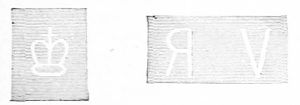
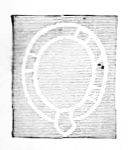
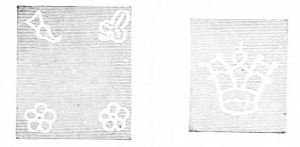
I have a number of inquiries every week regarding water-marks in stamps, especially since the U.S. has begun the practice. Many governments have used this method as a prevention to counterfeiting. The water-mark is made in the paper while in process of manufacture. When the paper pulp is somewhat solidified, a roller is run over it under pressure. This roller has on the outside a pattern made in brass or copper, and as it passes over the wet sheet it thins the paper wherever the pattern has pressed it. If well done, the water-mark can be seen by looking through the paper. If poorly done, the water-mark can be seen indistinctly. Philatelists look for indistinct water-marks by placing the stamp face downward on a piece of black paper, or japanned iron, and then apply pure benzine to the back of the stamp with a camel's-hair brush. This method reveals water-marks better than any other. Formerly most paper had a water-mark, but as a rule to-day it is used on fine qualities of writing-paper only.
England and her colonies have used water-marks in stamps since 1854. In that year the Small Crown was used for 1d. red and 2d. blue. The V. R. was used on the 6d. violet issued in the same year. In 1855 the Garter was used for the 4d. in three sizes known as the "Large, Medium, and Small Garters." To give an idea of the difference in value according to water-marks I quote from a late catalogue:
Unused.Used.
Smallgarter,4d.onbluishpaper,$75.00$1.25
""4d."white"100.002.50
Medium"4d."""60.001.00
""4d."bluish"75.002.00
Large"4d."white"1.75.08
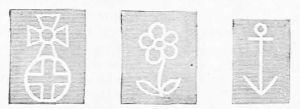
In 1856 the "Large Crown" and the "Heraldic Emblems," or "Four Flowers," were used on the 1d., 1-1/2d., 2d., 3d., 6d., 9d., and 1s. stamps.
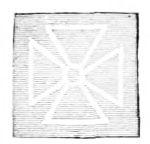
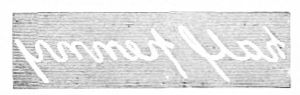
Eleven years later the "Spray of Rose" was used on all stamps from 3d. to 2s. The "Anchor" was used on the 2-1/2d. in 1875, and the "Orb" on the same stamp five years later. The "Maltese Cross" was used on the 10s. and £1 in 1878. This completes the water-marks on English Stamps, with the exception of 1/2d. stamp, which was printed on sheets marked "half-penny."
J. Hall.—All U. S. stamps since 1857 should have been perforated. Any unperforated U.S. stamps since then are the results of accident, and should not be catalogued. They are "freaks." Proofs are not perforated, and can be distinguished from stamps by their having been printed on card-board or India paper.
A. P.—I should like to follow your suggestion and give a list of all the new issues if space permitted.
A. Lordell.—There are three varieties of the current 2c. U. S. with the triangle more or less different, Types I., II., and III.
B. K. H.—I strongly advise you not to buy the Chinese local stamps. They are simply philatelic trash, and will probably be worth less money ten years from now than they cost to-day. Buy good stamps from a responsible dealer. As a rule the higher the value the more likely to increase in the future. This applies to all but the first-class rarities now worth from $50 apiece upward.
W. F. Brown.—No addresses of dealers can be given in this column. I believe the dealers have a full supply of all the Columbian stamps, except the $1 and $2, which are sold for $7 and $4 respectively. There is no 7c. Columbian stamp.
M. S. C.—The coin dealers sell the 1803 cent for 10 cents. The English coins mentioned are all common.
L. V. Bliss.—Thanks for your suggestion. I would adopt the same at once, but the postal laws do not permit the printing of any illustration of a U.S. stamp, or even part of such and the absence of illustrations would make such articles uninteresting and very difficult to understand.
H. Crossman.—England 1840 1d. black, 2d. blue.
Ray B. Baker.—The Cape of Good Hope, 1861, 1d. red is worth 60 cents, the wood-black, $15, the wood-black error, same issue, $250. The 1/2d, 1871 is sold for 6 cents. $1, $2, and $5 Columbian, $7, $4, $5.50 respectively.
O. A. P.—It is not a coin, and is worth nothing.
Helen O. Kauper.—The 90c. orange, 1890, is sold by dealers for $1.50 unused, 75 cents used. The coins are worth face value only.
B. W. Leavitt.—A 2c. stamp should always be enclosed with a letter of inquiry.
C. McQueen.—The values of all the Columbians are about the same as six months ago, except that the $1 has advanced to about $6 in value, and the $2 is hard to get at less than $4.
H. H. Bowman.—The 3c. 1861 mentioned by you is the regular rose issue, but oxidized by time. All red stamps with cochineal are subject to oxidization from dampness, sulphur fumes, etc.
H. C. Durar.—I congratulate you on your discovery of a rare local.
J. B. Daggett.—There are three varieties of the 1803 cent. The small circle is sold for 10c., the large circle for 40c., the 1-100 and 1-1000 for 35c. The Kossuth medal has no value.
W. S. Fowler.—The first postage-stamp ever made was the 1 p. black of 1840. It is sold for 8c. The 1 p. red was used from 1841 to 1880. There are many minor varieties, some of which are rare.
E. P. Noyes.—The silver dollar does not command a premium.
J. S. Green.—No premium on the eagle cent. The Dutch penny has no value in the U. S.
W. H. Kerr.—The two Siam provisionals, 1 att on 64 atts and 2 atts on 64 atts, are worth 10c. or 15c. each. The other stamp is a "sick-fund" stamp from Germany.
C. C. Perpall.—The difference in the stamps is caused by imperfect printing.
Ash.—The $3 gold pieces do not command any premium. The dates given are the common dates.
M. C. W.—The two stamps are revenue stamps from Bosnia. They cannot be used in payment of postage. Embossing was described in the last number of the Round Table. Stamps vary in value from year to year, and even month to month. Generally there is an increase year by year, but in a few instances they decrease in value. No catalogue can fix prices, and the same issue may be cheap or dear, according to the condition of the individual stamp.
Philatus.