HOW MAGIC IS MADE.
Reading edition
BY HENRY HATTON.
VI.
(Conclusion.)
"How does Professor —— cause a handkerchief to leave a decanter which he holds in his hand, and appear in another at a distance?" writes a correspondent.
Well, that depends on who the "Professor" is. One man, who says he would as lief receive a slap in the face as to be called Professor, does a trick somewhat like it in this way:
Two water-bottles, or carafes, the kind with large round bottoms and wide necks, are used. Concealed in his right hand this man has a red silk handkerchief folded into small compass. One of the carafes he proceeds to wrap in a large handkerchief, holding it mouth downward for this purpose, and it is while so wrapping it that he pops the concealed handkerchief into the mouth of the bottle, which he stands, covered, on the table. So much for getting the handkerchief in.
FIG. 1.
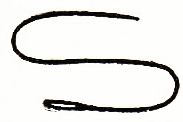
Running up his right sleeve is a fine strong cord; this goes across his back and out of the left arm hole of his vest, and ends in a loop which reaches nearly to his waist. At the end of the cord by the right hand is a piece of fine black sewing-silk, which is fastened into the eye of a strong, short needle, and this needle is bent[1] into the form of a double-jointed hook, as shown in Fig. 1. In this shape it will not catch in the sleeve.
As the man is returning to his stage after showing the second carafe and handkerchief to the audience, he attaches the hook to the latter. Then he pushes it well down into the carafe, using his wand for the purpose. Taking the carafe around the neck with his right hand, so that the mouth is almost at his wrist, he swings it back and forth, and then counting "One—two—three!" slips his left thumb into the loop, and at the word "three," gives a sharp jerk, and the handkerchief flies up his sleeve. As he stands with his right side toward the audience, and all eyes are fixed on the carafe, the movement of the left hand and arm is not noticed. The carafe which is on the table is now uncovered, and most of the audience, seeing the handkerchief, imagine it is the same one that was in the bottle, and that in some way inexplicable to them it has passed invisibly from one place to the other.
Another performer pursues a different method. When he comes on the stage, he too has a handkerchief concealed in his right hand, but it is already fastened to the thread attached to the cord which goes up the sleeve. This cord is connected with what is known as a spring-barrel—that is, a heavy coiled steel spring in a brass box, very much like a spring tape-measure.
He holds the carafe in his left hand, to show that it is empty, and then reaching with his right to the tail pocket of his coat, he pretends to take out the handkerchief, which he shows. This he pushes with a forefinger and his wand into the carafe. The spring-barrel is under his vest at the left side, and when it is time for the handkerchief to leave the carafe, a gentle pressure with the left-hand fingers on the button of the spring-barrel sets the cord in motion, and sends the handkerchief whizzing up his sleeve.
The spring makes a great noise, and to conceal this the man calls out, "One! two! three!—go!" shouting the last word, and accompanying it by a stamp of the foot and a crash at the piano, which is deafening.
The second carafe stands uncovered on a table, and has a small hole drilled in its bottom. The duplicate handkerchief which is to make its appearance in the carafe is arranged as follows: The centre is gathered into a point, and through this is run one end of a long double black thread. Both ends of this thread are led inside the neck of the carafe and out through the hole in the bottom, and again through a corresponding hole in the table, to the hands of an assistant, who is beneath the stage. The handkerchief hangs at the back of the table, where it cannot be seen by the audience. When it is to appear in the carafe, the hidden assistant gives a strong and quick pull on both ends of the thread, and the handkerchief flies so quickly into the carafe that it is impossible for the eye to follow it. When it is once inside the bottle the assistant pulls on one end of the thread, and thus soon pulls it through. The handkerchief is now detached, and may be taken out of the bottle to convince the audience that it is in no wise connected with any string.
Such wonderful tales are told by travellers of the feats of Indian magicians that many believe them to be more than human. I have never been to India, but two very clever conjurers who visited that country, the late Robert Heller and Samri Baldwin, have assured me that they have never seen anything but the most commonplace tricks performed there. I, for one, believe them, for they understood every move that was made, and could not be deceived. Some years ago a theatrical manager introduced a company of Indian jugglers at his theatre, but their tricks were so transparent that they did not succeed in creating any great impression on the public.
More recently a troupe of these wonderful jugglers visited us, and appeared at the Chicago Exposition and in other places through the country. They did the famous trick of putting a man in a basket and apparently making him disappear. It was very bad, and yet Dr. Hodgson, of Boston, who visited India in the interest of the London Psychical Society, says it was done exactly as it is done in India. One really clever trick they did which has as yet not been explained, and that I shall make plain.
THE HINDOO BOAT.
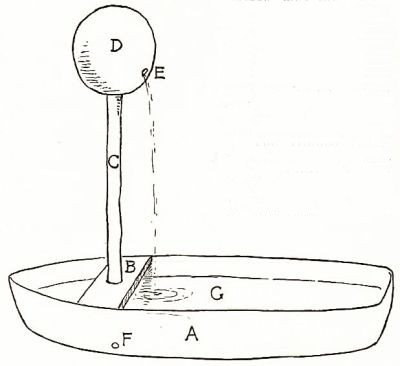
"The Hindoo Boat," a block of wood roughly hewed into the shape of a boat was shown. It was hollowed out inside. Near the bow was a cross-piece having a hole in the centre, and in this was inserted a hollow mast. The other end of this mast was stuck into a hole made in a cocoanut, which had been cleaned out inside. Below the centre of the cocoanut was another hole smaller than the one which admitted the mast.
The performer filled the body of the boat with water from a pitcher, splashing it about his table, and making a great muss. He also filled the cocoanut. Then at the word of command the water flowed or stopped flowing from the hole at E. As the performer stood at a distance from the boat, he had evidently no connection with it, though every control over it.
The secret lies in the fact that the boat was pierced near the bottom with another hole, F, which allowed the water slowly to trickle out. As soon as enough had escaped to bring the water below the cross-piece, the air would rush up the hollow mast, and the water would be forced out of the hole E. This would soon fill the boat again, and as soon as that happened the flow would cease. The performer had only to watch the water in the boat, and be guided by that in giving his commands. It is nothing more than the old story of the Tantalus cup in a new form.
A stage illusion which will compare favorably with the Hindoo tricks is the one known as "Flyto." In this a human being disappears from a large wooden cage which seemingly can conceal no one, and reappears in another cage which is swinging in the air.
THE FIRST CAGE.
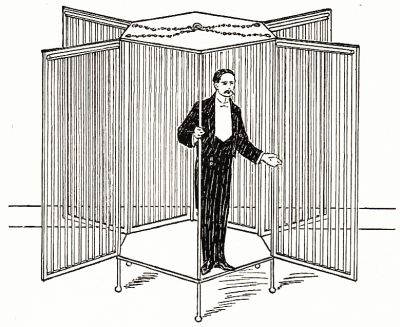
The first cage, or "cabinet," as it is called, is about seven feet high from bottom to top, and stands on slight legs, so that the spectator may look under it. It is hexagon in shape, and is made up, front, back, and sides, of doors. These doors are of slats placed about two inches apart, so that the audience can look in and through the entire cabinet. Inside the doors are red curtains on spring rollers. The background of the stage, or flat, is covered with green cloth, and the same material is on the floor of the stage. Outside on the top of the cabinet are four chains uniting in the centre in a ring.
When the cabinet is first brought out the inner curtains are pulled down. The cabinet is run down toward the foot-lights, and turned completely around so that all sides may be seen. It is then pushed well back on the stage, four of the doors are thrown open, and all the curtains are run up. The audience can now see through every part. The curtains are pulled down and the doors are closed.
A girl dressed in a fantastical costume comes on the stage and enters the cabinet. She is hardly inside when the performer again throws open the doors, and a tall man in military dress is seen inside. The girl has gone. The curtains are run up, but nothing is to be seen of the missing girl, and certainly there is no place to conceal her. The military gentleman pulls down the curtains, steps out of the cabinet, closes the door, and with the help of the performer once more rolls the cabinet towards the foot-lights. A rope is let down from the flies, fastened to the ring on top of the cabinet, and the machine is hoisted into the air.
In the mean time the girl, or some one like her, has come down the centre aisle of the theatre and mounted the stage.
THE SECOND CAGE.
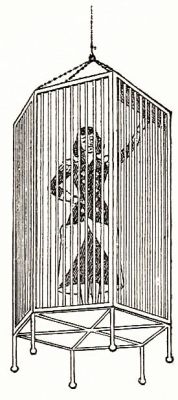
A second cabinet, exactly like the first but a trifle smaller, is rolled on the stage, and this the young lady enters. No sooner are the doors closed than the performer cries out, "Where are you?" "Here," comes the answer; the curtains fly up in the swinging cabinet, and there stands the girl. The doors of the second cabinet are opened, but it is empty.
As my readers may surmise, there are two girls in this trick as well as two cabinets. While it is not always possible to find twin sisters so like that you cannot "tell one from both," these girls in their dress and make up must look as much alike as possible. When the first cabinet is rolled on the stage the "soldier" is inside, but, as you will remember, the curtains are down. As soon as the cabinet is placed in position at the back of the stage Mr. Soldierman steps out of the back door and stands on the ledge.
The two back doors are furnished on the outside with green curtains of the same shade as the background and the stage covering, and herein lies the whole secret of the trick, for the audience do not see through those doors, but merely think they do.
When the girl enters the cabinet she changes places with the soldier. Afterward when the curtains are down and the doors closed she re-enters the cabinet, where she remains till she releases the curtains when she is swinging aloft. With some slight modifications the trick might be arranged for the drawing-room.
Most of the cabinet tricks shown on the stage depend on a back door. One magician has used it for many years, and showed considerable ingenuity in the way in which he managed to introduce the person who was to produce the "manifestations." My reader must not understand by this that he was aided by a second person in all his cabinet manifestations. When he was tied with ropes and placed in the cabinet all the manifestations that took place there were produced by him without assistance from any one. In such cases he simply releases one hand, having secured slack while he was being tied up by the committee, and with this one hand he rings the bells, shakes the tambourines, and "raises ructions" generally. Later on, when he ties himself up and re-enters the cabinet, he is tied in such a way that he can free both hands, and is enabled to take off his own coat and put on some other man's, and do all the other "two-hand acts."
Lately he has taken to building his cabinet in full view of the audience so that there may be no possibility of concealing any one in it. He brings out a platform mounted on legs with heavy casters, puts up the back and sides, which are hinged together, and screws them in place; then adjusts the front in which are the doors. Gradually in the process of putting this together the cabinet is pushed about until for a moment it backs against the "flat." That moment is not lost, for the one who is to produce the manifestations steps through the scene on to the ledge back of the cabinet, and there clings. No sooner is the front up and secured than he enters by the back door. The cabinet is now turned around, and when it is again in position well "up stage," its occupant once more takes his place on the back ledge. Now the doors are opened and closed. The man re-enters, rings the bells, blows the horns, knocks over the chairs, and while the clatter is at its height, escapes to the back again just as the doors are opened for the last time.
The performer bows. The curtain falls.
Note.—Articles on this subject have appeared in the following numbers of the Round Table: Nos. 844, 852, 862, 866, 869.