A RUN FROM AN "INDIAN DEVIL."
Reading edition
BY TAPPAN ADNEY.
wo generations have passed away from Tobique since the first settlers came, yet so little has man encroached upon the wild domain that the gaunt moose often stops and lingers with the friendly cattle, the shaggy bear as the spring comes round levies tribute on the defenceless flocks, while the balsam smells as sweet, and the crinkle of the crisp snow beneath the moccasined foot is still as pleasant music as of old. The woods seem changed but little; boys have turned men, the men have turned gray, and just a little more moss lies on the fallen tree-trunks. Yet the same change has passed over Tobique as has passed over all the backwoods of Maine and Canada. The dreaded panther, or "Indian devil," as it is known, seldom troubles one now, or startles the forest with its awful cry—so human, so bloodcurdling, that its very mention sends a thrill through one's body.
The dangers of the woods are exaggerated. No living thing is match for a man, and every creature among predatory beasts shuns the society of man. There are exceptions, as there are seasons when our black bear should not be provoked. So in the experience of every woodsman there have been times when the rule has been broken, and it is the man that has been hunted.
Raish Turner, now a man of some fifty years of age, still lives at the Red Rapids, on Tobique. I have stopped at his hospitable dwelling—back a ways from the river, on the slope of the hill, near the timber. There was still the old, low cow-shed alongside the barn, and I have been with him along the old wood road directly back of his place that was the scene of an exciting adventure of his.
Raish, still called "Raish," as when he was a boy of sixteen and hauled wood with oxen, has not forgotten the story, nor yet the long white scar above his temple that he will carry to his grave.
The story is known to every one on Tobique, but it needs to be heard from Raish himself, the sturdy, kindly old back-woodsman, with homespuns in boot-tops, knife sheathed at his belt, and generally an axe over his shoulder.
In the fall of one year, thirty-four years ago, about first fall, two hunters came out of the woods from Pokiok stream, which lay some five miles back of Red Rapids. They came with rather more speed than is customary with those who travel solely for pleasure. Their story, of which they sought to conceal nothing, and which was listened to the more gravely because of their reputation as brave men, was that in the night something had come around the camp, which was an open shelter with a fire in front. The growling of their dog awakened them.
They listened, peering into the darkness, and as they listened they heard a cry. It was not an owl, nor any wild-cat. It seemed at first afar off, not loud, like a child in awful distress, and it affected them strangely. Their dog began to tremble, and show fear that he had never shown before, even before a bear. The hunters jumped to their feet, kindled the fire, which threw a ruddy glare all around.
The thing, which they knew perfectly well, came nearer, uttering now and then that awful cry. They sat with their guns on their knees, speaking in whispers; but it did not attack them, and when daylight came it withdrew. When the sun rose they broke camp and made for the settlement.
Small wonder, then, that there was a stir in the settlement, for the men were known to be bold, fearless hunters, and, moreover, this was the first panther that had come near enough to bother them, for whatever the men in the timber-camps might have to tell, such things did not greatly trouble the settlers along the river.
Not long after that a woman living only two farms below went to the door at noonday, and saw, or thought she saw, across the field, a creature which she said was bigger and longer than any dog, trot away across the lot and enter the woods, looking back once or twice as it ran.
December came, and nothing more was heard of the panther. There was snow enough to make good hauling. Raish and his brother Howard, who was two years younger, had twenty cords of wood to get in from back. One dark cloudy day the young fellows were hurrying to get in another load before darkness shut down. The oxen were swung around, head homeward, alongside a pile of wood. A quarter of the load was on when the oxen began to act queerly. They commenced to sniff, putting their noses into the air, and looking all around. Raish had never seen them so behave, but he went on loading. Presently one of the steers put his head down and gave a long, low moan, at the same time pawing the snow.
Raish spoke to them, yet a curious feeling began to take possession of him, when, without a warning more than that, a cry rose upon the still air of the woods, and that same instant the oxen threw themselves against the yoke. There followed a crash of falling cord-wood as the sled started, and hardly slower, the boys sprang aboard, seizing hold of a sled-stake; and as Raish rolled over again he heard that cry, and something leaped into the middle of the road behind them.
IT WAS A WILD RUN.
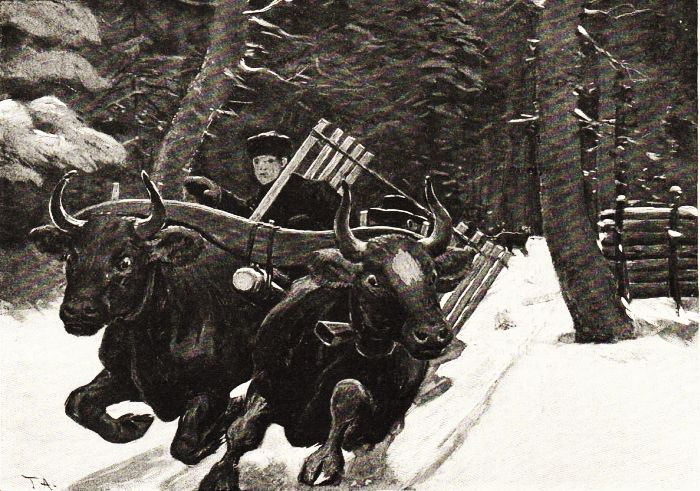
But that was all. The oxen plunged madly forward, and at every lurch their bellows mingled with the clangor of chains and the pounding of the sled. What power guided them along that road? Bounding over the cradle knolls, crashing now into this side, now into that, strewing the road behind them with the cord-wood sticks. It was a wild run.
A quarter of a mile was passed. There was no looking back, and no looking forward for the pelting of ice from flying hoofs. The clearing is reached. Wild with fright, on the steers go. The house, the wood-pile, as in a swim, flash by, and then there is a crash.
When Raish's memory gathered up the thread of swiftly passing events, he was lying on the floor of the cow-stable on the straw, and his brother, pale from fright, was bending over him, and there were some other frightened people crowded around, and a pair of steers were at the far end of the cow-stable. Raish was aware of some blood from an ugly cut. He lay stunned, they say, for some moments. Howard escaped without a hurt. The oxen, guided by instinct, made straight for the stable, and seeing the open door, made straight for refuge. The sled had struck the corner of the log barn, the tongue had snapped off, and the boys had been thrown forward; Raish's forehead struck, it was believed, either a sled-stake or one of the oxen's hoofs. The wonder was that both were not killed from the force with which they must have struck.
But all this time where was the panther? It came, so some persons at the house said, to the edge of the timber and a little beyond, where it stood some while, hesitating, and then turned back to the woods, where, instead of taking the road, it gave a mighty spring to the limb of a tree, and disappeared from view, no one venturing to follow.
Before the winter was over, however, some men with a small dog drove it to tree and shot it, after it had killed a fine heifer, no great ways from there. Out of curiosity the height of the panther's leap was measured, and it was said to be nearly eighteen feet.
The annual boat-races of the Halcyon and Shattuck crews of St. Paul's School, Concord, were held this year on June 18th, on Lake Penacook, as usual. The honors of the day went to the Halcyons, whose first and second crews won their events, the first crew breaking the school record for the distance by four seconds.
RACE BETWEEN THE FIRST CREWS, ST. PAUL'S SCHOOL, THE HALCYON EIGHT LEADING.
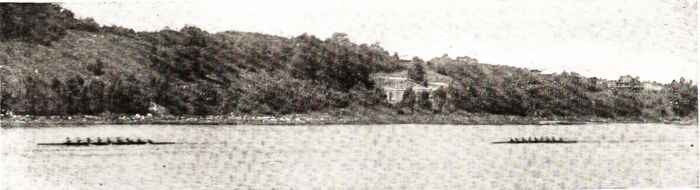
The most important of the three contests was the last race, between the two Senior eights. The start was made shortly before eleven o'clock in the morning, both crews getting away about together, rowing in good form and with very little splashing. The Shattucks started with a stroke of 42, the Halcyons pulling a 40 stroke. This pace was kept up for about a quarter of a mile, when both crews dropped their stroke a couple of points, and for the rest of the race neither eight went above 38.
THE HALCYON FIRST CREW, ST. PAUL'S SCHOOL. Holders of the record: Distance, 1½ miles; Time, 8 min. 21 sec.
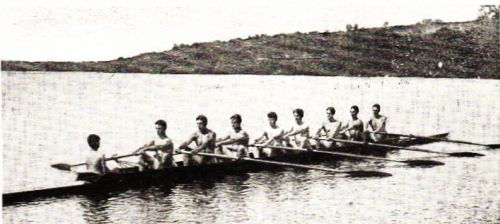
At the mile the boats were about even, but there the Halcyons began to draw slowly away, and although the Shattucks tried to keep up, they were unable to push their boat through the water as rapidly as their rivals. At the mile-and-a-half flag the Halcyon eight was two boat-lengths ahead of the Shattucks, and still gaining rapidly. The Shattuck stroke tried to hit it up, but his crew was unable to respond. The men in the Halcyon boat were rowing in beautiful form, with a long and regular body swing, and kept increasing their lead. They rushed their shell across the line nineteen seconds ahead of their rivals, their time over the course being 8 min. 21 sec., the best former record for the distance being 8 min. 25 sec., made by the Shattucks in 1891.
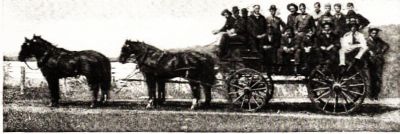
THE ST. PAUL'S CREWS GOING OUT TO PRACTICE.
The Halcyon men showed no signs of fatigue, but the Shattuck oarsmen seemed slightly done up, although they finished in excellent form. There is little doubt that this Halcyon crew of 1896 is the best that ever rowed on Lake Penacook, most of the men being veterans, the four stern oars especially being the best four that the school has ever turned out, so far as working together in the boat is concerned. The Shattuck crew, on the other hand, has had a good deal of hard luck this year, and the men were all younger and less experienced than their rivals. The crews rowed as follows:
Shattuck.
Stroke—Byrd.
No. 7—Stillman.
No. 6—Glidden (Capt.).
No. 5—Francis.
No. 4—Nickerson.
No. 3—McKay.
No. 2—Nugent.
No. 1—Vredenburg.
Halcyon.
Stroke—Thomas.
No. 7—Wheeler (Capt.).
No. 6—Brock.
No. 5—Howard.
No. 4—Niedecken.
No. 3—N. Biddle.
No. 2—Goodwin.
No. 1—L. Biddle.
In the race between the second crews, the Shattuck six got a better start than the Halcyons, and rowed 36 to the minute all through the race. The Halcyons overtook them at the first quarter, rowing 38. It had been supposed that these two crews were of about equal strength, and a close race was expected, but after the first quarter of a mile the Shattuck men seemed to go to pieces and splashed badly, and in spite of the continued exhortation of the cox-swain, the men were unable to hit up the stroke. The Halcyon oarsmen, however, rowed in good form, and broke the record for their event, covering the distance in 9 min. 23 sec. The Shattuck's time was 9 min. 45 sec. The men sat in the boats as follows:
Shattuck.
Stroke—Warmoth.
No. 5—Hogle (Captain).
No. 4—Wilson.
No. 3—Winter.
No. 2—Kaime.
No. 1—Campbell.
Halcyon.
Stroke—Barker (Captain).
No. 5—Henderson.
No. 4—Hollingsworth.
No. 3—Drayton.
No. 2—Wheeler.
No. 1—Berger.
In the race between the third crews the Shattucks again got a better start than their opponents, and secured a lead which they kept increasing as they neared the finish. Within half a mile of the line the Halcyons raised their stroke for a moment and tried to spurt, but they were unable to keep this up, and soon fell back to 35. This four did not row in as good form as the other Halcyon crews did, and showed considerable want of coaching. Their pluck, however, was good, and they never gave up work until they had crossed the line. The third Shattuck crew rowed a very steady race, showing good form for the entire distance. The men sat in the boats as follows:
Shattuck.
Stroke—Stoddard.
No. 3—Bloomer.
No. 2—Thompson.
No. 1—Keep (Captain).
Halcyon.
Stroke—Nelson.
No. 3—Phipps (Captain).
No. 2—Weston.
No. 1—Pruyn.
The breaking of the record by the first Halcyon is a feat to be proud of when it is considered that in the crew which held this record previously were Fennessy of Harvard, and Brown and Simpson of this year's Yale Henley crew. There are undoubtedly several rising oarsmen in both the Halcyon and Shattuck boats this year. Harvard will get Byrd, Stillman, Glidden, Nickerson, and McKay, whereas Yale will have Francis, Nugent, and Vredenburg.
RECORD OF CONTESTS BETWEEN THE HALCYON AND SHATTUCK CREWS, ST. PAUL'S SCHOOL, CONCORD, NEW HAMPSHIRE.
Year.Date.Winner First-Crew Race.Time of Losing Crew.
1-Mile Course.
1871.June 7.Halcyon, 8 min. 32 sec.8 min. 53 sec.
1872.June 20.Shattuck, time not given.3 lengths.
1873.June 7.Halcyon, 8 min. 45 sec.1 length behind.
1¾-Mile Course.
1874.June 16.Halcyon, 10 min. 23 sec.11 min. 8 sec.
Course, 1 Mile and Return.
1875.June 9.Halcyon, 14 min. 6 sec.14 min. 50 sec.
1876.June 10.Halcyon, 14 min. 28 sec.15 min. 13¼ sec.
1877.June 14.Shattuck, 13 min. 40¼ sec.14 min. 48 sec.
1878.No races.
1879.June 11.Halcyon, 14 min. 2¼ sec.Not taken.
1880.June 3.Shattuck, 14 min. 25½ sec.14 min. 57 sec.
1881.June 2.Halcyon, 14 min. 10 sec.15 min. 1 sec.
1882.June 13.Halcyon, 13 min. 28½ sec.14 min. 4 sec.
[3]1883.June 12.Halcyon, 13 min. 13 sec.13 min. 38 sec.
1884.June 9.Shattuck, 12 min. 41 sec.13 min. 16 sec.
1885.May 25.Halcyon, 14 min. 7¼ sec.[4]Not taken.
1886.May 24.Shattuck, 12 min. 51 sec.12 min. 58½ sec.
1887.May 29.Shattuck, 12 min. 42 sec.12 min. 46-4/5 sec.
1888.June 8.Halcyon, 12 min. 32-2/5 sec.[5]Not taken.
1889.June 1.Shattuck, 13 min. 10¼ sec.Not taken.
1¾-Mile Straightaway.
1890.May 28.Halcyon, 9 min. 2½ sec.Not taken.
1½-Mile Straightaway.
[6]1891.May 27.Shattuck, 8 min. 25 sec.Not taken.
1892.May 28.Shattuck, 8 min. 29¾ sec.Not taken.
1893.May 29.Shattuck, 9 min. 19 sec.Not taken.
1894.June 10.Shattuck, time not given.Not taken.
1895.June 11.Shattuck, 9 min. 14½ sec.9 min. 30 sec.
1896.June 18.Halcyon, 8 min. 21 sec.8 min. 40 sec.
Year.Date.Winner Second-Crew Race.Winner Third-Crew Race.
1-Mile Course.
1871.June 7.No race.No race.
1872.June 20.No race.No race.
1873.June 7.No race.No race.
1¾-Mile Course.
1874.June 16.Halcyon, time not given.No race.
Course, 1 Mile and Return.
1875.June 9.Halcyon, 14 min. 48 sec.Halcyon.
1876.June 10.Halcyon, 15 min. 2¾ sec.No race.
1877.June 14.Shattuck, 14 min. 9¾ sec.Halcyon.
1878.No races.
1879.June 11.Shattuck, 14 min. 22 sec.Shattuck.
1880.June 3.Shattuck, 14 min. 15¼ sec.Shattuck.
1881.June 2.Shattuck, 14 min. 5 sec.No race.
1882.June 13.Halcyon, 15 min. 1 sec.Halcyon.
1883.June 12.Halcyon, 14 min. 39¾ sec.No race.
1884.June 9.Halcyon, 14 min. 45 sec.Halcyon.
1885.May 25.Shattuck, 15 min. 11 sec.No race.
1886.May 24.Shattuck, 14 min. 3 sec.No race.
1887.May 29.Halcyon, 13 min. 53 sec.No race.
1888.June 8.Halcyon, 13 min. 32½ sec.Shattuck.
1889.June 1.Halcyon, 14 min. 39½ sec.Halcyon.
1¾-Mile Straightaway.
1890.May 28.Shattuck, 9 min. 53 sec.Shattuck.
1½-Mile Straightaway.
1891.May 27.Shattuck, 9 min. 49-1/5 sec.Halcyon.
1892.May 28.Halcyon, 10 min. 10 sec.Halcyon.
1893.May 29.Halcyon, 10 min. 23 sec.Shattuck.
1894.June 10.Shattuck, 9 min. 25 sec.Halcyon.
1895.June 11.Halcyon, 10 min. 21 sec.Halcyon.
1896.June 18.Halcyon, 9 min. 23 sec.Shattuck.
For the sake of the record I append the times of the several crews, as officially announced:
First Crews.—Halcyons, first; time, 8 minutes 21 seconds. Shattucks, second; time, 8 minutes 40 seconds.
Second Crews.—Halcyons, first; time, 9 minutes 23 seconds. Shattucks, second; time, 9 minutes 45 seconds.
Third Crews.—Shattucks, first; time, 10 minutes 4 seconds, Halcyons, second; time, 10 minutes 30 seconds.
After the races were finished, the crowd returned from Lake Penacook to the school grounds, cheering the victorious crews all the way; and when the students reached the flag-pole on the lawn, they followed the usual custom of hoisting the club colors and the stroke oar of the winning crew. And after this had been done the young men of St. Paul's did a very nice thing. They presented to the coach of the crews a ticket to Henley and back—a present that was probably more grateful to that instructor than any other his pupils could have thought of.
By the number of letters I have received from readers of this Department in Connecticut, I judge that the discussion of Hartford High-School's claim to the title of "Champion School" has aroused considerable interest in that section of the country. I am glad that this is so, for I believe that a wide discussion of such questions always tends toward good.
But either I did not express myself clearly in the few paragraphs that the Department devoted at the time to the discussion of the question, or else some of my readers have failed to comprehend the drift of my argument. One valued correspondent writes as follows: "I was very much interested in the argument which recently appeared in Harper's Round Table about H.P.H.-S. claiming the National championship. You say that they would have to defeat in dual contests the principal schools of the country in order to claim it. According to that, Hartford did not win the championship of the Connecticut H.-S.A.A. this spring, because she did not defeat each one of the schools in single contests. According to that, there is no honor to be gained in winning the greatest number of points in an Association field-day. Then why not do away with these Associations! Your suggestion about holding sets of dual games is not only impracticable but also impossible for ascertaining which school is National champion."
What I said in this Department on July 7 was that the National Games were a contest among "teams from leagues," and not among "teams from schools," and that therefore the question of school supremacy did not enter into the discussion. Further, I added that the only way the title of "Champion School" could be secured by Hartford would be for her to have dual meets with all other schools of her class. I should have added that another way for Hartford to earn the title of "Champion School" would be to hold a large interscholastic field-day, at which teams representing individual schools—not teams representing leagues or associations—should compete.
At any track-athletic meeting where teams of athletes represent certain units, the team winning the greatest number of points becomes the victorious unit, and the athletes who aided in piling up these points, as representatives of that unit, are of no importance whatever so far as they can claim any relation to the other athletes who strove as representatives for the rival or defeated units. The Connecticut High-School A.A. is made up of a number of units—schools. Each unit sent a team to New Haven on June 6 to the annual field-meeting of the association. The athletes who came from the Hartford High-School piled up the greatest score: therefore the Hartford High-School is the champion of that association. It seems to me that this must be perfectly clear, and I do not understand how any one can logically deduce anything else.
But, supposing a majority of this point-winners for the Hartford High-School on that day were members of the class of '96—as they probably were—have they any claim to the title of "Champion Class" of the State or of the association? Certainly not. The games at New Haven were not "class" games; they were "school" games, and nobody knew or cared to what class the winning athletes belonged. In the same way it was of no importance whatever, so far as the championship was concerned, to what school the point-winners in the National Games belonged. These games were held among associations, and the association that scored the greatest number of points became the champion association for the year.
In the case of the Connecticut Association it happened that the greatest number of point-winners were members of the Hartford High-School. This may justly be a source of pride for Hartford, and for all the members of the High-School, but it is not a matter to interest the National Association, nor is it a matter for the National Association to take any cognizance of.
The same correspondent whom I have quoted above goes on to say: "Therefore I think that Hartford has just as much claim to the national championship as she has to the Connecticut H.-S.A.A. championship, and as Yale has to the Intercollegiate championship." I feel perfectly confident that as soon as he, and others, who are of his opinion at present, make clear to themselves the difference between a contest among schools and a contest among associations, they will not think that Hartford has any claim whatever. I am very glad, too, that my correspondent cited Yale in his comparison, for it helps me to make my argument even clearer.
Yale is a university made up of Yale College, the Sheffield Scientific School, the Yale Law School, the Yale Medical School, the Yale Art School, the Yale Divinity School, etc. On every Yale team that goes to the Intercollegiate games there are College men, Sheff men, and frequently men who are in the Medical School or other departments of the University.
It is not necessary to look over the records to find out if a case such as the one I am about to cite as an example ever actually happened, for the illustration is just as strong whether it ever occurred in fact or not. But suppose that the majority of the point-winners of the Yale team of 1896 were Sheff men. Would the Sheffield Scientific School, for that reason, have any grounds to claim any kind of a championship? Of course not. The Sheff men went down to Manhattan Field as members of Yale University, just as the H.P.H.-S. athletes went to the Columbia Oval as members of the Connecticut H.-S.A.A., and neither body has any right to set up any kind of a claim for individual prowess. If I have not yet succeeded in making myself clear to all my Connecticut readers, I hope they will let me hear from them further, and I will try it again.
Another point over which there has been considerable misunderstanding is the difference between an "Interscholastic" record and a "National Interscholastic" record. The Constitution of the N.I.S.A.A., in its Laws of Athletics, section 18, says that a national interscholastic record is any record made at the annual meeting of the N.I.S.A.A. A.A. An interscholastic record, on the other hand, is a record made by a student in any annual field-meeting of any league, club, or association. [The National Association's Constitution puts it, "any leagues, clubs, or associations of this association," but we cannot accept this as correct, because there are several interscholastic records held by associations not members of the national body.]
To be brief, however, a national interscholastic record is one made at the national games; an interscholastic record is one made at any interscholastic meeting. As soon as space enough avails, this Department will print the tables of national and interscholastic records—for the comparison will be an interesting one.
Speaking of errors, it is well to refer to one which crept into almost all of the reports of the performances of the National games. In the high jump this Department credited Sturtevant of Connecticut with first place, and Flournoy of Iowa with second place. The facts of the case were these: Flournoy and Sturtevant, the only contestants in the event, tied for first place at 5 ft. 8 in. Therefore they divided the points, each man taking four.
Then they chose to jump over again for the medals, instead of tossing a coin, as is usual—although this athletic method of deciding the question is by far the more sportsmanlike. On the jump-off Flournoy was unable to repeat his performance of 5 ft. 8 in., and could only clear 5 ft. 7 in., whereas Sturtevant again got over the bar at the higher point. This gave Sturtevant the first-place medal and Flournoy the second prize. But this jumping-off business had no effect whatever on the two associations' scores, and consequently Connecticut's figures should be 24 instead of 25, and Iowa's should be 7 instead of 6.
While speaking of records, let me say a word in connection with the mile-walk figures of Eells, of the Hotchkiss School, at the Connecticut games last June. The performance as recorded was 7 min. 11 sec., and I believe these figures to be correct. When the time was announced on the field at New Haven some one raised a cry that it should be 8 min. 11 sec., and a report that the official time-keepers had made an error was assiduously circulated.
A number of letters have come to this Department since that time asking if 7 min. 11 sec. were the correct figures for Eells's performance, and I have consequently been at some pains to make a careful investigation into the matter. Mr. E. G. Coy and Mr. C. E. Hammett, Principal and Physical Director, respectively, of the Hotchkiss School, assure me that Eells is capable of walking a mile in 7 min. 11 sec. They must have every means of knowing this, Mr. Hammett especially, having seen the young athlete train for months before he went to the Connecticut Interscholastics.
They assure me that the time, 7 min. 11 sec., as announced on the field that day, is correct, and they regret that any contrary report should have been circulated by some irresponsible enthusiast among the spectators. Considering these facts, Mr. Eells, in the opinion of this Department, is entitled to be considered the holder of the interscholastic record, and will be put down as such in the table soon to be printed.
The Graduate.