CLEVER FEATS OF CHIMPANZEES.
Reading edition
BY R. L. GARNER.
hings are often done by monkeys which are very humanlike, but to them the acts may have no meaning whatever, being purely the result of imitation.
In all my researches among monkeys my chief aim has been to determine the innate powers of the mind, and therefore I have not regarded the tricks which they are often taught to do as being an index to their mental qualities. I shall relate a few of the most rational acts that I have known chimpanzees to perform. In these cases the animal was not actuated by fear, but was prompted by his own desire to accomplish a certain end to gratify his own wish.
Moses was the name of the young chimpanzee that lived with me in the jungle. One day as we were taking a stroll through the forest we came to a small branch of running water. Moses never liked to get his feet wet, but I thought on this occasion I would let him wade across it. The stream was not more than four feet wide and two or three inches deep. I first allowed my boy to pass over, and then I followed him, leaving Moses to get over by himself. When he reached the edge of the branch he began to beg for help. I seated myself on a log a few yards away from him, and he sat down on the bank of the stream. After a short time he walked along the bank looking for some means of crossing it without wading; two or three times he walked back and forth, and continued to beg for help. At last he discovered a clump of tall, slender bushes growing on the edge of the stream a few yards above the path; he went to these, took hold of one of them, and stood for a moment holding it; then he began to climb up it. He climbed up the side next to the water, and as he did so, the slender stalk began to bend under his weight. He continued to climb, and the plant continued to bend until the top of it almost touched the ground on the opposite side of the stream, and bore Moses safely across to the opposite bank. He released his hold upon the bush, and ran to me with a grin on his face, which was an evidence that he was conscious of having done a very clever thing. Whether other chimpanzees ever applied this means of crossing water or not I cannot say; but as it is not a constant habit with them, it cannot be called instinct. It was a piece of genuine engineering. No philosopher could have found a better solution to the problem.
Aaron was one of the brightest of his kind that I ever saw; he died in England. On the voyage from Africa to that country I had a cage for him and his companion constructed from parts of my own cage. On board the ship was a stowaway, who helped me to look after my pets; the boy was disposed to play tricks on the chimpanzee, and, whenever he had an opportunity, would do something to annoy him. Aaron was very fond of drinking water out of a long-necked bottle; this was very convenient, as the neck could be thrust through the meshes of the cage, and withdrawn after he had finished. When the boy gave them water, he would turn the bottle up and pour the water over them. They did not like this, and for a time refused to drink at all. At last Aaron found means of escaping; he climbed up on the side of the cage at a safe distance from the front, and about on a level with the neck of the bottle; then holding fast with his feet to the side of the cage, reached across the angle of the corner, took hold of the wires with his hand above the mouth of the bottle, and put his lips to it; when the water was spilled it did not touch him, but fell to the floor. After Elishiba witnessed this a few times she did the same thing, showing that she perfectly understood why he did so and what the result was.
I saw a young chimpanzee in Africa that belonged to a French officer. She was kept on board a small steamer that runs on the Ogowe River. This ape was full of mischief, and had to be tied or watched constantly to keep her out of harm. She had learned to untie all kinds of knots, so that it was very difficult to keep her confined.
On one occasion when I was aboard this steamer her master tied her with a long line to one of the rails alongside the boat. As a rule she always untied the knot next to her first, but on this occasion a new kind of knot had been tied. About six feet from her neck a single loop was tied around one of the iron rails along the side of the deck; then the long noose end of the string was taken to a stanchion about four feet away, and securely tied in the angle formed by the stanchion and the rail. The chimpanzee tried in vain to untie the single knot in the line which was near to her; but as one end was fastened to her neck and the other to the post, there was no loose end to draw through. She slacked the knot, however, as far as possible, but could find no loose end; she drew it tight again, and then examined it. Again she slacked it, and examined each strand separately; she traced one strand of it to the post, then she traced the other to her neck. For a moment she sat as if in deep study; then she slipped the knot along the railing, until it was near the stanchion. She slackened it, and surveyed it with care; she climbed down upon the deck, and pulled first at one strand, then another. Then she climbed around the stanchion and back again; she climbed up over the railing, down on the outside, and back again. She climbed through between the rails and back again two or three times, and again examined the knot; she tightened the loop, and moved it along the rail to the place it was first tied; she climbed up and again examined the knot; she drew first one end and then the other, but found them both fast; she drew the loop out as far as it would come, and, holding it in her hands, she examined each strand of it again; then she cautiously lifted it and put it over her head, crawled through it and the loop was undone. When the loose line dropped on the deck, with one end still fastened to her neck and the other to the post, she realized that she had untied the aggravating loop in the middle. To release the end fast to the post was only the work of a moment; the look of triumph on her face was enough to satisfy any one that she was conscious of her victory. As soon as she was released she gathered the line in a roll in her hands, and set out to explore the boat again.
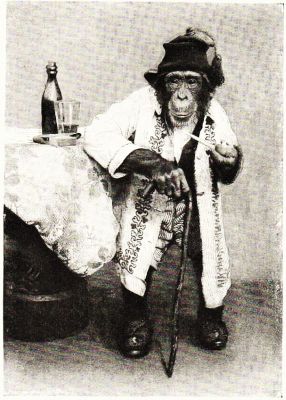
CONSUL IN STREET ATTIRE.
Away in the interior of the Esyra country I arrived at a town in which there lived a fine strong chimpanzee about five years old; he was playing with the children in the open space between the houses, and appeared to take as much interest in the game as any one of them. When they discovered a white man in the town they all came to take a look, and he showed as much concern as any one else. After a time he came to me and climbed upon my lap; he became a little too familiar, and I had him taken away. Then he and the children resumed their play for a while, and in the mean time I inquired into his history. He was captured in the forest near the town when he was a little babe, and had lived there ever since as one of the family. He ate and played with these children, slept in the same houses with them, and did not seem to realize that he was not a human being.
He belonged to one of the King's sons, who told me that the ape could talk, and that he could understand him. He entertained me with a number of feats that the animal had been taught to do. They were not mere tricks performed for amusement, but they were acts of usefulness. In fact, he was made to occupy somewhat the place of a servant.
One of the things that he required him to do, by way of entertaining me, was to go to the spring and bring a gourd of water. He was reluctant to do this, but he did it. As soon as he delivered the water to his master he ran away and joined the children in their play. I expressed a desire to see him fill the gourd with water, and his master called him again, gave him the vessel, and we went with him. He dipped the gourd in the water with the mouth downward, and having submerged it, turned it on its side, and lifted it up. There was only a little water in the gourd; he repeated this act a number of times until the gourd was almost filled; his master said that as long as the water continued to bubble at the mouth of the gourd the ape would continue to dip it in, showing that he was aware of the cause of the bubbling.
This ape knew all the people of the town by name, and knew his own name; he was required to aid the children in bringing firewood from the forest, and many other chores about the town.
CONSUL RIDING HIS WHEEL.
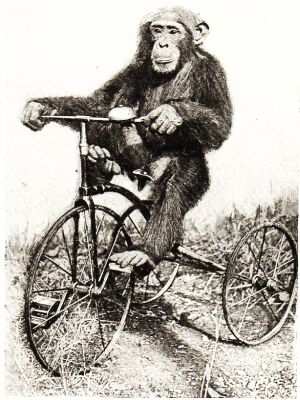
One of the most intelligent and quite the best educated chimpanzee that I have ever seen is Consul II. He is an inmate of the Bellevue Gardens at Manchester, England. He is the most humanlike in his manners of any of his kind that have ever been known in captivity. The many clever feats done by this ape would fill a small volume; he has not been trained to perform them as tricks, simply to amuse or entertain visitors, but many of them he has taken up of his own accord, having seen others do so. The feat that impressed me most was his skill in riding a tricycle, and his taste for that sport. He often takes his machine without being told, and rides all about the place; if he finds it lying on its side, he sets it upright, adjusts the handle-bar, mounts it, and takes a ride. He propels it with ease and guides it with dexterity. No boy of his own age can handle it with more skill. He rides all about the place, around the walks and drives, all over several acres of ground; he steers it around the posts and corners, around the curves of the paths, makes his way through crowds of people without colliding with them. He amuses himself by the hour at this pastime. When he tires of it he sometimes shoves the vehicle up in some corner and leaves it.
Consul also smokes cigar, cigarette, or pipe. He often finds a cigar stub about the place, picks it up, puts it in his mouth, and goes to his keeper for a light. One amusing habit he has is that of spitting; he is not very skilful in this, but is persistent. However, he has the politeness not to spit on the floor; he spreads a piece of paper on the floor, and uses it as a cuspidor.
Consul uses a handkerchief the same as a person does; he eats with a knife and fork, cuts up his food with ease, and never uses his fingers in eating; he can blow a horn, but does not attempt to carry any tune. He knows the first three letters of the alphabet, which he has painted on a set of blocks; when asked for any one of the three, he will select it and hold it up.
I regard the feats described above, except the last one, as being rational, and the result of the innate faculties of the actors. We are only beginning to understand the mental characteristics of animals, but our researches in that field are bearing abundant fruit, and we are now beginning to realize that all of these humbler creatures are component parts of the great scheme of life. When man becomes more fully impressed with the fact that all creatures think and feel in the same manner as himself, although not to the same degree, it will make the bonds of fellowship closer between him and nature.