THE TROLLEY SWIMMING TEACHER.
Reading edition
BY WILLIAM HEMMINGWAY.
Swimming on a trolley-line sounds like an impossibility. It is a very real practical feat, nevertheless, and hundreds of New-Yorkers can tell you all about it from their own experience. No other way of learning how to swim is half so pleasant as the trolley-line plan. There is no fear of bobbing under and losing your breath and swallowing a quart of water. Once you buckle on your trolley belt, there you are, and there you stay, right on the surface of the water. It is as safe as sitting in a rocking-chair, and a thousand times more fun.
Fred L. Balmes, a young swimming-teacher, invented the trolley plan. He found that the usual scheme of putting a belt around the pupil's chest, running a line from the back of it to the end of a long pole, and then towing the pupil along like landing a big fish, was not apt to encourage learners. They always feared that the teacher would stub his toe, or look around suddenly, or in some other way forget to hold up the end of the pole. That, of course, meant a ducking; and a beginner in the gentle art of swimming would rather suffer ten beatings than one ducking. Nobody ever learned well by wearing an inflated rubber life-belt. The belt has too much floating power, and boys who wear one when beginning always kick too high thereafter, and send their feet splashing above the surface, which is very bad form. When I was a boy we used to go down to the Sandy Flats, where there was a long stretch of river only three feet deep. An expert (a boy who could swim about ten yards) upheld the pupil's chin on the palm of his hand, and yelled, "Now kick like a bull-frog!" If the pupil was too embarrassed to do this immediately and successfully, the expert always popped him under, and when he came up spluttering and shrieking, sent him down again for luck. The system was perfect—all but the cruel ducking.
HE MIGHT LIE THERE ALL DAY WITHOUT WETTING HIS MOUTH.
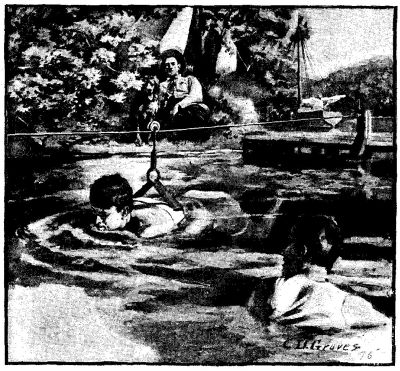
That sort of thing would not attract pupils to a swimming-school, so Fred Balmes tried to find the best substitute for the hand of the teacher under the chin of the taught. At last he hit upon the idea of running a wire along the pool two or three feet above the surface. Now, if there were only some way to hang the pupil to this wire so that he could move forward and backward and never be allowed to sink! A trolley was just the thing for that. Balmes bought a small metal wheel, with its rim deeply curved inward, so that it would not jump off the wire and become clogged. Hanging down from the axle of this wheel was a piece of brass that ended in a swivel. Balmes already had a broad canvas belt, with a ring at the upper part of it. He hooked the end of the swivel into the ring on the belt, and threw himself into the water. The trolley-line was a success. He splashed both hands and feet above the surface of the pool, but still he floated like thistle-down. Backward and forward he swam. The trolley rolled and creaked along the wire, and always held him up in precisely the right position. He might lie there all day if he chose without wetting his mouth. Not only can one learn to swim quickly by the trolley plan, but it is a fine way to learn how to float. Some of us are too thin ever to learn this branch of the art, but if any one possesses latent floating power, he may be sure that the trolley will develop it.
The inventor of this delightful way to learn swimming has not patented his trolley plan, so any one may use it. The wire can be rigged from side to side of any swimming-bath. It is best not to have the line more than fifty feet long, for a greater length than that will cause the wire to sag at the middle and let the pupil sink. In rigging the wire only one end should be wrapped fast around a post. The other end should be hitched to a stout rope and pulley-block. Before using the trolley the rope should be hauled as taut as possible and made fast securely. Then there will be a straight tight wire and no sagging.
If enough care is used, there is no reason why a trolley swimming line cannot be set up along a river-bank or the edge of a swimming-pond. In doing this, however, boys should not depend upon their own judgment. It is best by far to engage a competent man to set the posts and rig the wires. No matter how clever boys may be, they are not cautious enough to arrange against all the possibilities of danger. And it is necessary always to remember that in water is the most dangerous place to play.