HOW TO START IN LIFE.
Reading edition
FRUIT-GROWING—BY KIRK MUNROE.
In no other civilized country of the world is there so much fruit eaten as in the United States, consequently in no other is fruit-growing such an important and profitable industry. In proof of this, the great State of California is virtually given up to fruit-growing, and receives a greater annual revenue from its fruit trees and vines than from its gold-mines.
PACKING ORANGES IN CALIFORNIA.
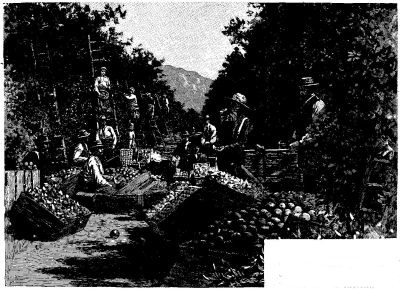
Any reader of this article who wishes to become a fruit-grower, and who can have the use of a few square feet of ground, or even a box filled with earth, may begin at once by planting seeds, and so starting a nursery. Of course the first thing to be considered is the locality in which the orchard or grove is to stand. If the young grower lives in one of the Northern States, he will plant apple, pear, or cherry seeds. If in one of the Middle States or on the Pacific coast, he will add to these peaches, prunes—which are only a fine variety of plum—and grapes. In the Gulf States he will substitute fig-cuttings for apples; and in Florida, southern California, southern Texas, or southern Arizona he will plant all the orange and lemon seeds he can obtain. Even if his grove never gets beyond the nursery stage he may still reap a return from his venture, besides the pleasure that it has afforded him, for in every locality there is a steady demand for young fruit trees, which thus have a cash value from the moment they are sprouted.
There is one section of the United States, not yet mentioned, in which can be grown fruits rarer and more profitable than any of those already noted. I mean "semi-tropical Florida," or that portion of the peninsula lying below latitude 28°, which is the latitude of Tampa. North of this even the orange and pomello, which latter is known also as shaddock and grape-fruit, are not safe from cold, as was shown by the freezes of 1886 and 1895, while lemons and limes, which are even more tender than oranges, may not be planted with any hope that they will yield cash returns.
South of the 28° line orange groves have thus far been safe from freezing, and with it begins the pineapple belt of Florida, that is destined to make the State even better known than have its orange groves. Below this line, too, guavas may be, and now are, grown at a profit.
Strange as it may seem to those only acquainted with northern Florida, this southern portion of the State is a very rocky country, and at first sight appears valueless for growing anything; but the rock is old coral filled with plant food, and so porous that tree roots penetrate it in every direction. From this section of the country, which includes the remarkable two-hundred-mile-long chain of islands known as the Florida Keys, the very first vegetables of the year reach Northern markets, shipments of tomatoes and egg-plants being made as early as Christmas. From here, too, comes the bulk of our pineapple supply; and here limes, guavas, and alligator pears grow with such readiness and luxuriance that they require but slight attention after once being planted.
Although this only semi-tropical portion of the United States is just now being penetrated by a railroad, its lands are already becoming very valuable for fruit-growing purposes, and command from ten to fifty dollars per acre; while to clear them in readiness for setting out fruit trees costs about forty dollars per acre more, so that the would-be grower must be prepared to spend nearly one hundred dollars per acre on his land before his orange, lemon, or lime grove, his alligator-pear, mango, or guava orchard, or his pineapple field, or "pine patch," as it is apt to be called, can be started. Then at least as much more money, and in some cases several times as much, must be expended on nursery stock, fertilizer, and labor before any returns can be expected. So, you see, fruit-growing is a business that requires capital to start it, the same as any other.
I should say that no one could hope to make fruit-growing profitable, and place it on such a footing that it would yield him an income for the rest of his life, without an investment of at least $5000. People have succeeded in making bearing groves for much less money; but they obtained their land for little or nothing, cleared it themselves, lived for years poorly housed, fed, and clad, and worked like slaves.
Even he who has the means necessary to make a grove must have enough more to support him until his trees come into bearing, or else be able to earn a living while waiting for that time to arrive. As I have already said, the fruit-grower may do this by raising vegetables between his rows of trees. By so doing he will not only gain a speedy return from his land, but his trees will be benefited by the constant working and fertilization of the soil. Better than vegetables, however, because more profitable, and directly in the line of fruit-growing, are strawberries. As I write, in January, the first strawberries are coming in, and are being readily sold at sixty cents per quart even here in Florida.
A PRUNE-TREE FARM.
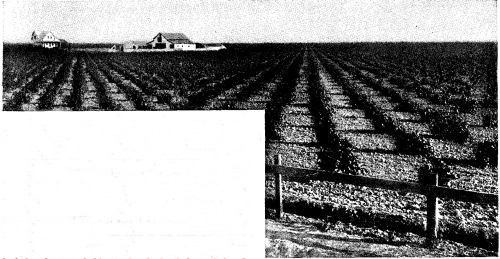
After the would-be fruit-grower has secured land and provided himself with the means for making his grove or orchard, there are a few cast-iron rules that he must learn and follow in order to insure success. The most important of these is that no fruit tree will attain a thrifty growth without constant attention and an ample provision of both food and water. Young nursery stock should be at least two years old before being transplanted, and when set out they should never be placed less than twenty feet apart. The little trees should be set in well-mellowed soil, to the exact depth that they attained in the nursery. They should be given plenty of water to start with, trimmed of all their leaves, and the earth should be packed solidly about their roots. After this be careful not to give them too much water; just enough to keep the earth about them damp is sufficient.
A year or so after being set in its permanent place, and after it has put on a healthy new growth, all nursery stock should be budded from well-known varieties of its own kind. After this the young tree must be well fed at least once in six months; it must be protected from high winds, and its delicate surface roots must be guarded against extremes of either heat or cold. Both trunks and branches must be kept clean and free from sap-sucking insects by occasional washings or sprayings, and a thick body growth must be pruned out so as to insure a free circulation of light and air, as well as to encourage a stronger growth of terminal branches, which, in all trees, are the fruit bearers.
The South, including all the Gulf States, contains vast areas of cheap lands available for fruit culture, while semi-tropical Florida, lying south of latitude 27°, offers a vast and as yet but little developed field for three fruit crops, the cultivation of which is but just begun. Most important of these, at present, is the pineapple, which can be raised in no other part of the United States, and which is grown in fields or "patches" of five, ten, or twenty acres. The fruit, or "apple," occupies the centre of a plant two or three feet high, having bayonetlike spiny leaves. It is not propagated from seed, but by slips or miniature plants that spring from the base of the apple, and which in turn will bear fruit eighteen months after being set out. These slips are worth one cent or one and a half cents each, and ten or twelve thousand of them, of which two-thirds will produce fruit, may be planted to the acre. The harvest, or cutting season, begins in April and lasts until June, so that pineapples are brought into Northern markets at a time when they are most nearly destitute of other fruits. Although the pineapple is so perishable that, for shipment by sea, it must be cut some two weeks before it is ripe, and so has come to be regarded in the North as a sour, hard, and indigestible fruit, it is when allowed to ripen in its native field, after being mellowed by weeks of a tropical sun to a golden yellow, one of the richest, sweetest, and most luscious of all fruits.
Another valuable fruit of this remote region is the guava, whose tree, about the size of a peach, has straggling branches clad in a light brown bark of satiny smoothness. One hundred and fifty trees may be set to the acre. They require but little care, and will produce fruit when five or six years old. A thrifty tree should yield at least one bushel of fruit, worth from one dollar to one dollar and a half, while two and three bushels to the tree are not unusual. The guava is yellow, smooth-skinned, and about the size of a nectarine or a very large plum. Its interior is pink, and is filled with small seeds. While most of us are familiar with the dark-colored guava paste that, packed in small wooden boxes, comes from Cuba, comparatively few have tasted the delicious, beautifully clear guava jelly or the darker and richer guava marmalades of Florida. The demand for these is rapidly increasing. Each year sees the establishment of new factories for making them, and many thousands of acres may still be set to guavas without overstocking the market.
Most interesting of all South Florida fruits, because little cultivated, almost unknown outside of the tropics, and most highly appreciated when once introduced, is the alligator or aracado pear—the aguacate of Cuba. A very few alligator-pear trees are grown in sheltered spots of southern California; but South Florida, below latitude 26°, is the only section of the United States where it can be cultivated on a large scale and as a profitable crop. Here it grows as luxuriantly and with as little care as the guava, though it requires a greater depth of soil. The tree is tall, slender, and covered with a dense foliage of dark glossy green, while the ripened fruit, also green in color, is smooth-skinned and as large as a man's two fists. Inside is a great round stone or seed surrounded by a soft yellowish-green pulp, which, sprinkled with salt and eaten with a spoon, or made into a salad, is delicious beyond description. No one ever eats an alligator pear without wanting another, and the taste once acquired demands to be gratified regardless of expense. I have known fifty and even seventy-five cents apiece to be paid for these pears, and when I once asked a Broadway dealer which was the most expensive fruit in his store, he promptly answered, "Alligator pears."
I have said little concerning bananas, cocoanuts, or mangoes, all of which are raised in South Florida, because they grow better in the West Indies and Central America, where labor is much cheaper than in any part of the United States, and from which they will safely bear transportation by sea.
It is often asked by young would-be fruit-growers, "How much land ought a grove to contain, and what will be the returns?"
A safe answer is that both of these things must be governed by circumstances and conditions. As a rule, however, a thrifty five-acre grove or orchard will yield a living, one of ten acres a competence, and one containing one hundred acres wealth. This year Florida oranges are worth, on the tree, from two to four cents each; alligator pears, from five to ten cents apiece; limes, five cents; and lemons, ten cents per dozen; while pineapples will average fifty cents per dozen in the field. A twelve-year-old orange-tree properly cared for should yield one thousand oranges; alligator pears and mangoes half that number; and pineapples 600 dozen to the acre. In other words, fruit-growing ought to average a net profit of from $150 to $300 per acre, while it is not unusual for the profits to reach $500 per acre.
It must always be remembered, though, that such returns are only realized after years of patient waiting, hard labor intelligently applied, and under favorable conditions. Thus, while fruit-growing is a pleasant and safe business for persons of all ages and both sexes, and while the grove or orchard is better than a bank account as a pension for old age, it must be studied and prepared for the same as any other calling in life. For this reason I should strongly urge any young person intending to embark in it to serve at least a two years' apprenticeship, or while his nursery stock is growing, in some well-established grove of the kind that he proposes to make. Here, in addition to familiarizing himself with the routine work of the grove, he should study the chemistry of soils and fertilizers, the habits of such insects as may attack his trees, and the laws regulating the supply and demand of markets. In other words, success in fruit-growing can only be attained by following the self-same rules that lead to success in every line of business under the sun, and by the practice of industry and perseverance.