A VERY FISHY FARM.
Reading edition
ONE OF THE OLD SAILOR'S YARNS.
BY W. J. HENDERSON.
It was a sultry summer morning. The rays of the sun beat down with merciless power through an atmosphere which was saturated with humidity. The sea, flashing in long slanting lines of dazzling silver, melted away in the distance into a cloud of thick yellowish haze. There was no horizon-line, for this haze hung downward from the sky like a veil. It seemed to grow thicker and more dingy in appearance from hour to hour, and as it did so the atmosphere became more and more oppressive. The sunlight, which had blazed in clear white glory early in the day, became yellow and faint, but its heat did not diminish. On the contrary, it seemed to grow greater every minute. The sky had been a deep luminous blue early in the morning, but at eight o'clock great tufted white clouds, looking like gigantic masses of white cotton sailing through the air, began to rise out of the west. After a time they seemed to draw parts of the low haze upward with them, and hence, now and then, a dark shadow appeared among the expanses of white. The light breeze from the west was soft and hot, as if it had passed over a great lake of warm water.
In short, it was one of those mornings which precede an afternoon of thunder-showers and squalls. The fishing-boats were close to the beach, and the fishermen were watching the western sky closely, not wishing to be taken unawares by some sudden development of troublesome weather. Henry Hovey and his brother George voted that it was altogether too hot and stuffy to stay in the house, and they felt sure that, with so many indications of weather, their friend, the Old Sailor, would be down at the pier gazing out upon the ocean. Accordingly they set out for the pier, and there, as they had expected, they saw the experienced mariner sitting in his accustomed place. About two miles off shore there was a handsome iron bark drifting slowly along, clothed with snowy canvas to the very summits of her tall masts. Her long powerful hull was painted a light salmon tint, and was decorated with a broad lead-colored stripe marked with false port-holes. The gilded figure of a rampant unicorn could be distinguished under her bowsprit, while here and there along her deck the glitter of brass-work told that she was a highly finished craft. The Old Sailor was gazing at her intently, and, as the boys paused beside him, without turning his head or seeming to know that they were there, he suddenly said,
"An' wot kind o' wessel might that be?"
"That," answered Henry, "is an iron or steel bark."
"Werry good, too," commented the Old Sailor. "An' wot canvas are she a-carryin' of?"
"Everything that will draw with a light wind abeam," said George, "even to a main-skysail."
"Werry good, too," declared the Old Sailor. "An' w'ich way are she a-headin'?"
"A little to the eastward of south, I should say," replied Henry.
"Not so werry good. She are a-headin' putty straight fur the Saragossa Sea, but, ef her skipper aren't crazy, she won't go there; 'cos w'y, it are not no place fur no sensible pusson to go, w'ich the same I know, havin' bin there in a bark edzackly like that one; but I ain't goin' no more, leastways not ef I know I'm goin', w'ich the same the other time I didn't."
"Oh," exclaimed George, quite carried away by this unwonted flow of eloquence, "please tell us all about that?"
"But wait a moment," interposed Henry. "Where is the Saragossa Sea? I don't remember that in my geography."
"The Saragossa Sea, my son," said the Old Sailor, gravely, "are not one o' them seas wot's surrounded by land. Contrariwise, it are surrounded by water."
"A sea surrounded by water!"
"Them are it. This 'ere sea are jess a part o' the Atlantic Ocean to the east'ard o' the West Injies. It are a place w'ere the current goes around in a sort o' ring, an' the sea-weed an' decayin' wegetables an' other sich truck out o' the Gulf gits out there, an' there it stays. It ain't s'posed to be a werry good sort o' place fur sailin', an' Cap'ns allers steers clear o' 't, onless, o' course, they gits blowed into 't by a storm, an' then steerin' don't clear nothin'. Nobody don't know werry much about that there place, 'ceptin' Cap'n Peleg Mahoney, Willum Smitzer, fust mate, the crew o' the iron bark Ham Bone, an' this 'ere werry identical Old Sailor wot are a-talkin' to ye."
The mariner paused for a moment to collect his memories, gazed keenly at the western sky, muttered something about clewing up a "bloomin' sky-scraper," and then started thus:
"The iron bark Ham Bone were a most wonderful trotter off the wind; but any other way she made so much leeway that she were mos' ginerally occipied in climbin' up hill from the place w'ere she ortn't to be to the place w'ere she ort, an' mos' ginerally not gittin' there. I shipped on to her in Liverpool as second mate, Willum Smitzer, him bein' a bloomin' Dutchman an' also fust mate. We wuz bound fur Jamaiky with a cargo o' plum-puddin', bottled soda, an' misfit clothes."
"Misfit clothes?"
"Yep. Ye see, the Jamaiky people is so werry Henglish that they prefers misfit clothes to any others, so them kind is allus sent there by the mother country, an' so the colony are kep' in a contented state o' mind. Waal, fur two weeks the Ham Bone didn't git along much faster'n that there yaller bark out yonder. The wind blowed mos'ly up an' down the mast, an' we wuz a-wallerin' along with all our light canvas set, an' not makin' more'n fifty to sixty mile a day. Howsumever, that were better'n wot were a-cookin' fur us. One mornin' it were jess like it are now, an' Cap'n Peleg Mahoney, w'ich the same he were a Frenchman, sez he to me, sez he, 'Eet vill be some sqvalls soon, yes, eh?' An' I sez to he, sez I, 'Oui, mownseer; you're dead right.' So he orders us to clew up an' furl the royals, an' ginerally to git ready for misbehavior o' the elements. Waal, sure 'nuff, 'bout six bells in the forenoon watch it got blacker'n a coal-bunker in the nor'west, an' afore seven bells down it came a-squealin' like ten thousand guinea-pigs struck by lightnin'. We wuz under nothin' but torps'ls, but we heeled over till the water were waist-deep along the lee rail. Then we righted, an' commenced fur to go ahead at a tearin' speed, an' off to leeward like a horseshoe crab. Waal, it jess blowed one squall arter another till four o'clock in the arternoon, an' then it fell flat calm, with a great big greasy swell a-runnin' out o' the no'theast, an' the byrometer indulgin' in disgraceful low conduck. Sez Cap'n Peleg Mahoney to Willum Smitzer, sez he, 'Eet vill be a bad gale, yes, eh?' An' Willum Smitzer, sez he to he, sez he, me a-hearin' of him, 'Ja woll,' w'ich are good Dutch fur 'Betcher life.' An' both on 'em was a-tellin' the truth.
"At six o'clock there were a white streak along the horizon in the no'theast, an' then the wind come, fust in little snorts, then in big puffs, an' last in a straight, howlin' gale. Cap'n Peleg Mahoney he hove the Ham Bone to on the starb'rd tack, an' then the bloomin' old hooker commenced slidin' off to leeward like a tissue-paper kite, only there weren't no string to keep her from goin' furder an' furder. Cap'n Peleg Mahoney he were on deck most o' the night, an' he talked a great deal o' French, w'ich the same I are not goin' to repeat. An' Willum Smitzer, the fust mate, he talked Dutch, an' there were a reg'lar Franco-Prussian war o' words. Howsumever, it didn't kill the wind, fur that bloomin' gale blowed right on end fur putty nigh a week. An' at the end o' that time there were sich a sea runnin' as I don't perpose fur to tell ye about; cos w'y, I ain't goin' to say nothin' wot might dammidge my repitation as a puffickly truthful pusson. All I kin say are that w'en the Ham Bone riz to one o' them seas we could hear the bottles o' soda fallin' over one another down in the hold, an' we had to lay flat down on the deck to keep from tumblin' off over the starn. That ain't no respectable weather fur to be out-doors in, but w'en the nearest port are more'n a capful o' degrees away, w'y, there ye are, an' there ye got to be, leastways till ye get blowed to s'm'otherwheres, an' that are wot.
"O' course the Ham Bone were hove to, but, bless ye! she made seven p'ints o' leeway, an' her drift were somethin' no human bein' could carkerlate. Waal, to git som'ers near to the crest o' this 'ere yarn wot I'm a-tellin' ye, at the end o' a week o' drivin' to leeward the lookout forrad sings out,
"'Land ho!'
"'Land! Pah!' sez Cap'n Peleg Mahoney, sez he. 'There ees not some land for one t'ousan' mile. Pouf!'
"'Aber ja!' yells the fust mate, Willum Smitzer, him bein' a bloomin' Dutchman; 'das ist land, nicht war?'
"The Cap'n he jumps to the lee bow, me a-follerin'. Waal, my son, ye 'ain't never seed nothin' like 't. The sea were full o' wegetables."
"Full of vegetables?" exclaimed Henry.
"Them's it. Onions an' beets an' pertaters an' queer fruits an' plants like cabbidges, only with leaves ten times as big, was a-floatin' on top o' the water. W'y, bless ye! a sea bruk over the starboard bow, bringin' one o' them there cabbidges with 't, an' it hit Willum Smitzer, an' knocked him down mos' beautiful fur to see. But that weren't the wust o' 't. Furder down to leeward we could see the waves a-breakin' in big hills o' spray on to some sort o' a beach that were dead flat. There weren't no hills nor nothin' behind it, but it looked jess like a perairie growed right out in the middle o' the sea.
"'Wot 'n 'arth are it?' sez I to the Cap'n, sez I.
"'Ze Saragossa Sea,' sez he to me, sez he.
"'An' ef we gets in, how does we get out?' sez I.
"'How I tell that?' sez he.
"An' that bein' so, there weren't no more to say. Waal, the Ham Bone druv down to leeward, an' the wegetables kep' a-gettin' thicker an' thicker, an' all kinds o' sea-weeds an' other sea-garden truck were mixed up with 'em. Ef the storm hadn' bin so heavy we'd 'a' stuck fast then. But seein' as how 'twere such a powerful gale, one smashin' big sea, about sixty feet high, picks up the old Ham Bone, an' carries her clean away over the edge o' the aforesaid beach, an' sets her down ca-plump about half a mile inland, w'ere she bruk through the crust, an' were wedged in jess like she mought 'a' bin in the ice up north. An' then we all seed that this 'ere perairie were nothin' but a bloomin' jam o' sea-weed, land plants, dead trees, wegetables, an' truck—all worked in so tight that they made a ginuwine solid crust on top o' the sea.
"'Sacré bleau!' sez the Cap'n, w'ich are French for 'I'm giggered'; an' Willum Smitzer he jess remarked, 'Warum und wohin?' w'ich are low Dutch for 'W'ere are I at?' An' me, I didn't say nothin'; cos w'y, there weren't no use. The nex' mornin' the gale were all over, an' there we was. I went to the mast-head fur to have a look, an' away down three miles furder into the bloomin' stuff than we was I seed another ship with her upper masts gone, w'ich the same I reported to Cap'n Peleg Mahoney. With that he sez he b'lieves we could walk on the bloomin' crust, an' he sends a hand over the side to try. Walk! W'y, blow me fur pickles ef ye couldn't 'a' built a house onto it. So the Cap'n he allows as how it were our dooty fur to l'arn wot we could about that there other ship. Accordin'ly him an' me an' Willum Smitzer started off together. We got about half-way w'en we seed men comin' from the other ship to meet us. That were mos' supprisin', cos she looked so fur in we thort she must 'a' bin there fur years. W'en the men come up one on 'em sings out,
"'Wot ship are that?'
"Cap'n Mahoney told him, an' then sez he, 'You're not bound fur nowhere now.' But Cap'n Mahoney sez he to he, sez he, 'We wuz comin' to see you.' An' sez I to he, sez I, 'How d'ye git hove so fur in?'
"'Oh, that are easy explained,' sez he to me, sez he; 'we got in four year ago, an' the bloomin' stuff are growed furder out since then.'
"'You bin here four years?' sez I.
"'Them's it,' sez he. 'Come along over an' see our farm.'
"'Your farm!'
"'Yep. We're farmers now, an' we raises crops as 'd make an Ohio farmer's eyes fall out o' his head. Come along.'
"Cap'n Peleg Mahoney he looks at me an' I looks at he, an' then we starts ahead fur to see this 'ere farm on top o' a crust o' wegetables with two thousan' fathom o' water underneath.
"'Wot started ye to farmin'?' sez I.
"'Want o' grub,' sez he. 'I are the Cap'n o' the farm; cos w'y, I used to be Cap'n o' the ship. W'en the grub commenced fur to run low, sez I, we'd better see how we kin raise some more. Werry good. An' so I plants a few seeds, an' there you are.'
"'An' they come up all right on this 'ere floatin' perairie?'
"'Come up! Wait till you see our farm.'
"So we walked on an' on, an' putty soon we see some stuff like grass a-growin', only it were about six feet high, an' each blade as thick as a six-inch hawser.
"'Wot are that?' sez I.
"'That are wheat,' sez the Cap'n o' the farm.
"'Fender Saint Grease!' sez Cap'n Peleg Mahoney, jess like that, the same bein' French fur 'I sart'nly are supprised.'
"'How'd ye like to pluck some o' 't an' see the grain?' axes the other Cap'n.
"'Goot!' sez Willum Smitzer, sez he.
"So the other Cap'n he pulls off a stalk an' han's it to Cap'n Peleg Mahoney, w'ich the same he husks out a grain, an' we all stood a-starin' at it as ef we see a ghost."
"Why?" demanded George.
"W'y, cos it weren't nothin' more or less nor a hard clam."
"A hard clam in wheat!" exclaimed both boys.
"That are wot," replied the Old Sailor, solemnly. "Every grain o' that 'ere wheat were a hard clam. The other Cap'n sez he to Cap'n Peleg Mahoney, sez he, 'That are the way wheat comes up out here. We grinds them grains up into flour an' makes reg'lar ginuwine sea-biscuit out o' them. They tastes o' the sea fur sure. Come over this way an' I'll show you our rye.' He tuk us along to a field o' rye, an w'en we opened one o' them stalks wot d'ye s'pose were in 'em?"
"Oysters?" inquired George.
"Not so werry good," answered the Old Sailor; "sardines—bloomin' little oily sardines. It were the ryest rye I ever see. Then the other Cap'n he tuk us over to his orchard. He sez, sez he, 'I set out here some young peach-tree slips wot I had aboard, an' the trees growed right up sixty feet high in two days. The third day they was in blossom, an' in two weeks they commenced fur to bear, an' they bin bearin' ever since. Have a peach?' An' with that he reached up an' picked—wot d'ye s'pose?"
"What?" asked the boys, eagerly.
THE TOMATTER VINES RIZ YOUNG LOBSTERS.
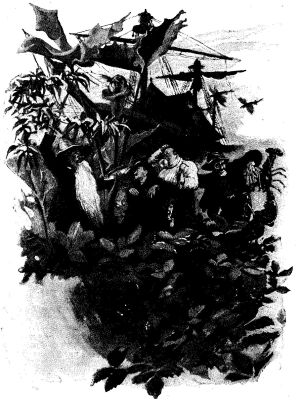
"A bluefish—a big fat six-pound bluefish. 'Name of grace!' sez Cap'n Peleg Mahoney, sez he; an' Willum Smitzer he sez, sez he, 'Donner und blitzen,' w'ich the same it are Dutch fur, 'Squalls to leeward.' Waal, them sailor-farmers they tuk us all over the farm an' showed us the mos' picooliar crops wot any one ever seed in this 'ere world, an' ye can see a good many queer things 'ere ef ye jess keep your weather eye a-liftin'. They had strawberry bushes wot gave boiled red snapper, an' potato beds w'ere they dug up mussels. The tomatter vines riz young lobsters, an' the cucumbers was eels. The cherry-trees gave shrimps, an' scollops growed onto gooseberry bushes. Then the other Cap'n axed us fur to go an' eat dinner with 'em aboard their ship farm-house. O' course we accepted. But afore we got half-way through the dinner we was all sick; cos w'y, everythin' tasted so all-fired fishy. Then the farmer Cap'n he got mad, an' sez he to we, sez he,
"'Ef ye don't like our grub ye can go back to yer own ship.'
"'Three beans,' sez Cap'n Peleg Mahoney, that bein' French fur 'Werry good.'
"'An' don't ye ever come here again,' sez the other Cap'n.
"'Nicht an sein leben,' sez Willum Smitzer, that bein' Dutch fur 'Not ef we knows ourselves.' An' with that we went over the side an' started fur home. An' them fellers throwed overripe strawberries an' termatters at us till we looked like cod-fishermen. We went back to our ship an' told our men about it, an' they sez that nex' day they was a-goin' over an' break up that farm. But 'twarn't so to be. In the night it came on to blow from the opposite quarter, an' the anchor watch called all han's, sayin', the ice—the land—the wotever ye call 't are a-breakin' up.' We all turned out an' found the ship in the water an' drivin' clear o' the stuff. We got sail on her an' hove her to, but she jess blowed away to leeward. In the mornin' we could make out the Saragossa Sea away up to windward, an' could see the tops o' them bluefish-trees a-wavin' in the gale; but we couldn't never git back there. An', my sons," added the Old Sailor, very solemnly, "I don't b'lieve that no other ships 'ceptin' the Ham Bone an' that farm-house ship are ever bin there."

Our discussion of National I.S.A.A.A.A. affairs last week was closed over the question of suitable grounds. As I said at the time, there are so many factors which enter into this that we should be careful about coming to a hasty conclusion, and whatever is said here on the subject should be understood as coming without prejudice. The grounds of the Columbia Oval do not seem to be so good, either from the point of view of the athlete or from that of the spectator, as those of the Berkeley Oval or Manhattan Field. I think that if the National games had been held at either of the latter places the crowd would have been three or four times as large. New-Yorkers are familiar with, and know how to reach, both Manhattan Field and the Berkeley Oval; but there are very few occasions that call them to the Columbia Oval. Many persons who are more or less interested in athletics might have gone to the Columbia Oval if they had known just where it was and just how to get there; but they did not go because so few athletic events are conducted at Williams Bridge that this class of spectators did not take the trouble to find out where the Columbia Oval is.
It is important to have as large a crowd as possible at a National Interscholastic meeting, and every effort should be made, therefore, to secure such a crowd. If we believe that a larger crowd would go to Manhattan Field or to the Berkeley Oval than to the Columbia Oval, we ought to have the National games at one of these two places, unless the expense of hiring the grounds puts them out of the question. It has become a sort of tradition in and around New York that the Berkeley Oval is the place to hold school and college sports. School and college sports have been held on the Oval almost exclusively for the past ten years, until this last spring, when the Intercollegiates went to Manhattan Field. The latter place, however, would not be the best one for interscholastic matches of any kind, for many reasons. No crowd that an interscholastic event could draw would ever fill those stands, and the expense of hiring Manhattan Field would doubtless be much greater than any interscholastic association could afford.
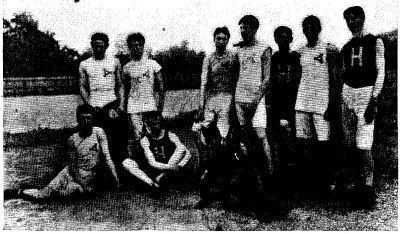
Ingalls. Bradin. Luce (Capt.). Strong. Wolfe. Morris. Blakeslee. Sturtevant. Condon. Brown. CONNECTICUT TEAM AT THE N.I.S.A.A. GAMES, 1896.
The Berkeley Oval, however, can be secured for less money for school games, because Dr. White is usually willing to meet school-boys half-way. Furthermore, the Berkeley Oval, although within the limits of New York city, is more or less in the country, and the atmosphere of the place savors less of professional baseball and horse-fairs. There is more of a lawn-party air about the Berkeley Oval than could be obtained under any conditions beneath the elevated railroad station at 155th Street, and there are lots of green trees and plenty of grass, and many other advantages which one associates with field days and similar events.
It may justly be said that for rural advantages the Columbia Oval can hardly be placed second to the Berkeley Oval; but there is a line to be drawn somewhere, even in rural advantages, and I think it is well to draw that line at climbing over stone walls in Williams Bridge. But this question of choice of grounds is so much entangled with the other question—that of having the games conducted by a club—that it is difficult, when discussing one, not to take the other into account. The school-boys ought not to criticise the convenience of the Columbia Oval when they consider that they were there by the courtesy of the Knickerbocker Athletic Club (which, by-the-way, is the name by which the New Manhattan Athletic Club is henceforth to be known).
It may be well to state, therefore, that whatever has been said in this Department about grounds for next year's National meeting has been said without any intention of reflecting in any way whatever upon the Knickerbocker Athletic Club's position at this year's meeting, and without any consideration whatever for what either Dr. White or Mr. Freedman may think of the advisability of leasing their grounds next season to the N.I.S.A.A. The question of advertising or of personal interest does not come into this discussion at all.
As to whether it is a good plan for the National games to be again conducted by a club, or by any organization other than the National Association itself, is a question that cannot be decided without the most careful thought and serious discussion. It was undoubtedly well to have the first meeting of the N.I.S.A.A.A.A. managed by a club, for if this had not been done, it is very probable that there would have been no field day at all, or, at best, an unsuccessful one.
There was considerable opposition among the school-boys of New York against having the Knickerbocker Athletic Club take charge of the event, and I know that there is considerable dissatisfaction now over the way the meet was conducted. The complaints, however, all come from those who took no part whatever in the contests, and who had no further interest in the games beyond being spectators; and their complaints, therefore, deserve but little attention. The question is not so much to find where the club fell short in its efforts, as to point out where matters may be mended on future occasions. If the Knickerbocker A.C. did not carry out the school-boys' ideas in the way the school-boys think this should have been done, or if they believe that they themselves can do better, they should attempt the entire management of the games next year.
It would be very much better, of course, not to have the games managed by a club, if the officers of the National Association could spare the time to look after the preliminary details of the meet. But there are so many other things that must take up the attention of school-boys in the spring months that it is difficult for them to spare the time necessary for the successful management of so great an undertaking as a National meet. We all of us recognize the fact that studies should come first. But after the studies there is always plenty of time, and there always should be plenty of time, for young men to indulge in other enterprises. It is good that they should have divers interests. It is excellent that they should go into the management of athletic organizations, and that they should indulge in sports of all kinds, for in both these pastimes they are gaining valuable experience,—experience which some people rank equal in importance with book knowledge.
It is usually the case, however, that the young men who are officers of the National Association are also officers of their own local athletic associations. This gives them double work. They have plenty of time to manage their own meets and field days, without being overburdened and without taking time from necessary work. But when they add to these responsibilities the management of a National Association, they are taking on considerable extra responsibility, and unless the particular young men have strong business capability, they are undertaking more than they can accomplish. It might be well, for this reason, that the officers of the National Association be chosen from men who hold no offices in their own associations. From a practical standpoint, however, this might not be a good plan, because the best workers and the men with the greatest executive ability are chosen as officials of the local associations, and it is most important that these men with the greatest executive ability should also be at the head of the National Association.
But there is another plan by which the National games might be managed without the assistance of a club, and if this plan could be successfully carried out, it would undoubtedly be better than any that I have as yet heard mentioned. It is the old idea of graduate assistance. In every city there are a number of college and school graduates who take a lively interest in the sports of the schools and the colleges, and who are always willing to give more or less of their time to the management of athletics. Up to the present time, in school athletics, this interest and assistance has largely been shown by the graduates acting as officials, because the management of the games has not been complicated enough to require their aid in the preliminary work. But in National matters it is different.
If the schools of New York, and the schools of Boston and Hartford and Philadelphia could get one or two graduates who would be willing to assist the Executive Committee of the National Association in the organization of the annual spring games, it is more than probable that the event could be made a greater athletic and social success than in any other manner. The graduates would have more experience in business affairs than the school-boys, and business men would probably be more willing to enter into contracts with the graduates than with the school committee—and I am sure, from my own experience when I was at school, that every scholar would much prefer to have the contracts undertaken by others who would be willing to assume all responsibilities.
By dividing the preliminary executive work between the Executive Committee from the schools and the graduate committee, no one would be overworked, and everything necessary to the success of the day would be done. This would be an ideal plan. The only trouble is to get the graduates. This is an obstacle that can be easily overcome if the search is begun at once. Mr. Evert Wendell, of this city, is a very good man to go to first. He has had wide experience in interscholastic matters, and there is no one who has better judgment than he in these affairs; and we all know that no graduate has given more time and more valuable assistance to school athletes than he has. He would undoubtedly be able to suggest the names of other gentlemen in other cities who would be willing to undertake to aid the Executive Committee of the National Association.
If it should be found that this plan could not be carried out, then it will be time to discuss the questions of club management and purely school-boy management, but until the other scheme has been found impossible, I think it would be well to keep it in mind. There is one more subject that this Department wishes to touch upon in connection with the National games, and that is the officials. But so much space has already been taken up this week with N.I.S.A.A.A.A. matters that the discussion of this question of officials will have to be postponed until next time.
The athletes of the Berkeley School may justly feel proud of the record they have made this year. They have taken every championship in the New York I.S.A.A.—football, track athletics, tennis, and baseball. In baseball the Berkeley nine was not defeated in any of the championship games; and in addition to this, the team secured a number of important victories over strong teams not in the League.
The result of the championship series is as follows:
First Section.Games Won.Games Lost.
De La Salle30
Barnard21
Cutler12
Condon03
Second Section.
Berkeley30
Columbia Grammar21
Trinity12
Hamilton03
The championship game between Berkeley School and De La Salle was won by the former.
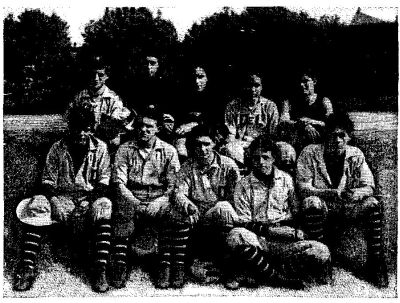
Williams. Groom. Baugh. Willing. Graves. Thackara. Fuller. Morris (Capt.). Seymour. Henry. DE LANCEY SCHOOL, PHILADELPHIA, BASEBALL TEAM.
The Berkeley nine was very strong in batting, its record being 107 base hits out of 214 times at bat, or a base hit every other time. The best individual batting average of the League, however, is held by Markell of Trinity—1000. His nearest rival is Hetzel of Barnard, whose average is 778, and the nearest Berkeley man to the top of the list is Wiley, who earned an average of 667. A number of players on the several teams secured an average of 1000 in fielding, but the best showing made by any individual was that of Gilchrist of De La Salle, who had 33 put-outs, 2 assists, and no errors. Berkeley's field-work was also very high, the average for the season being 924.
The Long Island championship went to St. Paul's again this year, although Brooklyn High-School and Adelphi both put up a strong fight—much stronger than they did last year. Brooklyn High finished second, and Poly. Prep., by making a strong brace, jumped into third place, the result being as follows:
Games Won.Games Lost.
St. Paul's50
Brooklyn High-School41
Poly. Prep.22
Pratt Institute22
Adelphi Academy14
Brooklyn Latin School05
The batting averages of the Long-Islanders are not so high as those made on this side of the river, the best being Griswold's of Pratt Institute—600. Higgins, also of Pratt, was a close second, his figures being 579. A Brooklyn High-School player, Mulvey, stands first on the list of fielding averages with 1000, his chances having been 54 put-outs and 1 assist, with, of course, no errors. Starr of St. Paul's comes very near to Mulvey, with 47 put-outs and 2 assists. The batting average of 500, made by Berkeley in the N.Y.I.S.B.B.A., is approached only as close as 301 by Pratt Institute, whose team made the best batting average in Brooklyn. Pratt made 50 base hits out of 166 times at bat; the winning team of St. Paul's made only 41 hits with 141 times at bat. St. Paul's, however, took first place in fielding average with 925, making only 12 errors out of 159 chances.
Englewood High-School took the championship of the Cook County (Illinois) High-School League at the annual field day held June 26. Out of a possible 141 points the winners scored 44, and the scores of the other contesting teams were as follows:
1sts.—5.2ds.—3.3ds.—1.Total.
Englewood56144
English High23524
Hyde Park23019
Lake View12011
South Division20111
Manual Training20212
Winnetka1016
Austin1005
Oak Park0114
La Grange0114
West Division0011
John Marshall0000
Jefferson0000
The feature of the occasion was the colossal mismanagement of everything. In the first place, the gentlemen who had been selected to act as officials were not notified of the day and hour of the games, and were consequently not on hand when the contestants and the crowd gathered at the grounds. It was some time before it was discovered that this was the reason why the officials did not appear. Then a professional sprinter, who happened to be training on the track, was called upon to act as starter, and a miscellaneous lot of men and boys were chosen from among the spectators to fill the remaining positions.
The result was, of course, to be anticipated. Few of the ready-made officials knew anything about the duties required of them, and so the professional became referee, judge, inspector, time-keeper, measurer, and marshal. The events dragged and dragged, and it was dark before the last one was finished. Under such conditions the performance credited to the young athletes cannot be looked upon with much confidence, although the published figures show a fairly good standard of attainment.
Several of the Association records were lowered. Bascom of South Division and Pingree of Hyde Park made the best individual showing of the day, each taking two firsts. Bascom won both the mile and the half-mile runs, and Pingree took the mile and five-mile bicycle events. Culver of Winnetka was responsible for all that went to his school. He won first place in the pole vault and third in the running broad jump.
Another interscholastic meet of considerable interest was that of the Washington High-Schools, which came off on the Georgetown College grounds a few weeks ago. The schools which sent teams were the Central, Eastern, Western, and Business High-Schools. Central won with 73 points out of a possible 88, having everything practically its own way. The Central representatives took first place in every event, and more than half the seconds. The best showing was made by Curtis, who took the low hurdles and the high jump; Stuart, who took the half and the mile; and Ruff, who got first in the 220 and the quarter. These Central High-School athletes of Washington are a promising lot.
In the table of performances made at the Pittsburgh Interscholastic A.A., published in Harper's Round Table No. 869, Bell, S.S.A., is credited with winning the half-mile run. This is an error; that event was taken by Atkinson of Park Institute. Atkinson was the only man entered from his school, and certainly ought to get the credit due him for his win.
"TRACK ATHLETICS IN DETAIL."—Illustrated.—8vo, Cloth, Ornamental, $1.25.
The Graduate.