THE TWELFTH-NIGHT PARTY.
Reading edition
BY EMMA J. GRAY.
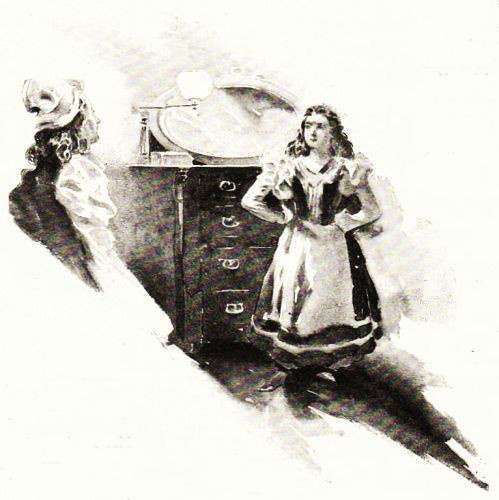
"Very jolly, isn't it?" was Bessie's criticism, as she gave a series of satisfied little pats to the skirt of her dress.
"Do you really think there is any one here we know?" was the reply.
"Why, of course there is! the costumes change everybody." But her friend Hortense looked bewildered, notwithstanding the hopeful words, as clouds of Valenciennes lace floated off down the stairs, and the two young girls were for a moment alone in the dressing-room.
"Bessie, you look fine! And how clever of your mother to get you up so awfully smart! I was simply horrified when I learned your character. For you're Maria, the waiting-woman, aren't you?"
"Yes; but mayn't waiting-women wear pretty clothes? This frock's only lawn, and cost thirty cents a yard."
"Bah! the price doesn't count; it's the color and the way it's made," said Hortense, walking off to more effectively study her friend's costume; and again came the words, more slowly this time, "Yes, you look fine; your dress seems a veritable French flower-bed."
"Who are you, Hortense?" and a wounded look came into Bessie's eyes, while she added, "I think you might have told me, since you knew who I was."
A light laugh followed, and then the words, "I'm ashamed of you if you cannot guess; surely you've read Twelfth-Night?"
"I have never read any of Shakespeare's plays; mamma thinks I'm not old enough. I don't believe half the children here have read it."
"Then how have they known the way to dress?"
"Their mothers or big sisters have told them, of course. I know what Twelfth-night means, for mamma explained that it was an old festival held twelve days after Christmas, and that it was a season of revels, dances, and the most comic of ludicrous games. I wish we got more fun out of our holidays. Mamma says when she was a girl Christmas used to last all the week. You know her home was away down South; and if people could spare time for a week's fun then, why can't they do so now? Besides, mamma told me many of the English people still keep festivities going from Christmas until Twelfth-night. I don't believe in letting England get ahead of us, even if she has the word 'merrie' tacked to her. When you came in, Hortense, I thought you were a boy, and wondered how you got into this room."
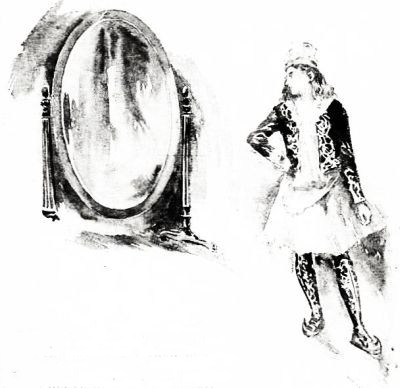
These words proved very amusing, and Hortense craned her neck haughtily while she promenaded before the pier-mirror, saying: "So I look like a boy, do I? Well, that's good; precisely the way I want to look, for I am a boy to-night; I'm personating Viola, and I may as well explain. She made believe she was a boy, and called herself Cesario, and got a lot of fun out of it too. So I'm really Viola, but call me Cesario."
They had just come to a Twelfth-night party, given by a dear friend two years their senior, and, as may be assumed, there had been considerable chattering between the knots of girls, assembled in recess hours, about their comical clothes; but there had also been considerable secrecy, as no one seemed very desirous to tell what she was going to wear; then, too, the boys were unusually quiet, and everybody wondered whether they were to dance, play games, or what was to be done anyway.
Therefore it was with a mixture of curiosity and satisfaction that these two young people descended the staircase. Curiosity, because they were sure of a surprise, no matter how things were arranged, and satisfaction, because, as has been stated, they were quite satisfied with their own and each other's appearance.
Having reached the last step of the stairs, they were met by a very magnificently attired young man, whom they had hitherto known as their hostess's big brother; but to-night he was no less a personage than the imperious Duke of Illyria. He asked each her name; and escorting Bessie in first, because she was the taller, he presented her to his sister as Maria, and immediately afterwards Hortense, as Viola, or the page Cesario. The hostess took the character of the Lady Olivia, and wore the apparel befitting the daughter of a wealthy duke. Her dress was white chiffon over white silk, and was spangled with gold dust. She wore a long necklace of pearls, and strings of pearls kept back her wavy though high-dressed hair.
Notwithstanding the fact that Hortense and Bessie were sure of each other for company, they did feel considerably confused at the singular strangeness of the scene, for the large rooms were filled with young people who seemed almost to have come from another world, so oddly were they attired; and they certainly were a part of another century, country, and station. For so carefully the costuming had been done, that, in fancy, the older people, who were the hostess's mother, father, and two great-aunts, could well believe they were living about the year 1600, and that they formed a part of a great pageant, that the Lord of Misrule was about somewhere, and William Shakespeare also, and that Christmas was a Christmas worth having this year, for it was lingering so long and so happily. Therefore, when the older people were so much impressed with the odd sight of children coming in Twelfth-Night costume, it was no wonder that the children were not a little awed until woke up first by the didos of the clown, and then by a party of revellers covered with white masks and dominoes, who fantastically capered and danced before them; then it was the awed feeling passed, and the spirit of wildest jollity followed. These revellers were none other than a dozen of the hostess's particular friends, whom she had prepared so to do.
None of the Twelfth-Night characters were missing—indeed, they were prominently conspicuous. Sir Andrew Ague-cheek, of whom Sir Toby said, "Thou art a scholar"; Malvolio, correctly yellow-stockinged and cross-gartered; my most exquisite Sir Topas; the two sea-captains, one the friend of Viola, and the other of her brother; the lost Sebastian; Feste, the clown; and lords, priests, officers, musicians, servants, and attendants.
So when all had at last arrived, the parlor was a rare and charming sight. Such a mixture of color and fantasy! Lavender, pink, and yellow silk hose; powdered hair, and as white, curled, or wavy wigs; velvet satin-lined short cloaks, velvet or silk knee-breeches; dark blue and white sailor's dress; navy-blue clothed and brass-buttoned sea-captains, scarlet and gold-buttoned officers, black-robed priests; Swiss-embroidered or lace flounces, trained velvets, white jackets, natty costumes, furbelows of all sorts; as also tambourines, banjos, mandolins, violins, and all the other musical instruments that formed a part of this altogether gay people that composed the dramatis personæ of Twelfth-Night.
The house was large and richly furnished, a proper setting for Olivia, daughter of a duke; to add to the grandeur and lavish beauty, rare plants and masses of flowers had been effectively placed. Yards and yards of evergreen and laurel were twined in and out and around staircase and fret-work. Holly and bay-leaves were wound most generously around pictures and over doorways; and mistletoe, the plant that the ancients bought from the Druids to wear about the neck to keep away the witches, was suspended from every chandelier.
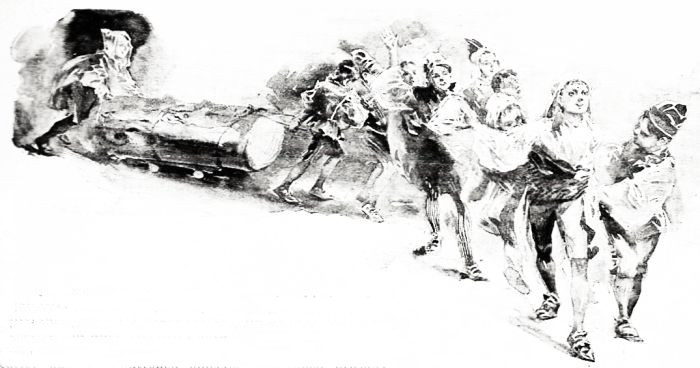
Early in the evening the sailors, sea-captains, and musicians disappeared, but with great hilarity soon returned, the sailors preceding, with the Captains at the head, drawing in the Yule-log. This was nothing more nor less than a rugged log, knotted at each end with long strong ropes, by which it was pulled. As they drew it, the sailors sang, the musicians accompanying:
"Welcome be ye that are here, Welcome all, and make good cheer; Welcome all another year, Welcome Yule."
And this verse was sung over and over, until the Yule-log lay on the hearth-stone.
Of course all the children who were not on their feet at its entrance rose to receive it; and even the older people's voices joined with the others as the verse, being repeated over and over again, closed with all singing "Welcome Yule."
This song was followed by the masked game of "Twelfth-night Pie."
Two people—a boy and girl—each in grotesque apparel and with masked faces, walked in, rolling before them, on a wheelbarrow, an enormous pie. It was made after the fashion of a Jack Horner pie, being in a deep dish covered with diamond-dusted white paper, with tiny ribbons exposed.
The first performance was to roll the pie all around the room, and then to the centre, where the boy and girl sang:
"Who'll have a bird from this Twelfth-night pie? Whoever guesses me may answer, I."
After this there was solemn stillness until the names were guessed; then the couple unmasked. The correct guesser then drew a ribbon; it proved to bring out a robin red-breast made of candy and stuffed with sugar-plums. As soon as the person drew it, the boy who rolled the barrow imitated a bird-song on a harmonica. This was easily effected, as it was the girl who presented the pie, and engaged the attention of the individual who was drawing; and, indeed, every one in the room was watching what was drawn, and therefore the boy for the moment was forgotten. He made believe something had been dropped, and, getting down back of the girl, sang at the time the bird was drawn, without detection. Ten of the others drew in a similar manner, the first ten to the right of the guesser; but the boy did not sing, except when he stood no chance of being caught.
"This would be good fun for New-Year's night," said Hortense to the boy standing next to her.
"Good fun for any time, I should say."
The next game was called "The Messenger-Boy."
One of the girls, stepping up to the wall, pretended she was talking through a telephone and wanted a messenger-boy. In a few seconds a bell was heard, and the boy, having arrived, was ushered into the parlor. The boy had left the room before the game commenced.
The players were seated when the messenger entered. He said to the girl,
"I was ordered to come to you."
"Yes, I'm waiting."
"What for?"
"For you to do as I do."
Then the girl nodded her head, the messenger then nodded his head, and the girl, turning to her right-hand neighbor, said, "Do as I do."
This party then repeated the same words to her right-hand neighbor, and so on, until everybody was nodding. And so they continued from nodding to rocking until every one was laughing uproariously, and the game was obliged to end. The evening was an undeniable success.