OUR SUBMARINE TORPEDO-BOAT.
Reading edition
BY FRANKLIN MATTHEWS.
Within a year the United States will have a submarine torpedo-boat. It will be 80 feet long and 11 feet in diameter. It will use steam when running on the surface of the water, and when running under water it will use electricity. It will be capable of going nearly nine miles an hour under water for six hours. On the surface of the water the boat will be able to go just twice as fast. When running "awash," that is, with only a small turret sticking out of the water, the speed will be only one knot an hour slower than when running on the surface.
The submarine boat, as well as most of the other boats of a like character that have been experimented with for nearly 300 years, should more properly be called a diving-boat. Its purpose is to duck under water and remain there as long as may be necessary when its own safety is in danger. When it engages in a fight, it will begin its work by a series of dives before discharging one of its five torpedoes from the bow. Much as a stone may be made to go skipping across the top of the water, so this boat may be made to skip along underneath the water, coming occasionally to the top. Although it will remain underneath the water only six hours without coming up when it is being worked at its full capacity, it will be able to remain under the water for several days if it is simply necessary to keep out of sight for a long time. As fast as fresh air is needed a float with a hose attached is released, and when it reaches the surface of the water the electric motors suck down enough air in a few minutes to fill the tanks again, and the stay may be prolonged until the supply of water and provisions gives out.
The boat is known as the Holland submarine boat, because it is the invention of Mr. John P. Holland, who has been studying this problem for more than twenty years. In his experiments he has gone under water, for a stay of from a few minutes to several hours, more than fifty times. In spite of discouragements that would have made many a man give up, Mr. Holland kept on, until he convinced the government that his boat was not only feasible, but an absolutely necessary article in the equipment of an up-to-date navy. Other countries have submarine boats, but none of the boats has been fully successful; and if this vessel will really accomplish what it is expected to do, the United States will again show the world that it excels in naval ship-building.
The use of electricity in propelling boats and the power to compress air in tanks makes navigation under water a comparatively simple matter. Remaining under water is the easiest part of the task required of a submarine torpedo-boat. The essential things are that the boat must be speedy in diving and in coming to the surface, that some means of steering accurately must be devised, that the boat must be kept at a certain level in the water, that it must have good speed under the water, and that it must be able to discharge torpedoes safely under vessels which it is attacking. If the vessel is successful it will solve the problem of harbor defence, for no fleet would dare venture into a harbor knowing that one of these submarine boats was on guard.
TAKING AN OBSERVATION OF THE ENEMY'S FLEET.
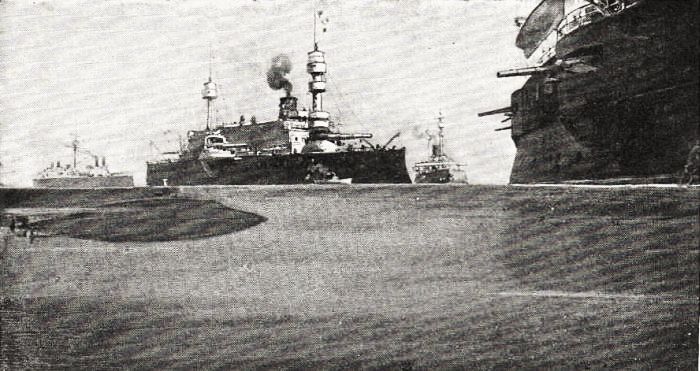
Every boat, no matter what its object, must have a certain amount of buoyancy to make it float. This vessel has the usual amount for one of its size. In its hold are a certain number of air-tanks, in which are stored 30 cubic feet of compressed air at a pressure of 2000 pounds to the square inch. There are also 620 electric storage batteries for propelling the ship when the steam is shut off under water. Let us take the little vessel under water. We have been running along under steam on the surface and have seen the enemy. All the hatches are closed water-tight, and the Captain goes into a little armored turret. He gives the word to run awash. At once the valves in the bottom of the boat are opened, and certain apartments are allowed to fill with water. This sinks the boat at once so that only the turret is visible. The enemy is near and has seen us. It is necessary to dive. Quickly the word is given, and the smoke-stack is dropped down into the ship and a thick plate is clamped over it. The fires are banked, and the engine is disconnected from the screw, and the electric power is attached. An indicator tells the depth we have reached, and then the mechanism is set at the required depth, and we are soon skimming along under the water in absolute safety. The air in the tanks is being released as fast as we need a fresh supply, and we are dry and comfortable.
DAVID STRIKING GOLIATH.
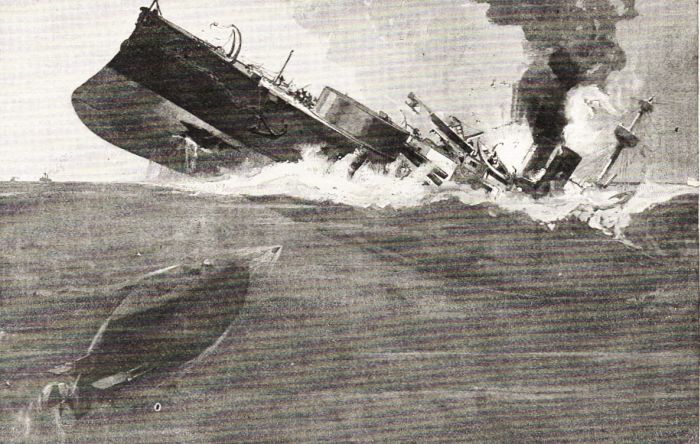
The Captain decides that he wants to look around. He steers the boat up to within four feet of the surface, and then he pokes up out of the water what looks like a stove-pipe. Its real name is a "camera lucida." It is an arrangement whereby those inside the turret can get a good look around by means of mirrors. The Captain decides to go under again, and makes for his target. He is soon passing under a ship. The darkened water tells us so. He makes a short turn, or stops, and then backs away and gives a signal to discharge a torpedo. It leaves the boat with a rush, and in a few seconds there is a muffled roar. A great war-ship has been struck. It lurches and staggers. Pandemonium reigns on it, the order is given for every man to save himself, and in less than five minutes after the torpedo has been discharged a five-million-dollar battle-ship, the most powerful engine of destruction man ever made, is lying at the bottom of the channel, and the enemy has received a mortal blow. We come up to look around again. David has struck Goliath with a stone in the forehead and killed him.
How is the diving done? If you will look at the boat you will see at the stern two horizontal rudders. They stick out behind like the feet of a swan as it swims about a lake. When it is necessary to dive, these flat rudders are tipped down in the rear, and the ship is forced under at the bow at an inclination. When the required depth is reached the rudders are flattened out, so to speak, or held at the inclination to keep the vessel on an even keel, the tanks having been filled to overcome all but a very small reserve buoyancy. An automatic arrangement allows the water to press on a rubber diaphragm, and keeps the boat at an even depth. It is a great problem, however, to steer absolutely straight. It has been found that under water the mariner's compass is not trustworthy. Mr. Holland devised an ingenious arrangement to overcome this. There is a triangular drag floating just above the diving-rudders. It is necessary, when the boat is running on the surface, to put it on the exact course it is to follow just before the dive is made. The rudders are tipped, and then this drag comes into play. If the boat veers to the right or left this drag sways to the opposite side. It is so arranged that it works a lever that at once swings the steering-rudder of the ship to the side that will bring the boat straight on its course again.
Suppose, now, it is necessary to come to the top of the water at once, without waiting for the diving-rudders to steer us up. The compressed-air tanks can expel nearly twenty tons of water from the tanks at the bottom of the vessel in about two minutes, and the boat will rush to the top at once. Here is where the matter of buoyancy comes in. A problem that has also been solved in this boat is the ability to remain stationary at a certain depth under water. There is an anchor which is run from a drum at the bottom of the boat near the bow, and it will hold the boat in any position independent of current or tide. If it is desirable to remain in one position, and not at anchor, we must use two little "down-haul" screws. They are little screws such as propel a ship at the stern. An electric dynamo is set going, and these screws are turned in a horizontal position, and the small reserve buoyancy in the boat, amounting only to about 375 pounds, is overcome. When we are running under water the slight dip of the diving-rudders keeps us at the required depth.
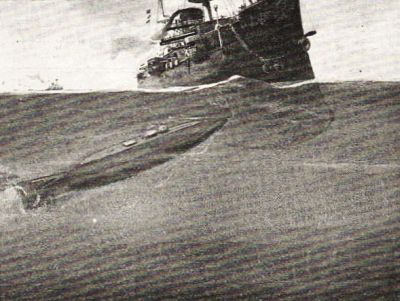
RAMMING A MAN-OF-WAR.
There have been several devices to make a vessel go under water. The oldest, perhaps, has been the sudden filling of tanks by allowing the water to rush in. The water has to be expelled by air pressure. This method of diving and coming up consists of a series of bumping motions, and is very crude. Another method used was by "down-haul" screws. These were turned, and they simply bored holes in the water, like an auger in a board, and the boat had to go down in the water. After the boat got down there was no satisfactory way of regulating the depth, and the rise to the surface was always too abrupt. Propelling the boats under water until recently has been an unsolved problem. Sometimes chemicals have been used, and sometimes the stored-up heat of the engine has been tried. Electricity has solved this problem, and made it possible to stay under water six hours going at full speed. During this time the boat can go fully fifty miles without once coming to the surface. Should any accident occur, each member of the crew is supplied with a life-saving helmet, which is easy of adjustment, and by means of which he may float to the surface of the water in safety. A folding rubber boat may also be carried in the super-structure of the craft, so that there is very little danger of loss of life under the water. Mr. Holland has explored all New York Harbor, and he says that ladies have often asked him to take them down in his experimental boats.
The facility with which this vessel will do its work may be judged from the fact that when running on the surface of the water it can dive to a depth of twenty-five feet in twenty seconds. When running awash it can dive to a depth of twenty-five feet in ten seconds. It can come up as quickly as it goes down. It is supposed that the vessel will never need to go any deeper than forty feet, and having the ability to dive when attacked it will carry no guns.
Mr. Holland was a young man in Ireland during our civil war. He studied engineering, and was especially interested in the submarine boat that the Confederates used with considerable success, but with great loss of life to themselves, in the war. The splendid ship Housatonic of our navy was sunk off Charleston, South Carolina, by one of these boats. Mr. Holland came here in 1873, and two years later made his first experiment in going under water. He has kept at it ever since, and more than once has he given the pilots and skippers of New York Harbor a scare by suddenly causing to come to the top of the water some sort of a sea monster, the like of which no one ever dreamed, and the appearance of which could not be explained. One of Mr. Holland's boats was popularly known as the "Fenian ram," because he was practising in it in New York Harbor about the time of the celebrated Fenian uprising. He has lost one or two boats by the mistakes of some of his helpers, and on more than one occasion he has been in a ticklish situation, but he always came out all right, and finally mastered all the intricate problems connected with submarine navigation—problems that have engaged scores of men ever since Drebbell, a Dutchman, first tried the experiment in the time of James I. of England.
The first partly successful boat of this kind seems to have been made in the time of our revolutionary war by a man named Bushnell, who lived in Maine. The boat could remain under water for half an hour, but the scheme of building them came to nothing. It will surprise most persons, probably, to know that the first really successful boat was made by our own Robert Fulton, the famous steamboat engineer. It was in 1800, and Fulton showed it to Napoleon Bonaparte in the harbor of Havre in 1801. He went down twenty-five feet in it, and remained there for one hour. Then he went down with four persons, and remained four hours. Compressed air was used for respiration in this boat. Various improvements have been made from that time to this. The crude boats of the civil war were displaced in the late seventies and eighties by those of fairly satisfactory working arrangements, and the Russian, French, and Turkish governments have built several, but they have lacked complete mastery of the problem of under-water navigation, such as this boat that we are now building is expected to display. By next summer the boat will probably be in service.
If the boat is successful it may make as great a revolution in naval warfare as the famous Monitor, built by Mr. Ericsson, did in the war of 1861. For what battle-ship would be proof against it? The biggest of all battle-ships would only sink quicker than smaller ones, and huge war-ships of all kinds would be nothing more than death-traps for all those aboard them. Another question of great importance is whether the guns of war-ships can be tipped sufficiently to strike the boat when it is anywhere near.