THE PROPOSED TRIP TO THE NORTH POLE.
Reading edition
BY WILFRID DE FOUVIELLE.
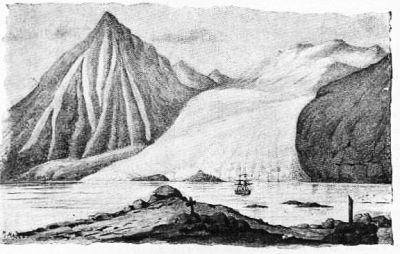
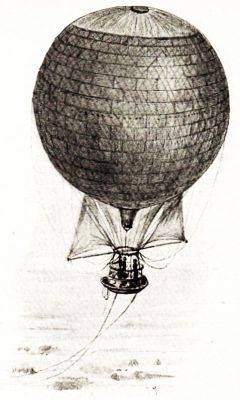
Twelve months have scarcely elapsed since Mr. Andrée, the Swedish balloonist, first published the details of his scheme for reaching the North Pole by the smooth and easy but crooked paths of cloudland. During this short period the clever and hardy aeronaut has had his proposals favorably received by the Swedish and French academies of sciences, and obtained the $36,000 required for his purpose from King Oscar, Mr. Nobel, and the Baron Oscar Dickson. Mr. Andrée has travelled all over Europe to consult the most competent specialists, and has completed all his preparations for the transportation of his huge balloon from Paris, where it is being constructed, to Spitzbergen early next May. The start will be made some time in July or at the beginning of August from Norskoärna, a small rocky and snowy archipelago situated on the northwestern coast of Spitzbergen, and the most accessible part of this famous territory. Norskoärna is almost under the eightieth parallel, and although sad and even grim in aspect, this remote spot will prove a convenient station for the departure, as the distance to the North Pole is only about 600 miles. Mr. Andrée's balloon, which will be called The Northern Pole, is to be made of triple French varnished silk, having a resistance of 250 pounds to the linear inch. It contains 130,000 cubic feet, and has a lifting power of more than 10,000 pounds. Besides the car and its three occupants—Messrs. Andrée, Ekholm, and Strindberg—the balloon will be supplied with scientific apparatus and 2000 prepared photographic plates, in charge of Dr. Strindberg. The Northern Pole will not carry sand for ballast, but use its large quantity of stores for throwing out in case of need. At Norskoärna the balloon can be kept waiting any length of time for a favorable wind. Held in place by sixteen tackles attached to the rocky soil, and connected by a system of ropes and pulleys with the whole netting, it can laugh at all the efforts of the strongest gale, and remain there for weeks ready for immediate despatch.
GRAPHIC PLAN OF THE NORTH POLE. 1. Spitzbergen 2. Franz Josef Land. 3. Asia. 4. North America. 5. Greenland. + North Pole.
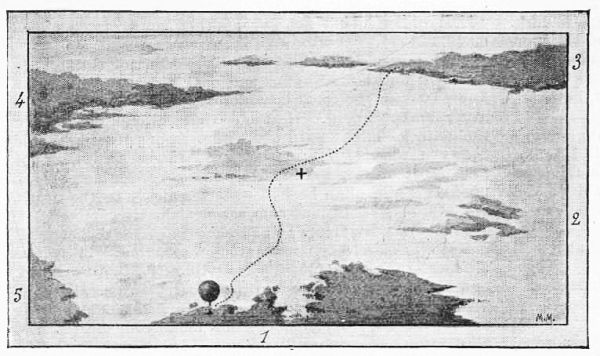
Mr. Nils Ekholm, the celebrated meteorologist of Upsal University, will give the signal for the departure of this fearless expedition. This signal will not be given until Mr. Ekholm finds a northern breeze blowing briskly and with all the known signs of permanency—a frequent occurrence, however, in those regions and in such a season. As a professional aeronaut, I may be allowed to say that Mr. Ekholm will not be mistaken in his prognostications, and that, once started, Mr. Andrée's aerial craft will be carried away for hours in the direction of the North Pole. It would be almost unreasonable to hope that the aerial travellers will float exactly above the foremost point of our globe from the tropics. It would be enough for Mr. Andrée to make such a nearing as would enable him to bring back to civilization hundreds or thousands of photographs recording all the features of those unattainable regions. His most ambitious desires will be wholly satisfied, I am sure, if he obtains a clear view of the rocky mountains that Lieutenant Peary is said to have seen from the top of the Greenland glaciers on a far distant horizon.
SPITZBERGEN, THE STARTING-POINT.
For my own part, I believe that the three aerial explorers will have no difficulty in running the greater part of the 600 miles separating Norskoärna from the North Pole. If by some unaccountable misfortune there should be a notable change in the moving paths of cloudland, it is certain that Mr. Andrée will be able to direct his balloon in a suitable siding. Then he will resort to his ingenious combination of guide-roping and sailing which I described in a previous article. Since his first trial, in 1894, he has realized great improvements, as will be seen by comparing the aspect of his new balloon with that of the Swea sailing above the Swedish lake country, already published in Harper's Round Table. Instead of using only one medium-sized guide-rope, he will drag in the Polar solitudes not less than three heavy hemp lines. With the aid of these gigantic and ponderous guide-ropes, each one measuring 1200 feet and weighing 600 pounds, he can set three sails, supplied with yards and moved by rigging, and attached to the upper part of the balloon, independent of the netting, so that they may receive their full expanse. Their total surface amounts to more than 700 square feet, and they will, if skilfully managed, impart a remarkable deviating power to the balloon. So The Northern Pole will skip along like a sailing-craft with a stern wind.
THE COURSE OF THE SUN IN THE ARCTIC REGIONS.
It must be remembered that in summer-time the winds and storms of the North Pole are far less treacherous than those of the most attractive parts of the tropical, or even those of the temperate zones. The north polar regions are never visited by cyclones or thunder. The only danger to be encountered is a slight fall of snow, not more than four or five inches in the whole season. For meeting this almost trivial danger Mr. Andrée has had the upper part of his balloon covered with a silk canvas, so that the meshes of the net will be free from any accumulation of falling snowflakes.
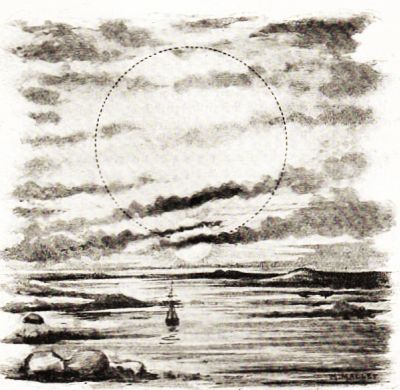
In the desolate northern lands the sun is a trusty friend to the aeronaut. By constantly shining over the horizon during a number of months he develops almost a comfortable degree of heat, while without any intermission during the twenty-four hours of each day he supplies a sufficient quantity of light for all photographic purposes. In the mean time, owing to his moderate altitude, even when he crosses the meridian line at noon, he is never elevating the unfortunuate aeronaut against his will to a dangerous distance from the more than half-frozen soil.
The NORTHERN POLE.
The real difficulty is for the balloon, loaded with numberless precious documents, to find its way out before winter sets in with its long cold nights and horrors. This exit must be made at any cost by directing the balloon into a wind tending to some part of the south. Mr. Andrée will certainly not pay attention to the geographical position of the spot where he is to alight. He will not care whether he lands on land or on sea. It will make no difference to him whether he sets foot on rocks or on cracking ice. He will trust equally to the frozen Atlantic or to the congelated Pacific if he can descend from cloudland above the horizon of a whaler. Russia, Siberia, Alaska, or the Northern Dominions are as good as his own country, if it is not beyond his power to reach some locality inhabited by Esquimos, Laplanders, or Samoyeds. The main point is to see The Northern Pole afloat for a long period, say a month. At all events, Mr. Ekholm calculates that the balloon will remain in the air at least fifteen or twenty days, and that during this time it will have passed over a distance of nearly four thousand miles.
In order to be quite sure to navigate in the atmosphere twelve times longer than any aeronautical run performed up to the present day (the thirty-six hours' voyage made in 1892 by M. Maurice Mallet, who has drawn the accompanying sketches), Mr. Andrée is having his balloon made absolutely impermeable, of the best and most costly material, with a new varnish and exceptional sewing. He has replaced even the usual valve at the top by two others a great deal smaller and fixed to the equator of the balloon, to be used only for ordinary manœuvres during the prolongation of the voyage, for he is determined not to make any pause, decided to fall from cloudland like a thunderbolt to the very spot selected by instantly opening his monstrous sphere with a tearing rope, to which will be attached a dagger for the grand and final moment.