HARPER'S PERIODICALS.
Reading edition
Postage free to all subscribers in the United States, Canada, and Mexico.
HARPER'S MAGAZINEper Year,$4.00
HARPER'S WEEKLY"4.00
HARPER'S BAZAR"4.00
HARPER'S ROUND TABLE"2.00
Booksellers and Postmasters usually receive Subscriptions. Subscriptions sent direct to the publishers should be accompanied by Post-office Money Order or Draft. When no time is specified, Subscriptions will begin with the current Number.
HARPER & BROTHERS, NEW YORK CITY, N. Y.


To Young Artists.
The Table offered prizes for best stories written by members under eighteen. The first-prize story is to be illustrated. Do you want to try to illustrate it? If so, write at once for a proof of the story. With the proof we send suggestions about size. You select any incident in the story, make your drawing, and return same to us. For the best illustration we offer $10.
If you send for proof, and then find yourself unable to make a drawing satisfactory to yourself, you can then retire from the contest merely by failing to forward a drawing. That is, you incur no obligation to submit a drawing. There are already about ten who are to try their talents. There is room for more. We print prize drawing and prize story together, provided, of course, that we receive a creditable illustration. You would not expect us to print one that was not so, even if it were the best we received.
"Voyage of Discovery" Awards.
The Table offered to divide $50 in money among the ten members of the Order who sent that number of best answers to twenty-seven questions which were written into jingle descriptive of a Journey taken by the "three wise men of Gotham who went to sea in a bowl." There were some riddles in the story, as that at a certain hotel in France the party wasgiven a queer dish, described in a charade. But most of the questions were such as these: "'Find a writer's tool in a Danish port"—Co-pen(17)-hagen—and "convenient coin in a Russian mart"—Ar-change(13)-l. Here are all the answers:
1, La-brad-or and Winni-peg; 2, Ba-ham-a; 3, Au-gust-a; 4, Hi-malay-a; 5, Cam-peach-y; 6, La-dog-a; 7, C-hin-a; 8, Arti-choke; 9, Pen-saco-la; 10, Ar-chip-elago; 11, S-imp-lon and Little Saint Bernard (dog); 13, Mada-gas-car; 14, C-helm-sford; 15, K-hart-oum; 16, Draft, Draught, Draft; 18, Mis-sou-ri; 19, Ma-rat-hon; 20, Co-top-axi; 21, Cotop-ax-i; 22, Wis-Cass-et, Franklin-ville, Lincoln-ville, and Pitt-ston; 23, C-asp-ian; 24, As-par-a-gus; 25, Tar-sus and Man-Chester; 26, Villa-franc-a; and 27, Wig-ht.
Three solvers found all of the answers, and we send them, with our congratulations, $7 each. Their names are: Paul B. Pitkin, Ohio; and Frederic W. Darling and Joslyn Z. Smith, New York. Margaret Fendall James, New Jersey, erred in one question, but she gave a better answered six others of the best ten, and we send her $5. The following six failed on one question each—not always the same one—and we award them $4 each: Mary G. Smith, Minnesota; Arthur M. Anderson, New Jersey; William C. Thayer, Michigan; Edith Starr Churchman, New Jersey; Gertrude G. Wilcox, Massachusetts; and Louise McKinney, Florida.
Winners who live near New York are asked to wait a few days for their prizes, to give time for this number to reach distant competitors. It is most pleasant for all to see awards in the paper, and hardly fair if some know in advance, as they would do were we to send prizes in advance of the paper's publication.
A Visit to a Mountain Palace.
One glorious September morning found us all awake bright and early, for at last, the day of our long-talked-of trip to Biltmore had arrived. Just as the sun rose from behind Glassy Mountain with merry good-byes we climbed into our coach, and rolled away down the avenue. The few miles from "Clovernook" to the queer little place called Buena Vista were soon covered, and we got a view of Asheville. But my eager eyes sought Biltmore. Miles away, up on the mountain-top, I caught a glimpse of gleaming white towers—the palace in the mountains.
We drove into the town of Biltmore, which, when finished, will seem like one of those cities built by the old kings for their amusement. On one side of the way costly buildings surrounded by asphalt walks and gardens; on the other side, manufacturing concerns. A turn in the road brought miles of the estate in view. Everywhere we looked hundreds of men were at work. Over the grassy hills roam the fine cattle, and here is the dairy farm, and there the nursery. At this point we came into the grand drive, which is only half completed. Trees of every variety border it.
Frowning down on us from a great height was what seemed to be a castle on the Rhine, vine-clad and impressive. By the winding road we reached the farther side of the palace; driving through a massive stone-vaulted hallway, on either side of which are the elegant stables, we passed out into a circular court. Across this and through another archway, and a palace of great architectural beauty rose before us. I was dazed at first, and can only remember a few things. The house seems to rise up around a semi-court paved in marble, in the centre of which is a fountain from Pompeii. The walls are carved in life-size statues. Dragons appear to hiss at us from above. Italian sculptors are at work everywhere. Even the ceilings are being carved in some rooms. My attention was called to a grand pavilion and terrace opposite the gardens, guarded by huge Assyrian monsters. Up marble steps and along another pavilion we could see the west side of the place. It reminded me of the Chateau of Chantilly, with its marble terrace and steps leading down to an arbor. Steps on the right lead to the greenhouses and gardens; to the left, beautiful little lakes.
The scenery from here is most beautiful. There are mountains for fifty miles around. At our feet the Swannanoa and French Broad rivers meet. No trees surround the palace. Mr. Vanderbilt expects to make this a winter house and wants the sunshine. I have built my "castles in the air," and just before we started homeward, as I stood there drinking in the beauty, I wondered if Mr. Vanderbilt dreamed in his boyhood days of such a place. We all dream, I suppose, but few can realize our dreams. At ten o'clock, we reached what now seemed plain "Clovernook." It looked so bright and homelike that we sang from our hearts—
"'Mid pleasures and palaces though we may roam, Be it ever so humble, there's no place like home."
May Inman Maguire. Hendersonville, N. C.
The Helping Hand.
The example of "Billy" is producing results. Following him comes "Sancho Panza," who sends, by the hand of his mistress, 25 cents, and "hopes everybody is as much interested as I am." Sancho Panza is a Yankee dog, at least he lives in Connecticut. Not to be behind him, here comes word from Washington:
"Two of us, Dick (the canary) and Polly (the parrot), are great travellers, as we have been out to St. Louis, Mo., St. Paul, Minn., and a great many towns and cities on the Mississippi River; we have also been in Massachusetts, New York, Virginia, and are now living in the District of Columbia, but hope to travel a great deal more, as the father of our master and mistress is a naval officer, and naval officers, you know, travel a great deal. We three little Paradise fish, Tom, Dick, and Harry, are new members of the family, so we have not travelled as Dick and Polly have, but hope to some day. We each send you a dime, and our master and mistress send a quarter each, making $1 in all."
"Bruno Morgan," who is a greyhound and lives in New York, sends 50 cents. Antonio France, another Connecticut "Yankee," who says he has no tail, sends 10 cents and his mistress 10 more, and "Midget" a like sum all the way from Nebraska. But "Midget," is a pony who says:
"I have a great many friends who are not so well provided for. I see so many of them whipped and overworked and shouted at by cross, impatient drivers, who, I am sure, if they were brought up at Good Will Farm, where Bow-wow Billy says they have established a Band of Mercy, would never, I know, no matter how discouraged or ill-natured they might feel, vent their anger on us defenceless creatures. I want more boys brought up at this Good Will Farm, where they think of animals and treat them kindly."
Danbury and Its Hats.
Hatting is the leading occupation of the people of Danbury. This has been an occupation for at least a century, and now Danbury is probably the largest hatting town in the country. The factories, too, are extensive, and almost every manufacturer has a salesroom in every important city. All kinds of hats are manufactured—soft, stiff, and straw. We have fur factories, one of which has branches in Mexico, Canada, Great Britain, and other countries.
We have also silk manufactories, woollen-goods manufactories, and a machine-shop. Recently a Danburian invented a trolley that would be run by power passing through the tracks, thus doing away with overhanging wires. If this proves a success, Danbury will have a new industry, as all of the cars will be made here. We have, besides these manufactories, two stock-farms which have gained national notoriety. One, the Ridgewood, owns the famous horse Quartermaster, which has gained several Blue Ribbons at the National Horse Show in New York. Quartermarch is another horse of that farm which has gained several prizes, one of which was at the Grange Show, I think it is, of Orange, N. J. The other, Bekerle's, owns several famous horses. One was sold to the Emperor of Germany recently. May I write about a hat factory?
Robert Bulkeley, K.R.T. Danbury.
Yes, and tell us just how hats are made, especially the felt of the stiff-crown ones.
Kingsman, Arizona, December 30, 1896.
Editor Harper's Round Table:
Dear Sir,—I wish to make a slight correction in my letter entitled "How Tortillas are Made." It should be yeast powder instead of yeast.
Very truly, Florence E. Cowan.
Questions and Answers.
Sir Knight W. D. Olmsted, 19 Orange Street, Worcester, Mass., asks to insert the following: "Will all who have sent stamps to addresses in the 'Want Corner,' and who have never heard from them again, please send me their address and a stamp or postal card for reply. Also send name of person to whom you sent the stamps, together with their address, value of stamps, and date of sending." First sergeants of companies A, B, etc., at West Point and in military companies rank alike. David Blondheim, 306 North Howard Street, Baltimore, Md., wants some correspondents. The charge made by the publishers for the cover of Harper's Round Table is fifty cents, post-paid. Any bookbinder can put it on. His charge is usually $1.
John G. Saxe, 171 West 132d Street, New York, wants to buy a copy of Harper's Young People for November 27, 1894. Write him. John H. Campbell, Jun., 413 School Lane, Germantown, Philadelphia, Pa., is, with two others, to begin in February the publication of The Keystone Monthly. Its price will be twenty-five cents a year, and for a limited time sample copies will be sent free. Original stories, poems, jingles, and letters to the editor are wanted. No pay for such contributions is offered, the paper being an amateur one. A. B. G., Jun.: Get Mort d'Arthur, through any bookseller or at the library, for references in the study of King Arthur, his Knights, and Round Table.
Amateur Soldier: At present enlistments in the regular army of the United States are suspended, the service having its complement of men. But this is only a temporary condition. Enlistments will begin again soon. Boys between sixteen and eighteen years of age may, with the consent of their parents, enlist as musicians; eighteen to twenty-one, with consent of parents, as regulars; over twenty-one, without consent of parents. The lad of sixteen who begins as a musician stands just as good chance of promotion as the older person who enlists a little later. Indeed, in many instances, if he be bright and faithful, he stands a better chance. The pay is $13 per month, and the enlistment for three years; but one may purchase his discharge at the end of one year by paying $120. Fannie E. May, Lee, Mass., is most desirous of obtaining the address of Edith A. Putnam. Will the latter write her?
This Department is conducted in the interest of stamp and coin collectors, and the Editor will be pleased to answer any question on these subjects so far as possible. Correspondents should address Editor Stamp Department.
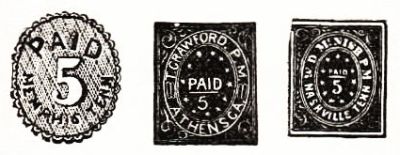
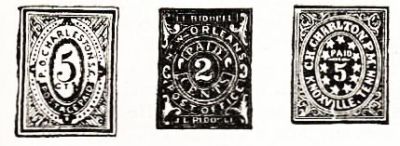
In the Round Table for December 10, 1895, the stamps issued by the general government of the Confederate States were illustrated in reduced form. This week I give the first instalment of the "Confederate Locals," all of which are either scarce or rare. Counterfeits abound, however, and the wise collector will take expert advice before parting with his money. As a rule, collectors prefer to buy these stamps on the original envelope, and the prices given below are those asked by dealers for copies in good condition:
Athens, Ga., $35 to $100.
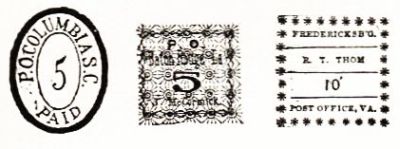
Baton Rouge, La., large size, $50 to $70; small size, $100. (The 2c. and 10c. stamps are not generally accepted as genuine.)
Charleston, S.C., $10 to $15. Envelope stamps, four varieties, $10 to $15.
Columbia, S.C., $15 to $20. This is an envelope only.
Fredericksburg, Va., $7.50 to $20. (10c. stamp, $20 to $30.)
Knoxville, Tenn., $20 to $25. The embossed envelope is worth from $50 to $100.
Nashville, Tenn., 3c., $3.50 to $20; 5c., $15 to $30; 10c., $50 to $100.
Mobile, Ala., 2c., $25 to $35; 5c., $3 to $6.
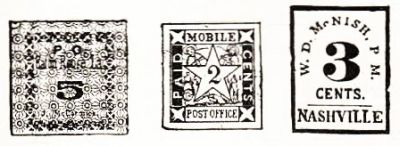
New Orleans, La., 2c. blue on white, $2 to $5; 2c. red on white, $2 to $6; 5c. brown on white or blue, $1 to $5; 5c. brilliant red on blue or white paper, $250 to $400. The so-called reprints of the New Orleans stamps are simply counterfeits.
Philatus.
There is a "comfortable feeling" that comes after a bath with Ivory Soap.