THE REMARKABLE ADVENTURES OF SANDBOYS.
Reading edition
BY JOHN KENDRICK BANGS.
THE LOST RING.
The boys had been discussing with Sandboys on the subject of fish and their habits, and, as usual, the bell-boy was full of information in that connection which he was willing to impart to his happy listeners. They found it hard to believe that sometimes, at the breaking up of winter, Sandboys had with his own eyes seen trout flop out of the lake and climb the bank after a worm that had come out of winter-quarters to rest for a little in the sun, but they did believe it, because he said it was so.
"I don't say that it's a reg'lar fixed habit of theirs, mind you," he added, as if he had no wish to deceive the boys into thinking that trout always behaved this way. "It's only occasionally you'll find a trout that'll do it, and then it's because he's so fearful hungry that he takes a risk. If it was a reg'lar fixed habit, catchin' trout'd be easy work. With a few decoy worms set around the banks o' the lake you could just sit down and wait till they came floppin' out after 'em, and then club 'em over the head with a tennis-racket or a cane. But it ain't, and you might wait a thousand years and never have the luck to see it."
"I'm rather surprised to hear that even one of them has ever done it," said Jack. "I always had an idea trout were shy, timid creatures."
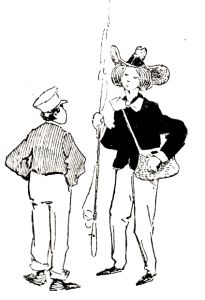
"That's all Tommy-moonshine," said Sandboys, scornfully. That's the sort of stuff poets tell you about trout. Poetry trout are always shy and timid. They are allers lurkin' in the cool blue depths of purkling nooks. They spring past ye like a flash o' sunlight, an' are gone—the poetry trout do; but real trout's different. The trouble ain't the shyness of the trout, but the fact that the general run o' poets don't know how to fish for 'em. Why, there was a poet up here last summer—a feller with three names to his autygraph—and he got me to take him out fishin' one mornin', and I said all right, bait or fly? 'I'll fish with a fly, of course,' says he. 'I hate impalin' worms on hooks. Besides,' says he, 'fly-fishin's more sportsmanlike.' So I got him a dandy pole, lines, and some of the finest yeller sallies ye ever see. Down we went to the lake, and the first thing he did was to ask for an anchor. 'Thought you was goin' to fish with flies?' says I. 'I be,' says he. 'Hurry up and get the anchor aboard and we'll start in.' I thought he was crazy, but it ain't my place to tell guests they're crazy, so I got him the anchor, and out we went. 'Where's a good place?' says he. I showed him, and plump he let the anchor flop into the water with noise enough to scare a whale, not to mention a trout. Well, thinks I, this is goin' to be the fliest fly-fishin' I ever see. I never let on, though. It was his picnic, not mine. I just watched to see what he was agoin' to do next. He picked up the pole, an' let out about fifteen feet o' line, an' then he looked at the fly. 'Where's the sinkers?' says he, lookin' up, after a minute. 'The what?' says I. 'The sinkers,' says he, impatient like. 'Seems to me you're a very careless boy to forget the sinkers.' 'What do you want sinkers for?' says I. He looked at me for a second, an' then he asked: 'What kind of a boy are you, anyhow? What do I want with sinkers? Why, to sink the fly down to where the fish be, of course.'
"That," sniffed Sandboys, contemptuously, "is the kind of feller that says trout is shy. I guess they be shy when a feller tries fly-fishin' with sinkers."
"Then," said Bob, "trout aren't shy?"
"Not so shy as they try to make 'em out," said Sandboys. "Of course they don't come walkin' up around the corridors of the hotel; an' you don't often find 'em makin' themselves conspicuous in the ballroom; nor they ain't bold like college boys, runnin' all around chuckin' their college yells at the echo—in comparison with some folks we know they be shy; but, judgin' 'em from the stand-point of plain fish, they're as ordacious as any. They'd swim up to a shark if they met one, and sass him right to his face if they wanted to, without any fear of consequences or any idee of bashfulness. Shy! Poh! It's all nonsense. Why, the only bit of highway robbery that's ever been known outside of the reg'lar business channels here was done by a trout—right down on Mirror Lake, too. Takes nerve to steal a ring right off a young lady's finger, I guess."
"Stole a ring off a young lady's finger!" cried Bob. "A trout?"
"Hyops!" assented Sandboys. "A trout, and right down there in the shadow of the Old Man too. It came near breakin' the young lady's heart. The ring didn't amount to much as a ring, but it had a lot o' sentimentals connected with it because it had been given to her by the young man she was engaged to, and she'd swore she'd never take it off. It was a little gold band with blue 'namel letters in it. The letters spelt MIZPAH. I don't know what Mizpah means, but I think it's Greek for George, because that was the young man's name.
"She'd only been here a week, and he was comin' up to spend Sunday. It was a Saturday afternoon it happened, and he was expected to arrive on the train that evening, and she was happy as could be over it. That afternoon she went out rowin' on the lake with another young man she'd met up here, and while they was out George arrived. He'd come up on an earlier train, just to surprise her, and I tell you what he didn't like it much when her ma said: 'Why, how do you do, George? This is delightful. Emily will be so pleased. We didn't expect you until to-night.' 'Well, I'm here,' said George. 'I thought I'd come some o' the way by boat, and get here three or four hours earlier. Started last night. Where is Emily?' 'She's down on the lake with Mr. Begum,' said the young lady's ma. 'Oh, is she?' said George. 'I'm glad she's havin' such a good time.' But he wasn't. You'd ought to seen his face fall when he heard she was out rowin', and not pinin' away because he wasn't there.
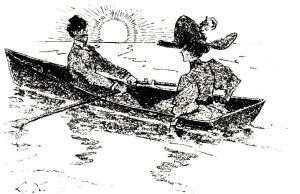
"Meanwhile the young lady and Mr. Begum was rowin' quietly over the lake, talkin' about literatoor and art and things like that. He was doin' the rowin' and she was trailin' her hand in the water—the hand with the Mizpah ring on it—when all of a sudden a trout gave a dart out o' the shadder of the rocks, opened his mouth, caught holt of the ring, pulled it right off, an' retired; an', worst of all, two minutes later George appeared on the bank o' the lake and called out to her that he was there. She was awfully cut up. The surprise at seein' him, an' the grief at losin' his ring she'd said would never be took off her finger, was a fearful combination, 'specially as George noticed, the minute she came ashore, that the ring was gone.
"'Where's the ring?' said he. An' she told him how the trout had behaved, and it seemed to make him awful gloomy. Ye see, he didn't believe it. He thought it was a fish story, and he said so. He had an' idee she'd given the ring to Mr. Begum, and he was pretty mad about it."
"It did sound like a fish story," put in Jack. "Seems to me I'd find it hard to believe myself, if you hadn't told it to me."
Sandboys smiled his appreciation of this compliment to his veracity, and continued:
"They didn't, either of 'em, say much after that, and all day Sunday George sat around and read novels in the office, and the young lady staid with her mother. They'd quarrelled, that was evident, and on Monday George went back home again, and the young lady said they'd never been engaged. The fact was they'd broke it off!
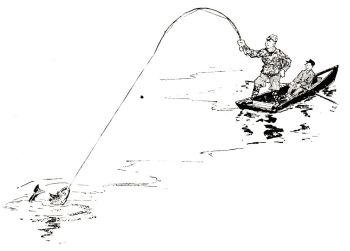
"And now comes the funny part of it. All that summer, and the next, and three more, went by, and nothin' more was ever heard of the ring. The young lady kept a comin' back every year, but she didn't seem to care anything about nobody. She just staid with her ma all the time, and looked pale and unhappy. She'd never made it up with George, and he never could be got to believe the story of how that dishonest little trout had golluped down the ring he'd gave her. The fifth summer after, he came through the mountains with a bicycle party, and they decided to rest a couple of days here. She wasn't here that summer, so he could stay without bein' embarrassed. The mornin' after he got here he asked me to take him fishin', and we went down to the lake. He was a dandy castin' a fly, an' I rowed him up and down, and up and down, for a couple of hours, and he kept a-whippin' and a-whippin' without any luck. Finally he says to me, 'Sandboys, I'll just try it once more, and if I don't get nothin' we'll go back to the hotel and order our fish off the bill of fare, instead of foolin' around here where I don't believe there ain't 'never been no trout.' I see in a minute what he was thinkin' about, but I never said a word. 'All right, sir,' says I, and he flicked the fly once more on the water, and, by hookey, up came a beauty! It was a reg'lar out-and-out three-pounder. And, I tell you, he had to work to get him into the boat; but as he wasn't no poet, an' knew how it was done, he did land him finally.
"'We'll have him for dinner to-night,' says he, with a proud look—and he did. The fish was fried and served at supper; but when the head waiter brought him in to the table, he hands George an envellup, with the remark that it contained somethin' that had been found inside the trout. George got white as a sheet, opened the envellup, and, by hookey, there was the Mizpah ring!"
"Goodness!" gasped Jack. "Wasn't that great!"
"What did he do?" queried Bob. "Faint?"
"Not he," said Sandboys. "He wasn't the faintin' kind. He jumped up from the table, and rushed off to the telegraph office, and sent a telegram to Miss Emily Harkaway at Narrowgansett Pier, sayin': 'Will arrive to-morrow. George.' And he went.
"The next summer he came back again, and he brought her with him. She'd become Mrs. George, and, by hookey, she had the ring with her; but this time she wore it on her neck, with a row o' diamonds set all about it that would have made that trout blind just to look at it, it dazzled so.
"So you just remember what I tell ye. When people give you that story about trout bein' shy, you can contradict 'em, whether it's perlite for small boys to contradict or not; an' if they take ye up, tell 'em about the speckled highway robber of Mirror Lake. That'll take the starch right out of their theories!"

The skating races of the New York Interscholastic League, held a week ago at the St. Nicholas Rink, proved exceedingly interesting, and all the events were unexpectedly hotly contested. Morgan of De La Salle had by no means so easy a time of it as his supporters had believed he would, and Paulding of Berkeley, who last winter represented Black Hall School in the pole vault at the Knickerbocker games, proved himself an important factor in the competition. Last year De La Salle carried off all the honors, but on this occasion Berkeley and De La Salle finished with an equal number of points to their credit.
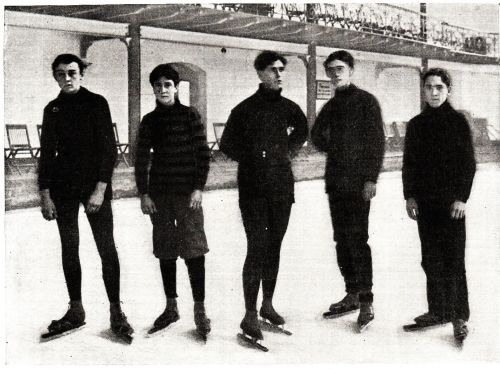
THE DE LA SALLE INSTITUTE SKATING TEAM.
The only thing that occurred to mar the pleasantness of the proceedings was the avalanche of protesting. At the time of writing no action has been taken on these protests, and I doubt if they will affect the results. The protest against Morgan, that he had worked for his living at one time, seems to be invalid, for, so far as I am aware, there is nothing in the constitution of the New York Interscholastic Association which prevents a boy from earning an honest living. Of course, when it comes to a question of a foul, that is a different matter; but I have it on very good authority that Paulding of Berkeley himself denies that he was in any way fouled by Morgan, and yet a protest against Morgan for fouling Paulding was entered.
Paulding. McClave. Morgan. THREE OF THE WINNERS AT THE N.Y.I.S.A.A. SKATING RACES.
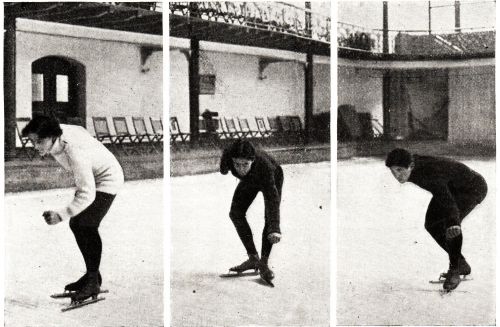
The preliminary heats were held on Friday evening, January 15, and there seemed to be more enthusiasm among the skaters in the trials than there was in the finals. There were about seventy-five entries all told. The events contested were 220-yard dash, 440-yard dash, 880-yard dash, and one mile. Morgan won his heat in the 220, the 440, and the mile, Paulding being second to him in the mile, third in the 220, and second to McClave in the second heat of the 440.
The 880-yard event was for "juniors," and the heats were taken by Inman of Cutler's, Einstein of Harvard School, and Rock of Condon's. The last heat would very probably have been won by Eddinger of Columbia Institute, if he had not had the hard luck to fall on the final lap, when he had a good lead, and was holding his own with the field.
In the finals on Saturday evening the racers made invariably better time than they had done in their trial heats. The 440 was won by Paulding, with Morgan second. Morgan's defeat was undoubtedly due to the fact that he made a false start, and was penalized three yards by the referee. There was a pretty good field, and the De La Salle man found it impossible, in the short distance, to pass through. The 880-yard event was taken by Inman of Cutler's; Einstein of Harvard gave him a pretty close race, but fell twice, and did not finish among the leaders.
The 220-yard dash was a victory for Morgan, who jumped to the lead as soon as the signal to start was given, and was never passed. He also won the mile in fine fashion, leaving his nearest rival, Paulding, two laps behind him, and Paulding headed the field by almost another full lap.
The summary of events follows:
Events.Winner.Second.Third.Time.
220 yards.Morgan.Paulding.Proctor.24-3/5 sec.
440 yards.Paulding.Morgan.McClave.52 sec.
880 yards.Inman.Coffin.Proctor.1 m.43-4/5 sec.
One mile.Morgan.Paulding.Ritman.3 m.7-2/5 sec.
SUMMARY OF POINTS BY SCHOOLS.
Firsts.Seconds.Thirds.Total.
De La Salle21013
Berkeley12213
Cutler1108
Trinity0011
Harvard0011
In-door baseball has not met with very much favor thus far among the South Side schools of Chicago, and the reason alleged is that Englewood and Hyde Park, the two schools which are leaders in almost every other branch of athletics, have not yet succeeded in winning a game this year at the in-door sport. Austin, the last year's champion, was defeated by Lake View, 7-3. This victory has led to the opinion that Lake View would probably take the championship this season.
Hyde Park was badly defeated by North Division in its schedule game. The score was 26-0. Englewood did better against Evanston, and besides putting up a better game was only defeated 10-4. Englewood's next game was lost to Lake View, 8-11. Hyde Park's next defeat was administered by Austin.
Austin's success is largely due to the excellence of its pitcher, Pottwin. Decker, the short stop, has also been putting up an excellent game, and in the match against Hyde Park he knocked out a home run, besides playing an errorless game in the field. The Hyde Park players seem to be fairly good at fielding, but they show a great lack of practice.
The matches in the ice-polo league of the Boston schools have developed good sport during the recent cold weather, and the schedule has afforded a number of close games. Dorchester played a tie game with Roxbury Latin on Franklin Field Friday afternoon, January 15, the score being 1-1. Only one twenty-minute period was played. Dorchester rather outclassed Roxbury Latin in passing and driving, but was unable, nevertheless, to get the ball into Roxbury's cage the second time.
On the same afternoon, at Mystic Lake, Winchester met Cambridge High and Latin, and was defeated 7-0. The Cambridge men developed some excellent team-work, and showed some pretty combination plays. In a game between Medford High and Everett High, Medford won 3-1. Especially good work was done by Otis, Thompson, and Glidden.
HOCKEY: SHOWING GOAL, CLUBS, AND PUCK.
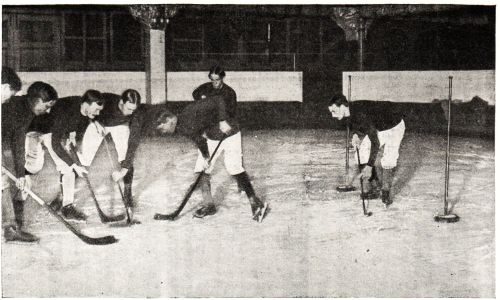
A number of communications have been addressed to this Department requesting that some description be given of the Canadian game of hockey, of which we have heard more than usual this year. In fact, in and about New York hockey is fast superseding ice polo; the latter, purely American game, being played mostly in New England. Hockey is, of course, akin to ice polo, but it has a number of points of difference, and is considered by the Canadians a much better game than our ice polo. Perhaps one of the chief advantages of hockey is that more players can take part in the sport than in ice polo.
The Yale Hockey Team is one of the few teams in this country, so far as I know, that plays the straight Canadian game, although this winter several of the athletic clubs in and about New York have taken up hockey, and will, no doubt, eventually develop strong teams. The Yale men have found the Canadian game so interesting, that they have devoted all their energies to it, and it is said that they will meet some of the Canadian teams during the winter. Space will not allow of a very lengthy description of the game, but in a few words a rough idea of the sport may be given, and a book of the rules with fuller information can doubtless be obtained of any dealer in sporting goods.
A Canadian Hockey team consists of seven players, who are known as Goal, Point, Cover Point, Centre Forward, Centre, Left Wing, and Right Wing, arranged on the field, or rather on the ice, in the following positions:
L.W.C.R.W.
C.F.
C.P.
P.
G.
Instead of the ball which we use in ice polo, the Canadians play with a rubber disk about an inch thick and some three inches in diameter. This is called a "puck." The sticks of the Canadians are also somewhat differently shaped from those used in ice polo, the main difference being that they are longer, and wider at the bottom, and usually constructed of lighter wood. They do not strike the puck as polo-players strike the ball, but rather aim to shove it along the ice, and more often than not the Canadians use both hands, instead of wielding their club with one hand only.
In this way the Canadians are able to make a certain peculiar shove which enables them to lift the rubber disk over the heads of their opponents, and some of them become so skilful at this that they can place the puck so that it will fall on edge and bound into the opposing goal. Perhaps it is this quality of the disk over the ball which has made it necessary in the Canadian game to allow the defensive players to stop the puck in any way they choose, instead of as in ice polo, where the ball may only be stopped by the sticks, the feet, or the body.
The space demanded for Canadian hockey is 112 feet by 58 feet, although the game is possible in a more restricted area. The goal is placed at the middle point of the two shorter lines; it consists of two upright posts four feet high placed six feet apart, and to score a goal the puck has to be driven between the posts. The game is played in two halves of twenty minutes each, and the opposing teams change sides after the interimission, which is of ten minutes.
The Canadians are very strict about off-side play, and the referees invariably enforce the rule which declares that when a player hits the puck any one of the same side who is nearer the opponent's goal-line is off-side, and may therefore not touch the disk or prevent any other player from doing so until the puck has been played by an opponent. A penalty for off-side play is the surrender of the puck to the opposing side; the other players must then stand at a distance of not less than five yards from the puck; but if the offence has been committed within ten yards of either goal the disk is faced in the ordinary way. There are the usual restrictions against kicking and tripping and charging, and against carrying the disk in the hand, and the goal-keeper is not allowed during play to lie or kneel or to sit upon the ice, but must maintain a standing position.
In the United States the hockey-players have not yet developed the team play which makes the Canadian game so interesting, our men, having been brought up on ice polo, relying more on their own quickness and individual skill. But the advantage of team-work is being more and more understood by us, and Americans will no doubt soon equal the Canadians at this feature of the sport.
At the several in-door games of the New York schools this winter we shall look for the development of much new material in track athletics, for by graduation and other causes many of the best performers of the Interscholastic League have made room for other stars. The New York pole-vaulters will have their hands full to hold their own against Paulding, the Black Hall vaulter, who is now at Berkeley, and I doubt if there is any one who can surpass him. The change in the height of the hurdles, too, will make that event more equal toward new and old hurdlers, and the chance of the appearance of new material in this event is excellent.
In Boston the chief in-door event of the winter for the schools is always the big B.A.A. meeting in March, and then we will get our first line on the New-Englanders that will come down here to measure skill with New York in the Madison Square Garden. Judging from the place-men in the spring events of the New England league, the Boston schools will turn out some strong performers this season.
In Connecticut there have also been losses; but many of the best athletes, especially of the Hartford High-School, are on hand, notably Luce and Sturtevant. The latter will be the most dangerous man in the high jump. I am told, too, that Hartford has a new man in the weights who will make Boyce of Boston English High stretch himself to the utmost.
"TRACK ATHLETICS IN DETAIL."—Illustrated.—8vo, Cloth, Ornamental, $1.25.
The Graduate.
SALUTING A CAT.
There is at least one place in the world where the cat was until recently held in high honor, and received the attention due to one of so high a station in life. That place is India, where in a fortress the sentries invariably used to present arms to every cat that appeared on the scene.
The custom is accounted for by this singular anecdote, which comes from what appears to be good authority.
Some fifty years ago it happened that a very high English official died in an Indian fortress, at a place that is one of the centres of Brahminic religion, and at the moment when the news of his death met the Sepoy guard at the main gate a black cat rushed out of it.
The superstitious guard presented arms to the cat as a salute to the dying spirit of the powerful Englishman, and the coincidence took a firm hold upon the locality, that up to a few years ago neither exhortation nor orders could prevent a Hindu sentry at that gate from presenting arms to any cat that passed out at night.
The train was roaring along about forty miles an hour, and the conductor was busily punching tickets full of holes, when a little thin old man who sat in one of the corner seats plucked his sleeve.
"Mister conductor, you be sure and let me off at Speers Station. You see, this is the first time I ever rode on steam-cars, and I don't know anything 'bout them. You won't forget it, eh?"
"All right, sir; I won't forget."
The old man brushed back a stray lock of hair and, straightening himself, gazed with increasing wonder at the flying landscape, every now and then exclaiming, "Gracious!" "By gum!" etc.
Suddenly there was a crash, and after a number of gymnastic moves that made him think of his school-days, he found himself sitting on the grass of the embankment alongside the track.
Seeing another passenger sitting a short distance away, patiently supporting various parts of the splintered car across his legs, he inquired,
"Is this Speers Crossing?"
The passenger, who was a drummer, and not altogether new to such happenings, replied, with a smile, although in considerable pain,
"No; this is catastrophe."
"Is that so," he irritably exclaimed. "Now I knew that conductor would put me off at the wrong place."