THE FIGHTING SAVAGE.
Reading edition
BY CYRUS C. ADAMS.
Within two years we have seen great nations waging four wars with peoples who are above the savage state, though not fully civilized according to our ideas. Two of these wars are now ended, and the results in both have been surprising.
It was thought that the Hova people of Madagascar would at least make an effort, when a French army invaded their great island in 1895, to repel the foreigners. They made a great show of resistance when the French landed their troops. They had cannon, powder, and thousands of rifles, collected an army of 30,000 men at their inland capital, and the Queen said she would lead them to battle if they needed her in the field. A nation of orators, they indulged in much brave and eloquent talk; but when it came to the pinch, they did not fight. The French marched into Antananarivo without any opposition worth mentioning, and are now the masters of Madagascar.
The brave mountaineers of Abyssinia have a different story to tell. For the first time a native African state has beaten a European power in a hard-fought war, driven the enemy out of her territory, and imposed her own terms of peace, including reimbursement for the board of about 2500 prisoners, at so much per week, during last summer. King Menelek has not lost a foot of territory; and Italy, which sent her army among those highlands to prove that the King was her vassal and his country her protectorate, has acknowledged the complete independence of Abyssinia. How did Menelek and his army win so signal a triumph?
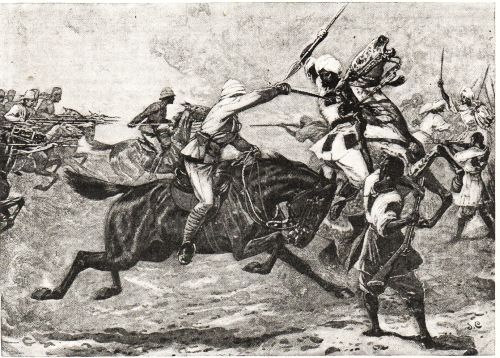
THE MAHDISTS FIGHTING THE ENGLISH IN EGYPT.
In the first place, no other half-civilized nation to-day is so well armed as the Abyssinians. They fought the British once, and later, the Mahdists, with spears and a few muzzle-loading rifles. None of the soldiers now carries a spear or a muzzle-loading gun. All the small arms are breech-loaders. King Menelek came to the throne nearly eight years ago, and being an enterprising and an intelligent ruler, he has made great changes. He imported, through French territory, large quantities of excellent rifles. He induced French and Russian experts to come to his court, and they taught him many things, such as how to make gunpowder, and to build small bridges and frame houses. In fact, for years he had been preparing for the possibility of a big war. His army outnumbered the Italians four to one. He had 60,000 fairly well drilled soldiers—all brave and hardy men, and he could depend upon their fealty, and knew they would fight as unflinchingly as any men.
THE WARRIORS OF KING MENELEK FIGHTING THE ITALIANS AT ADUA.
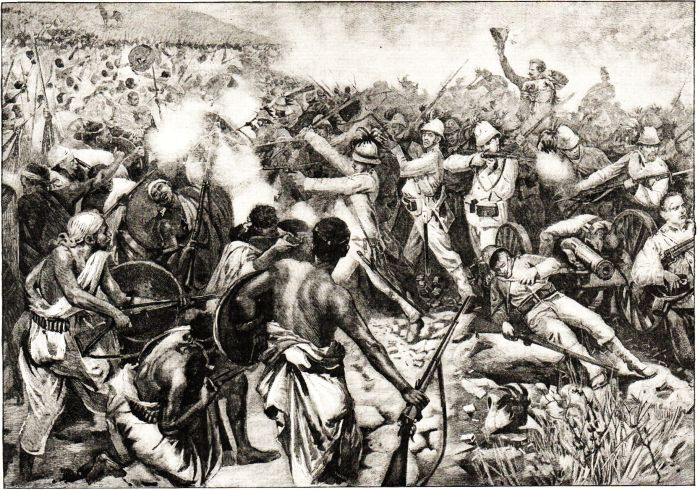
When the Italians moved into Abyssinia, Menelek and two-thirds of his army were in the southern province. The result was that the Italians pushed south to the very heart of the country before Menelek was able to confront them. After that, the Italians did not win a fight. In every battle, except the last one, the natives were the aggressors. Menelek's aim, with his larger force, was always to surround the enemy. He completely succeeded only once, and then the Italian detachment, 1000 strong, was killed almost to a man. Usually the Italians and their native allies broke and fled before Menelek had them penned inside his lines. The Abyssinians always tried to fight at close range, and were perfectly reckless in their daring. Their officers invariably led the charges and fought in the front rank, with the result that more of them were killed in proportion than of the common soldiers. The King had several thousand cavalry, but he made little use of them. Most of them were kept in the rear with instructions, if the infantry were compelled to retire, to impede the enemy's pursuit and guard the retreat. Under the circumstances the cavalry had little to do, except in the last great battle at Adua, where they pursued the routed Italians, and captured many of the 2500 prisoners.
While Menelek was forcing his enemies back north, the Italians paused from time to time in places they had previously fortified. Menelek had thirty cannon, but in no instance succeeded in destroying the walls. The courage with which the Abyssinians charged up to the fortifications won the admiration of their enemies, under whose galling fire many hundreds of natives were killed. Menelek could not capture the strongholds, and the Italians could not shake him off. In every case, till Adigrat was reached, hostilities were suspended by mutual consent; the Italians withdrew nearer to the northern boundary-line, and Menelek would then advance and attack them again.
Finally the Italians made a last desperate sally to retrieve their fortunes; and their fate was sealed in the all-day battle of Adua, where about 5000 of them were killed, wounded, or captured, and the rest fled pell-mell out of Abyssinia. At all times the Italian troops and most of their native allies fought well, but their leadership was shamefully incompetent. Even with good generals, they could not have whipped the Abyssinians without doubling or trebling their armed force.
Spain's present trouble in the Philippines extends to several islands, and includes the savages of Mindanao as well as the half-castes and creoles who live in Luzon. The latter island is the scene of the hostilities which are reported nearly every day. In a word, the trouble is that there are in the colony, according to Spanish statistics, 3000 Spanish priests and 5000 civil servants, and the people assert that they have been bled for the church, for the state, and for private peculators, until they can stand it no longer. In Luzon the inception and the progress of the rebellion have been marked by wonderful skill. Plans for the uprising, including the collection of arms and ammunition, were so quietly carried out that Marshal Blanco did not know what was going on until the very eve of the outbreak. In less than a week he was confronted by thousands of well-armed men, who dared to attack even the outskirts of Manila. At first they met the Spanish regulars in the open, but the insurgents had few if any cannon, and were at a disadvantage. A fortnight later they changed their tactics.
It is now their general policy to fortify strong positions and await the attacks of the enemy. When, however, they can bring against a Spanish force a much superior number of fighters, they attack with the greatest vigor. This plan of action seems wise, for the insurgents must bear in mind that they have only a fixed number of fighters, while the Spanish may fill up the gaps in their ranks with recruits from home. The insurgents have occupied many towns in several provinces, and while they show no mercy to Spanish priests and officials, they respect the lives and property of other foreigners. Spain has sent about 15,000 soldiers to the island, and the end is not yet in sight.
A leading event this year is expected to be the reconquest of the Egyptian Sudan by the British and Egyptian forces, which was really begun in 1896. The step has been decided upon, and it is believed the undertaking will not be extremely difficult; and yet if there is any fighting the British will meet the very men who in 1885 showed that half-civilized peoples can do all that any men can do on a battle-field. Fiercer fighting was never seen than that the Mahdi's Arabs gave General Wolseley's forces on those desert battle-fields; and no men could fight as those Arabs did, with nothing but spears in their hands against trained soldiers with the best of modern fire-arms, if they had not been consumed with fanatical zeal.
Their leaders had no guns to give them, and so the orders were; "You are not to fight the enemies of God with ammunition, but with spears and swords." The Mahdi sent them word that Mohammed had proclaimed to him that on the day of battle thousands of angels would be with them to help them vanquish the unbelievers. Wild with religious zeal these hordes would rush across the sands, poising their spears, and fall upon the square in which the British army was formed. They were not checked for an instant by the withering fire or the wall of bayonets, and the very force and fury of their onslaught at Abu-Klea, the greatest of these battles, carried them through the line; and soldiers on the opposite side, firing at the Arabs in the square, killed their own comrades on the broken line. There are few things finer in the history of warfare than the story of the old sheikh on horseback at Abu-Klea, his banner aloft in one hand, his book of prayers in the other, advancing with his men and chanting his prayers till he had planted his banner in the centre of the British square, where he fell pierced with bullets.
The Mahdi is gone. The Sudan has been half depopulated and ruined by his successor. The people hate the Khalifa Abdullah, who has ground them to earth. Fanaticism is dead. But if the flame the Mahdi kindled, which consumed Hicks's large army, killed Gordon, and turned Wolseley's forces back down the Nile, were burning yet, the British would think long and seriously before undertaking the reconquest of the Sudan.