THE CHILDREN'S HOUR.
Reading edition
BY EMMA J. GRAY.
"Isn't it blind-man's holiday?" was John's question, as, "betwixt the dark and the daylight," he put his head in his mother's lap, stretching the rest of his long body meanwhile on the tiger-skin rug which lay at her feet.
"Yes;" and immediately Mrs. Colfax laid aside her mending-basket, touching the top pair of socks as she did so, and then followed the words: "I've been busy with those for the last hour. Do you know you are more destructive on socks than your father and three brothers put together?"
"Am I, mother?" and the boy took one of her hands between his own, while she at once ran the fingers of her other hand through his short thick hair, remarking, "that she didn't know where it got its curly tendency from, as none of her family could lay any claim to curls, nor the Colfaxes either."
But John had not come to discuss his kinky locks, nor to talk about his school affairs; on the contrary, he had something peculiarly strange to tell to-night. In fact, nothing less than that his great chum, Hiram Scott, was to have an "out-and-out boss party to celebrate his sixteenth birthday."
"That means, my son would like a party on his sixteenth birthday."
"That's about the size of it, mother."
"All right. You may have one."
"Hurrah!" and John sat upright, while he eagerly explained, "But, mother, Hiram's going to have a regular gilt-edged affair. One of the kind you read about."
"And you wouldn't wish to be outdone by him; is that it?"
"Well—no, I wouldn't."
"Is his birthday before yours?"
"Yes; ten days."
"Has Hiram told you any particular plans about his party?"
"Why, all there are to tell, I suppose. They are to have the biggest orchestra—harp, horn, and all that sort of thing." Then, shaking his head impressively: "And the supper will cost one hundred dollars—maybe two hundred. And Hiram is to have a new pair of black silk socks and patent-leather pumps, and an elegant new dinner jacket, for the occasion; he's to be brand-new all over, indeed, for, with a real whipper-snapper air, he informed me he was to have awfully swell black trousers and waistcoat, and a new black satin tie. The whole thing is to be mighty fine, I can tell you."
"Well, it's quite impossible for you to give as costly a party as Hiram's, for your father is a poor man in comparison to his, my son."
"I know it," and John once more threw himself forward and laid his head on his mother's lap.
"So we must think of something fantastic and fanciful," Mrs. Colfax resumed, "and hope that the unusualness of your party will compensate for the expensive supper and orchestra of Hiram's."
"What would you give, mother? For you know right off I could never plan a new party any more than if I was a—"
"A what, my son?"
"A—barber's pole—or a wax figure, or any other know-nothing thing."
"You're interested in Indians, aren't you?"
"Indians!" and jumping to his feet John trod forcibly across the floor, as if he was on his way to encounter a whole tribe of them. Then he slowly stated: "I should remark that I am. But what have Indians to do with my party?"
"You'll see," and Mrs. Colfax, leaning back in her chair, inquired: "How would you like to play that you are Hiawatha just for a night? In fact, the invitations might read:
"Hiawatha
"Requests the pleasure of
"Miss B—— B——'s
"company on Monday evening,
"March nineteenth, at eight o'clock.
"Dancing, Games. Address."
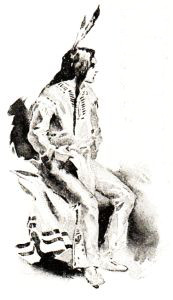
"Oh, go on, mother," were John's impatient words, as Mrs. Colfax hesitated a second; "I can hardly wait," and giving a low whistle, he shouted: "Excellent, fine, clever! Hiram is welcome to his new toggery for aught I care; I'll appear in Indian array—eagle feathers, bead necklaces, bracelets, moccasins, and all. What a jolly scheme!" and John stood as erect as though his eagle plumes were already waving above his head.
"And perhaps, since Hiram is your most intimate friend, he would take the character of Chibiabos, for
"Very dear to Hiawatha Was the gentle Chibiabos.
"And then another of your friends should be the very strong man Kwasind, and then, of course, there must be Laughing Water, Minnehaha, and the old arrow-maker, her father."
"Would it be a Hiawatha party or an Indian party?"
"Neither, John, because all of Longfellow's people should come. The only reason I have been talking about Hiawatha was because we might as well fix your character at once."
"Oh, that's the how of things. Are you sure there would be enough characters to go around?"
"Without a doubt, John;" and then, with an affectionate gesture on her big boy, Mrs. Colfax added, "I guess somebody that I know would better read Longfellow's poems over again."
"I am sort o' rusty. I suppose, too, that would be the only way to advise a fellow as to his get-up."
"It would be the best way; for example, in the Tales of the Wayside Inn we read
"But first the Landlord will I trace; Grave in his aspect and attire;
"and
"A youth was there of quiet ways, A student of old books and days;
"and a
"Theologian from the school Of Cambridge on the Charles was there.
"And a Poet, and a Spanish Jew, a young Sicilian, and a Musician, all are minutely described."
"Will Minnehaha be the only girl, mother?"
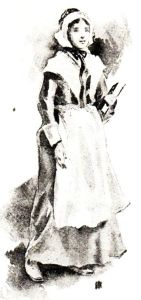
"Why, what a nonsensical question! Perhaps somebody would personate Margaret, the Blind Girl of Castèl-Cuillè, only it would be pleasanter to personate her before
"The dread disease that none can stay, The pestilence that walks by night, Took the young bride's sight away.
"And surely some mischievous girl would delight to make believe she was
"A woman bent and gray with years,
"and be the village seer. And I've just had an idea, John, that your father can be the Master who builds the ship. You remember the way the poem commences,
"Build me straight, O worthy Master.
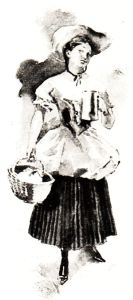
"And I'll dress like a young girl and be the promised bride
"Standing before Her father's door."
"Oh, capital! What fun!" and John excitedly once more jumped to his feet, adding, "What a jolly mother I have!"
"And, of course," Mrs. Colfax continued, "there will be a Priscilla and an Evangeline. Indeed, you need not trouble about there not being enough characters to go around."
"Well, granted that they all come, mother, what then?"
"Then we will give a tableau vivant, called The Children's Hour. Our house is just the place for it."
"In what way? I don't understand."
"The library can be seen from any part of the parlors. And grandpa, who bears such a close resemblance to Longfellow, can act his character. The library must be dimly lighted, because
"The night is beginning to lower,
"and the parlors will have to be almost dark while the tableau is shown, otherwise we cannot see into the library. There grandpa will sit in his favorite high chair, in the attitude of listening to the patter of little feet above him. Some unseen person, perhaps I, will read the poem which describes the scene, and after a while three young girls,
"Grave Alice, and laughing Allegra, And Edith with golden hair,
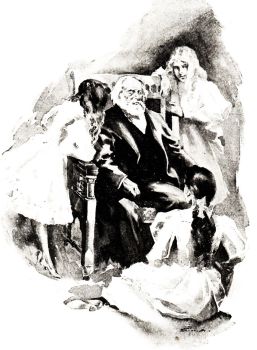
"will be heard descending our long stairs, and they will make a rush from the stairway through the hall and climb over the arms and back of his chair. Trust me, John, the tableau will be very pretty. I know exactly how to arrange it, and if I did not, there is a fine illustration in the edition that your father gave me last Christmas. Besides, grandpa will enjoy it so much. Indeed, it was only the other day that he told me that his party days were over."
"I'm so glad you thought of putting grandpa in, mother. But after the tableau?"
"After the tableau it will be a Children's Hour in very truth—games, songs, dances, and supper. During the dance immediately preceding the supper, paper hats will be given as favors, which everybody will don, excepting when, like yourself, their eagle plumes would interfere. In that case they can suspend them from the arm. The girls will wear broad-brimmed hats, and the boys, turbans; and the boy must invite the girl who has the same colored hat as himself to go to supper."
"But where are all these hats to come from? I guess you're the one that's forgetting that papa isn't rich."
And Mrs. Colfax, throwing back her head, laughed merrily. When she recovered herself she exclaimed: "Why, John, I'll make the hats. It will only be a little bit of fun for me, and all the paper put together wouldn't cost a dollar."
"I know the fellows will just think you're a beaut—y." For it was very difficult for John not to use slang.
But Mrs. Colfax talked on regardless of her son's interruptions, and therefore it was that John learned that both the Longfellow and birthday schemes should unite in the supper-room.
"For example, The Children's Hour would appear in large letters over the mantel-piece. The letters could be cut out of card-board and covered with asparagus, which should be tacked on with green silk. Then candy could be twisted to represent a coil of rope, and a candy man to represent the Skipper. Another candy man would be called the Village Blacksmith, and a chocolate man the Black Knight, and so on. Tiny papers, similar in size to motto papers, should be glued at one end to these figures, thus introducing them. The large cakes should be iced around with flowers, for Longfellow wrote, 'Everywhere about us are they glowing,' and the ice-cream models should be as appropriate as the caterer could arrange. A ship would be a fine example; so would a bell, the Curfew Bell; an arrow, The Arrow and the Song; and a clock, The Old Clock on the Stairs.
"And the birthday feature, John, should be indicated by the flower for your month; you were born in March, therefore your birthday flower is violet. Violet-colored satin ribbon might be used to decorate the table, and potted palms, etc., could stand in violet crépon paper pots, but, nevertheless, real violets must show themselves as freely as we can afford them." And Mrs. Colfax smoothed back the hair from her son's forehead.
"I never knew that before."
"Never knew what?"
"That everybody had a birthday flower. What are the flowers for the other months?"
"April, daisies; May, hawthorn; June, roses; August, poppies; September, convolvulus; October, hops; November, chrysanthemums; December, holly; January, snow-drops; February, primroses."
"I like my flower best, don't you."
"Yes, I think I do. But I must talk more about the party. At the supper table each one in turn must tell his or her character."
"Cannot people guess before?"
"They can guess all they like, John, if they will whisper. Part of the amusement at such a party is to discover your friends."
"What about games, mother?"
"Try the Cent Hunt. Say that a cent is wrapped in violet tissue-paper, and is within sight. The discoverer quietly tells you, and if he is correct, present him with a boutonnière of violets. Afterwards give a cent, pencil, and paper to everybody, and state five minutes are allowed to write what each side of the cent will tell. This game is called A Penny for your Thoughts.
"Find on one side: A beverage—T. A messenger—one c(s)ent. A piece of armor—shield. A symbol of victory—wreath. A weapon—arrow. A mode of punishment—stripes. A gallant—bow. A sheet of water—C.
"Find on the other side: A portion of a hill—brow. A place of worship—temple. An animal—hare. Youth and old age—18-96. One way of expressing marriage—U. S. A cultivated flower—tulip. An emblem of royalty—crown. Fruit—date.
"And afterwards play Stage-Coach, but, John, you know that game."
"Here comes father; shall we tell him?"
"Wait until to-morrow."