WITH THE THANKS OF THE WAR DEPARTMENT.
Reading edition
BY WILLIAM DRYSDALE.
"Yes, the boy is in a bad way," Dr. Murray said, with his fingers on Frank's pulse; "a very bad way. This is a serious case. Why not let me take him out to Tortugas? We have plenty of fresh air there, and I should like to have him with me."
"To Tortugas?" Mrs. Bethel exclaimed. "To the quarantine station? Why, you are liable to have yellow fever cases there any day! Oh, doctor, I never could let him go out there!"
"Do you think I would take him into any danger?" the doctor laughed. "It is much safer there than in Key West. Our quarters are in the great fort, but the pest-house is on Bird Key, half a mile away. I do not know of any place in the far South that has as good a summer climate, for the wind strikes us on every side, as we are seventy miles from land. And as to danger—pshaw!"
With Frank eager to go and his mother anxious to have his health improved, there was not much doubt that in the end the doctor's invitation would be accepted. That was the way it turned out, and when the doctor's steam-launch started from the naval depot wharf two days later, Frank was in the little cabin with the doctor, and his trunk was stowed away somewhere up forward.
"Now for a quick run to 'Tugas, let us hope!" the doctor exclaimed, as the launch began to cut through the clear water of Key West Harbor. "Eight-thirty; we ought to be there by four-thirty this evening, unless the weather changes. We can't risk any rough seas in this launch, you know. If a storm should come up, we'd have to take refuge on one of the four or five keys between here and 'Tugas. Do you know that Fort Jefferson is the hardest place in the United States for a traveller to reach, Frank, unless he has a government boat to travel in?"
The Gulf was as smooth as a pond, as it often is in summer, and every minute Frank could see fish darting through the transparent water, and great turtles and sea-fans and brain-stones on the bottom. He was as much excited over it as if he had been starting for China.
"There's something ahead," he exclaimed, about the middle of the afternoon, "that I should say was a city growing right out of the water if I didn't know that it must be the great fort. But there can hardly be any fort as big as that. Is that really it, doctor?"
"That is really the fort," the doctor answered, "and I think we will be there now inside of an hour."
"But it seems to stand right in the water!" Frank exclaimed. "I don't see any land around it at all!"
"It would take good eyes to see any land around it," the doctor replied, with a twinkle in his own eyes. "You see, the island was only five acres in extent, and they built a fort covering seven acres, so the foundations were laid right out in the water."
When they were near enough to see plainly, Frank did not try to conceal his delight.
"What an immense building!" he exclaimed. "I never imagined there was such a big building in the world. No wonder it cost thirty millions! And there are roofs and chimneys inside the walls, and palm-trees waving over the top. I didn't know they had chimneys on a fort, doctor, and palm-trees?"
"They do in this one," the doctor laughed. "The roofs and chimneys belong to the officers' quarters and barracks, and the palm-trees have been growing ever since the fort was dismantled, thirty years ago."
Once inside the great walls, they were in a large yard grown up with palms and bushes; and crossing this, they entered the officers' quarters, where Dr. Murray had his office and living-rooms. Such big rooms, too, with great open fireplaces, and broad halls with iron staircases.
"Now make yourself at home, Frank," the doctor told him. "The whole place is open to you, and you can go anywhere you like."
For an hour or more he wandered alone among the open casemates, dodging around conical piles of cannon-balls, patting the immense but long-silent columbiads. Then the doctor joined him for a short time before dinner in the vaulted casemates.
"There are so many rusty machines here, doctor!" Frank exclaimed. "This looks like a little furnace. What do you suppose it was for?"
"That was for heating cannon-balls," the doctor answered, "so that they could fire hot shot into a hostile ship."
"And this thing looks like an oven big enough to supply a city."
"It is an oven," the doctor explained. "This is the fort's oven. You know at one time there were nearly three thousand people here, prisoners and garrison, and all their bread was baked in this brick oven. That is the reason it is almost as big as a house."
"And this great machine in the bastion?" Frank asked. "It looks something like a steam-engine; but it is rusty enough to fall to pieces."
"Ah, I am glad you reminded me of that!" the doctor explained. "I must caution you about the water-tanks. That big machine is a condenser, Frank. So many people required not only a great deal of bread, but a great deal of water, too, and no fresh water is to be had out of this coral rock. So this big condenser was put up. It pumped water out of the Gulf and converted it into steam, and when the steam condensed into water again the water was fresh. This old machine used to run day and night at one time.
"Then," the doctor went on, "they had to have places to store the water, of course. For that purpose they built a system of water-tanks under the entire fort. Under every one of these lower casemates there is a great stone tank twenty or thirty feet square and ten or twelve feet deep; and they are all connected, so that now when they are not full you could go under the whole fort through the tanks. I suppose there is not another series of water-tanks like them in the whole country. They have not been used for years, but a little rain-water still flows in from the roofs, so that the water is always two or three feet deep in them. It is a dark, slimy place down in the tanks.
"And that is what I want to caution you about," he continued. "You see in the stone floor of every one of these lower casemates there is a trap about two and a half feet square, covered with a square stone with an iron ring in the centre. Those traps lead down to the tanks. Sometimes one of the covers is lifted and is carelessly left off. I want you to be very careful about them if you come into the casemates at night, for it would be an ugly thing to tumble into the tanks. Here, I will lift this cover and let you look down."
"UGH!" FRANK EXCLAIMED; "WHAT A GHOSTLY PLACE!"
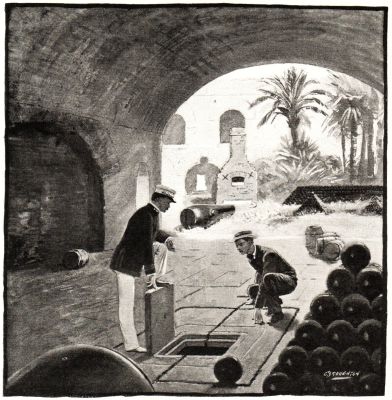
"Ugh!" Frank exclaimed, drawing back from the black hole. "What a ghostly place! I suppose that stagnant water is full of all sorts of creatures, too!"
The dinner bell called them back to their quarters, and Frank found that the quarantine establishment comprised about eighteen persons, including the doctors and nurses, engineers, boatmen, and laborers; and these, with the ordnance sergeant and the light-house-keeper, were the sole inhabitants of the big fort.
After dinner the doctor was busy, but Frank went out alone into the soft moonlight to enjoy the cool evening breeze. He soon made the acquaintance of the ordnance sergeant, and together they climbed the solid stone stairs in one of the bastions up to the upper casemates.
"Why, this is like fairy-land, if there is such a place!" Frank exclaimed. "Just see the moonshine through the long rows of brick arches! What a tremendous big place! And the water looks like silver outside, and in the enclosure everything is dark green."
"This is only one section of the fort that you see," the sergeant said, smiling at Frank's enthusiasm. "There are six sections just like this. To-morrow I will take you up on the parapets. You can almost see Cuba from there, but not quite."
"And to think that three thousand people once lived on this little island!" Frank exclaimed. "They must have been packed pretty thickly in these casemates."
For days Frank spent all his spare time in wandering about the great fort, sometimes alone, and sometimes with the doctor or sergeant. There were so many queer things to see! And everything was so solid and warlike! And every evening while the moon lasted he climbed to the upper casemates to enjoy the silvery water and the cool breeze.
But after a while the moon disappeared and the nights became dark. Then he moved about with caution, for the bushes in the enclosure tripped him, and the vastness and silence of the great place awed him. Late one evening, after he had said good-night to the ordnance sergeant and was thinking of going to bed, the notion occurred to him:
"How terrible it must have been to be shut up for months in one of those lower casemates, with only a big columbiad and a pile of shells for company! It makes a fellow shiver just to think of it!"
"Pshaw!" he exclaimed, a moment later. "I don't like this being scared at a shadow. I'm going over to some of those cells this minute, just to punish myself. I know every inch of the way now, and can easily find them in the dark."
He started across the enclosure, picking his way carefully among the bushes. The long grass tripped him, but he persevered. Once he ran plump against something tall and hard, and after feeling it with his hand he knew just where he was, for it was the tombstone of Major Smith, who died in the fort of yellow fever in 1867, and was buried on the spot. That made his flesh creep just a little bit, but he kept on. After he reached the sally-port, which always stood wide open, he turned to the right, dodging piles of solid shot, a fallen partition, and an old steam-engine. In a minute more he was in front of the casemate he wanted—not the casemate which he had stood in so many times already to look out upon the sea, but a particularly gloomy one he remembered. He stepped into the casemate, about two feet higher than the ground, and the thick darkness staggered him for a moment. But he would not back out now. Slowly he groped his way across the stone floor.
Crash! In a second he saw a thousand stars shooting, and like a flash he thought he realized that some one had struck him a blow on the head.
"Help! help! help!" he shouted. "Murder! help! help!"
He put up a hand to ward off a second blow, and found that it was dripping wet. Blood, perhaps! Something was trickling down his face. Maybe that was blood too! He was dripping all over. He tried to run, but he could not, for something held his feet. He was standing in water above his knees!
Then he realized his terrible situation. Somebody had uncovered the trap in the casemate and left it open, and he had fallen into the tank. He was down in that horrible, black, slimy pit. Perhaps he had struck his head in falling, but the water had broken the fall.
"Help! help!" he cried, when this dawned upon him. But he soon stopped that. All the men, he knew, were on the opposite side of the fort, and probably all in bed. There was not the faintest hope of making any one hear if he shouted all night. To climb out was impossible, for the hole was six feet above his head, in the middle of the ceiling. He was doomed to spend the night in that dreadful place, and in the morning he might hope to attract attention.
How long he stood there, shivering with the damp chill and with terror, he does not know. It was long enough, at any rate, to make him fear that he might lose his senses before morning, and fall and be drowned in the slimy black water. Perhaps older fellows than Frank would have shivered with fear in that awful black vault.
He had pulled himself together enough to try to dry his upper clothes, when he was startled by a slight noise overhead. Yes, he was sure he heard a noise; and the next moment he heard a voice. Ah! surely a human voice never sounded so sweet before! He had his mouth ready to cry out for help, when he caught a word or two that made him pause to listen.
"I tell you I'll wait no longer," the voice said. "They're all in bed before this, and we're going to work. Come on."
Frank was familiar with all the voices in the fort, but this was a strange voice. Evidently strangers had landed; but what could they mean by going to work at night?
He still waited to listen, but instead of more words he heard the tread of feet overhead. Could they be going away? Whoever the men were, he must have help, and he would have called out in a second more if— Hark! There was a grating on the stones above, then a glimmer of light, as if from a lantern. Then another strange thing happened. By the dim light he saw the end of a ladder come down through the trap—not the trap over his head, but two casemates further down, nearer the sally-port.
By the same dim light Frank saw that the tanks were connected by broad brick arches, through which the water flowed from one to another. The ladder was let all the way down, and down it came four men, one after another, one carrying the lantern, all carrying hammers and saws, and all strangers. Frank was so surprised that he could do nothing but stand still and watch. There was no danger of his being seen, for he was in the deep gloom; but he could see every move the men made, as they carried the light.
The men seemed to know the ground thoroughly, for they waded off through the water without hesitation, going in the opposite direction from Frank. Through two of the brick arches they went, then up to the front wall of the tank, and began to use their hammers and saws briskly.
Frank saw that the wall was covered with a perfect maze of pipes, both iron and lead, and that made it all plain to him. These men were thieves, and they were cutting away the lead pipes to steal them. Perhaps the strange situation sharpened his wits. At any rate, Frank saw that the men were all absorbed in their work two casemates beyond the ladder, and without waiting a moment longer he waded silently but swiftly down to the foot of the ladder, flew up its rounds like an athlete, and drew the ladder up after him. That left the thieves securely trapped in the tanks. The stars were shining brightly now, and half wild with joy at his release Frank rushed across the enclosure.
"Help! help! help!" he shouted again. "Thieves! thieves!"
His friends could hear him plainly enough now that he was outside; and when Frank told his story they made short work of capturing the burglars and taking possession of their sloop that waited by the wharf.
"Those fellows have been here before," the men reported who were sent down into the tanks: "they have cut away miles of lead pipe."
The doctor saw that Frank was nearly used up with the excitement, and insisted upon his having a cup of hot coffee and going to bed.
"You have made an important discovery," he said, "and the War Department ought to have something to say to you for it. Those fellows must have taken hundreds of dollars' worth of pipes, and I think we can recover them. I shall make a report to the Department, of course."
It was not long before nearly $1600 worth of lead pipes were recovered in Key West, where they had been taken; and when Frank went home late in the fall, as strong and brown as any mother could ask to see her son, he found a big letter waiting for him, without any stamps on the envelope, but printed in the corner, "War Department, Adjutant-General's Office. Official business."
"Mr. Frank Bethel," the letter said:
"Dear Sir,—The Secretary of War has learned from Dr. R. D. Murray, and from other official sources, of the recovery, through your efforts, of a large amount of government property stolen from Fort Jefferson.
"I am therefore directed to forward you the enclosed check for one hundred dollars, with the thanks of the War Department. Respectfully yours,
"J. W. Armstrong, Chief Clerk."
"Phew!" Frank exclaimed. "I'm glad the War Department don't know how scared I was down in those tanks!"

The interest in golf among the schools of the country seems to be growing rapidly, and at a number of the large out-of-town schools, as has already been told in this Department, courses have been laid out, and tournaments have been held, notably at St. Paul's School, Concord, Hotchkiss School, Lakeville, and at Lawrenceville.
BERKELEY SCHOOL GOLF CUP.
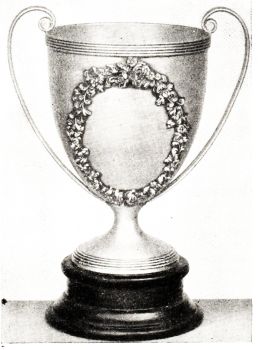
The first scholastic tournament to be held in New York was that played by the students of Berkeley on Election day. The competition was medal play for a cup offered by Dr. White, the winner to receive an individual cup in addition to having his name engraved on the championship cup, which is to remain in the possession of the School Athletic Association.
Great interest was taken in this tournament, and although H. M. Bowers, one of the best golfers in school, was unable to take part, the competition brought out some good play. The tournament was held at the Van Cortlandt Park links, and there were fifteen entries. Studwell won by an easy margin of seven strokes over Granbery, who came in second. Summary of the match: G. Stuart Studwell, Jun., out, 63; in, 60—total, 123. E. Carleton Granbery, out, 73; in, 57—total, 130. Theodore R. Pell, out, 67; in, 66—total, 133. Cornelius S. Pinkney, out, 76; in, 64—total, 140.
The last three holes on the Van Cortlandt course are long ones, the equivalent in distance to the total of the first six, the distance between the eighth and ninth holes being nearly half a mile. Thus a score of 60 on this course at Van Cortlandt Park would seem to be about as good as 50 on an ordinary course where the holes are shorter.
THE VAN CORTLANDT PARK GOLF COURSE.—THE THIRD HOLE.
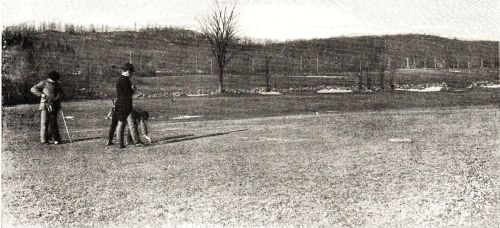
The Van Cortlandt Park course has only recently been opened to the public, but doubtless it will soon become one of the most popular in the neighborhood of the city. The first hole is an open one, and may very well be made in three strokes. There are two obstacles before the second hole, a stone wall and a brook, but a long drive ought to clear both of these. A skilful player can make this hole in three, but the ordinary player will doubtless require four strokes, by reason of falling short of the stone wall.
There is a bunker that even the unskilful player should be able to drive over toward the third hole. On the way to the fourth there is another stone wall, just beyond which is a hazard in the form of a dry river-bed. The third stone wall lies on the road to the fifth hole, and ought to be cleared with the second shot. It is unadvisable to attempt to drive over it, unless one is particularly skilful.
THE VAN CORTLANDT PARK GOLF COURSE.—A TYPICAL HAZARD.
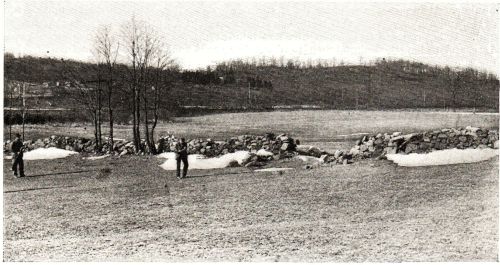
The sixth hole is a very short one. It starts with an easy hazard, a little ditch not more than ten yards from the tee, which anybody but the most inexperienced should be able to drive over safely. The return trip consists of only three holes, but they are all harder than any of the preceding. There is long grass, and the railroad track along the right of the first two, and then the shore of a pond as a boundary for the ninth. Therefore any swaying to the right will prove expensive; to the left the ground is level and safe.
The seventh hole might be called an open one, except for the low stone wall that runs through it, and a dirt bunker at a good distance this side of the putting-green. Both these obstacles, however, are placed so as only to penalize the very poor player. Toward the eighth hole one meets two more bunkers, that ought also to be easily handled by a fairly experienced player. Thereafter comes what is said to be the longest hole in the United States, the distance being 700 yards. The turf is fairly clear, and crossed by two stone walls, and broken by a dirt bunker. It is possible to clear the first stone wall on the drive, and a brassey shot will bring the ball nearer the second. It is proposed to shorten this last hole at an early date, and to lengthen the eighth to about 580 yards, making the two thus more nearly equal. As it is, the ninth hole is an unsatisfactory one to play.
THE VAN CORTLANDT PARK GOLF LINKS.
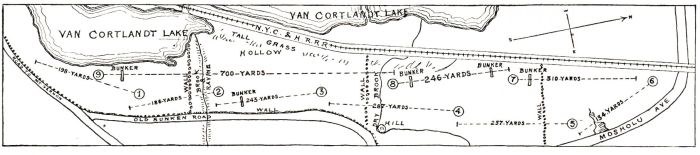
The trouble about crossing the next hazard is the danger of swinging to the right and going into the tall grass, or even into the pond. Then comes the bunker, and after that the course is clear. I am told that the best record for this hole is 7, which is remarkably good. It is also said that the best amateur record over this course is 42, but there is nothing to show that this is a fact. Studwell's best figure was made in the second round,—60; but Granbery made it in 57, making the record for that tournament.
The rules adopted by the Milwaukee schools to govern interscholastic sport are in some respects severe, but it is very probable that the condition of affairs necessitated this stringency. Many of the students are complaining that the 70-per-cent. standard in scholarship required of all those who wish to take part in athletics is too high, and it is very probable that next year this figure will be somewhat reduced. It will not do any harm, however, for a short time, to bring things around with a sharp turn, and to make high scholarship a condition of participation in sport.
In looking over these new rules there are some which strike one as somewhat peculiar. For instance, it is specified that nobody shall play under an assumed name. That it has been necessary to insert such a regulation proves conclusively that amateur sport must have fallen to a pretty low ebb if boys would enter contests under names not their own. But we know that this is done, and that it was shamefully done, by a number of football-players in Chicago this last fall.
One of the new Milwaukee rules provides that "the principal of the school, or persons authorized by him, shall be the manager or managers of the teams representing the school." This is not a desirable change. It is always best for schoolboys to manage their own sports, and if it is found that they cannot or will not manage them properly and honestly and in a sportsmanlike manner, then it is time for older heads to take a hand in the proceedings. But even then it is not advisable to have head masters as managers.
It is far better to let graduates of the school act as an advisory board, and to empower graduates with sufficient power to control the actions of the undergraduate managers. It is hardly possible to find any school principal who can understand and be in thorough sympathy with the boys in their athletics. A schoolmaster is bound to look at things from a different point of view from his pupils, and he would naturally try to reach an end, doubtless for good, in an entirely different way from that which will appeal to the students.
On the other hand, graduates of the school, who are no longer affected by the influences of active personal competition in sport, can better understand the methods and feelings of the students and the requirements of school athletics. They are closer to the boys than the professor can possibly be, and they naturally inspire more confidence in the younger men, because the latter feel that these graduates have a livelier personal interest in sport itself than an older man can have, who has probably never participated in any of these games. Furthermore, a number of these graduates, who might be called upon as advisers, are probably in college or have been through college, and have there acquired much valuable experience in the conduct and management of athletics of all kinds.
One of the chief elements to do away with in the management of sports, especially where reforms are being undertaken, is friction; and there is bound to be more or less friction between head master and pupils, because their chief relations are so entirely different from the new ones that are being inaugurated through athletics.
Among other suggestions proposed at the time these rules were adopted at the Milwaukee schools was one that certain changes be made in the football-playing rules. Fortunately, however, there was enough good sense in the committee to overcome this proposition, and it was decided that the intercollegiate football rules were plenty good enough for Milwaukee.
A new departure in interscholastic sport is to be made by the East Side High-School of Milwaukee this spring. It intends to put a crew on the water. A number of men are already in training, and a racing-shell has been secured. If an eight is eventually turned out, it will be the first crew that ever represented a high-school in the West, and, so far as I know, the first that ever represented any high-school in this country.
No particular progress has been made so far in the arrangements for the Knickerbocker in-door games. It is probable that there will be a relay-race for "juniors," which is an absurd and unnecessary event, as most of these "junior" events are. If a boy is too young to compete in the regular events at an athletic meeting, he is too young to go into active competition at all, and it will do him more harm than good to train at that age. I hope to see the day when these "junior" events will be entirely done away with, and when boys under sixteen years of age will be discouraged from competition with older lads. These youngsters have plenty of time ahead of them, and their constitutions will be much the better for it if they postpone athletic work until their muscles are better able to stand the exertion.
A very good change that is to be inaugurated at these games is the adoption of the regulation high hurdles—3 ft. 6 in.—instead of the dwarfed obstacles that the New York I.S.A.A. has hitherto favored.
It is reported that the Harvard School will apply for readmission to the New York Interscholastic League this spring. It is to be hoped that there will be no opposition to this request, for it would be unjust to keep a body of young men from participation in interscholastic sport because of the mistakes of some misguided youths who attended the school before they did, and for whose actions they should never, of course, be held responsible.
Just as we are about to go to press I am informed that the Connecticut Interscholastic Association has decided not to divide up the $400 surplus remaining in the treasury after the football season. The officers of that Association are to be congratulated upon this action. They will no doubt eventually realize that they have done much for the good of amateur sport in Connecticut by keeping the money question as far away as possible from athletic competition.
The Interscholastic skating-races held at the St. Nicholas Rink last week were contested at too late a day to allow of proper comment in this issue of the Round Table. Mention of them, therefore, will be reserved until next week.
Ice polo has begun to be played among the Boston schools, the first game of the season having been held in the last week of December. There were several matches on the 21st of that month, Stoneham High defeating Wakefield High, 1-0, English High First defeating English High Second, 2-1, and Somerville High defeating Medford High, 5-0.
A few days later Arlington High met Cambridge High and Latin, and took them into camp, 2-1. Arlington's team-work was far superior to that of the Cambridge men, and although the latter tried all sorts of changes in their team, they were unable to withstand the fierce rushes of their opponents. The same afternoon, on Spy Pond, Arlington met Winchester High, and scored another victory, 3-0.
This Arlington H.-S. team is undoubtedly a very strong one, and is putting up good polo this winter. On January 3 they met Cambridge Latin, and defeated them, 6-0. Arlington's especially strong point is in passing.
A very unsportsmanlike dispute has arisen between two schools of the Worcester County South Football Association. Both the North Brookfield H.-S. and the Southbridge H.-S. claim the championship of the League in football, and so eager is each to write the word "championship" upon its school banner that each seems to have lost its head in the discussion. As to which school is entitled to this rather empty honor I am not prepared to determine, although both parties have laid rather lengthy arguments before me, but it would seem that North Brookfield has the better claim.
A game was played early in the season between these two schools, in which a member of Southbridge H.-S. acted as referee. His decisions proved unsatisfactory to the North Brookfield players, and a squabble ensued. As I understand it, the game was left undecided, with the score favoring Southbridge. Later it was arranged that a second game should be played by these two schools. It was played, and North Brookfield won, 4-0.
If this contest was held to settle the question that arose over the first game, then the first can have no bearing on the championship, and the final game alone counts as a championship game. But the defeated players cannot see it this way, and the result is that both schools are claiming everything in sight, and their mathematicians are juggling figures to prove the case. This is one of the evils of the "championship" system.
"TRACK ATHLETICS IN DETAIL."—Illustrated.—8vo, Cloth, Ornamental, $1.25.
The Graduate.