GOLF WITHIN-DOORS.
Reading edition
BY W. G. VAN TASSEL SUTPHEN.
The true and zealous golfer is not to be deterred from his favorite sport by the ordinary accidents of the weather, and indeed it is one of the great merits of golf that it can be played under almost any atmospheric conditions. Baseball, cricket, tennis, croquet, and archery are poor fun on a very windy day, while a wet one makes play impossible. And then these games have each of them a recognized season, and as winter comes on bat, bow, and ball must be laid aside for good. Football and hockey are independent so far as rain and cold are concerned, but the exercise is too violent a one to be continued into the warm days of spring and summer.
Golf, on the other hand, is restricted to no particular season, and it is one of the rules governing medal competitions that competitors may not discontinue play on account of bad weather. Of course on abnormally warm days any sort of physical exertion may become a burden, and in very cold weather stiffened fingers and frozen "lies" do not conduce to good scoring. But there is only one thing that really puts an end to the game, and that is a heavy fall of snow. With a light sprinkling of an inch or two, very good golf may be played by using red balls and having the putting-greens carefully swept, for the snow serves the purpose of a universal tee, and a special ruling may be enacted allowing the player (in the event of the ball being buried) the privilege of lifting or of lightly brushing the snow aside. Among the pines of Lakewood, New Jersey, golf is played all through the winter, for on that sandy soil the snow lies but a short time, owing to the mildness of the climate and the proximity of the ocean. But of course Lakewood is an exceptionally favored spot for these northern latitudes. In and around New York city there is generally enough snow by New-Year's day to stop play, and golf at the big clubs is virtually at an end after the holidays and through the months of January, February, March, and April. Even after the snow has disappeared the frost must be allowed to get entirely out of the ground before play is resumed, or the course, and particularly the putting-greens, may be ruined.
FIG. 1.
We must therefore admit that golf may have its "close" season, at least for places that lie north of Mason and Dixon's famous line, but no golfer worthy of the name is content to entirely abandon all attempts at practice. If he can do nothing better, he will at least try "putting" into tumblers laid on their sides on the dining-room floor, or he will find some pretext to steal away to the attic for a few trial swings at a mythical ball. Inventive genius has appreciated this unquenchable craving on the part of the enthusiastic golfer, and several ingenious appliances have been patented and put upon the market, by the use of which he may keep up his practice in putting, approaching, and even driving.
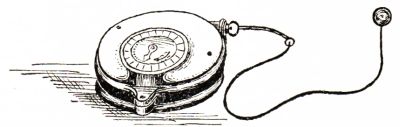
In Fig. 4 is shown an apparatus called Linka. Inside the machine is a powerful spring pulley-wheel, and over this runs a stout cord with an ordinary golf-ball attached at the free end. When the ball is teed and struck away, the propelling force is communicated through the spring to a self-registering dial. So many pounds of pressure indicate so many yards in distance, and the scale is graduated in five-yard divisions from zero up to 225 yards. Fifteen or twenty feet of clear space is ample for the use of the machine.
FIG. 2.
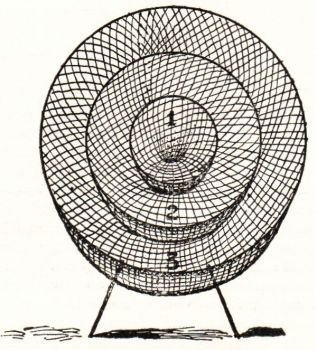
For practice in approaching the putting-green there is the stand shown in Fig. 3. It consists of three concentric hoop-nets, and the accuracy of the shot is determined by the particular hoop into which the ball is played. Of course a free ball is used, and the weak point in the apparatus is that it does not indicate the distance covered (a point which in real play is quite as important as accurate direction). But it may be arbitrarily assumed that a ball in the smallest hoop has been laid within a foot of the hole, while the middle and outer rings may stand for six and fifteen feet respectively.
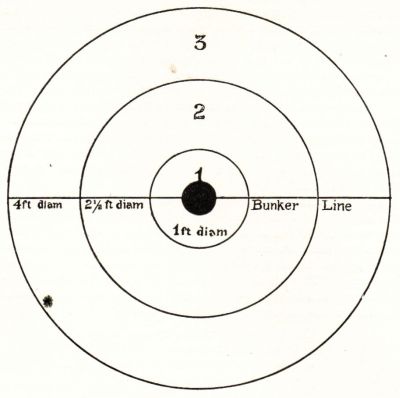
A cheap and effective substitute for the approaching-stand is the simple target depicted in Fig. 2. It may be painted either upon canvas or roughly sketched out in chalk upon the barn door. The canvas should be eight feet square, and provided with guy-ropes and ring-bolts for attaching to the floor and ceiling. If the lower edge of the canvas just touches the floor, the centre of the target and the "bunker-line" will consequently be three feet above it. (The use of the bunker-line will be explained further on.) The diameter of the outer circle should be four feet; of the middle one, two and a half feet; and of the inner ring, one foot. The bull's-eye, which represents the hole proper, should be four inches in diameter. As before, a ball striking in the outer ring is supposed to lie fifteen feet from the hole; one in the middle ring, at six feet; and one in the inner ring, at one foot. A ball that strikes the bull's-eye is assumed to be in the hole. A ball on the line is credited to the inside division.
FIG. 3.
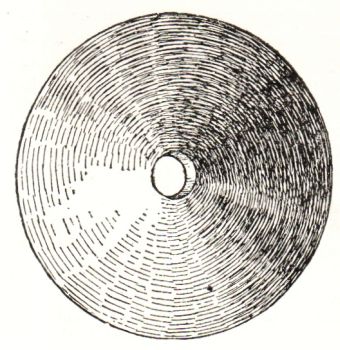
For putting there has been devised the stand shown in Fig. 1. It is nothing but a circular convex piece of tin with a hole in it. The tin has a diameter of eight and a half inches, and that of the hole is two and a half. The convexity is such that the depth of the hole is three-quarters of an inch. It looks easy, but nevertheless it takes a good deal of skill to "putt" a ball up the slope and safely into the cup. If the direction be not accurate the ball will fall off, and if the force be too great it will run completely over the hole in a very irritating manner.
Now all of these appliances may afford amusing practice, and there is no reason why they should not be so used in combination as to give much of the variety and excitement of a regular round of the links. Granted the use of the attic or that of the barn floor, and we may at once proceed to set up our miniature course of in-door golf. The principal expense will be in the purchase of the driving-machine, which costs several dollars at the shops; but we will assume that a small club has been formed, and that the cost of the several pieces of apparatus is to be equally divided among the playing members. The substitute for the approaching-stand (Fig. 3) may be gotten up very cheaply, and the putting-stand can be bought for fifty cents.
FIG. 4.
It is essential that there should be enough of clear space to allow a full swing with the driving-clubs. Fifteen feet will do, but eighteen or twenty will be better. The ball attached to the driving-machine must have a free course in front of it of at least a dozen feet, for otherwise its full force will not be communicated to the spring, and the dial will not register correctly. The machine itself is placed a little to one side, so as not to interfere with the club, and the ball should be teed about a yard in front of it. After the tee shot, when the ball is supposed to be on the ground (as in actual play), we may use an old door-mat as a substitute for turf, and we will call this the "driving-pad."
In playing approach shots a free ball is used, and it may be placed on the "driving-pad" and about fifteen feet from the approaching-stand or canvas target. In the middle of the floor should be a mark for the placing of the putting-stand during the process of "holing out." A chalk line should be drawn from this mark fifteen feet long, with cross marks at the one, six, and fifteen foot points. So much for the mechanical apparatus; now for the course itself.
No. 1.—Ball in earth bunker or fence, drop five yards back and add one stroke. Ball in sand, play off bare floor. No. 2.—Ball in "Serpentine," drop five yards back and add one stroke. No. 3.—Ball in pond is lost. Tee again and add two strokes. No. 4.—Ball in sand bunker, drop five yards back and add one stroke.
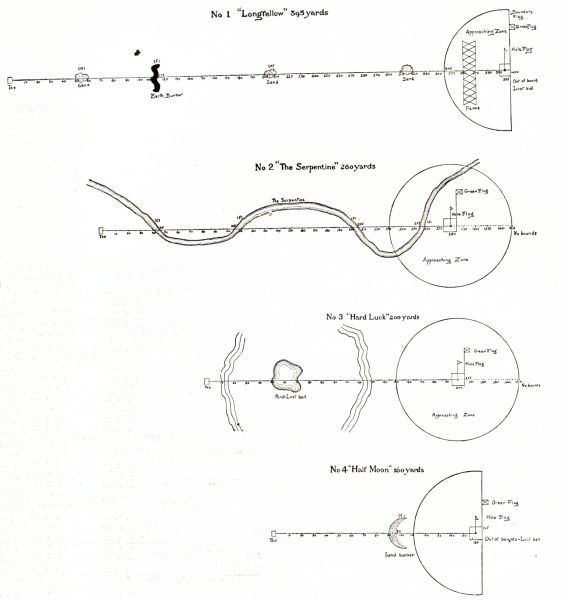
Suppose that our course is to be a nine-hole one, we must provide ourselves with some sheets of stout wrapping-paper, a three-foot rule, and an assortment of colored pencils. Each imaginary "hole" must now be sketched out upon a separate sheet, after the fashion shown in the plan. The sheet should be three feet long, and a convenient scale of measurement will be a quarter-inch to five yards. Five inches will therefore represent 100 yards; seven and one-half inches, 150 yards; ten inches, 200 yards; and so on. Thirty inches is equivalent to 600 yards, which should be the maximum. The putting-greens should be thirty feet, or ten yards, square. A line should be drawn from tee to centre of the putting-green, and each ten-yard point along it should be marked by a red dot with the number underneath, 10, 20, 30, and so on. A circle fifty yards in diameter is drawn around the hole, and the space enclosed is called the "approaching-zone." Water hazards may be indicated by blue shading, the ordinary earth bunker by red, stone walls by black, and the tees and putting-greens by green. Everything should be drawn accurately to scale, and the artistic appearance of the little map will be improved by introducing hole and line flags in the proper colors. On an eighteen-hole course red flags are used for the nine outgoing holes, and white ones for the incoming ones. Red and white flags are used to indicate the line of play at blind holes, and green flags may mark the boundaries of the course.
Any boy who has a practical knowledge of golf, and who is possessed of reasonable ingenuity, may lay out in this manner a series of holes which, if properly varied, will make the play very interesting. The principal difficulty is the proper arrangement of the hazards, and this will be largely determined by the average driving ability of the club members. Generally speaking, a bunker must never be so situated as to spoil a really good drive. Hazards are intended to punish bad shots and not to injure good ones. Accordingly we may place a hazard ten yards from the tee, or any distance between that and 100 yards. But a bunker 160 yards from the tee would be in just the place to trap a really good drive, while the topped or short one would go unpunished. Side hazards will not be required on our in-door course, as there is no way of determining the "slice" or "pull" of our drives. Each player must be provided with a stick-pin to mark his progress on the map, and these may be distinguished by dipping the heads into different colors of melted sealing-wax. The maps of the holes are tacked up on the wall in regular succession as the play goes on. And now we are ready for the actual match, and we will suppose that we are playing the "Longfellow hole."
M. and N. are the players, and M. has the "honor." This being his tee drive, he is allowed to use a rubber or some other kind of artificial tee, and of course he plays with the ball attached to the driving-machine. The dial shows that he has driven 115 yards, and has therefore carried the earth bunker. He sticks in his pin at the 115-yard point, and N. has his turn. We will suppose that N. tops his ball, and the dial shows that his ball has travelled only 50 yards. He sticks in his pin at that point on the map. N. being the farthest from the hole, must now play again, and this time he must not use a tee, but must simply place the ball on the "driving-pad." As he is fifty yards from the bunker he will probably use his brassie, and this time he gets in a good shot of 130 yards, which will advance him to the 180-yard point.
The play goes on in this manner until both balls have been played inside the "approaching-zone" or fifty-yard circle. Then the driving-machine is set aside, and the approach shot is made with a free ball, and at the stand (Fig. 3) or target (Fig. 2). As before explained, a ball in the bull's-eye means that the player has holed out, if in the smallest ring he is one foot from the hole, and six and fifteen feet away for the middle and outer rings respectively. A ball that misses the target altogether is held to be "foozled," and must be taken back and played again (counting a stroke each time) until the player has succeeded in hitting the bull's-eye or one of the numbered rings. And particularly note this: if, as in this case, there is a hazard between the player's ball and the green, the ball must not only hit the target, but it must do so above the horizontal mark called on the diagram (Fig. 2) the bunker-line. Failing in this, the player is held to be in the bunker, and must add a penalty stroke to his score, and try again, until he does succeed in hitting the target above the bunker-line. The balls being now within holing-distance they are placed at their respective marks (one foot, six feet, or fifteen feet from the putting-stand), and holed out in the ordinary manner.
The small type under the plans give specific directions for the playing of each hole, and may be varied at discretion. In sand the player must drive off the bare floor instead of from the pad, and for a heavy lie or long grass an old bear-skin (or other long-haired skin) rug may be substituted. The half-circles mean that a ball driven beyond the marked figures is out of bounds and lost.
Finally, in the event of a long shot that exactly covers the distance to the hole, the player may be considered to have holed out in that shot. M. is 110 yards from the green. He drives, and the dial indicates exactly 110 yards. M. is down by a lucky fluke, and does not have to do any approaching or putting.
It is hardly worth while to make any argument against the assertion that all this is not golf. Of course it is not golf, but it is as near to it as we are likely to get within the limits of our four walls. Driving with the machine is good practice for the "long game," even though it cannot help us in correcting that dreaded "slicing" and "pulling." But these last, again, are principally matters of a faulty aim; it is the eye that needs correction. Practice with the approaching-target may teach us the sense of direction with our wrist shots, and we can leave the distance problem for our open-air play. The putting will train both eye and hand. Finally, the game is a practical one, and with a little ingenuity and intelligence in laying out the imaginary course, it may serve very well by way of amusement during the winter afternoons and evenings when the mercury without is hovering around the zero mark and the snow lies deep upon the links.