THE OLD DAYS OF CLIPPER-SHIPS.
Reading edition
BY DUNCAN McLEAN.
During the great wars of Napoleon the mercantile shipping of the world was much deranged, but at the peace of 1815 it began to revive. New York organized splendid lines of packets, ranging from 500 to 1000 tons, and these had the most of the passenger trade with Europe, principally with Liverpool, London, and Havre. Maine, New Hampshire, Massachusetts, Rhode Island, and Connecticut built many smaller vessels, which traded with all parts of the world, and which at the same time carried on an extensive coasting and fishing business, and were manned almost exclusively by American seamen.
As trade increased, ships were built faster than trained seamen could be found to man them. This brought seamen from Europe, and in a few years our shipping, excepting the officers, was manned by foreigners. Many ship-builders of New England were also farmers, who made both occupations pay. Although the size of our ships has been increased, and their models have been improved, there has been no improvement in their materials or in the style of their construction. As a rule, they were built of the best seasoned white oak, copper-fastened, coppered, and through treenailed, and they lasted longer than the best built ships of thirty years ago. They were certainly far more seaworthy than the best wooden ships of to-day. These, then, were the vessels which in so short a time became the subject of remark all over the world. The term clipper was first applied to schooners built at Baltimore (Maryland), designed to trade with South America, Africa, the Mediterranean, and the West Indies. They ranged in size from two hundred tons down to pilot-boats of fifty tons, were sharp at the ends and sharp on the bottoms or floors, and had raking masts. In time they became notorious as slave-traders and pirates, and during the last war with Great Britain were successful privateers. They were first upon the world of waters for speed and weatherly qualities. The "long low black schooner" so often mentioned in exciting sea-stories as a pirate was a clipper.
The late Captain R. B. Forbes, his father, mother, and two brothers, embarked on board the Orders in Council at Bordeaux (France), in 1813, bound for the United States. She was one of a numerous fleet of Baltimore and New York clippers, armed with six nine-pounders, and had a crew of about twenty all told. Shortly after leaving port she was chased by three British cutters, sloop-rigged, and outsailed them, but the wind died away. The boats of the three cutters towed the Wellington, the nearest, within range, and a fight ensued, which lasted over an hour, when a breeze sprang up, and the Orders in Council soon showed her clipperly speed. A parting shot cut the cutter's peak-halyards away, and before they could be replaced the American had escaped. War was then in progress between the United States and Great Britain. During the war of 1812-14 American clipper-privateers captured over one thousand British merchantmen.
The same year, Sir Walter Scott, the author of Waverley, while returning in a cutter along the west coast of Scotland from a cruise among the Shetland and Orkney islands, was chased by an American privateer, and barely escaped capture. The result of this cruise was the production of The Pirate, one of the best of his many delightful books.
THE GREAT RACE ROUND CAPE HORN.
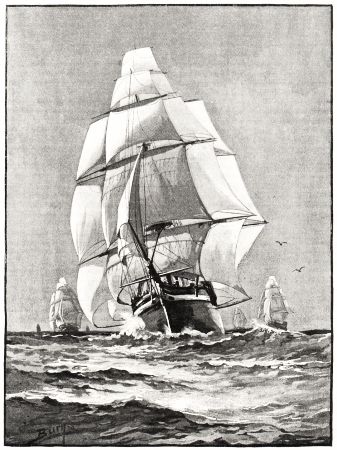
Among the many great results of the discovery of gold in California in 1849, none were more interesting than the clippers which were built in a few years to perform the carrying trade to the new El Dorado. Rapidly as the population increased, it hardly kept pace with the means to furnish supplies, notwithstanding the distance and the tempestuous nature of the sea they had to be carried over. Month after month ships surpassing in beauty and strength all that the world had before produced were built and equipped by private enterprise, to form the means of communication with the new land of promise. The most eminent ship-builders and enterprising merchants vied with one another to lead in the great race round Cape Horn. The common rules which had for years circumscribed mechanical skill to a certain class of models were abandoned, and the ship-owner contracted only for speed and strength. Ships varying in size from 1000 to 3000 tons were soon built and sent to sea, and their wonderful performances, instead of satisfying, increased the demand to excel. The ship Flying Cloud, of 1700 tons, commanded by Captain Creesy, made the passage from New York to San Francisco in 89 days and 4 hours. Such results would have satisfied most men that they had at last produced a model that would defy competition, but such was not the conclusion of Mr. Donald McKay, who built her and several other successful clippers. He consulted their captains about wherein they had failed to come up to his designs. Like a proof-reader, he only desired to detect their errors. The floor, or bottom, of the Flying Cloud represented the letter V. The next ship he designed was made to represent the letter U. This gave her more capacity and increased stability.
He built the Sovereign of the Seas, of 2400 tons, on his own account. Although she did not make as short a passage from New York to San Francisco as the Flying Cloud, yet she beat the swiftest of the entire fleet, which sailed about the same time, 7 days. In 24 consecutive hours she ran 430 geographical miles, 56 more than the greatest run of the Flying Cloud, and in 10 consecutive days she ran, by observation, 3144 miles. In eleven months her gross earnings amounted to $200,000.
The following were the passages made from New York to San Francisco by the clippers:
Tons.Passage.
Flying Cloud170089 days.
Flying-Fish160092 days.
Sovereign of the Seas2400103 days.
Bald Eagle1600107 days.
Empress of the Sea2250118 days.
Staghound1550112 days.
The following sailed from Boston to San Francisco:
Tons.Passage.
Westward Ho1700107 days.
Staffordshire1950101 days.
Mr. McKay built the Great Republic, of 4550 tons, with four decks; but she was partly burned in New York in 1853, and when repaired the fourth deck was taken off. She sailed several voyages between New York and San Francisco, and was never beaten. During the Crimean war she was hired as a transport by the French government, and with a leading whole-sail breeze not a steamer, far less a sailing-vessel, could keep alongside of her.
SHOWING DIFFERENCE BETWEEN THE LINES OF THE OLD SHIPS AND THE NEW CLIPPERS.
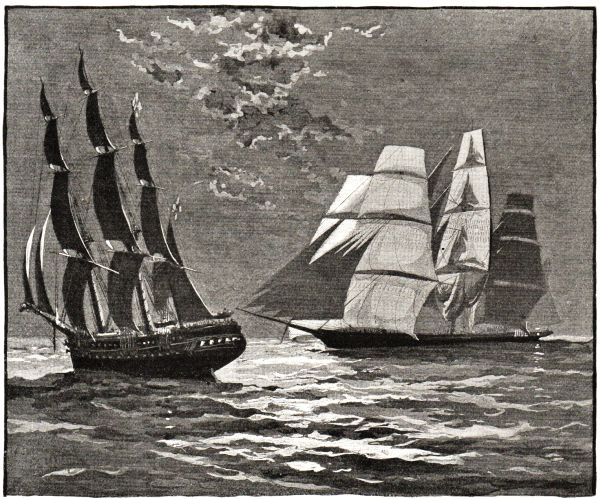
The last great ship designed and built by Mr. McKay was the Glory of the Seas, of 2009 tons. She was a combination of the clipper and the New York packet-ship, designed to carry a large cargo, to sail fast, and to work like a pilot-boat. She was 240 feet 2 inches long, had 44 feet extreme breadth of beam, and was 28 feet deep, with three decks. Captain Tom Chatfield, who commanded her several voyages, speaks of her as the grandest vessel he ever knew. She is still afloat, and hails from San Francisco. At one time she was owned by J. Henry Sears & Co., well known as eminent merchants of Boston.
Captain Waterman, in command of the clipper-ship Sea Witch, made some of the quickest passages on record between New York and China. His last command afloat was in the ship Challenge, which he took from New York to San Francisco. Captain Philip Dumaresq, of Boston, who last sailed in the ship Florence in the China trade with New York, ranked high during his whole service afloat. At sea he never took his clothes off to turn in at night, that he might always be on hand to spring on deck. The quickest passage on record from Shanghai (China) to New York was made in the ship Swordfish by Captain Crocker. Though becalmed a week on the equator, he made the run in 84 days, and beat the overland mail from India a week. It was stated in a San Francisco paper that the Young America made the passage from New York in less time than the Flying Cloud, but it was not confirmed. One hundred days was considered quick time for an outward passage. The ship Northern Light made the passage from San Francisco to Boston in 76 days. She was in ballast, and had fair winds all the way.
To show the rapidity with which clippers were built, the ship John Bertram, of 1080 tons, was launched six weeks from the time her keel was laid, and in two weeks more was on her way from Boston for San Francisco with 1500 tons of cargo on board. When she was launched, her builder, Mr. Robert E. Jackson, fell overboard; her owner, Captain William T. Glidden, plunged after him, without even taking off his coat, and saved him. Old sailors predicted that she would be unlucky, yet she kept afloat thirty years afterward, and cleared her original cost a dozen times.
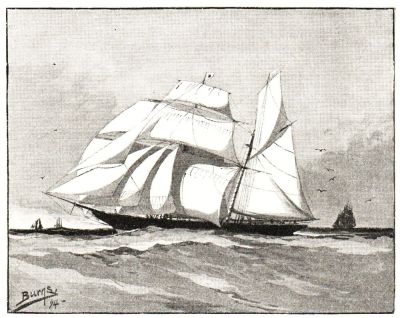
A CLIPPER-BRIGANTINE.
In 1855 there were 268 ships of an average of 1200 tons each under our flag, and most of them were clippers. In addition to these there were many barks, brigs, and schooners remarkable for beauty of model and famous for speed. From 1849 to the breaking out of the civil war we had the cream of the carrying trade of the world. After that our shipping declined rapidly; many of our famous clippers were sold to avoid capture. Steam navigation has superseded sails in the China and Mediterranean trade, and to-day there are not a dozen clipper-ships left under our flag.
When gold was discovered in Australia, the British purchased many of our fine clippers, which were very successful in their passages. The emigrants from British ports soon preferred them to their own vessels, on account of their spacious between-decks and high rate of speed. We also shared largely in the trade, and for several years kept regular lines of swift ships, laden with American goods, which found a ready market in Melbourne. After the adaptation of iron to ship-building, the British copied our clipper lines for most of their new sailing-vessels, and now compete successfully with us in carrying heavy cargoes. Iron ships have the preference in carrying grain from San Francisco to Europe.
In 1813 a vessel from China received a pilot off Cape Cod in a fog, and kept close inshore to avoid two British frigates which were in the bay. When off Plymouth the fog lifted and revealed the frigates about two miles distant, which instantly made all sail in chase. It was only half-flood, and the pilot was afraid that there was not water enough to run in; but he took the chances and succeeded, though both vessels opened fire upon him. Fortunately there was a company of militia on hand with a field-piece, which protected the ship against the boats that were despatched to cut her out. All the men of the place turned out and soon landed her cargo, composed of teas and silks, and then stripped the ship to her lower masts, apprehensive that the boats might make a night attack on her. But they did not.
William Gray, a rich ship-owner, had a clipper-bark which had been knocking about in the West Indies in search of freight. A vessel laden with sugar put into St. Thomas in distress, and sold her cargo, which the American purchased as a venture. She ran the blockade, and Mr. Gray was the first to board her. "Captain," he said, nervously, "I see you're very deep; what have you got in?" "Sugar," was the brief reply, "purchased on the ship's account." He felt that he had made no mistake, especially as Mr. Gray threw his hat in the air before he responded. Picking up his hat, Mr. Gray faced the Captain with a pleasant smile, and said, "It's just our luck, Captain; you have not only saved your ship, but this day there are not fifty boxes of sugar in all Boston, and prices are sky-high."
Early in the century Salem had some swift vessels engaged in the East India and China trade, but these have mostly disappeared.
Although large clipper-ships have mostly disappeared, we have many fine clipper-schooners engaged in fishing, which are unequalled for speed and weatherly qualities by the fishermen of all other nations. Change is the order of the day in shipping, as well as in most other things. The navies of the world have been changed three times during the past fifty years. The huge wooden ships of the line and frigates were displaced by the application of steam, and these have been superseded by iron and steel; and the end is not yet, for inventors assert that electricity will be the motive power on the ocean as well as on the land.