THE USE OF TORPEDOES IN WAR.
Reading edition
HOW THEY ARE MADE, AND WHAT THEY DO.
BY FRANKLIN MATTHEWS.
he most dreaded implement of war in these days is the torpedo. One of these darting fishes of death, costing a little more than $3000, can almost instantly send the most powerful battle-ship, costing as much as $5,000,000, to the bottom of the sea. This shark of war has a destructive charge of guncotton in its nose. When it strikes the war-ship it destroys itself and the ship also. No ship has ever been built stout enough to withstand an attack by one of these artificial monsters of the sea. They are made to leap from the side of a vessel into the water, and after they are once released they go with the speed of an express train to the place where they are aimed to go. They propel themselves through the water, and they keep exactly at a depth which is fixed before they are fired. Nowadays they dive from the ship into the water. It is probable that soon they will be sent into the water below the surface and out of sight of the enemy. Then no captain of a ship in battle will know when to expect an attack by a torpedo, and perhaps when he fancies that he has beaten his enemy, and has the other ship at his mercy, a torpedo may be darting at him, unseen and unerring in its track, that will send him and his ship to the bottom before any one on board can save himself.
A CONTROLLABLE TORPEDO IN ACTION.
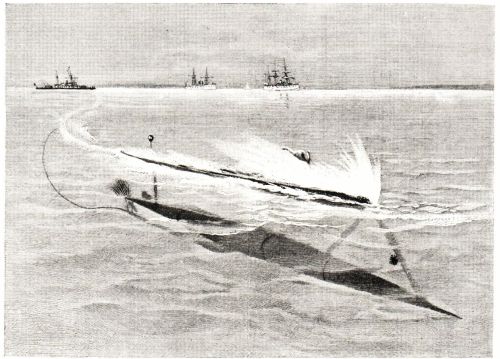
Torpedoes are of two general kinds. One is the automobile type and the other is the controllable type. The first goes its own way, that is, controls itself. The second may be steered or controlled from the place of its discharge. This country and most other countries use the automobile torpedoes, and we have two kinds of them. One is the Whitehead torpedo, and the other is the Howell. The Whitehead is practically a submarine boat, intended to destroy itself and anything else it hits after a limited run under the water. It has its own engine for propulsion, and uses compressed air as the motive power. The Howell is also intended to cause as much destruction as the Whitehead, and is also a submarine vessel. It is propelled by the rotation of a centrifugal wheel, which has been turned by machinery up to about 10,000 revolutions. As this wheel unwinds itself, so to speak, it sets the machinery of the torpedo in motion, and it goes on its errand of destruction. The Whitehead is a foreign invention, and the Howell is the invention of one of our own naval officers. This government has favored the Whitehead for the equipment of most of the ships of the navy, and for the purposes of this article we may take that as a type.
These torpedoes require as much delicacy in their manufacture as a watch. They are boats, and must be fashioned in their outlines so as to glide through the water without the slightest deviation. Any inequality of shape would send a torpedo flying off in some other direction than that in which it was intended it should go. Inside, the complex machinery must act as accurately as the machinery of a watch, or the torpedo will fail of its purpose. It would be tiresome to go into the full details of the machinery of a torpedo, and, besides, it is practically a government secret; but we may tell about the general features of these engines of war.
A WHITEHEAD TORPEDO.
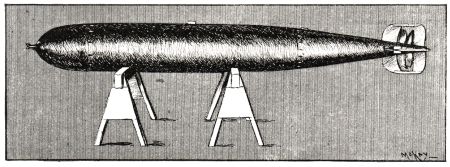
The Whitehead torpedo consists of several well-defined parts. The first is the head, where the guncotton is placed for explosion. This part is what is called "ogival" in shape, and is bluntly rounded. Then comes quite a long straight part. That is the chamber for the compressed air. Then there is what is called a buoyancy chamber, in which is placed the diving apparatus. Then follows the engine-room, to which the water is admitted through little slits in the torpedo. Then comes another buoyancy chamber, in which the important parts of the steering apparatus are placed, and then comes the tail with its two screws and rudders and fins.
The war-heads of the torpedoes of the largest size contain 220 pounds of guncotton. Most of this guncotton is kept in a damp condition. The rest is dry. The dry guncotton is exploded by a small charge of fulminate of mercury, and that in turn explodes the wet guncotton. About the only thing that will explode wet guncotton is dry guncotton. The war-heads of the torpedoes are so arranged that until they travel at least eighty yards from a ship the firing apparatus is locked. This saves the ship from being destroyed by its own weapon in case of accident. When the nose of the war-head strikes an object, it pushes a pin through a copper partition into the fulminate of mercury, and the explosion follows.
The torpedo's air-chamber consists of forged steel about an inch thick. It must be very strong, for it must be charged with compressed air to a pressure of 1350 pounds to the square inch. Expensive machinery is used in finishing off this part of the torpedo. The lathes, that work on the inside can produce steel shavings of the thickness of a thousandth of an inch. The long after-part of the torpedo is made of thin steel, but strongly braced so that the machinery can do its work.
We probably can best understand how these little ships are made by studying what they do. Suppose the battle-ship Kentucky wants to sink an antagonist in war. The air-compressor is set at work. A large-size torpedo is swung on a rack and lowered to a tube in the side of the ship, and slid in place. A valve is attached to an opening in the torpedo, and the air is compressed into the air-chamber. By means of a measuring device the observer has fixed the exact time and direction when to discharge the torpedo so as to hit the enemy. Four ounces of powder have been inserted in the torpedo-tube back of the torpedo, and the word to fire is given.
By a simple arrangement the air-valves are closed, the machinery in the torpedo unlocked so that after it strikes the water the air will flow into the engine and start the screws going. The gauges and springs have also been so arranged that the torpedo will remain at a fixed depth. With a speed of about a mile in two minutes the 16-foot torpedo rushes through the water. If it strikes the enemy, a great naval catastrophe happens. If it misses, it is so arranged as to sink after it has spent its force, and to disappear out of the way of doing harm to shipping. If practice work is being done with the torpedo at any time, the mechanism is so arranged beforehand that when the torpedo has run its course it rises to the surface and is recovered.
How does a torpedo keep at a certain distance under water? Well, there are two bits of machinery to accomplish that. One is a pendulum. If the nose of the torpedo raises itself, the pendulum swings backward and depresses the rudders at the stern, and brings down the nose. If the torpedo begins to dive, the pendulum moves forward, and the opposite result follows. The torpedo remains at the required depth through the pressure of the water that comes into the engine-room on a rubber diaphragm, to which is attached a delicate spring. The pressure of the water and the strength of the spring offset each other when the torpedo is at the depth wanted. If the torpedo sinks or rises, the harmony between the spring and the pressure of water is disturbed and the steering-engine is affected, and the rudders moved so as to keep the weapon at a certain depth. Slight changes up or down are regulated by this machinery; but if the plunge or rise is of a serious nature, the pendulum begins to swing, and the torpedo corrects its course at once.
Another most delicate part of the torpedo's machinery is what is called a "valve group." This is a set of valves used for various purposes, the chief of which is to restrain violent action from the compressed air during changes in direction of the little craft or during its run. They have such names as the "controlling valve," the "reducing valve," the "regulating valve." The flow of air into the little three-cylinder engine must be constant and of a certain pressure. The screws at the stern of the boat must be turned at the rate of about one thousand revolutions a minute, and the control of the force that propels them must be most efficient.
Another piece of important machinery is known as the "locking gear." When a torpedo is shot into the water from a ship the pendulum may lag a little in its swing forward. This would put the rudder down and make the torpedo take a deep dive. In shallow water this might mean contact with the bottom, and of course that would never do. The locking gear prevents any action by the rudder until the torpedo has travelled about a hundred yards. By that time the craft has settled to its work, and has ceased to make any skipping motions in the water. Thus we see that the torpedo is not ready for full duty until it has gone a considerable distance from the ship. It cannot explode nor steer itself until it is darting through the water under its own power at a certain depth and at a certain speed. If it does the work expected of it, it will strike its target in probably less than one minute. It therefore does appalling destruction in almost an instant.
TORPEDO AND LAUNCHING TUBE.
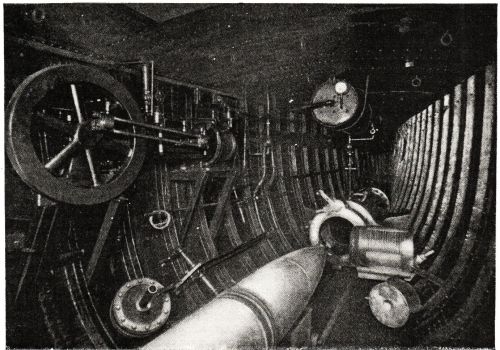
The reason that there are two screws at the stern is to make sure of propelling the torpedo in a straight line. One screw turns to the right, and one to the left. The tendency to go to the right or left which would occur if there were only one screw is thus equalized. The fin part of the tail also serves to keep the torpedo on a straight course. There is a great deal of variety in the machinery which is crowded into one of these torpedoes, but with that we need not concern ourselves. There is almost as much delicate machinery necessary to place the torpedoes in the water as to keep them going after they get into the water. The launching tube and air-compressors look like simple affairs, but in reality they have to be adjusted most delicately and most carefully to the torpedoes.
Great care is bestowed not only on this machinery on shipboard, but also on the torpedoes. The torpedoes are smothered with grease, and every precaution is taken to prevent rust from accumulating in any spot outside or inside. Every torpedo is tested most thoroughly before it is accepted by the government, and a careful record is kept of the performance of each in practice on the ship to which it is sent.
No one knows the full power of one of these missiles. In recent times two large war-ships, the Aquidaban in the Brazilian civil war, and the Blanco Encalada in the Peruvian-Chilian war, were sunk by torpedoes. Several smaller craft were sent to the bottom in the war between China and Japan. When we think of their power of destruction, and the extreme care and skill required to make them, it seems wonderful that such implements of war can be made for about $3200 each. That is the sum which the government pays for each of the 16-foot torpedoes. For those that are 11 feet 8 inches long the cost is, in round numbers, $2500 each.