Chapter VII
Reading edition
HARDSHIPS.
Now behold the third attempt that I have made to condense this part of my narrative.
In desperation, for I wish to push on, I have adopted the measure of giving but an outline of my personal history covering two years.
So I jump to a day in June, after I had been living in the little house on Mountain Brook some seven months.
During this time I had been to Miller's Falls but once with my uncle, but so insolently was I stared at that I did not care to withstand again the ordeal of pointed fingers and the whispered conversations of the curious. But now on this June day, here I was standing at the edge of the pasture waiting for some one most impatiently.
From the door-step of Belair but one other dwelling was in sight; except this, nothing but ranges of hill-tops. But a mile below lived a farmer named Tanner, who managed by hard labor to gain his living from the ground. But I was not waiting for him, nor for my uncle, nor for Gaston, who, by-the-way, had been constituted, or had appointed himself, my guardian to such an extent that I might at times, with no stretching of the imagination, consider myself a prisoner. No, I was not waiting for any of them, but for some one who soon hove in sight across the slope of the opposite hill. It was a little girl of my own age, and the only living being at that time who knew anything of my thoughts or life; and they were both strange enough for a boy of fifteen to possess or to endure.
Perhaps if I should tell of our conversation on this day it might recount something that would show how things were with me. In our meeting there was nothing but the friendship of two lads, to put the case as it really appeared to be, and when she had climbed up on the top rail of the fence beside me, and hooked the hollows of her feet behind the bar to keep her balance, the way I was doing, we began, as children do, to speak without preliminaries of any kind in the way of greetings.
"Why weren't you here this morning?" she said, as if accusing me.
"He had one of his fits on and kept me at work," I replied. "First I had to practise with the small sword for two hours. If I don't look out he will run me through some day. I almost wish he would."
"I heard you shooting," said the girl.
"Yes, he wouldn't let me off until I had placed three pistol balls inside a horseshoe nailed to the side of the barn; but I'd rather do that than go through the fencing."
"Down in the village and at our house every one says you're all crack-brained up here," the girl said, making a grasp in the air at a yellow butterfly that flittered over her head. "What else did you do?"
I was ashamed to say that I had been at my dancing-lesson, so I said: "I had to translate four odes of Horace and learn all about a lot of stupid people named De Brissac. I'm glad they had their heads cut off."
"Why did that happen to them?" asked the girl. "What did they cut their heads off for?"
"Because they were nobles and offended the French Republicans by being polite and well dressed and clean, my uncle says."
"Tell me all about it."
I had had the history of the great French revolution, at least one side of it, drilled into me ever since my advent at Mountain Brook. I had learned that my uncle had escaped to America from France, where he had fought for the King, and that my mother and her twin sister had also managed to get away from the frightful prison of La Conciergerie with their lives, but that my grandfather, two uncles, and an aunt by marriage had all lost their heads by the guillotine for the sole reason that they were rich, very well dressed, and very polite indeed, so far as I could make out.
I had learned by heart the family histories of any number of the great noble families of France, and all of this I considered most dull work indeed, and wasted time. However, the story that I related to Mary Tanner, as we sat on the top rail of the fence, seemed to interest her greatly.
"You see," I was saying, after I had finished spinning the long yarn, "my name is not John Hurdiss at all; it is something else."
"What is it?" asked the girl.
"I have no idea," I replied; "but my uncle always calls me Jean, which means John, and, to be honest, I don't think he knows himself."
"I don't see why he shouldn't be able to tell," replied Mary, "if he knows so much about other people."
"No more do I," I answered. "But I don't care. John Hurdiss is good enough for me."
Now, the fact of the matter was this, and I may as well state it here as afterwards: I had guessed about the truth. My uncle did not really know my name, and for this reason:
You see, as I have told, my grandfather was the Marquis de Brienne (I have forgotten to set down that Gaston always called my uncle "Monsieur le Marquis," or something that might be resolved into that). Well, the old gentleman (my ancestor) had three children—the present proprietor of the Château de Belair on Mountain Brook, and twin daughters, Hortense and Hélène, who afterwards married two of the well-dressed and well-hated ones at a time when they had more titles than gold.
Now it happened these two latter gentlemen—my father and uncle, of course—had each the same initials (it is no consequence what the names were, but each ended in "de B"). Early in the great troubles they had sought refuge in England, having better luck than their future wives, who were taken by the revolutionists. But the two ladies escaped through the aid of an adventurous sea-captain, and they joined the colony of refugees in England, where they each found a husband. But affairs did not prosper with them. In the year 1798 the Duke de B—— became entangled in a plot of some kind for the restoration, was caught in France, and lost his head like the rest of his family; and in the same year the Comte de B—— had an unfortunate duel with an English Major of infantry, and was killed. This left the two noble ladies widows, each with an infant boy of a few months old to take care of. For some reason they packed up their belongings and set out for America on a sailing-vessel, commanded, it appears, by no less a person than the sea-captain who had assisted in their first escape from France.
Sad to relate, the ship in which they sailed was wrecked, and one of the ladies was lost with her infant in the disaster. Whether it was the Duchesse de B—— or the Comtesse de B—— was not placed on record, but the commander of the ship, Captain John Hurdiss, married the survivor at some place in the West Indies, I believe.
Now there was no way of finding out which one of the ladies the gallant Captain Hurdiss had married, and I had never heard my mother's first name mentioned that I could recall. My uncle did not know it, of a certainty. This was the situation in a nutshell, and I trust that I have made it plain, for I have endeavored to do so in the very shortest manner, to the best of my ability.
Thus the loss of the letter and the burning of the strong-box were two misfortunes that had prevented me from knowing really who I was.
All this may seem complicated, but I have done my best to make it lucid; and with a heartfelt apology for this long digression, let me return to the day in June, and to the boy and girl talking together, balanced on the top rail of the pasture bars.
"Did you bring the book with you that you were speaking about?" I asked of my companion.
"No," she replied; "but I will leave it under the flat rock this evening."
"I'll get it, then," I answered. "Halloa! Look at that."
"It's a woodchuck," said the girl, jumping from her perch, and we both charged at a small brown animal that scurried into a hole beneath some loose stones. We were busily engaged in routing him out and he was whistling back defiance (we had almost got at him), when I heard my name called. I looked up and saw my uncle and old Twineface approaching along the path.
"Jean, Jean! Come here at once!" called Monsieur de Brienne, in French.
"I'm going to run," said the girl, who had often expressed her terror at Gaston's appearance.
Without another word she turned and fled, jumping over the tall ferns like a deer.
My uncle had now approached within a few feet's distance.
"Who is that with you?" he inquired, angrily.
"Mary Tanner, the daughter of the farmer below," I replied. "I have known her for some months. She is very nice—and—and pretty," I faltered.
"Bah! You shall have nothing to do with her. Never speak to her, d'ye mind me? And here's where you have been spending your time instead of being at your studies. Come back with me; I will fence with you."
It was one of my uncle's young days; and here, to put down something that neither I nor any person of real learning to whom I have related the facts, could account for: at varying periods my uncle, who was past sixty, seemed to be gifted with an agility, a nervous force and strength, that I have never seen equalled in a man of his slightness. This rejuvenation, during which he often sang rondeaux and tinkled an accompaniment on an old lyre, would last for some ten hours, perhaps, and would be followed by two or three days, or sometimes a week, of collapse, during which he appeared on the verge of dissolution, and either Gaston or myself had to be with him every minute, administering from time to time a few drops from an acrid-smelling vial.
But, as I have said, this was one of his youthful days.
I had been awakened in the morning early by a strange sound, and had found him jumping the colt backwards and forwards over a hurdle on the grass-plot before the house, Gaston standing by, a grim spectator, with no interest in his dull, lack-lustre eyes. For an hour the old man had put me through a practice with a small sword (he was the best fencer I have ever seen), until I almost cried out from weariness, and we changed the exercise for pistol practice. Now we returned to Belair, and despite my complaining, I was forced to take up the foils again, and actually to defend myself, for my uncle kept me up to my work by now and then giving me a clip over the thigh or forearm. At last I grew angry, and pressed him so close that a smile of pleasure drew his lips, and he muttered "bravo" two or three time beneath his breath. Suddenly I noticed a gray shadow cross his face, and his eyelids drooped. He raised his hand, and without a word fell forward at my feet. It was one of the worst attacks that he had experienced, and for five days Gaston and I nursed him, and I found no chance to get away to the pasture bars, or to the flat rock where Mary had placed the book we had spoken of.
On the sixth day my uncle was up and as spry as ever, but now I found that I was practically under surveillance; wherever I went the frightful Gaston would go also. He was a most unpleasant person to have around, for although his senses were most acute and he possessed the cunning of a wolf, it was impossible to carry on a conversation with him. He had an impediment in his speech, a combination of a stutter and the result of having no roof to his mouth, that made his utterances sound like those of a savage or wild beast. To say "yes" or "no" was an effort for him, and he usually expressed his meaning by making signs.
One day, I remember, I had determined to test my authority over him (for in most things he obeyed me implicitly, so far as the fetching and carrying went, but upon this occasion, as I say, I determined to give him a test). I had walked as far as the edge of our clearing, and paused on the bank of the brook.
"Gaston," I said, "go back to the house. I'm going on alone." The only reply was a shake of the head. "Do you hear me? I'm going on alone." (It was my intention to make my way to the Tanner farm-house, where, by-the-way, I had never been, and ask for Mary.)
Now, seeing that Gaston did not intend to obey me, I jumped down the bank and dashed across the stream, but I had not taken a dozen strides before the old servant had me by the arm; his long fingers closed on my flesh like a steel clamp. The result was that I went back to the house. But that evening I managed to get away, and went to the flat rock, under which I found the book. I had to wait until daylight before I could examine it, although Mary, a week or so before, had told me of its contents.
It was an old volume relating the adventures of an Englishman named Robinson Crusoe (I can recall the musty smell of its pages at this very instant). Oh, the delight that I had for the next few hours, reading the greatest story, to my mind, that was ever penned! Oh, the desire for freedom and the longing to see the world which was builded up within me as I turned each page! Ah! Robinson, Robinson! despite the moral you intend to teach, you have turned many lads' minds to the sea, and given them a burning, dry thirst for adventure not to be quenched at home! I had read few stories in English up to this time, but I fairly shook, as I read this one, with the intensity of my sensations.
I am afraid that living this life gave me a tendency for dissimulation, although in my gaoler, Gaston, I had a hard one to deceive. Nevertheless I succeeded in getting away one afternoon, and made my way through the woods to Farmer Tanner's. Suffice it to say that I was chased out of the door-yard by the goodwife, with a broom in her hand, who informed me that Mary had gone away—where, she did not state. I was threatened, incidentally, with the ox-goad, if I should return; and so my errand was not altogether successful.
Now to give a big jump over time. Another year went by. Oh, the misery of it all! The long, snowed-in days of the winter when, although my uncle had money, I think, I had scarcely sufficient clothing to keep me warm, and barely enough to eat. M. de Brienne's conduct and manner by now had become so strange and his mind was so volatile that I could never say that I felt affection toward him. I had begun to hate Gaston generously.
When spring came, to amuse myself, I delved in the garden, and was rewarded by seeing all my green things prosper wondrously. An illness that had lasted over a month almost brought me to my grave in April, but I cannot complain for lack of nursing. Now, however, there had entered my mind but one idea—to escape, and that right soon. Why I had not thought of it seriously before must excite wonder. The determination to begin to prepare for an actual separation came to me in this fashion.
Owing to the strangeness of the costumes I was forced to wear, I had much hesitancy about going abroad. People would have taken me, I fear, for a mountebank. My coat, much too small, was of velvet; my breeches, of stained and heavy brocaded silk, much patched; and my hose tattered and threadbare. I was well shod, as my uncle possessed a box of shoes and boots of curious fashion and superior workmanship, that fitted me, even if those I wore were not always mates. But I determined I must have other clothing.
I knew nothing of the goings on of the outside world. Now to come to the day on which I was enlightened.
June again. I had escaped from Gaston's eye (the old man had begun to show some signs of age), and had gone down to the highway that led to Miller's Falls. Half hid in the bushes, I was seated, hoping to catch a glimpse of some human being, when I saw walking down the hill a man whose appearance made my heart give a leap—a tall, broad-shouldered figure, dressed in a sailor jacket and wide trousers. A great bundle, that he carried as if it was a bag of feathers, was on his back, and he was whistling merrily as he swung along the road. I knew him in an instant, and his name came to me. It was Silas Plummer, who had been one of the crew of the Minetta. I sung out to him by name. He came to a halt, but showed half fright upon my appearing through the bushes.
"What in the name of Moll Roe have we here?" he cried.
"It is I, Master Plummer," I answered, and I told him who I was. In my eagerness I must have appeared half crazed, I judge, for he looked at me askance as I grasped him by the arm.
"What are you doing, lad?" he inquired. "And how you've grown!"
In a few words, and in an incoherent fashion, I fear, I told him of my life and my virtual imprisonment. Evidently the explanation that I made set his mind at rest in regard to my sanity.
"Why don't you clear out?" he said. "There's a chance for a fine lad like yourself to the southward. The sea is not far away (how my heart leapt at the word 'sea'!), and there are great goings on there. We've taken their frigates, and given the lion's tail a twist until it is kinked like a fouled hawser."
"What do you mean?" I inquired.
"Hear the lad!" Plummer responded, setting down his bundle and going into the pocket of his jacket and drawing out a newspaper. "There's a war between America and England. I'm just in off the Comet privateer. Listen to this," he said. He slapped his trousers pocket, and it chinked to the sound of gold. "And listen here," he repeated, and he tapped the other side. It jingled musically. "Ho, but we are getting even with them for all their mail-stealing!"
"A war with England!" I cried, taking the paper that had "Victory!" spread across it in large type. "Do you remember Dash, and his hand there on the deck?"
"Ay, like a glove thrown in the face of the King," said the sailor; "and the news of it is about the world."
"Plummer," I said, "sell me some clothes. I'll pay you for them—if you'll wait." I had hidden three or four of the gold pieces under the flat rock. "I will run and fetch you the money," I continued, eagerly.
"Not a penny, not a farthing," answered the man, giving my shoulder a push. "Come into the woods. I have some duds that might fit you here in my bundle."
My hands and, indeed, my knees also, were trembling so that I had to have his assistance (a strange tiring-maid) in getting into my clothes. But in ten minutes I was rigged out all-a-taun-to in the outfit of a swaggering privateers-man, even to the shirt opened at the throat and the half-fathom of neckerchief. I recollect that I was crazy to see how I looked in it.
"And here's a cap, too," he said. "It has a Portugee rake to it, but never mind; now you're ship-shape."
He stood off and looked at me, with his head sidewise, as if I was wholly some workmanship of his own hands.
"ANCHOR'S ATRIP!" HE CRIED; "SET SAIL AND AWAY."
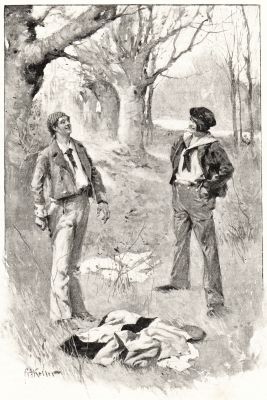
"Anchor's atrip," he cried, imitating the shrilling of a boatswain's whistle; "set sail and away."
"How—how can I thank you?" I said, half faltering, and blushing, for I felt hot all over.
"By meeting me ten days from now in Stonington. There's a crack brig, the Young Eagle, about to sail from there; and though they'll take few greenhorns, togged out that way you can pass muster. Ship with me, mess-mate. I'll help you out!" He grasped my hand. "Ah, you've got a good grip for a rope! And look at the chest and the arm of you! Big as my own, I'll warrant."
I had never realized what a size I had become; but I had been finding out that it was only my uncle's skill that kept me from disarming him in our fencing-bouts of late, and that Gaston had not laid hands on me since some time before my illness. Now I was fully recovered and in fine fettle.
"I'll go with you," I replied, grasping Plummer's hand again, "and God bless you!"
"The Young Eagle, then, at Stonington, eh?" He slapped his pockets and started off. "I'm bound up-country to see my sweetheart," he shouted back from over his shoulder, and I heard him chanting the "Sailor's Return" as he disappeared about a bend in the road.
I gathered my rags and made for the brook, where I looked at myself until I became fairly ashamed, and threw a stone at my reflection in the water. Then taking off my clothes, I donned the old ones, and hiding my bundle beneath the old flat rock where I kept the Robinson Crusoe, an old horse-pistol, and many treasures (including a half-score of the De Brienne buttons), I went up to the house. I could see that my uncle was in a strange excitement (that he was going mad I have no doubt of now). Gaston cast a suspicious look at me, in return for which I, elated by the doings of the day, made a threatening gesture. Of a truth, I think the man had grown afraid of me, for he cringed.
At twelve o'clock that night I was awakened by some one stirring in my room. I looked up. It was my uncle. He was in his night-dress, and his gray hair straggled over his ears. Held close to his side, as if it rested in a scabbard, was a narrow court sword, whose naked blade flashed in the ray of the moonlight that came in at the curtainless window.
"No, by St. Michel, they shall not enter!" he cried, and he stopped suddenly, rigid, as if he were listening for some one coming up the stairs. Then he turned to the bed on which I lay.
"Arise, your Majesty!" he said. "They're upon us. Come, gentlemen, stand fast!"
Again he listened. "No, they're gone," he whispered, softly. "Is the Princess calling for me?" He made as if to sheathe the sword, and I saw, in doing so, the sharp blade cut into the palm of his left hand; but he paid no attention to it, and went down stairs.
To say that I had shuddered would not express it. And suddenly, as if a burst of light had come upon me, the idea that I need no longer stay flooded my brain.
"Why, he might murder me!" I thought, the conviction coming then for the first time that he had turned mad-man. I arose, and only putting on half my clothing and my shoes, I lowered myself out of the window.
It was cloudless, and the moon was at the full. My shadow chased before me as I ran down the path. Freedom! freedom! seemed to beckon me. I breathed the same sensation that I had on that clear moonlight night when the salt breeze was in my hair, and when the wide sea rose and fell and the little brig dashed through it—as if she had caught my exultation of I hers.
I leaped the brook and scattered the sleeping birds out of the bushes up the banks. "Ho for the sea! Hurrah!" I cried; and I never turned to give even a farewell look at the Château de Belair.