Chapter I
Reading edition
THE THREE-CORNERED BOAT.
"It goes through the water like a wedge," said Pete. "Old Captain Kroom had it made for himself. That's why it's so wide."
It was "so wide" only at the stern, and it narrowed to a blunt edge at the prow. All of its lines were pretty nearly straight. Its bottom was as flat as a floor. At its forward end it was decked over for about two and a half feet. It was a bit of deck that might serve for a seat, but in the middle of it was a round hole, and from this there stood up a straight stick nine feet high.
"There's a pretty long boom for that mast," said Pete. "When the sail's on it's a kind of cat-boat. Old Kroom won't row a stroke if he can help it."
"Well," said Sam, "I guess I wouldn't, either. But won't it tip over with a sail?"
"No, sirree," replied Pete, confidently. "It needn't ever tip over. Why, if you know how to sail a boat, you won't let yourself be upset."
"Boys," roared a deep husky voice behind them, "what are you doing with my boat?"
They both whirled around instantly.
"We weren't touching it, Captain Kroom," said Pete. "I met him up in the village, and he wants to go fishing. He says his name is Sam Williams. We've bought some clams and some sand-worms."
"Both of you get right in," commanded Captain Kroom. "I guess he's a city fellow. We'll show him some fishing. Pete, put in that pail of live bait. They're prime minnows. Sam, take the sail and boom and lay them forward, ready for me. Jump, now! the tide's turning. If we don't get right out across the bay we won't catch a bite."
"Sam," said Pete, as his companion seemed to hesitate, "pitch in. He knows fish."
The two boys were not so much unlike in their height and age, but there was hardly any other resemblance between them. Sam had no need to tell anybody that he did not belong on that shore. He was too nobbily dressed, his dark hair was too smooth, and his hands were too white. There was some healthy sunburn on his face, but it was nothing to the tan on Pete's. Besides, Pete was red-headed, and had a full supply of freckles. What was more, his rig, from his straw hat that turned up in front, down to his bare feet, was as unlike as could be to Sam's neatly fitting navy blue. Nevertheless, they were a bright-looking pair, and Sam stepped ahead quickly enough, after his momentary flush of rebellion at being "ordered around."
The fact was that old Captain Kroom was "bossy." It was his boat, to be sure, but he stood there and looked in all directions, as if he owned the bay, if not also the sand-bar on the further side of it, and the Atlantic Ocean beyond that.
He was a very large man, and very heavy. The three-cornered boat hardly seemed to feel the weight of Pete and Sam when they went into it with the bait and fishing-tackle and the other things. It rocked, of course, but it was steady enough, as if it were accustomed to boys, and did not mind having them on board. When, however, Captain Kroom finished his observations of the sea and the sky, and very deliberately put one foot into the boat at the stern, that end began to go down.
"Hold hard, boys," he said; "I'm a-comin'. Steady, now."
His other foot came in, and he at once sat down upon the stern seat; but at the same moment Sam, at the prow, felt as if he and the mast and sail were going up.
"Boys," said Captain Kroom, "I'm glad you're here. Keep well forrard, and it'll kind o' trim the boat. Pete, you and Sam can 'tend to the sail. Cast her loose from the wharf. Give her her head."
"Sam," said Pete, "let the sail swing right out. You and I'll have to row till we get out of the creek."
"No, you won't—not with this breeze," growled the Captain. "Give me the ropes. We'll dance right along."
"He knows how to handle a boat, Sam," said Pete. "He can get out all there is in her."
Right at the shore of the mainland there was a kind of small shut-in harbor. It had a rickety old wharf, at which the boat had been fastened. Other boats were there, hitched a little way out from the wharf. Some of them were pretty good sized sailing-boats. Straight across the harbor, the patch of open water in front of the wharf, was a wide reach of rushes, and among them wound the narrow crooked ribbon of water that Pete called "the creek." Outside were the dancing waves of the bay, and there was bright sunshine everywhere.
If it was all a kind of every-day affair to Pete, it was not so to his friend, and Sam's eyes were glistening with excitement. "Ain't I glad I met you!" seemed to almost burst from him; but Pete's reply was uttered in a very matter-of-fact tone.
"You'd better be glad that Captain Kroom came. We wanted a boat, too, but it's the best kind of luck to have a man that knows fish. I've known lots of fellows like you come out here to fish, and that didn't catch a thing."
"Up with her!" shouted the Captain, and in a moment the sail was full.
In spite of the two boys forward, the boat was inclined to lift its nose, but away it went slipping into the creek, and making swift headway along the crooks and turns among the rushes.
The steering and the management of the sail were all in the hands of the old fisherman. It almost seemed as if the wind must be, too. There was enough of that, and the boat went this way, that way, so far as Sam could see, with very little regard to the direction the breeze came from. He said so to Pete.
"Guess so," replied the 'longshore boy. "He knows his boat. So long as a wind isn't dead ahead, he doesn't care. But he hates oars. So do I."
There the oars lay, along the sides of the boat, two of them; but an oar stands for work, and Sam was quite willing to let the sail work for him. He was now sitting forward of the middle of the boat, looking ahead, but every now and then he glanced back at Mr. Kroom. He looked all the bigger and heavier for being in a boat and because he weighed it down. It occurred to Sam that it probably would not tip over so easily with so much human ballast to steady it.
"Queerest kind of beard," he said to himself. "His mustaches are awful."
Not that the beard was so very long, but it was stiff-haired and curling, and it stuck out on all sides. Below his chin it came down in a great gray bunch. That and his gray mustache and his jutting eyebrows and the deep wrinkles across his forehead gave him a fierce look. It grew worse every time he gave an order. His hands, too, were large, hairy, and looked as if they had been stained like old mahogany. It was not by any means a shallow boat, and it was not short, but it was not exactly like anything else that Sam was familiar with, and he said so to Pete.
"Of course it isn't," said Pete. "He'll go out to sea in it, where nobody else'd dare to. But he knows the sea. He's been everywhere."
"Out, boys! We're out o' the creek!" shouted Captain Kroom, as if it excited him to get clear of the rushes. "Hurrah! Troll, both of you! Get out your lines! I won't fish; I'll sail. Quick!"
Sam felt as if something in Kroom's voice took hold of him and set him going, it was so tremendously bossy.
"He's a captain," thought Sam. "He's been a ship-captain, and he's used to ordering sailors. Guess they jumped."
That was what Pete had done, for he had the basket of tackle on his side of the boat. She was dashing along now, right out into the bay, and she rode the waves capitally. The sail swung away out and the boat leaned over, but for all Sam could see, the stern with Captain Kroom in it sat almost square on the water. No boat bends in the middle, but it had that look.
"She's going!" exclaimed Pete. "Tell you what, Sam, the Elephant can outsail some of the fastest boats along shore. She's a ripper!"
"Out with your lines!" growled the Captain of the Elephant. "You won't catch anything, but I like to see the lines out. No bluefish in the bay, unless they came in last night."
Sam evidently felt very much as Captain Kroom did about having the trolling-lines out, but Pete seemed entirely willing to let his city acquaintance have the first line that was ready. Both of them had already said enough to let Captain Kroom know that Sam's city relatives were boarding at a sea-side hotel a mile or so up the coast, and that he had visited the village that morning for the first time. There he had met Pete, and they had agreed to go fishing together.
"Humph!" said Captain Kroom. "I always had to pick my crews anyhow I could. Made sailors of 'em, though, after we got afloat."
The boys heard him, but Pete was making no haste with his line. He remarked to Sam,
"If he says there are no bluefish, then there ain't any. He knows."
"None yesterday," came hoarsely from the stern of the boat. "What do you know about fish? Did you ever catch a whale?"
"Never trolled for one," said Pete. "Guess you didn't, either."
They must have been old acquaintances, but Sam looked astonished to hear Pete answer so tremendous a man in that free way.
"Didn't I?" grumbled thunderously out of the deep chest of Captain Kroom. "Well, I did, then. Struck him, too, and made him tow my schooner further than across this bay. What do you think of that?"
"What did you do with him?" exclaimed Sam. "Did he get away?"
"No, sir, he didn't get away," replied the Captain. "But he sounded, and that's where the whale-line went."
"Sounded?" gasped Sam. "I didn't know a whale could holler."
"Holler?" put in Pete, with some contempt in his voice for the ignorance of a city fellow. "He means the whale dove to the bottom."
"Don't know about the bottom," went on the Captain. "But he pulled out a mile of line, and when he came up the harpoon was in him yet. We got him."
"Oh!" said Sam. "You trolled for him with a harpoon. Oh! Hullo! I've got a bite. Oh!"
His hook was a pretty big one, set firmly in a bone that Pete called a "squid," and this had been glimmering over the waves astern while Pete was getting his own line unsnarled.
"Hold hard!" shouted the Captain, as Sam tugged and strained.
"I can't," said Sam, as the line was jerked from his hand and began to run out swiftly over the side of the boat. "He's getting away!"
"Lost him!" almost groaned Pete. "He pulled like a shark."
"More like a stick of timber," very quietly but gruffly remarked the Captain. "I'll tack and see what it is."
He was swinging the boat around while he spoke, but the moment he had done so he reached out and grasped the line which had been so suddenly jerked away from Sam. It was running loosely now.
"Haul it in, boys," he shouted. "We'll see what's at the other end of it."
"Biggest kind of fish!" said Sam. "It hurt my hands."
"Fish?" said the Captain. "Don't you know a fish-bite from a snag? You will when you've catched more of 'em."
Nevertheless the boat could not go directly back upon its former trail, and the line the boys were pulling in grew taut again. As soon as it straightened, the Captain once more touched it, and his fingers told him something, for he remarked:
"It's kind o' loose, too. There are lots of stuff floatin' 'round this bay. It might be wreckage."
Sam was hardly enough of a seaman to get a clear idea from that, and he stood up to watch. He was a pretty good-looking young fellow, with bright dark eyes, and with, just now, a very enthusiastic, highly colored face.
"I knew we'd have some kind of luck if we sailed with Captain Kroom," said Pete.
"Here we are!" shouted the Captain, and down dropped the sail as he added: "Take the oars, Pete! Sam's catched a cod-lamper-eel."
Pete sprang to the oars with the activity of a monkey, and they were instantly in the rowlocks.
"I'll bring her around," he said; but Sam was leaning over the side of the boat to get a glimpse of his "eel."
"Humph! Canvas! Old sail! Bit of spar!" growled the Captain. "I'll cut Sam's squid loose. Sam, hand me that boat-hook."
It lay on the bottom, and hardly was it in the Captain's hand before the three-cornered Elephant began to lean over with his weight.
"'Twon't do," he said. "Fetch her starn around. This 'ere's a find. Boys, there's been a wreck somewhere. It's a jib-topsail. That's a spritsail-yard."
"He knows," said Pete; but Sam was in the dark as to how one piece of half-sunken canvas could be distinguished from another.
"Steady, Pete! Pull!" commanded the Captain. "I'll get a good look at it. It's worth towin' in; but we'll make this tide carry it as far as it will. Pretty good bit of duck."
Sam saw no kind of water-fowl, but in an instant more he remembered something, and said, "Cotton duck."
"English duck," said the Captain. "Pretty near new. And there's something down there hitched to the spar. We don't need any fish to-day, boys. I'll gear this fast to the boat, and then I'll gropple 'round."
He had spare rope enough in his three-cornered boat to make a hitch with, and the Elephant was quickly anchored to the all but sunken prize. While he was doing that, however, and while Pete worked the oars, Sam had not been idle. He had a very clear idea that whatever this might be, he had caught it. Of course it belonged to them all, like any other fish, but it had bitten upon his hook. Now that he had that back again, he was disposed for more catching, but not one of his motions had escaped the keen eyes of the Captain.
"That's it," he said to Sam, after making a fruitless sweep through the water with his boat-hook. "You can gropple, too, but put on a sinker, or it won't go down. Heaviest chunk of lead there is in my basket."
It was plain that he liked the quick and handy way with which Sam followed his directions, for he said:
"I've known a young lubber like you, green as grass, turn out to be a right good foremast hand. Tie it tight and swing it out. That's it. Let it go down. There! Pull!"
"I've struck something!" said Sam, breathlessly; but even as he did so he was thinking.
Wrecks? He had heard all sort of things concerning wrecks. What if a sunken ship should be away down there? The Captain said this was a topsail. He must know. Then there were lower sails. There were masts. Every ship had a hull. What about drowned people? What if he were about to pull up somebody that had been drowned?
It made a kind of cold chill run all over him, but he tugged upon his line, and something at the end of it slowly yielded and came nearer. Meantime the Captain plied his long-handled boat-hook, and now he suddenly exclaimed:
"I've hitched on a hawser! Here she comes! Look out for the boat, Pete."
"Guess I'd better," said Pete, for the Elephant was tipping around in a most disorderly way, and the water was a trifle rough with waves.
"Only a rope," thought Sam, as the Captain's catch came in sight, but the old sailor's eyes twinkled, and he said to himself,
"There's something at the other end of it."
"Sam!" exclaimed Pete. "You've struck a bundle! Haul it in!"
"Can't," said Sam. "I guess it's fastened to the rope the Captain hooked."
"No, bub, it's hitched to the spar," said the Captain. "Cut it loose, and in with it."
Sam pulled out his pocket-knife, but his fingers trembled so that he hardly could open it. Then he reached over and began to cut away, but before the bit of rope that held the bundle was severed the Captain shouted:
"Wreck it is! Got another catch! It's a valise. There comes the spar, all afloat. Hullo! That's too bad. Somehow I unhitched that sail. It's gone to the bottom."
It was just so. The water-soaked canvas had been buoyed only by the wood, and as soon as that was cut away it went down out of sight.
[to be continued.]

BY CYRUS C. ADAMS.
The schools for black boys and girls in the Congo country have a very unusual feature that perhaps is not found in any other part of the world. Some of these schools are exclusively for boys, and the others for girls, and the intention is, when they grow up, to have them marry one another, thus creating civilized families, who will help to improve the people around them. Probably the young men and women will not think this is a hardship, for it is believed they will prefer to choose their wives or husbands from among those who have had some education, like themselves; and if they do not, they will undoubtedly have the privilege of choosing where they please. Whether this plan is wise or not, it shows at least that the white race is beginning to think a good deal about the black children in Africa; in fact, these coming men and women are expected to help far more than their barbarous fathers and mothers of to-day to civilize Africa.
SISTER OF CHARITY AND SOME OF HER PUPILS.
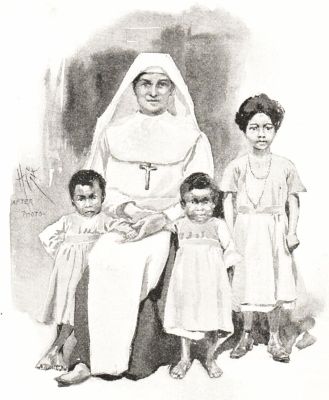
If we were to visit Belgium this summer we should find many little black girls from the Congo in the convents there learning to read and write, sew and cook, and to do many other useful things. When they go back to their homes it is expected that they will wear the garb of the Sisters of Charity, and teach their people as the devoted white Sisters have been doing since 1892; and if they do well, they will ultimately take the place of those pale-faced women from Europe, who suffer from the trying climate. Thus far one-fourth of all the girls in the chief Congo Catholic school, the brightest among them, have been sent to Belgium for years of training.
All through the French Congo we see the government officials keeping a sharp lookout for the more promising sons of native chiefs; for some day these boys will become the most influential natives in the country, and so the French are gathering many of them into schools near their homes, and are sending others to France to be educated. Of course they will not all turn out exactly as the French hope they will.
Some years ago an African chief was killed in battle with the French forces. One of his sons was sent to France. No black boy there makes better progress in his studies, but visitors shake their heads when they hear his answer to the question what he hopes to do in the world.
"I hope to live long enough," he sometimes says, "to avenge the death of my father."
He will probably change his mind, and, at any rate, France will give him no opportunity to make her any trouble.
Professor Drummond, after his visit to Africa, said he would like to get inside an African for an afternoon, and see how he looked at different things. Wouldn't we like to know just how these boys and girls feel, and what they think, when they are suddenly landed, fresh from the depths of a savage land, in the streets of Paris, Brussels, or Berlin, and see more things in a day they never heard of than we do in a year? They learn many things, as a baby does, by stern experience. When Von François brought an eight-year-old boy from inner Africa to the sea, the youngster chased along the beach in high glee, and before any one could stop him, tried to refresh himself with a big swallow of ocean water. This same boy, Pitti, thought the snow he saw falling in Berlin was a swarm of butterflies. The first horse he saw terrified him, and the Berlin newspapers told of his unbounded astonishment at the strange dishes and viands on his master's table. What a marvellous change in the condition of these children! Many of them were slaves, and some of them had been brutally treated and even wounded by cruel slave-dealers. To-day they have good homes, and the world is doing all it can to make them intelligent and honorable men and women.
There are "street arabs," or homeless boys, in the Congo villages, just as there are in New York city. They live on what they can pick up, and it sharpens their wits to have to hustle for a living. It would take a smart Yankee boy to beat some of these Congo youngsters in a trade. Even a five-year-old will sometimes amass a little capital. Somehow he will get hold of a string of beads. He may trade it for a small chicken, which thrives under his nurturing care, and in a few months he can sell the fowl for four strings of beads, quadrupling his capital. Pretty soon he is able to buy a pig, which follows him like a dog, and sleeps in his hut; and when piggy grows up his owner gets a good price for him in the market.
I think you have never heard of Mr. Stanley's purchase of eighteen little black boys for three cents apiece. He told me the story once, and as I have never seen it in any of his books, I will tell it here. On the upper Congo he met a slave gang that was likely to die of starvation, for little food was to be had. His offer to the Arabs of a cotton handkerchief for each of the little boys in the party was accepted. The handkerchiefs had cost the explorer just three cents apiece, and it is doubtful if slaves were ever purchased so cheaply before. The explorer tucked his boys away in corners of his little steam-boat, and as he went down the Congo he distributed them among the stations he had built along the river-banks, and there the boys were taught to read and work. He took one of them to England, where the lad soon learned to speak English, and Mr. Stanley was surprised to find how much the boy could tell him about the language, customs, and legends of the people he came from, far up the Aruwimi River.
Young folks in Africa act a great deal as other boys and girls would do under similar circumstances. If we were unfortunates who were surely dying of hunger in a wilderness, perhaps we should be as glad as these boys were to be sold for three cents apiece, if the change meant plenty to eat and a kind master; and, if, free children as you are, you were mistaken for slaves, I doubt if you could be more deeply grieved than some untutored black children have been by such a blunder. On the lower Niger lives Sanabu, daughter of a chief. Awhile ago, when the girl was fourteen years old, she was permitted to accompany the French explorer Mizon, because she knew several native dialects, besides a little English and French, and was useful as an interpreter. One day a Portuguese asked Mizon how much he had paid for his little slave, and offered to buy her. Angry tears came to the child's eyes; but she brushed them away, as she drew herself up with the air of a little princess, and said: "I am no slave. I'm as free as you are. No one shall ever sell me." Sanabu was taken to France, and all the French people know the story of her life, and of her wanderings for a year as the interpreter of an explorer.
Sanabu is not the only little girl who has gone with an explorer as interpreter. In 1888 Mr. Paul Crampel brought to France the little daughter of a chief. The explorer did not want the child, but he found that the old African would be seriously offended if he did not accept the unique present. "Go with the white man," said the stern old father, as he led the trembling Niarinze to Crampel. "You have no longer a father or mother. You are going to the white man's country."
Crampel's young wife welcomed the little girl in Paris, where she was to learn to read and live out her days. But another fate was in store for the bright young creature. The time came when France sent Crampel back to Africa on a very difficult mission. He needed an interpreter among the widely spread Pahuin tribe, who are believed to number a million people. Niarinze was one of these people, and it was decided that she should go back with the explorer as his interpreter. A great crowd on the wharf saw them waving their handkerchiefs as the steamer bore them away, and that was the last that their friends in France ever saw of them. A few months later they were in an unknown country north of the Congo, and there Crampel was stabbed to death by treacherous men. The brave girl, rushing to his aid, seized a gun and shot dead one of the men who were murdering her white friend. She was knocked down and disarmed, and we do not know whether she ever rose again. Some of the fugitives said she was killed on the spot; but there was a later report that she was led away a slave, far north toward the Sahara Desert.
Do not some of these incidents show good qualities in these far-away African boys and girls that should attract in their behalf the sympathy and interest of more fortunate children in other lands? What boy could do more to show love for his mother than the little ten-year-old on the upper Congo whose thrilling story was told by Captain Coquilhat?
One day a woman of the great Bangala tribe was crossing the Congo in a canoe with her little boy. Kneeling in the dugout, she leaned over the side as she bent to her paddle. Suddenly a huge crocodile came to the surface, closed his jaws upon the mother's arm, and pulled her out of the canoe. The one thought in the boy's mind, a thought that triumphed over his terror, was that he must save his mother if he could. The paddle drifted near, and he picked it up. He could see by the swell of the water ahead where the crocodile was swimming with his prey, just below the surface. He started in pursuit, wielding the paddle with all his might.
WITH WHAT FRANTIC ENERGY THE BOY WORKED!
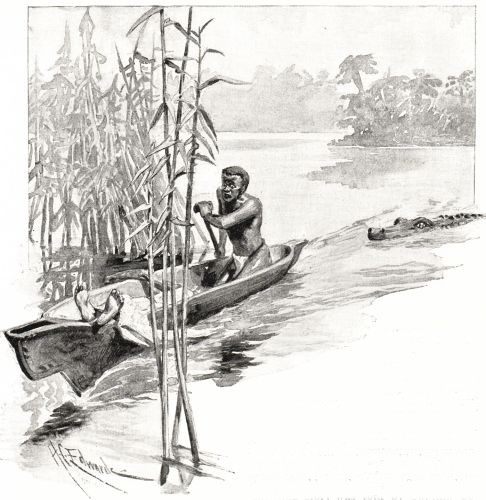
The animal easily gained on the canoe, and finally, far in advance, he pulled his victim out of the water upon the shore of an island. Then he plunged into the river again and swam away, perhaps to find his mate and share his prize with her. The boy paddled straight for the spot where his poor mother lay. As he gained the shore he knew that she was either dead or senseless. He leaned over her, and saw her terrible wounds. He was not strong enough to carry her in his arms, but he could draw her to the water's edge and pull and lift until the poor body was in the canoe. With what frantic energy he worked! And he had need; for before he could push off and point his boat homeward, he saw the crocodile up the river, and coming nearer every moment.
When the crocodile had reached the shore, the canoe was well out in the river. If the animal had not stopped to crawl out on the land and look around for his victim, the boy's devotion would probably have cost him his life. As it was, the crocodile had nearly overtaken the canoe, when the boy's cries brought the villagers to the shore, and the shouts and missiles frightened the angry pursuer away. The poor mother was dead, but her little son, who had risked his life to save her, had at least the satisfaction of knowing that her body would not be the food of crocodiles.
"Don't you fire guns in your country when a baby is born?" asked a Congo native of a missionary, who had rushed in great alarm when he heard a volley fired.
"Come back," shouted the natives to him. "It's only a baby born, and everybody is glad."
That white man was glad too it was only a baby. Many an African child, more unfortunate than most of them, has been glad to be befriended by the white men who are living in their country. Here is one among many stories illustrating this.
One day, in Central Africa, Mr. Arnot found several girls in a slave caravan, nearly dead from the hardships they had suffered. He bought them for a few yards of cloth, and took them home. One of them, little Mwepo, was very bright and happy, and was the favorite in the household.
Mr. Arnot went one day to dine with King Msidi. A little girl came into the yard where they were sitting and threw herself at the King's feet. When he bade her tell her troubles, she said she was a slave whom the King's soldiers had taken from her home. She said her mistress treated her so cruelly that she had run away to beg the King's protection. Arnot was about to leave, and the sly old King told the girl to follow him if she wanted a good home. So Arnot took her hand and led her to his cottage, where Mwepo and the little stranger flew into each other's arms, weeping as though their hearts would break. Three years before they had been playing on the banks of the Luba River when slave-stealers suddenly tore them from their homes and parents; but after many months of suffering they had been reunited in the home of a white man.