ADVERTISEMENTS.
Reading edition
The absolutely pure
BAKING POWDER.
ROYAL—the most celebrated of all the baking powders in the world—celebrated for its great leavening strength and purity. It makes your cakes, biscuit, bread, etc., healthful, it assures you against alum and all forms of adulteration that go with the cheap brands.
ROYAL BAKING POWDER CO., NEW YORK.
Copyright, 1896, by Harper & Brothers.
This Department is conducted in the interest of Bicyclers, and the Editor will be pleased to answer any question on the subject. Our maps and tours contain many valuable data kindly supplied from the official maps and road-books of the League of American Wheelmen. Recognizing the value of the work being done by the L.A.W., the Editor will be pleased to furnish subscribers with membership blanks and information so far as possible.
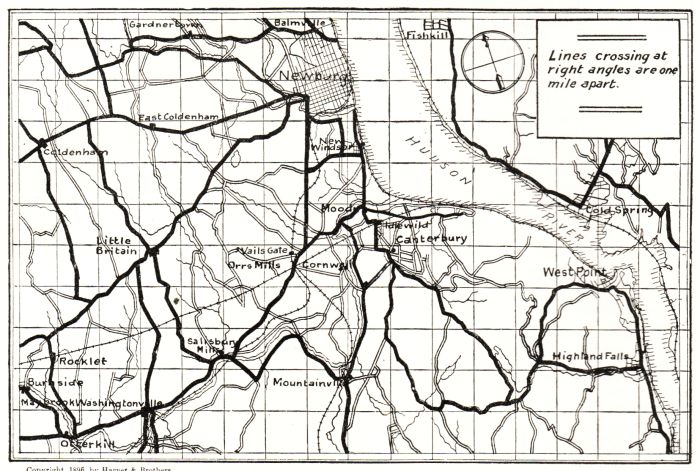
The final stage of the run from New York to Newburg is given this week. In the previous three weeks the country between Hoboken and Newburg up the western bank of the Hudson has been published, and, of course, the wheelman, if he chooses, may run on further up the Hudson. Beyond Newburg, however, the country becomes very hilly, and some of the roads are practically unrideable in some cases because the hills are too steep to ride up, and in others because they are too steep to ride down. Some of the roads around Newburg are very bad for the same reason, especially those running southward from the city through Canterbury and Cornwall, and down below West Point. Through this part of the country in the vicinity of the river it is wiser, both for your own good and that of your wheel, to refrain from wheeling at all.
The main road to Newburg is good riding, however—that passing through Tuxedo, Highland Mills, and Woodbury Falls, on last week's map, to Mountainville. Thence turn left, and run to Salisbury Mills, keeping always to the right until you leave the latter place, and run up to Orrs Mills and Vails Gate, thence proceeding direct to Newburg. None of the roads hereabout can be called first-class, and this particular route is by no means the best. If your run is to be as far as Poughkeepsie, it is wiser to keep further westward, and run from Blooming Grove on last week's map, out through Otterkill, Maybrook, and Coldenham. Any bicyclist who wants to reach Poughkeepsie from New York is strongly advised to keep to the east bank of the Hudson all the way up. The wheeling through the country where Tuxedo is situated is good, but except for a few roads outside of this small bit of territory, the riding is pretty hilly. The road-bed, as a rule, is in fair to good condition, but the unevenness of the ground is a constant worry to a bicyclist—the kind of worry that wears him out in short order, unless he is an experienced wheelman.
The only reason for riding through this country is a historic one, for the ground is covered with objects of interest connected with the Revolutionary war, and of course West Point itself is one of the sights of the Hudson, both from the fact of its being the seat of the military academy, and because of the scenery thereabouts.
This closes the particular trip which for several weeks we have been discussing, and for the present, during the winter season, the Department will be discontinued. Questions on bicycling matters, where they can be answered, will be attended to as before, and the Department will be resumed in the early spring. All applications for explanations as to the method to be followed in becoming a member of the L.A.W. will also be answered as heretofore.
Note.—Map of New York city asphalted streets in No. 809. Map of route from New York to Tarrytown in No. 810. New York to Stamford, Connecticut, in No. 811. New York to Staten Island in No. 812. New Jersey from Hoboken to Pine Brook in No. 813. Brooklyn in No. 814. Brooklyn to Babylon in No. 815. Brooklyn to Northport in No. 816. Tarrytown to Poughkeepsie in No. 817. Poughkeepsie to Hudson in No. 818. Hudson to Albany in No. 819. Tottenville to Trenton in No. 820. Trenton to Philadelphia in No. 821. Philadelphia in No. 822. Philadelphia-Wissahickon Route in No. 823. Philadelphia to West Chester in No. 824. Philadelphia to Atlantic City—First Stage in No. 825; Second Stage in No. 826. Philadelphia to Vineland—First Stage in No. 827; Second Stage in No. 828. New York to Boston—Second Stage in No. 829; Third Stage in No. 830; Fourth Stage in No. 831; Fifth Stage in No. 832; Sixth Stage in No. 833. Boston to Concord in No. 834. Boston in No. 835. Boston to Gloucester in No. 836. Boston to Newburyport in No. 837. Boston to New Bedford in No. 838. Boston to South Framingham in No. 839. Boston to Nahant in No. 840. Boston to Lowell in No. 841. Boston to Nantasket Beach in No. 842. Boston Circuit Ride in No. 843. Philadelphia to Washington—First Stage in No. 844; Second Stage in No. 845; Third Stage in No. 846; Fourth Stage in No. 847; Fifth Stage in No. 848. City of Washington in No. 849. City of Albany in No. 854; Albany to Fonda in No. 855; Fonda to Utica in No. 856; Utica to Syracuse in No. 857; Syracuse to Lyons in No. 858; Lyons to Rochester in No. 859; Rochester to Batavia in No. 860; Batavia to Buffalo in No. 861; Poughkeepsie to Newtown in No. 864; Newtown to Hartford in No. 865; New Haven to Hartford in No. 866; Hartford to Springfield in No. 867; Hartford to Canaan in No. 868; Canaan to Pittsfield in No. 869; Hudson to Pittsfield in No. 870. City of Chicago in No. 874. Waukesha to Oconomowoc in No. 875; Chicago to Wheeling in No. 876; Wheeling to Lippencott's in No. 877; Lippencott's to Waukesha in No. 878; Waukesha to Milwaukee in No. 879; Chicago to Joliet in No. 881; Joliet to Ottawa in No. 882; Ottawa to La Salle in No. 883; Jersey City to Englewood in No. 890; Englewood to Nyack in No. 891; Nyack to Washingtonville in No. 892.
Any questions in regard to photograph matters will be willingly answered by the Editor of this column, and we should be glad to hear from any of our club who can make helpful suggestions.
PHOTOGRAPHIC-PRINT EXCHANGE.
We have received many letters from members who are interested in the print exchange, and for the benefit of those who did not see the suggestion details will be found in the Camera Club Department for October 13. If any member who desires to exchange prints does not succeed in getting those which he wishes, if he will send word to the editor, the "want" will be printed a second time.
Sir Knight Arthur Inkersley, 709 Hyde St., San Francisco, Cal., wishes to exchange prints of Alaska, Mexico, and the country round San Francisco, for England, Ireland, and Scotland prints; and of the forts, guns, navy-yards, and coast defences of the United States. Sir Arthur's prints may be had in silver, salt, or aristo-platinotype, and are 5 by 7 in size.
Sir Knight Frederick Clapp, 175 Boston St., South Boston, Mass., has prints of Boston and vicinity to exchange for photographs of State Houses, as he is making a collection of such photographs. Sir Frederick makes fine pictures, judging from the specimens sent to the Round Table.
Sir Knight Louis A. Dyar, Winona, Minn., wishes to exchange prints of the bluffs of the Mississippi River, the Maine coast, and interior or animal studies, for pictures taken near Ogunquit or Strong, Me.; interesting figure or animal studies; or historical places in the United States. His pictures are 3½ by 3½ and 4 by 5, clear and well finished.
Ernest T. Selig, Lawrence, Kan., wishes to exchange photographs of the collection of animals in the Kansas State University for pictures of the government buildings at Washington, D. C. A part of the collection mentioned was in the Kansas building at the World's Fair.
Sir Knight John N. Prothero asks how to filter solutions. Take a piece of filtering-paper, which may be bought either at the druggist's or of the dealer in photographic goods, fold it through the centre (it comes cut in circles), then fold it back and forth from the centre like a fan. Crease these folds, open the paper, and put it inside a glass funnel, and turn in the liquid to be filtered. The funnel may be set in a bottle, or one can use a regular filter-holder. The creases in the paper prevent it from sticking to the glass funnel when it is wet with the solution, and the liquid runs through faster.
Sir Knight F. Elton Morse, 11 and 13 Market St., Lynn, Mass., wishes to exchange photographic views with members of the Camera Club. Sir Knight Elton says that he has a 5-by-8 Rochester Optical Co. single-view lens which he would like to exchange for a 4-by-5 size of the same make, if any member would like to make the exchange.
Sir Knight William Merritt, Rhinecliff, N.Y., says that he has a 4-by-5 Manhattan Camera, almost new, carrying three double plate-holders, and is suitable for instantaneous or time exposures, which he would like to sell. He also asks when the next contest is to be held. The contest is now in progress, and will close December 15.
Sir Knight L. P. Dodge asks if films are made for the pocket kodak for more than twelve exposures, and if there is any contest open to Knights and Ladies who own pocket kodaks. Twelve exposures is the regulation length for the pocket kodak. A box of films containing four spools (forty-eight exposures) may be bought for $1, and as the camera may be loaded by daylight, the small rolls are more convenient. There is no contest open for pocket-kodak pictures. A pocket-kodak picture may be enlarged to a 4-by-5, and sometimes even larger, if clear and sharp.
Sir Knight S. F. Macquaide writes that he has an Eastman pocket kodak which he would like to sell, as he wishes to buy a larger camera. This camera, he says, is in first-class condition, and has been used but a short time. His address is 46 Mechlin Street, Germantown, Pa.
Sir Knight Vincent Aules, New Dorp, Staten Island, asks if plates on which pictures have been taken can be used again for making pictures. They cannot be used for making pictures unless the glass is cleaned, and then coated again with the sensitive solution, and for an amateur this involves more trouble and expense than to buy fresh plates. Old plates may be used for making transparencies, directions for which were given in No. 857, March 31, 1896.
Lady Edna Knapp encloses a print with a white streak across one end, and says that all her negatives have the same defect, and asks the reason. The camera leaks light and fogs the plate. There is probably a pin-hole in the bellows, or perhaps the lens is not fitted tight enough. As Lady Edna is a beginner the editor would advise taking the camera to an expert and have it examined, or to return it to the dealer and have it exchanged for a perfect one. The latter course would be the better of the two.
Sir Knight Joseph K. Fornance asks why the film of negatives turns an olive color; if there is any way of burnishing prints without a burnisher; and if a picture taken with the No. 2 Bullet, pictures 3½ by 3½, is eligible for the contest. The olive color of the film is due to insufficient fixing, leaving in the film undissolved silver salts. Pictures may be burnished by squeegeeing them to a ferrotype-plate, directions for which were given in No. 884, October 6, answer to Sir Knight Hubbard Marsh. The smallest size picture admitted to the contest is 4 by 5.
Sir Knight Joseph Gibson, Jun., Ingersoll, Ont., Canada, asks how the focal length of a lens may be found; what causes a plate to turn yellow after it is developed and fixed; if warm water will loosen the film from the glass. Directions for finding the focal length of a lens will be given in an early number of the Round Table. The yellow staining of the negative is caused by its not being left long enough in the fixing-bath, and portions of the undissolved silver salts remain in the film. Warm water would soften the film, and cause it to swell and separate from the glass. Use cold running water; 70° is a safe temperature.
FEED THEM PROPERLY
and carefully; reduce the painfully large percentage of infant mortality. Take no chances and make no experiments in this very important matter. The Gail Borden Eagle Brand Condensed Milk has saved thousands of little lives.—[Adv.]