THROUGH A CANDY-FACTORY.
Reading edition
BY BARNET PHILLIPS.
To begin at the beginning of a great candy and sugar-plum factory in New York, there was one trait shown by its founder which established its reputation. The man had the same characteristics as had Josiah Wedgwood. In England one hundred years ago pottery was a rude and incomplete business. Josiah Wedgwood made it one of the most classic and elegant of the plastic arts. When Wedgwood went through his vast Burslem work-shops, and noticed a piece of his ware—say a teapot—which was not up to the mark, he took a stick, and he simply smashed it.
There was once a baker who made cakes. Occasionally there would be a failure in his batch. The raising of the dough or the baking was defective. That baker never would sell these poor cakes to his customers. He might give them away. What he said was this, "These poor cakes are not a fair equivalent for good money." In time his business prospered because his cakes were the very best. Then he took to candy-making in a small way—only molasses-candy. But what he made was so super-fine that he could hardly meet the demand. Then he made other kinds of candy, with the same success. So his business grew and grew, until to-day this enterprise founded by this baker occupies a large building with many stories in New York, and the motive power for making chocolate, candy, and sugar-plums is a 300-horse steam-engine, and 350 people are employed.
To give some idea of the quantity of the prime material, sugar, used every day in the year in this establishment, the total mass may be fairly grasped at in this way: An acre of good ground in the West Indies produces twenty tons of sugar-cane; the sweet juice expressed from the cane represents some eighteen per cent. of this.
Before the sugar is turned out by evaporation the percentage of weight is notably diminished. It takes then about three-quarters of an acre of cane to supply this factory with the sugar necessary for its daily consumption. It is not only candy and sugar-plums which this concern makes, but chocolate in quantity, and sugar enters largely into the composition of this last substance.
From top to bottom the floors of the factory are covered with tiles, and I noticed that there were people engaged in all parts of the building scrubbing and washing these tiled floors. For a candy-factory it was the least sticky or smeary place I ever saw. Absolute cleanliness and sweetness was the rule. There was a slight drift of sugar about, as in a mill where wheat is being ground, and your coat might get a little powdered, but there always was sweeping going on.
Chocolate-making I need not describe, only to state that everything was done here by machinery, for the chocolate as produced enters for a large percentage into the bonbons manufactured.
SUGARED ALMONDS.
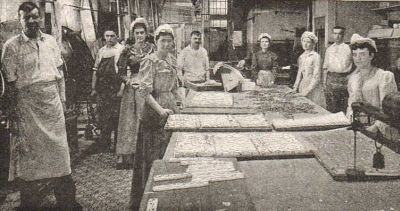
In the sugar-plum departments hand-work seemed to be constant. Tidy-looking young women, all with caps on, were working away, each one with a little saucepan before her full of sugar; the sugar was in a pasty condition, the heat being derived from steam. In these saucepans were colored sugars of all the lines of the rainbow. The work-women would take up an almond or a pistache-nut, and drop it in the saucepan, then fish it out with a bit of wire fashioned in loop form. The art was to get just the proper coating. Then with a dexterous motion of the wrist the sugar-plum would be placed in a tin pan, and with a deft motion of the wire loop a nice finish would be given to the top of it. There were some very small sugar-plums, and it would take two hundred of them to make a pound. They were all exact in form. These little things, so the foreman told me, had gone through ten processes before they had arrived at their present condition. Some of the sugar-plums were made in moulds. There was pure legerdemain about these. A man took a funnel, and dropped the sugar, just at the crystallizing point, in moulds. They were very small things, not more than an inch long by half an inch wide, but the confectioner never poured a drop in the wrong place. Dear me! if I tried to do that, I should make a precious mess of it.
Here were sugar-plums of many shades, every work-woman seeming to have a specialty. It was something not alone requiring alertness of hand, but constant watchfulness as to the condition of the material used. If it had been too soft, the bonbon would have run and been out of shape. If the sugar paste had been too hard, it would have been intractable. How they managed not to burn anything was a wonder.
Behind all this was the care necessary in the make-up of the first materials, and in the methods employed to give the colors and the flavors. Then there was the element of time, or a succession of processes. As soon as one batch of sugar-plums was finished, the saucepans had to be filled up again.
For the coloration of the sugar-plums many vegetable substances are used, and the utmost care was taken that nothing unwholesome should enter into the manufacture. Then it is, too, a nice question of flavors, for it is so easy to add too much of an essence and so spoil the bonbons. When the sugar-plum is made it must have powers of resistance. Sugar tends in some conditions to deliquescence, and so sugar-plums might all run together, and their appearance would be ruined.
WRAPPING CARAMELS.
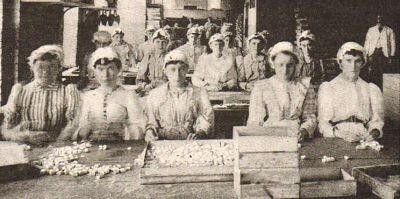
There were some of the smaller candies which passed through rollers, whereby the crystallized sugar was shaped into squares or lozenges. In many of the rooms workmen were manipulating great masses of amber-colored melted sugar, turning and turning them on slabs of marble or iron. Here the skill was shown in getting the mass to exactly the proper temperature so that it could be worked. A hundred or more pounds of sweet stuff had to be of just such a consistency so as to shape it. If there had been a mistake, just as likely as not the whole batch would have been spoilt, for if heated over again its character would have been changed.
There was one room entirely devoted to nut-cracking. A nut, as a walnut or a pecan or a filbert, had to be cracked just so, and an old man tapped and tapped the nuts with the regularity of a machine. Then there was a corps of nut-pickers, who removed the shells and put aside the meats. Then there were several women who did nothing else but police these nuts, so as to remove the least possible fragment of shell. Just think of the horror of breaking a tooth while in the act of biting an inviting sugar-plum!
All day long almonds were being blanched. Almonds are too delicate to be passed through any machine, and so have to be slivered with a knife. Here were cocoanuts in quantity. They could be run through machines, and there were great heaps of ground cocoanut looking like snow. Figs form the basis of many sugar-plums, but these have to be all handled and picked before they are ground up.
Just think of not less than one hundred and fifty varieties of candies or sugar-plums, and you can appreciate how many differences there must be in the manufacture of these.
PACKING CHOCOLATE.
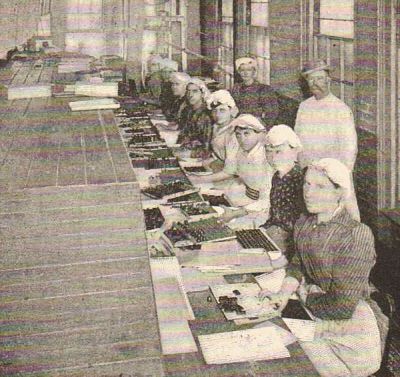
When the sugar-plums leave the workman's or work-woman's hands they are not yet ready for consumption. They must be nice enough when fresh, but they have to be hard enough or of such a consistency as to stand travel. If chocolate enters into their composition, they would be likely to run if preventive measures were not used. The chocolate bonbons have to be hardened in currents of cool air. If there is no chocolate, or if it is in small quantity, the sugar-plums are dried by heat, but not at a high temperature. Some sugar-plums are frosted, by means of crystallized sugar, then a rich syrup is put on them, and slow drying gives them a silvery appearance.
There is just as little touching of the sugar-plums as possible; not that the hands of the working-people are not clean, but to finger a bonbon before you help yourself to it is to take away something of its pretty bloom. I saw trays full of moulded chocolate bonbons, almond shaped, and some of them had a little rim of chocolate around them, which had exuded from the mould. A girl with a pair of gloves on was breaking off the excess of chocolate. Said the foreman: "Chocolate is so sensitive, that if the workwoman did not use gloves there would be thumb-marks, and a sugar-plum with a finger-mark on it is a spoilt sugar-plum. We have those gloves washed everyday."
In the make-up of the ordinary one-pound box of mixed sugar-plums there generally are some fifteen varieties. It would take a five-pound box, probably, to hold the one hundred and fifty different kinds this manufactory turns out.
In filling the boxes, some hundreds of empty ones are placed on a big table, and two or three women lay in the sugar-plums, one sort at a time in each box. Strange to say, you cannot hurry up this packing business. You cannot shoot sugar-plums into a box like coal into a bin. A bonbon refuses rough treatment. Be the least rude with a sugar-plum, and it is mashed. Gentle management does wonders with a great many things.
If the bonbons themselves are excellent, much of their saleability depends on the way they are put up. The utmost nicety is used in the construction of the box, with its frill of lace paper and the bit of silver or gold cord or the ribbon used in fastening it.
CREAM WALNUTS.
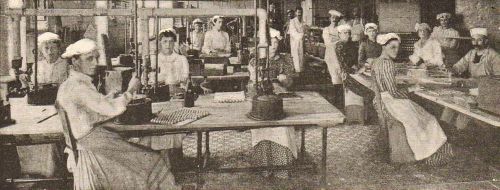
Some of the departments in this manufactory are noisy. Chocolate is a troublesome material, and it won't work well, save at certain temperatures. It has a decided disinclination to pack itself solid. A vast quantity of small tablets of chocolate are used. To make them the soft chocolate is placed in small tin moulds, and these are put on a rocking table, and the tins dance and rattle until the chocolate assumes the proper shape and consistency. Then sugared almonds in the act of manufacture make quite a racket. The almonds are surrounded with a sugar paste, and then put into revolving cylinders, and they roll and roll, making a sound like theatrical thunder.
The word bonbon is French, and really means "good-good." When we study early language, at the very beginning we find that primitive races had a way of reduplicating the same syllable, so it was a smart child who must have invented the word bonbon, which has about its equivalent in our "goodies."
You may rest satisfied that when you are lucky enough to get a box of these sugar-plums it is the result of an endless amount of painstaking labor and exceeding niceness, but it is questionable whether that will stop you for a moment in putting one of these pretty things into your mouth. Maybe when the very last sugar-plum is eaten you may think about the way they are made, and then you can ask for more, so as to be fully impressed with the cleverness of the bonbon art.