BICYCLING.
Reading edition
The Editor will be pleased to answer any question on the subject. Our maps and tours contain much valuable data kindly supplied from the official maps and road-books of the League of American Wheelmen. Recognizing the value of the work being done by the L. A. W. the Editor will be pleased to furnish subscribers with membership blanks and information so far as possible.
Copyright, 1895, by Harper & Brothers.
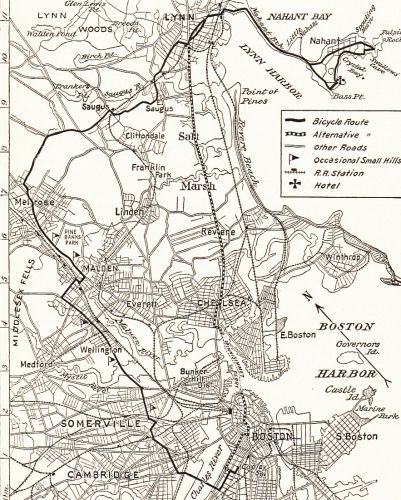
Start from Copley Square. Go through Dartmouth; turn to left onto Commonwealth Avenue, turn to right at Massachusetts Avenue, and cross Harvard Bridge over the Charles River to Cambridgeport. Keep on direct road, and at Windsor Street turn to the right, passing car tracks, and continuing to Webster Avenue, there turn to left, and keep straight road to Somerville. Turn to the right onto Prospect Street, go up small hill, cross railroad. Turn to right onto Washington Street, and follow it to Medford Street; there turn to left, and following Medford Street to Central Square, there turn to right on Cross Street, and to the right onto Mystic Avenue. At Middlesex Avenue turn to left, and follow direct road through Wellington to Pleasant Street, Malden. (So far road very good, macadam most of the distance, small hills, and good level stretches.) Continue through Highland Avenue to Clifton Street, where turn to right, and follow it until you come to tracks of the B. & M. R. R. Then turn to right over the tracks onto Washington Street, and take second turn on left. Then turn to left on to Main Street, and follow direct way to Melrose. (Small hills, but good macadam road.) Keep to right at Green Street, to the right at Franklin Street, bearing to right into Saugus by Main Street. Turn to right, cross tracks of B. & M., then keep to left into East Saugus. At watering-trough, beyond which keep to left out Boston Street over Tower Hill, and at horse-car station turn to right to Common Street, there turn to left, and to right onto Market Street. Turn to left at Broad Street, and to right at New Washington Street, and cross the long narrow isthmus, with Lynn Beach on the left and Lynn Harbor on the right. In passing through Lynn, considerable paving has to be ridden over. This is more than counterbalanced by the fine level road from Lynn to Nahant. It is one of the very best in the State, a refreshing ride on a hot day, water either side. Keep to left and follow main road, making a circuit of the end of the peninsula, which is high and rocky. There are excellent views both here and at Bass Point. Tri-Mountain House is a good place for a fish dinner.
A $50 Prize Puzzle.
There are twenty seven questions in the following. $50 in money will be divided among the ten, all under eighteen years, who send the best solutions. Correctness, spelling, and neatness count. Give answers by numbers. Put your own name and address at the top of every sheet, and at the top of the first sheet put the words "Round Table." Mail solutions not later than December 31, 1895. Correct answers and names of prize-winners will be given in Harper's Round Table for January 28, 1896. "Everything comes to those who try." Address the publishers, and put "Puzzle Answer" in lower left-hand corner of your envelope.
A VOYAGE OF DISCOVERY.
There were three wise men of Gotham Who went to sea in a bowl. What did they find the earth around Before they reached their goal?
They found a good many things. To enumerate a few:
A nail in North American land; (1) A meat in the isles of the sea; (2) A gale of wind in a city of Maine, As you may plainly see; (3) A yellow man in Asian heights; (4) Delicious fruit in a bay; (5) A friend to man in a Russian lake; (6) A measure of oil in Cathay. (7)
At a hotel in France they were given a queer dish of food. Here is the receipt for it:
Take poetry, music, and painting, Already well combined, And to make the dish we are wanting, Add the first person you find. Then stifle my first by my second, And let all stand until cold, When you have a delightful pickle That our grandmothers made of old. (8)
Proceeding, they found
A town of Maine in a Floridian bay, (9) A bit of wood in a sea; (10) A little friend in an Alpine pass, As travellers all agree; (11) Convenient coin in a Russian mart; (12) Bright light in an African isle; (13) A part of a ship in a British town, (14) A stag in a town of the Nile. (15)
In Egypt a landlord presented them with a bill that read:
When first you know that I am near, You turn from me and flee; Yet if I harm you, what seems queer Is that you send for me; And when my bad effects are gone, You make me pay for what I've done. (16)
Their time getting short, the wise men left their bowl for a balloon, and found
A writer's tool in a Danish port, (17) French coin in a State of the West; (18) A rodent fierce in a Grecian plain, A dreaded household pest. (19) A favorite toy in a burning mount, (20) With a cutting tool they see; (21) A statesman famed in a town of Maine; (22) A snake in an inland sea. (23)
Being up in the air, they had to exist on light dinners. Here is the receipt for one of their meals:
Take a conjunction and lay it near Something that's fully equal. The smallest article you can find Follows this as a common sequel. Add a substance of nature aerial, And so make a food fit for palate imperial. (24)
Going back to their bowl again, they saw
An American stream in a city famed. (25) French coin in an Italian town; (26) A head of hair in an English isle, A place of great renown. All these they saw as they sailed afar, Where'er their course they bent; But never found 'neath the farthest star The secret of content. (27)
This Department is conducted in the interest of stamp and coin collectors, and the Editor will be pleased to answer any question on these subjects so far as possible. Correspondent should address Editor Stamp Department.
Another great find has been made. A philatelist in a town in Illinois applied to the postmaster for a 90c. stamp, expecting to receive the current issue. Imagine his surprise when the postmaster handed him a 90c. 1869 issue (portrait of Lincoln) in fine condition. Of course he immediately bought all the postmaster had, twenty-eight copies. One of these is now in his collection, the other twenty-seven have been sold at $30 each.
Doubtless there are many thousands of old issues still on sale in country post-offices, and I would advise the purchase of any or all U.S. stamps issued before 1887. Of the later issues dealers have a good supply. Plate-number collecting is growing every day. As time goes on the scarce plate numbers advance in price, and the commoner numbers decrease. No. 89 2c. is still the scarcest, although some of the first numbers are now almost unobtainable. All the unwatermarked sheets are growing scarce; the $1 has already advanced fifty per cent. since the change to watermark. The $2 and $5 will doubtless soon do the same.
M. Hess.—The stamps mentioned are sold by dealers at 1c. or 2c. each.
Watrous.—I do not recognize the coin by your description.
N. D. Henderson, 135 West Eighty-ninth Street, New York, wants to exchange stamps with Round Table collectors.—As the same rare stamp may be cheap or dear according to its condition, the only absolute test of its value is to sell it at auction.
E. France.—No addresses of dealers are given in this column.
Lester Hicks.—The 1858 flying-eagle cent is quoted by dealers at 5c.
H. E. P.—The half-cent 1809 is worth 10c.
L. E. S.—The ore coin is Swedish. The other coins are worth face only.
E. Ring.—Half-dollars of any date from 1817 to 1836 can be bought of dealers at 75c. each.
S. B. N. and A. C. H.—See answer to R. Baker in No. 837.
F. James.—The Antoninus Pius is an old Roman coin. The cent and gold piece have no premium value.
O. Furhman.—All the stamps are revenues, not postage.
Philatus.