Songs.
Reading edition
Franklin Square Collection.
It would be difficult, if not impossible, to gather more features of interest into a work of this kind. Not only are many of the best songs and hymns in the English language here given—both old and new—but there are also songs and hymns for children and the schools. There are songs of home and of country, of love and fame, of heart and soul, of devotion and praise, with their sad and sweet or lively melodies, and with grand old chorals that stir the heart and lift it in worship. Besides the words and music, explanatory and historic notes are given to indicate their origin and significance. These books cannot fail to become immensely popular.—Lutheran Observer.
Sold Everywhere. Price, 50 cents: Cloth, $1.00. Full contents of the Several Numbers, with Specimen Pages of favorite Songs and Hymns, sent by Harper & Brothers, New York, to any address.

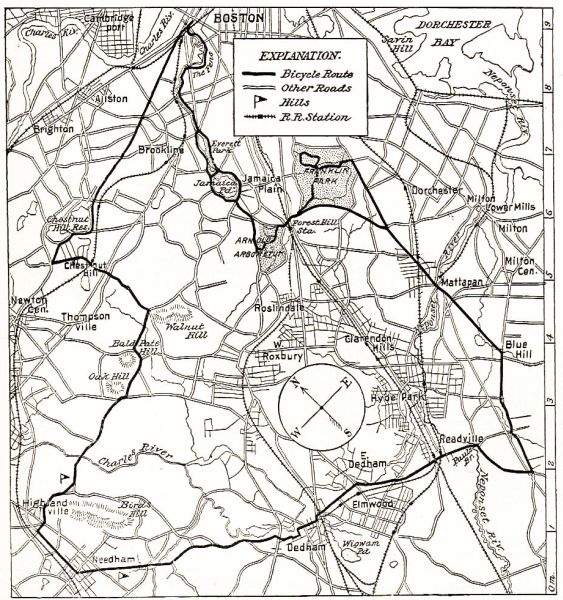
The Editor will be pleased to answer any question on the subject. Our maps and tours contain much valuable data, kindly supplied from the official maps and road-books of the League of American Wheelmen. Recognizing the value of the work being done by the L. A. W., the Editor will be pleased to furnish subscribers with membership blanks and information so far as possible.
CIRCUIT RIDE.
Starting from the Ericson monument on Commonwealth Avenue, go westward, joining Beacon Boulevard, which follow direct by the electric-car tracks to Chestnut Hill Reservoir. After passing car station at end of route, keep to left around the reservoir, and a short distance on Beacon Street beyond reservoir; then turn to left on to Hammond Street, following it southward, and turn to right at Brookline Street. Turn to right at Dedham Street, and bear to the left out Nahanton Street, going over the Charles River and up the hill by direct road to Highlandville. Turn to left on to Highland Street, following straight road south to Needham. Thence the course is down hill on Dedham Street, leading over the Charles River, after crossing which you bear southeast by direct road into Dedham; go under the bridge beyond the station, and from there take direct road to Paul's Bridge. Turn to right at fountain, and go, viâ Brush Hill Avenue, to the base of Blue Hill. There turn to the left, and take the direct road for Mattapan, viâ Canton Avenue, and turn to left at Mattapan Street into Mattapan. From here follow Blue Hill Avenue direct to Franklin Park. Enter, and make circuit of park, keeping to right and then to left, or keep to left on Morton Street direct to Forest Hill Station. At the drinking-fountain turn to the left after passing tracks, and go through the Arnold Arboretum; pass out of the Arboretum by the Centre Street entrance, and, turning to the right, take Centre Street, and then go through the Arborway and Park system to Jamaica Pond. There is a good roadway around this pond both to the right and left, and the distance is about the same either way. After passing the pond keep direct road, viâ Park system, to the Fenway Parks, in passing through which keep to the left, and it will bring you across the bridge, over the railroad tracks, and on to Commonwealth Avenue; there turn to right, and ride direct to Ericson statue near Massachusetts Avenue. Distance covered, about thirty miles.
By taking this circuit ride one gets a fair idea of the new boulevards and public parklands of the Metropolitan system, which is making rapid strides of development, and promises to be in the near future one of the finest in America, if not in the world. The roads are good throughout the entire distance, and it is a fine country ride from Chestnut Hill Reservoir through Highlandville, Dedham, Blue Hill, to Franklin Park.
Copyright, 1895, by Harper & Brothers.
This Department is conducted in the interest of Girls and Young Women, and the Editor will be pleased to answer any question on the subject so far as possible. Correspondents should address Editor.
One of my correspondents asks, in a general way, what I think about old school-books. Should a girl sell them, if she can, when passing on to a higher class in which she does not need the books used in the former term? Ought they be taken care of with as much pains as one bestows on the books in the library or the pretty illustrated editions which come to one as gifts at birthdays and holidays?
To the first question I answer, without hesitation, keep all your school-books if you possibly can. Never sell them or dispose of them in any way unless it is very plainly your duty to somebody else to do so. For instance, in a family an older sister may let the younger children have her books when she is done with them. This may save her parents the expense of buying new ones, and having the same books duplicated in the household collection. Or there may be in your acquaintance a girl too poor to buy new books, who will be very glad and thankful to have yours as a gift. In this case it will be your pleasure, I am sure, to make this friend happy, and to relieve her of anxiety, and help her in procuring her education. But, as a rule, I would advise you to keep your books for yourself. Even when you have finished studying in a particular book you may want it to refer to, and after your school-days are over your books will be reminders of the delightful times you had when you used them. School-books are valuable because they are written in a clear, plain, straightforward style which it is quite easy to comprehend. They do not wander away from the point, and they give a great deal of information packed up in a small compass. A good school-book on any subject is a real treasure.
All books should be treated with respect. No nice person leaves books lying around heedlessly, with the bindings opened widely so that they become loosened, and the pages curling up at the corners. If a girl is neat about her room and her dress, she will surely be so in the care of her books. Never let books gather dust. They are as ornamental as pictures or flowers or vases, and a house in which there are a number of books is already half furnished.
I speak with the more emphasis about the folly of selling school-books because I have a confession to make. Once, a long while ago, I was moving from my home to a distant State, to stay for some years, and I owned a book-case, a pretty affair with five shelves, to which a friend took a fancy. "Sell me the book-case," she pleaded; "you will not need it for ages, and I would like it so much for my own library." Well, I did not sell the book-case; I gave it away, and that part of the transaction I have never regretted in the very least. But, alas! the little case was full of grammars, and geographies, and logics, and rhetorics, and spellers, and arithmetics, and lexicons, the dear books that had kept me company all the way from childhood on, and in an evil moment I was persuaded to sell those to a dealer in second-hand books. I was sorry the next time I needed to look at one of the dear things, and, if you will believe me, girls, I am still sorry. I changed something precious for a little bit of money when I disposed of my books. And I wish I had not done it.
If by any chance books have been used by a patient in illness, such as scarlet-fever or any other contagious disease, they must immediately be burned up. This is the only safe way. A child recovering from such an attack may ask for his or her books to play with. Let the books be given, if the mother is willing, but they must be destroyed afterwards. Even if they have remained on shelves in the room and the patient has not so much as touched them they must be burned, for books have a way of preserving germs of disease, and must be used only by people who are not ill with anything infectious or who are perfectly well.
Do I think books should be covered? To save the bindings, you mean? It depends on how very clean and dainty are the hands which hold them. Smooth white paper makes a good covering, and is easily renewed, and most publishers in these days provide attractive covers for the beautiful books they sell.
As December finishes the period for their subscriptions, will the friends who accepted the Baby boxes a twelvemonth ago kindly send their boxes as soon as possible to Mrs. Sangster, care of Harper's Round Table, Franklin Square, New York?
Any questions in regard to photograph matters will be willingly answered by the Editor of this column, and we should be glad to hear from any of our club who can make helpful suggestions.
SUGGESTIONS FOR CHRISTMAS GIFTS.
Summer has gone, with all its delightful outings, but the amateur photographer, if he has been wise, has not only many photographic souvenirs as reminders of his vacation, but has also abundant material for making his friends glad at holiday-time.
A dozen, or even six or seven, finely finished prints, mounted in an attractive way, make a most acceptable gift, and one which the recipient is sure not to have duplicated.
Blue prints, which are the cheapest and easiest form of photographic printing, are just the thing for waterscapes. If one's outing has been by the lake or seashore, select six or eight of the prettiest waterscapes, something which would make a sort of series. Do not print them all the same uniform size, but select different-shaped mats for each one. One picture may look better vigneted, another would not be pretty printed except in a circle, and still another would need to be printed in a long narrow oblong to make an attractive picture. Choose the mat which best fits the picture. All styles and sizes may be bought at the dealer in photographic goods, or one may make the mats himself. A pretty mat is made by taking a piece of post-office paper and marking an irregular opening large enough to take in the picture; tear the paper on the pencilled lines, peeling it so as to leave it thinner at the edges. Any-shaped opening may be made, and a picture which has a spot or scratch which would mar it if shown in the print may be blocked out in this way. Pictures printed in this way are very pretty, and something out of the ordinary way of printing.
Having the pictures printed, the selection of the card mount is the next consideration. The mount should show at least an inch or more margin all round, and one may buy the plain mounts and punch eyelet-holes in the edges to fasten them with, or else the regular album leaves, which have holes for fastening together. The album leaves are really better than the cards, as the edges having the eyelet-holes are finished with cloth, which prevents the card from breaking.
Under each picture letter a title or an appropriate quotation, using either ultramarine or cobalt blue water-color. Either corresponds with the color of the finished print.
The cover may be of rough water-color paper, and decorated with the brush in blue, or an opening may be cut in the cover, and a tiny blue print set back of it like a picture in a frame. In such a case there would need to be two pieces for the front cover, glued at the edges. Tie the whole together with a heavy blue silk cord the color of the blue prints, or with two-inch-wide blue ribbon with a butterfly bow.
DON'T WORRY YOURSELF
and don't worry the baby; avoid both unpleasant conditions by giving the child pure, digestible food. Don't use solid preparations. Infant Health is a valuable pamphlet for mothers. Send your address to the New York Condensed Milk Company, N. Y.—[Adv.]