IN THE TOWER OF MANY STORIES.
Reading edition
BY MRS. LEW. WALLACE.
SIR WALTER RALEIGH.
he most illustrious name connected with London Tower—high over king, priest, or prince—is the name of Raleigh. There at four different times he was sent, not so much prisoner of England as of Spain. He never lay in the lonesome cell in the crypt called his. His longest term was in the grim fortress Bloody Tower, where his undaunted spirit taught the world
"Stone walls do not a prison make, Nor iron bars a cage."
GARDEN INSIDE THE TOWER, WHERE RALEIGH WALKED.
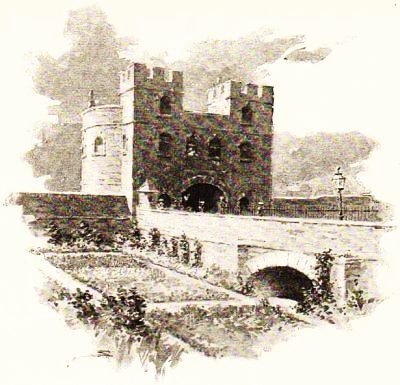
He was allowed the freedom of the garden, with a little lodge for a study—a hen-house of lath and plaster, where he experimented with drugs and chemicals, studied medicine and ship-building, kept his crucibles and apparatus, and the near terrace he paced up and down through weary years is to this day called Raleigh's Walk.
It was in the reign of King James the First—the cruel and cowardly—and never in his peerless prime was Raleigh greater than in the fourteen years that sentence of death hung over his head. His prison was a court to which men crowded with delight. Queen Anne sent gracious messages to him, and Prince Henry rode down from Whitehall to hear the old sailor tell of green isles with waving palms like beckoning hands, hints of wonderful plumage, hissing serpents in tropic jungles, barbarian cities built of precious stones, and of rivers running over sands of gold, all waiting for the English conqueror to come and make them his own.
After a morning of high converse the Prince cried out, "No man but my father would keep such a bird in such a cage," and when the young listener fell ill the Queen would have him take nothing but Raleigh's cordial, which, she said, had saved her life.
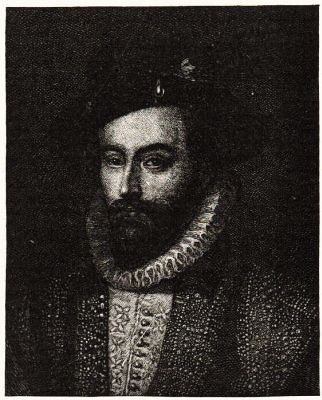
His best biographer writes: "Raleigh was a sight to see; not only for his fame and name, but for his picturesque and dazzling figure. Fifty-one years old, tall, tawny, splendid, with the bronze of tropical suns on his leonine cheek, a bushy beard, a round mustache, and a ripple of curling hair which his man Peter took an hour to dress. Apparelled as became such a figure, in scarf and band of richest color and costliest stuff, in cap and plume worth a ransom, in jacket powdered with gems, his whole attire from cap to shoe-strings blazing with rubies, emeralds, and pearls, he was allowed to be one of the handsomest men alive."
In the eleventh year of his bondage he finished the first part of the History of the World. He wrote what men will not let die, invented the modern war-ship, and from the turrets of Bloody Tower looked across the vast blue plain of ocean and directed operations in Virginia and Guiana. He was a guiding light to his beloved England; proud and brilliant heroes deferred to him, sought his advice; charming women were charmed by the most courtly of courtiers, and all felt him to be a man whom the government could not afford to spare. He knew more than any other person living about the New World offering endless riches to the Old, and his services were at the King's command. While prisoner to the crown he sailed with five ships under royal orders for the region of the Orinoco, the land of promise unfulfilled. The golden city lighted by jewels was a vanishing illusion ending in bitter disappointment.
Years before, in 1609, he had written to Shakespeare, whom he called, "My dearest Will":
"Great were our hopes, both of glory and of gold, in the kingdom of Powhatan. But it grieves me much to say that all hath resulted in infelicity, misfortune, and an unhappy end.... As I was blameworthy for thy risk, I send by the messenger your £50, which you shall not lose by my overhopeful vision. For its usance I send a package of a new herb from the Chesapeake, called by the natives tobacco. Make it not into tea, as did one of my kinsmen, but kindle and smoke it in the little tube the messenger will bestow ... it is a balm for all sorrows and griefs, and as a dream of Paradise.... Thou knowest that from my youth up I have adventured for the welfare and glory of our Queen, Elizabeth. On sea and on land and in many climes have I fought the accursed Spaniard, and am honored by our sovereign and among men ... but all this would I give, and more, for a tithe of the honor which in the coming time shall assuredly be thine. Thy kingdom is of the imagination, and hath no limit or end."
The dreams of the Admiral far outran any possibility, and the mines of Guiana proved a cheat equal to the yellow clay of the Roanoke. Peril of life, fortune, and the varied resources of genius and valor were not enough to insure success, and a failure in the paradise of the world probably hastened the sentence for which Philip III. of Spain clamored.
The charges of treason against Raleigh were pure invention; but on his return from South America he was arrested, committed to the Tower, and the warrant for execution was signed without a new trial, while men from the streets and ships came crowding to the wharf, whence they could see him walking on the wall. He was advised to kill himself to escape the shameful sentence of James I., but he solemnly spoke of self-murder, and declared he would die in the light of day and before the face of his countrymen. In the field of battle, on land and on sea, he had looked at death too often to tremble now.
His farewell letter to his wife is one of the sweetest. I wish I had space for it all. It concludes:
"The everlasting God, Infinite, Powerful, Inscrutable; the Almighty God, which is Goodness itself, Mercy itself; the true light and life—keep thee and thine, have mercy on me, and teach me to forgive my persecutors and false witnesses, and send us to meet again in His Glorious Kingdom. My own true wife, farewell. Bless my poor boy. Pray for me, and let the good God fold you both in His arms. Written with the dying hand of sometime thy husband, but now, alas! overthrown.
"Yours that was, but not now my own,
"W. Raleigh."
In his final imprisonment Lady Raleigh was not allowed a share. When she caught his youthful fancy it was as Elizabeth Throckmorton, maid of honor to Queen Elizabeth.
"Sweet Bess" was a favorite there among ladies of gentle blood. The flatterers of the dazzling court fluttered round the lovely young girl, conspicuous for beauty and grace; slender, fair, golden-haired. Her sighs were only for the sea-captain who expected to crown her with glory won by his sword, and riches, the spoil to be fought for in many lands. She was his loyal wife to the end, always pleading for pardon, defiant before King and court, where she appeared daily in her husband's cause, "holding little Wat by the hand." When her petition was refused, she was not afraid to call down curses on the head of the tyrant, who heeded not her wrath or her grief.
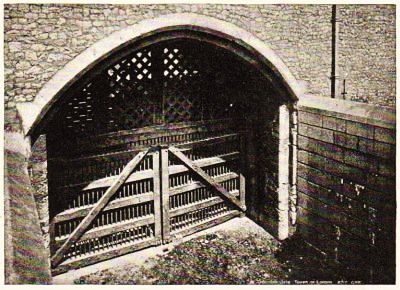
The water-way from the Thames is a dark passage under whose arch a pale procession of ghosts of the murdered may easily be fancied as coming up out of the past. Beneath it went Raleigh from prison to hear his sentence in Westminster Hall; from the King's Bench he was sent to Westminster Abbey. Crowds thronged to watch him pass, and from the carriage window he noticed his old friend Burton, and invited him to Palace Yard next day to see him die.
THE TRAITORS' GATE.
The warrant came on a dark October morning, 1618. Raleigh was in bed, but on hearing the Lieutenant's voice he sprang lightly to his feet, threw on hose and doublet, and left his room. At the door he met Peter, his barber, coming in. "Sir," said Peter, "we have not curled your head this morning." His master answered with a smile, "Let them comb it that shall have it." The faithful servant followed him to the gate insisting on the service. "Peter," he asked, "canst thou give me any plaster to set on a man's head when it is off?"
John Eliot wrote: "There is no parallel to the fortitude of Raleigh. Nothing petty disturbed his calm soul in ending a career of constant toil for the greatness and honor of his country. The hero who created a New England for Old England was fearless of death, the most resolute and confident of men, yet with reverence and conscience."
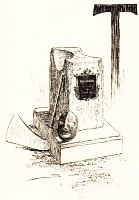
The executioner was deeply moved by the matchless spirit of the martyr. He knelt and prayed forgiveness—the usual formula at the block or scaffold. Raleigh placed both hands on the man's shoulders and said, "I forgive you with all my heart. Now show me the axe." He carefully touched the edge of the blade to feel its keenness, and kissed it. "This gives me no fear. It is a sharp and fair medicine to cure all my ills." Being asked which way he would lie on the block, he answered, "It is no matter which way the head lies, so that the heart be right." Presently he added, "When I stretch forth my hands, despatch me." There were omissions in his last speech, but we may be sure they were noble utterances. He prayed in an unbroken voice, and begged his friends to stand near him on the scaffold so they might better hear his dying words. Which being done, he concluded, "And now I entreat you all to join with me in prayer that the great God of Heaven, whom I have grievously offended—being a man full of vanity, and having lived a sinful life in all sinful callings, having been a soldier, a captain, and a sea-captain, and a courtier, which are all places of wickedness and vice—that God, I say, would forgive me and cast away my sins from me, and that He would receive me into everlasting life. So I take my leave of you making my peace with God.
"Give me heartily of your prayers," he repeated, turning right and left. The headsman cast down his own cloak that the victim might kneel on it after laying off his velvet robe. An act which reminds us of the happy chance for like courtesy that made Raleigh's fortune when he was a boyish adventurer in the train of Sussex; a beautiful youth watching the state barge of Queen Elizabeth.
SIR WALTER RALEIGH.
The supreme moment came; the great captain, never greater than in death, stretched out his palsied hands. The deathman hesitated. "What dost thou fear, man? Strike, strike." One blow—a true one—and the murder was done. There were those standing near who saw his face as it had been the face of an angel. Courtier, historian, poet, seaman, soldier, his was "the noblest head that ever rolled into English dust."
The wasted body was laid under the altar of St. Margaret's, the church of the House of Commons, across the way from Westminster, with only a small tablet to mark his resting-place.
Sweet Bess, who shared his glory and his prison-house, and with little Wat had walked the terrace with him, does not lie beside him. I do not know where that fond and faithful heart went to dust, but I do believe that in the final day, for which all other days are made, true love will find its own, and they will be reunited for evermore.
I saw no monument to Raleigh in Westminster Abbey. The fame of the colonizer of Virginia belongs to us of the New World, and in 1880 a memorial window was placed there at the expense of Americans in London. Canon Farrar's address at the unveiling was a brilliant review of Raleigh's life and varied fortunes in the most glorious portion of the Elizabethan era. It concluded with an earnest appeal to the England of Queen Victoria and the America of Lincoln and of Garfield to stand shoulder to shoulder under the banner of the cross.