A MODERN LABYRINTH.
Reading edition
BY WALTER CLARK NICHOLS.
Clickety-click! click! click! go the levers in the narrow brick house at six o'clock. Rapidly yet surely five alert men, clad in blue railroad blouses and trousers, rush about from handle to handle.
"Quick, Jim!" shouts the head man, "49, 61, and 72! There comes the Boston express, and the Croton local only two minutes behind! Shove 'em in there lively!"
"All right," responds Jim.
On the instant this lever is down, the others snapped up, and the express train just out of the tunnel has a clean, clear track into its haven at Forty-second Street. Three hundred yards before the station is reached the flame-throated iron monster, uncoupled from its burden of cars, darts forward on a siding like a spirited horse unharnessed from its load, while the train glides forward with its own momentum, slowly and more slowly as the brakes are applied, until it comes to a stop under the depot shed. Hardly have the passengers poured forth when another train rolls in, and then another, the pathway in each instance cleared by those keen men at the levers in this tower-house of the yards of the Grand Central station in New York city. For they only know the intricacies of this interesting modern labyrinth where more iron paths and by-paths are to be found, in all probability, than in any other place of the same size in the world.
There is a strange fascination about this labyrinth. Business men on their way to work and children on their way from school stop to watch the scene. The light iron foot-bridges which span the tracks for several blocks, saturated and blackened by the steam and smoke of the five hundred engines which pass underneath every day, separate you by barely two feet from the tops of the trains which run in and out of the great union depot, and from the smoke-stacks of the engines which dart about from siding to main track and from main track to round-house, where they sleep and dream fire dreams at night.
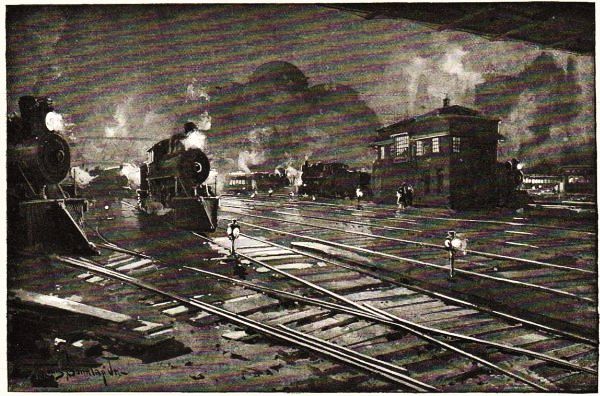
And the chief heart-throb of all this incessant activity, the centre of the iron labyrinth, in which Theseus himself, were he alive, would be lost, is the smoke-begrimed tower-house in the middle of the yard, where all the switching for the New York Central, the Harlem, and the New Haven railroads in the vicinity of the tunnel is done. From every train that comes in from or starts out for the West or the East through the long smoky tunnel that leads into the heart of New York a pathway is found by the clear-headed men in this house. Every rail on the many tracks and sidings of the busy yard can be coaxed and compelled from this house to do its part in forming a new wheel path. It is the busiest tower-house in the world, according to the yard-master.
Suppose you enter this rectangular house with one of your railroad friends and go up stairs. Here there is a long "key-board," as the men call it, consisting of one hundred and four numbered iron levers. You see the men in charge grasp lever after lever, apparently at random; you hear the sharp click of these gunlike rods as they move backwards or forwards, and then as you see a red light flash white or a white red two blocks away, you are told by one of the men at the levers that a path has been cleared for the Stamford local or the Empire State express. If you look in the room underneath it seems like the interior of a huge piano-board. Here are stiff-moving wires and bars, each one connected above to its particular iron key. Beneath they spread out in every direction, like the thread-like legs of a spider, each connected with its special rail or switch or light, and never interfering with its neighbor—so delicate the mechanism. As you go up stairs a second time, to hear Mr. Anderson, the man in charge of the great key-board, talk about the arrangements, you cannot help thinking again how like a monster piano it is. To be sure the iron keys are pushed and pulled instead of gently struck. But then what of that? They must be skilful musicians at those keys, these men. Suppose a false note were struck, what a discord would be sounded! It is a human symphony these men play, where a wrong chord might bring death to many people.
But Mr. Anderson, the head operator in the tower-house, doesn't seem to be thinking of these things. It is his duty and his work. He bends his mind to it, and he never makes a mistake. For a few minutes now he gives the direction of the work over to another man and speaks of the work. Over five hundred "pieces of rolling stock"—as the railroad men speak of trains and engines—have to be sent in and out of the depot and yard in a day. These include nearly three hundred regular incoming and outgoing passenger trains, the "stock" and baggage trains which ply between there and Mott Haven, carrying empty cars and station freight, and the "made-up" and "unmade" trains passing to and fro. When a through Western or Boston express starts out of the station, the arrangement of one or two levers by no means insures it a straight track into the tunnel. Oftentimes a combination of ten or fifteen all over the switch-board is necessary to give a train a straightaway track, and you wonder, as you hear this, how the men ever learn the varying combinations of keys. The train-despatcher in the depot notifies the men in the tower-house on which road each arriving and departing train is—whether New York Central, Harlem River, or New Haven—and they instantly know the answer to the problem.
THE LABYRINTH AND THE TOWER-HOUSE AT GRAND CENTRAL STATION.
It is a noisy piano these men play, noisier and larger than in the switch-house of the Pennsylvania Railroad yards in Jersey City. There the electric pneumatic interlocking switch and signal system of Mr. Westinghouse is in use. In this one man can do the work of several, although many old railroad men believe that the operation of a switch key-board by hand is the only one absolutely safe and reliable. This key-board in the house at the Pennsylvania yards is a glass-topped case about the size of a grand-piano box. The case is apparently full of metal cylinders. About seventy handles project from the front of the case—half of them numbered in black, the other half in red. Each is, or seems to be, the handle of a cylinder. The train-director is in charge of the room, and the young men under him touch the handles as easily as piano keys when the different switch numbers are called out. Suppose he calls out, "29, 21, 23, 20, 17, 13, 12, 7, 8!" One of the men touches the black handles bearing these numbers, then the red. The switches begin to waver up in the yard, though the gush of compressed air which precedes the wavering cannot be heard. Finally, as the last of these numbers is touched, a red signal in the yard droops from its horizontal position to an angle of sixty degrees. Then an empty train comes out of the shed from track 9 to 0 viâ switches 29, 21, 23, 20, 17, 13, 12, 7, and 8, as you note on the yard model—black ground, with bright brass tracks—above the case. Although it seems so simple, it is really as intricate as is the network of wires running down from the glass case through the tower-base to the various switches.
It is early in the morning and late in the afternoon that there is the greatest activity in the yards of the New York Central Railroad. Between seven and nine in the morning so many trains come in that frequently the switching necessary to give them clear ways in and out has meant the moving of 1400 levers in the tower-house. Hardly an engine, as it passes Forty-ninth Street, dragging its train on its way in, but darts away from the cars to a siding, leaving the train to roll in by itself, controlled by the trainmen at the brakes. You are not conscious of this if you are on the incoming cars. But as you get out and walk along the platform you note that yours is an engineless train. It saves time, this swerving of the engine off to right or left, and it is immediately ready to drag another load out. But the alertness of these tower-house men is here called into keenest play, for but a second elapses between the arrival of the engine and its train at the self-same switch, and each must have a separate path.
Although you can plainly see all this rush and bustle on a winter morning just as the sun is creeping over the top of the Grand Central palace, can note so clearly, as you stand on the bridge, which switches are turned for a particular train, and can count exactly the thirty-two tracks from the round-house alongside Lexington Avenue to the "annex sheds" on Madison Avenue, it is far more interesting to visit the yard late in the afternoon, just after dusk. Then you can stand on one of the bridges and see a brilliant panorama—the moving flash-lights of the engines, the quickly shifting red and white signal-lamps, the brilliantly lighted outgoing trains, standing out in relief against the dark narrow bulk of an "unmade" train on a distant siding, and, a short distance away, veiled every now and then by puffs of smoke from an impatient engine, the dazzling arc-burners of the station.
Shut your eyes, then open them, and again almost shut them, and give yourself up to the scene. It is fairy-land, all these moving lights, this brilliant panorama. Close your eyes still more till you can just peep out at the motion around you. It is no longer the iron-threaded yard of the Grand Central station. You are in the midst of some wild, strange region. Great dragons snorting flame and smoke move uneasily about. Black serpents with eyes of flashing fire and long dark bodies trail their way through the flat country past you, and disappear in that cavern of a tunnel above. On all sides are weird noises. But in the midst of it all you half dreamily see, not many feet away from you, the men at the levers in the tower-house, playing their mechanical music so well on the great key-board that every iron monster is charmed, and keeps safely and quietly his own pathway.