THE SCIENTIFIC USE OF KITES.
Reading edition
BY H. H. CLAYTON,
Of the Blue Hill Meteorological Observatory.
Kite-flying has been a pastime and a pleasure for many generations of boys and, indeed, of men. In China and Malay it is one of the chief sports for men. In China kites are made in strange and fantastic shapes, and are flown in great numbers on fête-days and holidays. It seems strange that some of the forms of Chinese and Malay kites were not long ago imported and used by our boys.
METHOD OF FLYING SERIES OF KITES.
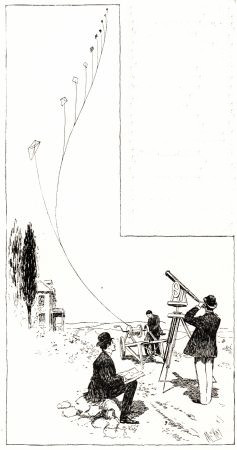
But kites are useful for science as well as for sport; and this scientific men are now finding out. Inventors and engineers have discovered that kites present interesting problems for experiment and study. Men who watch the air and the sky find that kites are useful in getting records of what is going on far above the earth's surface. Nearly a hundred and fifty years ago, in 1749, the idea of using kites for a scientific study of the air occurred to two young men in Scotland. They were Alexander Wilson and Thomas Melvill. They made half a dozen large paper kites as strong and as light as the materials would permit. They began by raising the smallest kite, which, being exactly balanced, soon mounted steadily to its utmost limit, carrying up a line, very slender, but of sufficient strength to command it. In the mean time the second kite was made ready. Two assistants supported it in a sloping direction between them, with its face to the wind, while a third person, holding part of the line in his hand, stood at a good distance directly in front. Then the extremity of the line belonging to the kite already in the air was hooked to a loop at the back of the second kite, which, being now let go, mounted superbly. In a little time it took up as much line as could be supported with advantage, thereby allowing its companion to soar at an elevation proportionately higher. All the kites were sent up, one by one, in this manner, the upper kite reaching an amazing height, according to the writer who described the experiment. It disappeared at times among the white summer clouds. The pressure of the breeze upon so many surfaces attached to the same line was found too great for a single person to withstand, and it became necessary to keep the mastery over the kites by additional help. In order to learn about the warmth and the coolness of the air aloft, these young investigators fastened thermometers to the kites. The thermometers had bushy tails of paper, and were let fall from some of the higher kites by gradual singeing of a match-line. However, these young men probably did not learn much in this way, because a thermometer sinking slowly or rapidly to the ground would change its temperature. The kites were found to be capable of useful scientific work, but self-recording instruments to be sent up with the kites were not then invented.
Two years later than the experiment described above, as every boy knows, or ought to know, Benjamin Franklin, by sending up a kite during a thunder-storm, and collecting a charge of electricity, proved that electricity is the same as lightning.
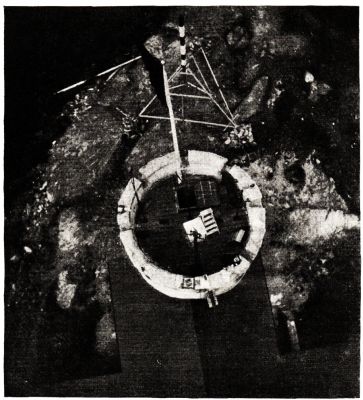
PHOTOGRAPH TAKEN FROM A KITE ABOVE THE BLUE HILL OBSERVATORY, MASSACHUSETTS.
For another hundred years kites were used only as toys. Then came the present age of wonderful inventions, beginning about fifty years ago. For the first time instruments were invented which could be lifted into the air, and could make on a sheet of paper a record of all the changes through which they passed while aloft. In 1883 Mr. E. Douglas Archibald, in England, used kites for sending up instruments to measure how much stronger the wind was aloft than near the ground. In 1890 Mr. McAdie used kites as did Benjamin Franklin, in order to study the electricity in the air. By sending kites tied to a string around which was wound fine copper wire, he found that sparks would fly from the wire to his finger, even when the sky was clear. When a thunder-storm came in sight the sparks became so strong that it was thought best to bring the kites down, on account of the danger. Within the last ten years M. Richard of Paris, and Mr. Fergusson of Blue Hill Observatory, have made instruments so simple and so light that at Blue Hill Observatory we now have instruments weighing less than three pounds, which record on a single sheet of paper how cool or warm the air is, how damp it is, how dense it is, and how fast it moves. One of these instruments, lifted by several kites all tied to the same line is easily sent up a mile or more above the top of the hill from which the kites are flown. On August 1, 1896, an instrument weighing three pounds was sent 6700 feet above the top of Blue Hill, near Boston. It was then 7333 feet above the level of the sea, or more than a thousand feet higher than the fop of Mount Washington, the highest mountain in New England. The highest kite was then higher than the instrument by more than a hundred feet.
Mr. W. A. Eddy, of Bayonne, New Jersey, has used the kites successfully at Blue Hill and at Boston for taking photographs of the surrounding country from a height of several hundred feet in the air. The camera is fastened to the kite-string, and the exposure of the plate is made by pulling a second string which hangs from the camera to the ground. One of the photographs, taken several hundred feet above Blue Hill, is shown here. The picture gives the Blue Hill Observatory and the country for several miles around.
Mr. J. Woodbridge Davis proposed to use kites for sending life-lines to vessels wrecked near the coast, and devised kites for this purpose which could be steered to any point nearly in a line with the wind.
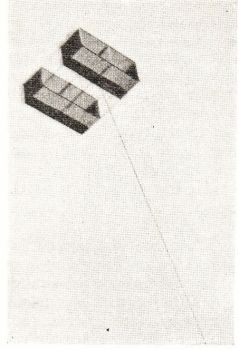
HARGRAVE KITE IN THE AIR.
The largest kite ever built was lately made by Mr. Lamson at Portland, Maine. This kite was built on the plan of Hargrave's kite, shown in one of our pictures, except that the cells were curved, and various other improvements made in construction. This kite was 32 feet long, and had 900 square feet of surface. It weighed about 150 pounds, and lifted a dummy-man weighing 150 pounds several hundred feet into the air. Then the cord broke, and kite and dummy floated off into an adjacent swamp.
To see the air lift such weights astonishes most people, because in the quiet of our rooms we move through the air without an effort, and it even fails to support the lightest and downiest feather. But give the air enough motion and it will lift anything made by man. In the terrific wind of a tornado houses are lifted and burst like egg-shells. Even locomotives are not too heavy for such winds to lift. A locomotive is said to have been lifted in a tornado at St. Louis and carried fifteen feet. At Blue Hill we find that the kites in a wind that blows 10 miles an hour lift about two ounces for each square foot of surface; in a 25-mile wind they lifted about a pound for each square foot; and in a 40-mile wind, nearly three pounds for each square foot.
FIG. 1.
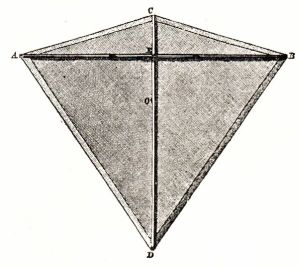
The recent interest in kites has brought about a great improvement in their forms. The Malays discovered that a diamond-shaped kite constructed with two sticks could be made steady in the wind, and could fly without a tail if the cross-sticks were bent backward and tied with a cord so as to hold them in the shape of a bow. A writer in the American Boys' Handy-Book calls a kite of this form a Dutch kite, indicating that it has been flown for a long time in Holland. Mr. W. A. Eddy, of New Jersey, is one of the first persons who have attempted to improve the kite for scientific use. He did this by making a kite with the bowed cross-sticks longer and nearer the top than they are in the Malay or the Dutch kite. Mr. Eddy's kite is illustrated in Fig. 1.
FIGS. 2, 3, 4.
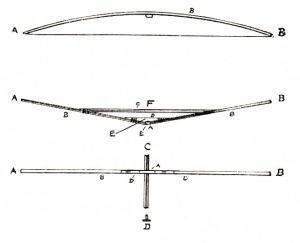
To make a kite of this kind five feet tall the sticks should be about ½ by 3/8 inch cross-section if only two sticks are to be used; but if they are to be strengthened by cross-sticks, as is done at Blue Hill, they should be about ¾-inch wide and ¼-inch thick. These sticks can easily be sawed out of a board of the proper thickness. A B and C D should each be 60 inches in length. C E should be 18 per cent. of C D; that is, in a five-foot kite A B should cross C D 10.8 inches below the top of C D. O is the centre of gravity, or the point where the kite balances when supported on the finger. It is placed about 35 per cent. of the distance from C to D. In the simplest form of construction A B is bent backward like a cross-bow (see Fig. 2), and tied so that the deepest part of the bow is about one-tenth of the length of A B. The lower part of the kite should be strung first, and the eye should not be trusted to make A D and B D equal. The distance should be carefully measured, because the success of the kite depends on the exactness of these proportions. In bending A B great care is required to make the bend on one side of the point of junction at E exactly symmetrical with the other bend. The slight bagging inward of the covering of the triangle A E D should be equal to the bagging of B E D. If the kite flies sidewise, owing to inequality in the two sides, it can be partly remedied by tying half-ounce or quarter-ounce weights at A or B. If A should swing too far to the left, tie the weight at B. If B should swing too far to the right, tie the weight at A. The hanger should be tied in front of the kite at E and D, and when pulled sidewise should extend nearly to B, and have a loop or ring tied in it an inch or two inches below B for the kite line. To make Eddy's kite strong and trustworthy, a more complex method of building it, adopted by Mr. Fergusson at Blue Hill, is as follows:
FIG. 5.
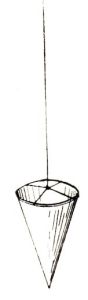
A drawing of the actual size of the kite is made on a floor or a table, and four screws are driven into the positions occupied by the corners, leaving the heads projecting about a quarter-inch. The cloth covering is then stretched over the floor or table, and tacked down several inches outside of the edge of the kite, as outlined by the screws. A piece of cord for the edge is then passed around the outside of the screws, drawn tight, and tied at the top by a square bow-knot. A knot is also made just below each of the corners at the sides so that when the cover is transferred from the floor to the sticks the knot will prevent the ends of the cross-sticks from slipping downward, because that is the cause of most of the trouble due to bad balancing. The cover is then pasted to the cord, a lap of about one inch being sufficient, and the cord is left bare at each corner where it passes over the screws. It is well first to wet with water the part of the cloth which is to be pasted, and the paste should be rubbed into every part of the cloth, and a smooth seam should be made. The cover should not be removed from the screws until perfectly dry. While it is drying, the kite-frame can be made. The upright stick is made of two flat sticks fastened at right angles to each other, so as to form a T; that is, they have that appearance when looked at endwise. (See bottom of Fig. 4.) The two sticks are glued to each other, and then firmly lashed. For the cross-stick A B two sticks set at an angle to each other are used instead of a single bowed stick. The method of making the angle joint is shown in Figs. 3 and 4. In a piece of square brass tubing, B, is cut a slot, into which fits the upright stick, C D. The tubing is then bent around the upright stick, C D, to the angle desired; a piece of wood, E, is fitted to the angle, and the whole is firmly lashed together. The ends A and B of the two arms of the cross-stick are driven into the ends of the tubing and strengthened by a brace, F. The frame is then ready for the cover, and the proportions are the same as those of the kite with two sticks. The ends of the sticks are notched to receive the loops of cord left at the corners of the cover, and the cover is slipped over the frame with the knots at A and B beneath the ends of the stick. The cord in the cover should then be lashed to the sticks, except at C (Fig. 1), and coated with glue, in order to prevent the cover from drawing away from the corners. The cord at C is left free to permit adjusting the tension of cover and string by retying when necessary. These kites will fly without a tail, but they are much steadier and better if flown with a tail, like the one invented by Mr. Archibald. This tail does not act by its weight, since it should weigh only one or two ounces, but by the pressure of the wind on it. It is made of two or three cloth cones joined to each other and to the end of the kite at D (Fig. 1) by a fine cord. The front of each cone is made of a wire ring, stiff enough to hold its shape, and two cross-braces of wire, or two cross-strings, as shown in Fig. 5. The tail string is tied to the braces in the centre of the ring, and passes down through the end of the cone, and several feet beyond it, where a second cone may be attached. To make the kite lift well, and to fly it in wet weather, it is best to cover the cloth and sticks with varnish which is mixed with rubber to make it elastic, as suggested by Dr. Stanton. The following proportions are used at Blue Hill: Pure rubber, shredded, 2 ounces; bisulphide of carbon, 2 to 4 pounds. When the rubber is dissolved, this solution is mixed with spar-varnish in the proportion of 2 pounds of the solution to 1 pound of varnish, and thinned with turpentine. Apply a small quantity at a time, evenly distributed, and give two or three coats.
A new form of kite was invented a few years ago by Mr. Hargrave, an Australian inventor, who is devising a flying-machine. A picture of a Hargrave kite floating in the air, taken from a photograph made by Mr. Alexander McAdie, is shown in the illustration. In this kite the wind acts on a number of thin strips rather than on a single broad surface, and at the same time it gets steadiness of flight by putting the planes in pairs in two directions, and adding side planes. The general principles to be remembered are to have the width of the kite five-sixths of its length, the width of the cells a little less than a third of the length of the kite, and the depth of the cells the same as their width. The description of Hargrave's improved kite appeared in 1895. Since then numerous forms having something of his principle have been invented. The most interesting are Lamson's multiplane and schooner kites, Potter's diamond kite, and Hammon's hemispherical kite, all shown in the illustrations. No tails are used with any of these kites.
Mr. Hargrave's kite is complex, and not easy to build. Simpler forms of the frame have been used at Blue Hill, but probably the simplest and best frame is that devised by Mr. S. C. Keith, Jun., and described here for the benefit of those boys who may wish to try one.
The cells have the same shape and appearance as Hargrave's kite, shown in the picture, but the frame is different.
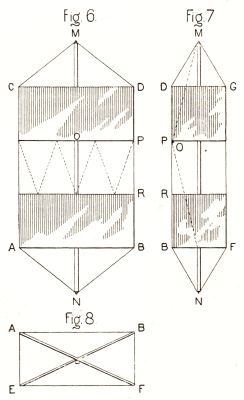
Fig. 6 is a plan of the kite; Fig. 7 is a side view; and Fig. 8 an end view. In Figs. 6 and 7 the stick M N is 66 inches long, and has a cross-section of ½ by 3/8 of an inch. At C D and A B are cross-sticks, two at each place. An end view, at A B, is shown in Fig. 8. The cross-sticks A F and B E are 33 inches long, and 3/8 inch square, or even smaller. Small screw-eyes like those used in hanging pictures are screwed into the ends of each stick. Pass a strong wire or cord—steel piano-wire is best—through the screw-eyes at A B E and F (Fig. 8), and fasten it firmly at the corners by a cord, or otherwise, making A E and B F 14 inches, and A B and E F about 30 inches. Next pass a wire from M through the screw-eyes at C and A to N (Fig. 6), and then on through F and G (Fig. 7) to M again, and fasten it. Pass a similar wire on the opposite side of the kite from M through D B N, etc., to M, and fasten it. These wires, and also the wire around A B E and F (Fig. 8), should be light. It is best to have turn-buckles at some point in each wire, so that it can be tightened after it is in place. Since the sticks at A E F B and C D G are liable to slip along the wire, it is necessary to hold them by stays tied to M and N. The cells are made of cloth (nainsook being the best). After the cloth is folded over at the edges, and hemmed or pasted, it is in two strips, each 14 inches wide and 90 inches long, so that the strips will pass entirely around the kite-frame and form two cells, D P and R B (Fig. 7). The distances from the line B F to N, and from the line D G to M, is 9 inches, and the distance P to R is 20 inches. The cloth, after being fastened around the kites, should be tight and smooth. This can be obtained best by putting lacing-strings in the edges, and making the cloth 3 or 4 inches shorter than the measure given above—say 86 inches. The cloth should then be fastened to the corners of the sticks, and also to the wire which passes around the kite at C D and A B. Next, the edges of the two cells should be laced together all around by cords running across from one to the other, as shown by the dotted lines in Fig. 6. To fly the kite, tie a strong cord at M, and also at the other end, where M N joins the cross-sticks which run from B and F. (See the broken line in Fig. 7) Tie a ring or a loop-knot at O at the rear edge of the cell D P (Fig. 7). Or the hanger may be tied at M, and brought down under the cell D P. In that case the ring O should come farther forward. It also insures steadiness to run two strings from O, one to F, and the other to E. The kite-string is tied in O.
The best material for the construction of a kite is straight-grained spruce. The best covering is bond paper, nainsook, or silk.