THE PINGRA POL.
Reading edition
BY ALLAN FORMAN.
"Shall we visit the Pingra Pol to-day?" said my Parsi friend, who was hospitably showing me the sights of Bombay.
"Oh, certainly!" I replied, with alacrity, though I had very vague notions as to what a Pingra Pol might be, and cherished a hazy idea that he was some sort of dignitary of the Hindoo Church, an archbishop or the like.
"You know what the Pingra Pol is?" queried my friend, as we seated ourselves on the cushions of his neat little gharry behind a team of spotless white bullocks not much larger than calves. Our driver, clad in flowing white garments and an enormous white turban, was seated in front of us astride the tongue, and seemed to guide his animals by patting them on the flanks. The willing little beasts started off on a brisk trot in the direction of the native city, and my friend repeated his question.
"So you do not know what the Pingra Pol is?" he said, smiling.
"I have not the slightest idea," I replied.
"It is our hospital for worn-out and disabled animals, and it is one of the oldest and most extensive charities in the world. In your country, if an animal breaks its leg or otherwise injures itself, you kill it to 'put it out of its misery'; we hold that life is sweet to even the humblest of God's creatures, and that we have no right to take away that which we cannot give again. So, instead of killing our disabled animals, we care for them until they die a natural death. This is a part of the religion of all Hindoos, but some sects are much more strict in their observance than others. The Jains, for example, will turn out of their way on the street to avoid stepping on a bug or a worm, and after going to the temple they wear a cloth across their mouths until sunset, that they may not breathe in any living creature."
While he was talking we had been trotting rapidly through the narrow streets of the native city, past gorgeous Buddhist temples, the gay residences of the wealthy Hindoos, and the tiny shops and squalid huts of the poorer people. At last we came to a high wall of dried clay which surrounded an enclosure of about ten acres. On one side was a great gateway, devoid of ornamentation, but forming a resting-place for scores of monkeys. Little monkeys and big monkeys; busy, nervous mother monkeys, at their wits' ends to keep their lively youngsters out of trouble; and gray, dignified grandfather monkeys, who looked down upon us as if they were proprietors and managers of the whole busy scene. Myriads of little green parrots screeched and swung in the trees which overhung the wall, and blue pigeons plumed themselves in the sunshine. Through the gateway came the lowing of cattle, the yelping of dogs, the quacking of ducks, and a strange medley of noises that sounded like a barn-yard gone mad.
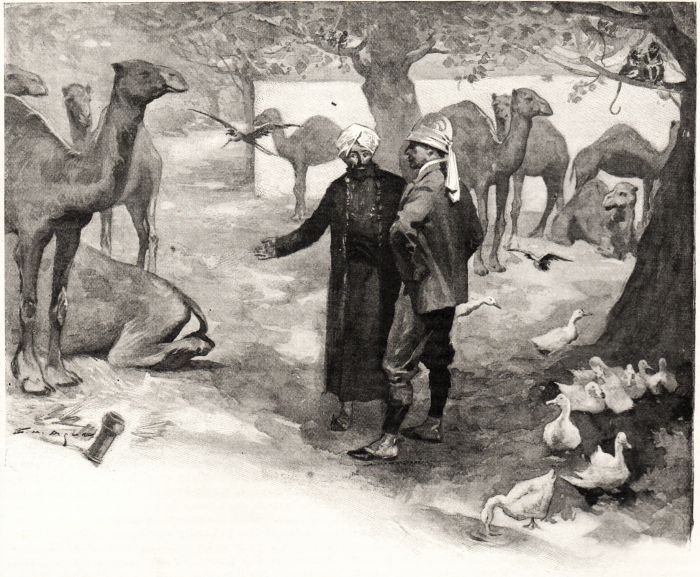
We alighted, and passing through the gateway, where we were provided with a guide and a quantity of "gram"—a peculiar native grain which tastes something like pea-nuts—we proceeded to make the rounds of this strange hospital. A dozen or more camels with broken legs, ragged and disreputable looking, glowered at us with evil eyes.
The natives say that a camel's greatest delight consists in biting a man; they can kick, too, in a way that would make an American army mule blush with envy; but they enjoy biting better; they can then witness the pain of their victim, while if they only kick him they have to go over to an adjoining county to view the remains, and a camel hates to exert himself. From all I have been told, I judge that a camel is a very even-tempered animal—always ugly.
A CAMEL IS A VERY EVEN-TEMPERED ANIMAL—ALWAYS UGLY.
From the camels we pass on to the horses, about three hundred of them, housed in comfortable box-stalls around the walls. Dainty Arab ponies, sleek and well kept, but with a leg dangling limp and useless. They crowd about you for caresses, for the Arab pony is a pet by long generations of breeding, and he craves attention like a house cat, rubbing against you, and pleading with his soft brown eyes for a lump of sugar or a bit of salt. Great rawboned "Walers," as the horses which are imported from Australia for the use of the English army are called, stand side by side with the shaggy rough little hill ponies, which are apt to be vicious, and make but a poor showing in comparison with the lovable, graceful Arabs. Some dozens of gray donkeys, looking as forlorn and dejected as only donkeys can look, yet fat, sleek, and lazy, complete the equine section.
All this time we have been threading our way among broken-legged and broken-winged ducks, cats of all sizes, ages, and colors, and in all stages of decrepitude, solemn storks standing on one leg, gulls fighting over some scrap of food that has been thrown to them, tiny striped squirrels scampering up and down the trees, pigeons without number, and monkeys everywhere. It seemed to me that there were enough monkeys to stock all the menageries in the world.
The monkeys, the gulls, the parrots, the storks, and the squirrels are not legitimate occupants of the Pingra Pol, but they have discovered a place where they are kindly treated and well fed, and where that despised and detested creature, man, has to turn out for them instead of making them fly or scamper out of his way, and they are not slow to realize its advantages. One has to witness it to appreciate the malicious joy a bedraggled stork can find in standing directly in the middle of the path and refusing to budge while the unfortunate human carefully skirts round his storkship in the mud. Then the bird raises his head, ruffles, out his neck feathers, and winks a wicked wink of triumph, and you feel that they make entirely too much of animals in India.
But we have not nearly finished the Pingra Pol yet. From the horse enclosure we pass into a much larger court, devoted to animals of the cow kind. Here are upwards of fifteen hundred water-buffaloes, trotting-bullocks, sacred Brahmin cows, oxen, some deer and antelope, and innumerable goats. With the exception of the water-buffaloes, the motley collection is hardly worth looking at; they are fat, lazy, and appear to be perfectly contented. The water-buffaloes, which I recently saw described at a travelling circus as "the ferocious Bovapulous from the jungles of India," is a most grotesque beast—a smooth skin of faded black with hardly a hair on it, stretched over so clumsy a carcass that it looks as if it were badly stuffed, a great head bearing a pair of the most ferociously villanous horns, and lit up by as mild a pair of light blue eyes as ever beamed from the countenance of a Quaker. The combination of the piratical horns and the peaceful eyes gives the beast a strange, contradictory appearance. It is a harmless creature, and when not wallowing in the mud, it trudges patiently after its owner from house to house, and furnishes the best milk procurable in India, unless you happen to have the rare good fortune to secure the produce of an imported English cow. These poor beasts are almost all broken-legged, and while it is satisfactory to see that they apparently suffer no pain, they are too contented to rouse much sympathy.
With the dogs, however, it is different. There are three or four hundred of them confined in great cages in a large court-yard, and they are the only occupants of the Pingra Pol who do not seem satisfied to remain there. They are all yearning for human companionship, and the barks and yelps which greet the visitor as he passes their cages are most pitiful. "Take me away with you; I will be a good dog for you; take me with you," is the burden of the canine chorus, and the expression of dull despair that succeeds the hope that lights each doggy face is enough to melt the heart of the most rabid dog-hater. There are a few good dogs here—setters, Great Danes, and mastiffs, and other imported animals which have been injured and sent here by their owners—but the most of them are what are known in India as "dogs of sorts," meaning all sorts, or, as a friend of mine said, "the most thoroughbred mongrels he ever saw." But some of these mongrel curs make the most faithful and affectionate canine companions, and it is surprising the accession of dignity and self-importance that will come to the humblest "yaller purp" of the streets when he is adopted by a good master. The English residents use the native mongrels to hunt jackals, as they use fox-hounds for foxes in England, and the pluck and endurance of the unpromising-looking beasts surprise a good many Englishmen who have been used to hunting behind the carefully bred fox-hounds of the mother-country.
But a globe-trotter can't be encumbered with pets, and we pick our way out of the Pingra Pol, carefully avoiding the ducks, pigeons, and other small fry which squat unconcernedly in our path, and dodging as best we can the sticks and straws which the ever-active monkeys try to drop on our heads.
"Well, what do you think of one of the oldest charities in the world?" inquired my Parsi friend, as we passed through the gateway and seated ourselves in the bullock gharry.
"It is very interesting, but it must cost a deal of money to keep all those animals after they have ceased to be of any use," I answered.
"Yes; but we cannot kill them, and if one recovers so that it can be worked, or if there is healthy increase, they are given to deserving persons who will treat them kindly. The Pingra Pol is supported by voluntary contributions from the Jains, Parsis, and other Hindoo sects; there are others in Ahmedabad, Jeypoor, and other large cities. In Ahmedabad, which is the headquarters of the Jain sect, they have a building for fleas. When a pious Jain catches a flea among his scanty garments, he does not do as you cruel Occidentals do, ruthlessly crush the poor insect. Oh no! He carefully carries it to the Pingra Pol, and deposits it in the flea-house, where every day a brawny coolie is paid to spend a few hours and give the inmates a square meal," and my friend laughed as if he were not in thorough sympathy with the extreme customs of the Jains.
I found subsequently that this same regard for animal life extends all over India. The monkey, the gray crow, and the green parrot ravage the gardens and fields undisturbed save by ineffectual scarecrows. Occasionally a house-servant would catch a crow and wire a soda cork on his bill, but I fancy that the crows regarded it as a mark of distinction; the wild peacocks committed such depredations in the vicinity of Jeypoor that the people were obliged to employ double sets of watchers to drive the birds out of their gardens. And in Agra the monkeys became such a nuisance that the native merchants joined together, chartered a train of flat cars, which they plentifully covered with gram, and when the train was well loaded with monkeys busily engaged in eating, they ran it up country into the jungle about two hundred miles. I am assured, however, on the authority of a Judge of the Supreme Court of India, that the monkeys, like the cat, came back, and that each brought with him seven new chums who had been lured from their native jungle by tales of city life as told by the involuntary wanderers. I will not vouch for the accuracy of the figures of my friend the Judge, but I did not miss any monkeys in Agra or any other part of India. But while the monkeys and birds are a nuisance, it is far pleasanter to see them taken care of than killed in wanton cruelty, for "sport."
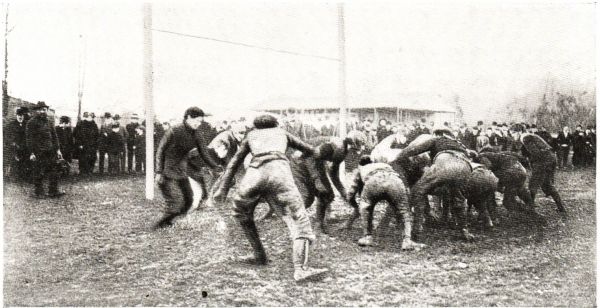
After a season that has been unusual in more respects than one, the New York Interscholastic football games have come to an end, and De La Salle stands as the champion of the League. The final game was played on the Berkeley Oval, a week ago Saturday, between De La Salle and Trinity, the former winning by a score of 2-0.
FINAL GAME OF THE NEW YORK INTERSCHOLASTIC FOOTBALL ASSOCIATION. De La Salle has the ball on Trinity's 10-yard line.
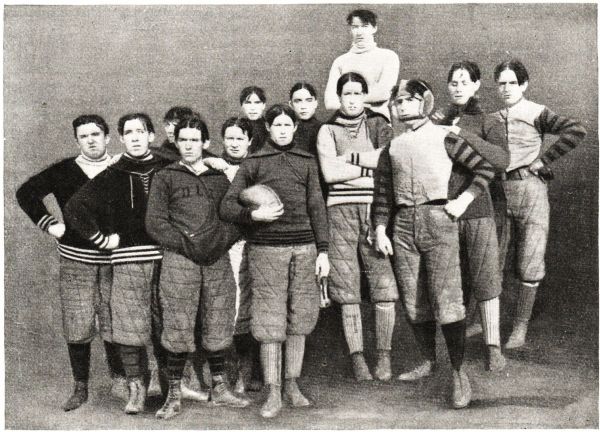
THE DE LA SALLE INSTITUTE FOOTBALL TEAM.
The grounds were in miserable condition, and the last part of the game was played in total darkness. The only scoring that was done occurred in the first half. De La Salle made a succession of gains through Trinity's left tackle, and got the ball to within a couple of yards of the line, when it went to her opponents on downs. Page was then tried for a centre play in an attempt to get the leather out of danger, but De La Salle proved equal to the emergency, and forced her opponents over the line for a safety.
The play in the second half was hard and fast. The ball was kept moving up and down the field with rapidity. But it soon became almost impossible for the men to do any kind of systematic work, owing to darkness, and the game degenerated into a series of blind scrimmages, from which no one profited, until time was called.
The football season in Wisconsin has come to an end, and the Madison High-School can claim the honor of having defeated every high-school team it has met this year. Madison defeated Minneapolis, 21-0, and on Thanksgiving day routed an eleven who appeared to represent the Hyde Park High-School of Chicago, 22-0. The Hyde Park team was likewise defeated on the following day by a combination team from the Milwaukee East and South Side High-Schools, 12-0. In this last game Milwaukee made long gains through centre and tackles, but was unable to make any headway around the ends. The score would doubtless have been greater except for the fact that fifteen-minute halves were played. The best work for Milwaukee was done by Tuttrup, full-back, and Collins, centre.
Now that the Cook County High-School Association's football season is closed, the Chicago athletes will turn their attention to in-door baseball. Representatives from the Englewood, Austin, Lakeview, Evanston, English, North Division, and Hyde Park High-Schools met recently, and made preliminary arrangements for an in-door baseball championship series. Austin won the pennant last year, and hopes to be successful again this season. Its most formidable opponents will probably be Lakeview and North Division. Englewood has never before been represented in the in-door baseball contests, and Hyde Park has not even yet set about organizing a team. Nevertheless, the interest in the game will doubtless insure a successful season.
CLINTON (IOWA) HIGH-SCHOOL FOOTBALL TEAM.
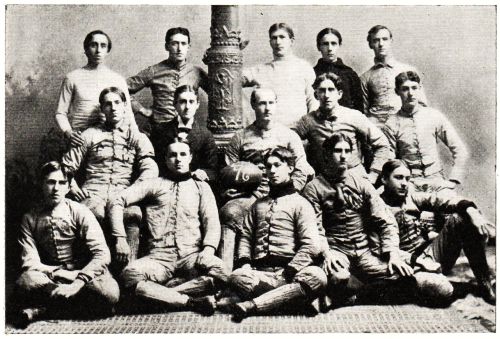
The Clinton High-School football team is undoubtedly the strongest scholastic eleven in Iowa. Its record this season is one that it may well feel proud of; and although nine games were scheduled early in the season, and only two were played, it was not the fault of Clinton that this was the case. In the first game Clinton defeated the Savannah, Illinois, H.-S., 56-0; the second game was against Cornell College, of Mount Vernon, Iowa, and resulted in a tie, neither side scoring.
When the high-school teams of Moline, Davenport, Dubuque, Sterling, Dickson, and Rock Island learned of the prowess of the Clintonians, they backed out of their scheduled games, and Clinton was left without any opponents. The Cornell team ranks third among the colleges of Iowa, and averages 170 pounds.
The average weight of the Clinton H.-S. eleven is 157, with 160 pounds average for the backs. Keister, left half-back, is probably the best player on the eleven; he is a sure tackler and a strong ground-gainer. Holmes, at right guard, weighs 181 pounds, and knows his position thoroughly. He tackles well, and has great skill in breaking through the opposing line. He proved himself capable, also, running with the ball, and made frequent gains around the ends in practice. Verrien, at full-back, is a new man, but he punts well, and should develop into a good line-bucker. It is to be hoped that next year Clinton will be more successful in securing opponents who care to play football for the sake of the game rather than for the satisfaction of victory.
Although athletics have not yet reached that stage of development in Cleveland to which they have attained in many other cities of equal size, yet there is a lively interest in schoolboys' sport there, and for the past two years a football league has been in operation. In 1895 it was composed of the Central High-School, the University School, the West High-School, the South High-School, and the Freshman teams of the Western Reserve University and of the Case School of Applied Science.
This year, however, some wise sportsman must have informed the schoolboys of the absurdity and inadvisability of having such a mongrel combination of schools and colleges, for during the football season the association consisted only of the Central High and University Schools. The former has the advantage in numbers, there being about eight hundred scholars enrolled; but the University School, with about two hundred boys, has the advantage of being a private school with greater resources at its command.
The championship game of football was played this year on a very muddy field, but both teams had had good coaching and put up good sport. A feature of the game was a goal from the field by Ammon of the University School, the first performance of the kind ever witnessed in the City of Cleveland. The final score was 12-9 in favor of the Central High-School, but it is said that this score does not show how close the game actually was, the University School having missed winning by the failure of a foot for a second goal from the field. Most of C.H.-S.'s gains were made through right tackle, and the High-School players resorted almost entirely to a rushing game. The University School players, on the other hand, kicked a great deal, and as Ammon is probably one of the cleverest punters and drop-kickers of any of the schools of the West, this style of play proved most effective for that side.
The senior interscholastic football season in Boston was brought to a close last week in a manner that was somewhat unlooked for. The unexpected was due to the action of the Executive Committee of the Association at its last meeting. At the opening of the football season, early in the fall, it was announced that all the teams must strictly obey not only the letter, but the spirit of the Constitution, and they were warned that they must take the consequences if the rules were not thoroughly lived up to.
As a result, however, of the game played on November 14, between Hopkinsons and Cambridge Manual-Training School, a protest was entered against C.M.-T.S., and charges were made that their team had violated one of the Articles of the Constitution. When the protest came up for decision before the committee, to which all such matters are referred, the committee decided that while the intention of C.M.-T.S. was not of a malicious nature, the situation, nevertheless, was too grave to admit of any alternative but that of depriving Cambridge of the game and of awarding it to Hopkinsons.
This decision would give the championship, then, to Hopkinsons. But the captain of the Hopkinson football team refused to accept an honor gained on a technicality of the Constitution, and declined to take advantage of the committee's decision. The committee, therefore, voted that no championship should be awarded for the season of 1896.
In the past few years the rules of the Constitution have not always been rigidly enforced or stringently lived up to, and the sudden change of affairs has rather surprised the League members who supposed the lines would not be drawn so closely. At the present time, when some of the teams seem to be not satisfied to settle disputes on the gridiron, but seek rather to fall back on the Executive Committee, it has become necessary to strictly enforce the most insignificant clause of the Constitution.
The Cambridge Manual episode has attracted considerable attention in the Boston Interscholastic League, and while the result is a most severe lesson to that school, and possibly out of proportion to the offence alleged to have been committed, the result will be that in future years there will be less unnecessary action for the Executive Board, and the schools will learn to adhere to the clauses as set down in their Constitution.
In spite of Cambridge Manual's misfortune at the close of the season, her record of play has been rather exceptional during the playing weeks. One noticeable feature has been that C.M.-T.S. has scored the first goal from the field since 1891, when Moore, C.M.-T.S., kicked one, as he did also the previous year. Considerable attention has been given by the Cambridge team this fall to the development of a kicking game, and good results have followed. It is asserted that they have never had a kick blocked, and there seems to be little doubt that Sawin, the captain of the eleven, is the best kicker in the League.
Another feature of Manual-Training's game has been their system of interference, which proved particularly effective, and the backs have been drilled to hurdle the pile after the interference had been broken, and thus frequently to gain an extra couple of yards. The C.M.-T.S. manner of defence was likewise a strong one, and although outweighed man for man by a number of the teams against which they played, the Cambridge eleven proved themselves capable of forcing their opponents to kick or to surrender the ball time and time again.
RECORDS OF THE N. E. FOOTBALL ASSOCIATION.
T
'
Gc
ohS
a-a
ldf
soe
wtT
fGniTo
roseot
oasta
mlfal
sabl
TiyP
oflPoG
uriOoiGa
conpinam
hmgpntme
-otses
dFGnss
oioeLL
weanWoWo
nlltosos
Teamssdssntnt
1888.
Cambridge H. and L.20..4..136..60
Boston Latin12..17..1401551
Roxbury Latin10..11665642
English High2..2..207823
Stone, Nichols, and Hales4..51465213
Hopkinson's1..3..1812615
Nobles..11..910803
1889.
Cambridge H. and L.1136..1051630
English High3..7..463221
Boston Latin7..4..582022
Roxbury Latin4......246822
Hopkinson's1......610304
1890.
Cambridge H. and L.10..8..913551
English High10..7..882641
Hopkinson's7..8..745232
Manual-Training614..5748(1)13
Roxbury Latin5..51528014
Boston Latin..........1220(1)4
1891.
Hopkinson's17..7..130440
Manual-Training915..795622
English High2..12..604822
Boston Latin4..2..325822
Cambridge H. and L...........13504
1892.
Hopkinson's12..4..88840
Manual-Training2..3..24341(2)1
English High5..4..46522(1)1
Cambridge H. and L.1..1..10341(1)2
Boston Latin2..1..165604
1893.
English High11..3..7856(3)4(2)0
Manual-Training19..5..13428(3)41
Boston Latin3..3..306823
Newton High10..3..728823
Cambridge H. and L.5..1..34781(2)2
Hopkinson's5..6..54840(2)4
1894.
Manual-Training9..5..74..40
English High11..2..682632
Cambridge H. and L.2..1..169823
Hopkinson's5..3..421623
Boston Latin3..1..223223
Newton High1..2..145813
1895.
English High4..12..561450
Boston Latin2..211410(3)32
Hopkinson's6..7..403632
Cambridge H. and L.1..11840(4)13
Brookline High3..4..2216(5)13
Manual-Training1..3..1436(1)03
1896.
Manual-Training1213191641
Hopkinson's8..4..6421(1)31
Brookline High5..1..3430(1)31
English High4..2..2212(2)21
Boston Latin6..1..406414
Cambridge H. and L...........12805
Note: (1) One tied. (2) Two tied. (3) Forfeited. (4) One tied and protested. (5) Protested.
An interesting table of records is printed with this issue of the Department because it must prove valuable as statistics for reference; a few points of further statistical information may likewise prove of value: since the Interscholastic League was first started, in 1888, the greatest number of points piled up by any single team is 140. This total score was made by the Boston Latin School in 1888. In the same year Cambridge High and Latin made a total of 136 points, and was not scored against in any of the championship games.
The record also shows that only six safeties have been made in the League games since they were first started—two in 1888, one in 1890, two in 1895, and one this fall. Only seven goals from the field have been kicked during these nine years; this includes those mentioned above.
The standing of the teams in the Senior League and those in both divisions of the Junior League follow:
SENIOR LEAGUE.
GamesGamesGamesPointsPoints
won.lost.tied.won.lost.
Hopkinson's4016421
Brookline High3113430
Cambridge Manual320912
English High2123212
Boston Latin1404064
Cambridge High and Latin0500128
JUNIOR LEAGUE.
Division A.
GamesGamesGamesPointsPoints
won.lost.tied.won.lost.
Hyde Park High3015222
Roxbury Latin2114430
Dedham High020422
Dorchester High020430
Division B.
GamesGamesGamesPointsPoints
won.lost.tied.won.lost.
Somerville High400906
Medford High3106028
Newton High1203046
Chelsea High020246
Nobles and Greenoughs030056
FOR THE CHAMPIONSHIP.
Somerville High12Hyde Park High6
SCORE OF GAMES PLAYED.
Hopkinson's34Cambridge High and Latin0
(1)Hopkinson's0Cambridge Manual15
Hopkinson's14Boston Latin6
Hopkinson's0English High0
Hopkinson's16Brookline High0
Brookline High6Cambridge Manual2
Brookline High12Cambridge High and Latin0
Brookline High10Boston Latin6
Brookline High6English High6
Cambridge Manual6English High0
Cambridge Manual34Boston Latin0
Cambridge Manual34Cambridge High and Latin0
English High20Cambridge High and Latin0
English High6Boston Latin0
Boston Latin28Cambridge High and Latin0
Note: (1) Game given to Hopkinson's by action of the Executive Committee.
Unless something unforeseen occurs to prevent, the All-Connecticut Interscholastic Football Team, and in all probability the All-New-York Interscholastic Football Team, will be announced in the next number of the Round Table.
"FOOTBALL FACTS AND FIGURES."—By Walter Camp.—Post 8vo, Paper, 75 Cents.
The Graduate.