HARPER'S CATALOGUE
Reading edition
thoroughly revised, classified, and indexed, will be sent by mail to any address on receipt of ten cents.
For Young Naturalists.
H. Notman, 182 Amity Street, Brooklyn, N. Y., wants to join a corresponding Chapter, or some society of young naturalists. He also wants the pupa of the cicada and the shell it leaves on the trunk of trees. He has beetles, and wants correspondents among members of the Order interested in natural history.
A Modern Curfew.
The saying about history repeating itself has an example in the modern curfew, which is in legal effect in about two hundred cities in this country. Many years ago, in English towns, a bell was rung every night at a certain hour, and after that hour people found on the streets were liable to be caught, tried, and punished. This old law applied to grown folks, but the modern curfew law applies to children only, and is designed to keep boys off the streets. It is said to be in successful effect in Omaha, Nebraska; St. Joseph and Kansas City, Missouri. Besides these large cities, eight or ten smaller cities in New Jersey, Ohio, and Michigan contemplate enacting the law, and there is to be a movement made this winter to get it passed in New York city. Will members living in any city in which it is in effect tell the Table about it? Tell us just what the ordinance says, and how it works in practice.
To Amateur Journalists.
William F. Tillson, 149 North Street, Springfield, Massachusetts, is interested in music and dramatics, and wants correspondents. He wants to receive amateur papers from publishers as samples. So does Ethel S. Deane, Dean, Ohio.
Will do for Next Summer.
Please give me plan and measurements of a single tennis-court, and tell me how it may be made a double court.
Will Kelsey. Baraboo.
Choose the place for your net so as to give an equal space behind each base-line. Measure 36 feet, and put in a peg at either end, with the tape-line fastened to it. Take 39 feet on one measure, and 53 feet ¾ inch on the other. Where they cross is one corner. Mark off 21 feet from the net from one end of the service-line. Transpose the measures and do the same thing, and you have half the court. Carry the measures to the other side of the court, and repeat the operation. The central-line runs from the middle of each service-line. The inner side-lines run from base-line to base-line 4 feet 6 inches inside of the side-lines. If you are marking out a double court only, do not carry the inner side-lines beyond the service-lines. Make a mark inside the middle of the base-line to show where the server may stand. The diagonal of a single court is about 47 feet 5 inches. If possible, have the court run north and south.
The New Mint Building.
The old United States Mint, for so many years in the crowded and expensive neighborhood on Chestnut Street in this city, is to be torn down and removed to Spring Garden and Sixteenth streets, about one mile north of its present location. Strong efforts were made to get the Mint removed to Washington when it was found necessary to build a new one. Even Chicago and New York tried to get it away from here. But five years ago a whole square was purchased for its site, and Philadelphia breathed easier.
The new Mint will have a main entrance on Spring Garden Street. It will be in the form of a hollow square, giving a court-yard open to the sky. It is to have a terrace balustrade constructed of granite. Above it the material will be marble. The style is severely plain classic, and the design as shown on paper is far from pleasing. In the plan is provided a spacious room for the coin museum, which many readers have doubtless seen in the old building. It is by far the finest collection of old coins in the world, outside of the British Museum. Work upon the new Mint building is expected to begin next spring.
Fred B. Biddle. Philadelphia.
Answer to Convent Puzzle.
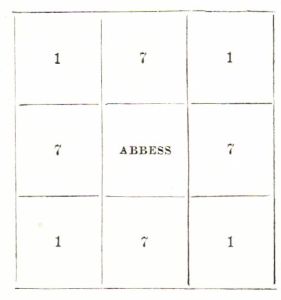
By looking at these four diagrams you will see the trick of the puzzle. Fig. 1 shows the nuns on good behavior; Fig. 2, when four sisters have escaped; Fig. 3, when they have returned with four friends; Fig. 4, when four more outsiders have been admitted—presumably by a rope-ladder.
Fig. 1.
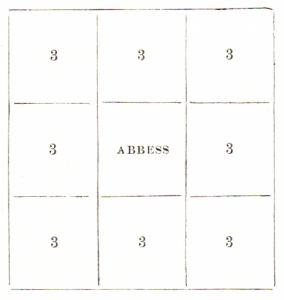
Fig. 2.
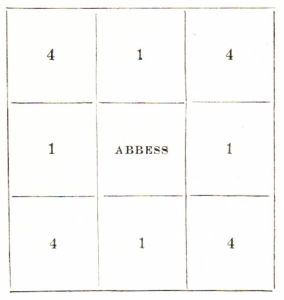
Fig. 3.
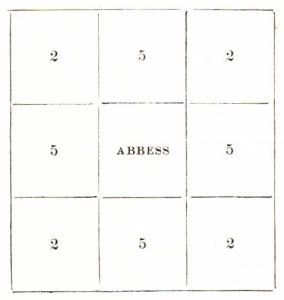
Fig. 4.
Queer Weather Signs.
Not long since a number of natural signs were given by which a change in the weather could be easily told. Here are a few more:
When a strong hoar-frost is seen in winter, it will rain in two, or, at most, three, days.
It commonly rains on a day when the sun appears red or pale; or the next day when it sets in a cloud.
When the moon is pale, rain; when red, wind; when of a pure and silver color, fair weather; according to the old verse, silver color, fair weather; according to the old verse,
Pallida pluit, rubicunda flat, alba serenat.
When the sun appears double or treble through clouds, a storm of long duration may be expected.
When a halo is seen around the moon, rain; around the sun during bright weather, rain; around the sun during a rain, fine weather.
Jean Bonpére.
Questions and Answers.
Helen L. Codey: The United States takes a census each decade—1880, 1890, 1900, etc. The first national census was made in 1790. No, it was not that this government neglected it up till that date. It was not then the custom of countries to take careful censuses. Some States take censuses on the abstract decades, as 1885, 1895, 1905, etc. The figures about shipping, the crops, railway earnings, etc., to which you refer, are collected, for the most part, by a bureau of statistics, at Washington, and published free for general use.
Fred B. Davies asks what is meant by an advertisement, which he encloses to us, asking for bids in connection with the making of pennies, and he inquires if the United States does not coin its own money. Yes, our government coins its own money, and prints its own paper bills. But it gets blanks for pennies and nickels made by private parties. The advertisement enclosed specifies that "one-cent blanks must be properly annealed, cleaned and milled, and ready for the press, composed of 95 per cent. of copper and 5 per cent. of zinc and tin, in equal proportions." These blanks are made by private concerns, and then the pennies are coined at the mint. The blanks cost the government 21.95 cents per pound, and there are approximately 146 pieces to the pound, avoirdupois. Last year the mint at Philadelphia coined 46,168,422 pennies.—Foster W. Stearns, 269 Park Street, Newton, Mass., wants to hear of some amateur journals whose editors desire contributions.—May Inman Maguire, Hendersonville, N. C., expects soon to move to Washington, D. C., and desires to hear from some Chapter or young ladies' literary club in that city to which she may belong.—George E. Purdy, Box 1228, New York city, will write a description of the New York Stock or Produce Exchange to any member anywhere willing, in turn, to write and send him a description of an interesting spot, feature, industry, etc., in any other city.
"Page": You should apply at once to the member of Assembly from your district if you would become a page in the Assembly-Chamber at Albany this winter. But, to be frank with you, it must be said that, as a rule, boys whose parents reside in Albany are almost always appointed. Boys are required to be bright, well behaved, and strong enough to endure several hours of hard work per day, with sometimes a night session thrown in. The pay is $2 per day.
Frederic B. Schurman: Charity organization societies are not found in cities as small as the one in which you live (Erie), for the reason that the necessity for them does not exist. They are a banding together of public and private charities for better administration and for the study and cure of pauperism. It is an English idea. Organized charity was undertaken in London in 1869, and in this country in 1877. The first American society was organized in Buffalo, N. Y., and the organizer of it was an Episcopal clergyman named Rev. Humphrey Gurteen. The second American society was organized in Philadelphia in 1878, and that of New York city four years later. There are now seventy-eight such societies.
This Department is conducted in the interest of stamp and coin collectors, and the Editor will be pleased to answer any question on these subjects so far as possible. Correspondents should address Editor Stamp Department.
The publishers of a paper in Boston, having occasion to send out many thousands of their annual announcements, by a special arrangement with the postmaster used 1c. stamps which had been cancelled in a press by the entire sheet as follows:
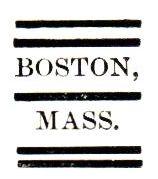
I understand that an employé of the P. O. inspects the affixing of stamps thus cancelled.
This is a variety well worth collecting, but possibly the same plan may become popular at other large post-offices, and it would be a little difficult to determine the genuineness of many varieties.
Mr. John N. Luff read a paper on the early issues of Switzerland, at the Collectors' Club, and illustrated the same by stereopticon views of the stamps, counterfeits, cancellations, etc. Most of the unused stamps from which the photographic slides were made came from Mr. H. J. Duveen's wonderful collection of these rare stamps. This was one of the best papers ever read before a philatelic audience, and the first stereopticon stamp lecture given in America.
People wonder at the high prices asked for old postage-stamps. The same people probably wonder at the still higher prices asked for old books, old armor, old pictures, etc. But the curious thing is that a man who gives $5000 for a unique stamp is not thought to be quite as sane as the man who gives $100,000 for an old master, or $50,000 for a rare orchid. Still philately flourishes, and the press is educating the public.
I very much regret to announce the death, on Thanksgiving day, of the Daily Stamp Item, at the age of one year. Begun as a joke, edited by "the office cat," it has appeared day by day for a full year, always bringing a little philatelic titbit, and sometimes containing as much news as the average weekly or monthly stamp paper. The publishers purpose to issue a special souvenir number during the holidays, containing a review of the year's work, and also a complete list of the subscribers, to each of whom a copy will be sent.
F. W. Lerk.—The little true value of "Seebecks" was shown at a late auction, where sets of these stamps were sold for $3, the catalogue value of which was $28. If you are looking at collection as a speculation, my advice is to buy high-priced stamps only, the higher the better, as a rule; but if you are collecting for fun, go in for everything in the countries you select, and you will have much satisfaction, and not suffer any money loss should you wish to sell your collection, provided you study your stamps carefully, get and keep them in fine condition, and make up all the chief varieties in shades, etc.
Philatus.

There is a "comfortable feeling" that comes after a bath with Ivory Soap.
Th: Procter & Gamble Co., Cin'ti.