THE IMP OF THE TELEPHONE.
Reading edition
BY JOHN KENDRICK BANGS.
VI.—THE CIRCUS (Concluded).
"Hullo," said Jimmieboy. "Back again?"
"Do I look it?" asked the Imp.
"Yes, I think you do," returned Jimmieboy. "Unless you are your twin brother; are you your twin brother?"
"No," laughed the Imp, "I am not. I am myself, and I am back again just as I appear to be, and I've had a real dull time of it since I went away from you."
"Doing what?" asked Jimmieboy.
"Well, first I had to tell your mother that the butcher couldn't send a ten-pound turkey, but had two six-pounders for her if she wanted them; and then I had to tell him for her that he could send mutton instead. After that I had to blow up the grocer for your father, whose cigars hadn't come, and then tell your father what wasn't so—that the cigars hadn't been ordered—for the grocer. After that, just as I was leaving, the cook came to the 'phone and asked me to tell your Aunt Susan's cook that her cousin in New York was very ill with a broken wheel on his truck, and that if she would meet her in town at eleven o'clock they could go to the matinée together, which she said she would do, and altogether it has been a very dull twenty minutes for me. Have you enjoyed yourself?"
"Hugely," said Jimmieboy, "and I hope now that you've come back I haven't got to stop enjoying myself in the same way. I'm right in the middle of the Fish Circus."
"Oh, are you," said the Imp, with a smile. "I rather enjoy that myself. How far have you got?"
"The Shark and the Lobster had just gone off when you came back."
"Good," returned the Imp. "The best part of the performance is yet to come. Move over there in the chair, and make room for me. There—that's it. Now let's see what's on next. Oh yes. Here comes the Juggling Clam; he is delightful. I like him better that way than if he was stewed."
The Book interrupted the Imp at this point, and observed:
"Now glue your eyes upon the ring, And see the Juggling Clam Transform a piece of purple string Into a pillow-sham. "Nor think that when he has done so His tricks are seen and done, For next he'll turn a jet-black crow Into a penny bun. "Next from his handsome beaver hat He'll take a piece of pie, A donkey, and a Maltese cat, A green bluebottle fly; "A talking doll, a pair of skates, A fine apartment-house, A pound of sweet imported dates, A brace of roasted grouse; "And should you not be satisfied When he has done all that, He'll take whatever you decide Out of that beaver hat. "And after that he'll lightly spring Into the atmosphere, And show you how a Clam can sing If he but persevere. "When he has shown all this to you, If you applaud him well He'll be so glad he'll show you through His handsome pinky shell."
Jimmieboy didn't believe the Clam could do all this, and he said so to the Imp, but the Imp told him to "wait and see," and when the boy did wait he certainly did see, for the Clam did everything that was promised, and when Jimmieboy, just to test the resources of the wonderful hat, asked the Clam to bring out three dozen jam tarts, the Clam brought out the three dozen jam tarts—only they were picture jam tarts, and Jimmieboy could only decide that it was a wonderful performance, though he would have liked mightily to taste the tarts, and see if they were as good as they looked.
"What comes next?" queried Jimmieboy, as the Clam bowed himself out of the ring.
"Listen, and the Book will tell," returned the Imp.
The Book resumed:
"We now shall have the privilege Of witnessing the Whale Come forth, and set our teeth on edge By standing on his tail. "When this is done, he'll open wide That wondrous mouth of his, And let us see how the inside Of such great creatures is; "And those who wish to take a trip— Like Jonah took one time— Can through his mammoth larynx slip For one small silver dime. "For dollars ten, he'll take you to The coast of Labrador, The Arctic Ocean he'll go through For dollars twenty-four; "And should you wish to see the Pole, He'll take you safely there, If you will pay the usual toll— Ten thousand is the fare."
"I'd like to go to the North Pole," said Jimmieboy.
"Got ten thousand dollars in your pocket?" queried the Imp, with a snicker.
"No; but I've got a dollar in my iron bank," said Jimmieboy; "perhaps he'd take me for that."
"YOUR EARS WOULD BE FROZEN SOLID."
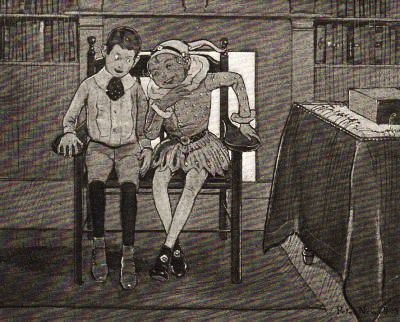
"Very likely he would," said the Imp. "These circus fellows will do almost anything for money; but when he got you there he would tell you you could stay there until you paid the other $9999; and think how awful that would be. Why, your ears would be frozen solid inside of four weeks."
"Is it as cold as that at the Pole?" said Jimmieboy.
"Colder!" ejaculated the Imp. "Why, when I was there once I felt chilly in spite of my twenty-eight seal-skin sacques and sixty-seven mufflers, so I decided to build a fire. I got the fagots all ready, lit the match, and what do you suppose happened?"
"What?" queried Jimmieboy, in a whisper, for he was a little awed by the Imp's manner. "Wouldn't the match light?"
"Worse than that," replied the Imp. "It lit, but before I could touch it to the fagots the flame froze!"
Jimmieboy eyed the Imp closely. This seemed to him so like a fairy story, in which the first half is always untrue and the last half imaginary, that he did not exactly know whether the Imp meant him to believe all he said or not. It did him no particular good, though, to scrutinize the Imp's countenance, for that worthy gave not the slightest sign that there was any room for doubt as to the truth of this story; indeed, he continued:
"Why, the last time I went to the North Pole I took forty-seven thermometers to register the coolth of it, and the mercury not only went down to the very bottom of every one of them, but went down so quickly that it burst through the glass bulb that marked 4006 below zero, and fell eight miles more before it even began to slow up. It was so cold that some milk I carried in a bottle was frozen so hard that it didn't thaw out for sixteen months after I got back, although I kept it in boiling water all the time, and one of the Esquimaux who came up there in midsummer to shoot polar bears had to send for a plumber after his return home to thaw out his neck, which had frozen stiff."
"Maybe that is why the whale charges so much to take people there," suggested Jimmieboy.
"It is, exactly. There is no risk about it for him, but he has to eat enough hot coal and other things to warm him up, that really it costs him nearly as much as he gets to make the trip. I don't believe that he clears more than half a dollar on the whole thing, even when he is crowded," said the Imp.
"Crowded?" echoed Jimmieboy. "What do you mean by that?"
"Crowded? Why, crowded is an English word meaning jamful and two more," said the Imp.
"But crowded with what?" queried Jimmieboy.
"Why, passengers, of course. What did you suppose? Ink bottles?"
"Then he takes more than one passenger at a time," said Jimmieboy.
"Certainly he does. He'll hold twenty-five boys of your size in comfort, thirty-five in discomfort, forty-five in an emergency, and fifty at a pinch," said the Imp. "But see here, we are losing a lot of circus. There goes the Educated Scallop out of the ring now. I'm sorry you missed him, for he is a tender."
"A what?"
"A tender. That is, he is ten times as marvellous as a wonder. Why that Scallop is the finest comic actor you ever saw. His imitation of a party of sharks off manning is simply the most laughable thing I ever saw," said the Imp, enthusiastically.
"I wish I could understand half of what you say," said Jimmieboy, looking wistfully at the Imp. "Because if I did, you know, I might guess the rest."
"What is it you don't understand now?" asked the Imp.
"What is a party of sharks off manning?" queried Jimmieboy.
"Did you ever see a man fishing?" questioned the Imp.
"Yes."
"Well, if a man can fish, why shouldn't a fish man? Sharks can catch men just as easily as men can catch sharks, and the Scallop shows how sharks behave when they catch men—that's all."
"I wish I'd seen it; can't you turn back to that page in the book, and have it done all over again?" asked the boy.
"No, I can't," said the Imp. "It's against the rules of the Library. It hurts a book to be turned back, just as much as it hurts your little finger to be turned back, and in nine cases out of ten turning back pages makes them dogeared; and dogs, or anything that even suggests dogs, are not allowed here. Why, if the other Imps who own this Library with me knew that I had even mentioned dogs they would suspend me for a week. But, my dear boy, we really must stop talking. This time we've missed the Crab with the iron claw—why, that Crab can crack hickory nuts with that claw when he's half asleep; and when he's wide awake he can hold a cherry stone a hundred miles a minute, and that's holding mighty fast, I can tell you. Let's hear what the Book has to say now."
"Bang!" said the Book.
"Dear me!" cried the Imp. "Did you hear that?"
"Yes," said Jimmieboy. "What does it mean?"
"It means the circus is all over," said the Imp. "That was the shutting up of the Book we heard. It's too bad; but there are other things quite as well worth seeing here. I'll tell you what we'll do—I'll find the Pixyweevil Poetry Book, and turn that on, and while you are listening, I'll see who that is ringing, for I am quite sure the bell rang a minute ago."
[to be continued.]
The game between the elevens from the Carlisle Indian School and the Y.M.C.A., at Manhattan Field, Thanksgiving day, was one that I wish could have been witnessed by every football player in the country. For real earnest football play I have never seen the Indians' performance beaten. They went on the field not to talk, not to slug, not to wrangle with the officials, but to play football. And they did play football. They attended strictly to their business from whistle to whistle, and not a word did one of them say, except to call out the signals. I will make another exception. One player did make a remark. Some of the Y.M.C.A. men were talking and objecting in a manner unfortunately too common with some football players, when one of the red men tapped his opponent quietly on the shoulder and said, "Ugh, too much talk!"
Lone Wolf, c., Kiowa. Campeau, sub., Chippewa. Wheelock, r.g., Oneida. Pierce, sub., Seneca. Printup, sub., Tuscarora. Irwin, r.t., Gros-Ventre. Cayou, l.h.-b., Omaha. Metoxen, f.b., Oneida. Pierce, l.-g. and Capt., Seneca. McFarland, r.h.-b., Nez-Percé. Seneca, sub., Seneca. Leighton, sub., Crow. Schanandore, Oneida. Hudson, q.-b., Pueblo. Miller, l.e., Stockbridge. Jamison, r.e., Seneca. CARLISLE INDIAN FOOTBALL ELEVEN.
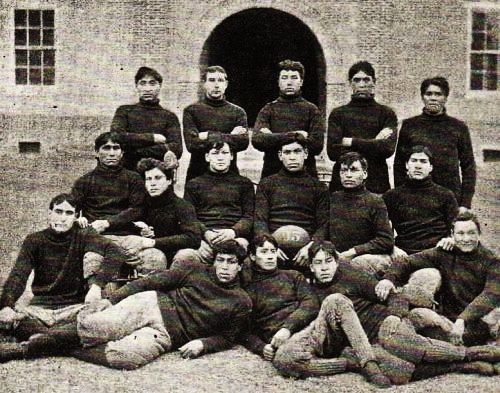
When one considers that these Indians had never played football, nor had even seen a game, before they came East from their reservations—some of them three years, some only one year ago—their work and behavior are all the more notable. Their first knowledge of the game came from watching the Dickinson College men. That was four or five years ago. Now the Indians can defeat Dickinson in a majority of games played. This year's eleven is the strongest the school has ever put into the field, and it has been the most successful. Most of the players are from the Western tribes, and they are a strong, wiry lot. Their quick movements and splendid muscular development enable them to make great gains in bucking the centre, which is the play more favored by the Indians than running around the ends. Their early life and training have hardened them, too, so that they are able to stand the strain of football much better than their white brethren.
The Captain of the eleven, Bemos Pierce, a Seneca, is over six feet tall, and weighs 203 pounds. He is at left guard; the right guard, Wheelock, an Oneida, is likewise a six-footer, and weighs 185 pounds. Lone Wolf stands in the centre, completing a trio unprofitable to buck. Lone Wolf specially is a hard man for an opponent to handle, being as hard as iron and as lithe as a serpent. He stood as model for the statue of the Indian killing a buffalo in front of the Fine Arts Building at the World's Fair. Metoxen (or more properly Met-the-Oxen) is the full-back, and has made a reputation for himself as a clever punter. He is also a swift runner, and invariably makes a gain when he takes the ball. In a game last year he made a 95-yard run. The half-backs are noted more for the strength of their running than for swiftness, and the linemen are models for quick play and sharp following of the ball.
Lawrenceville's victory over the Hill School was somewhat of a fore-gone conclusion, but in spite of the advantage the Jerseymen had from the start, the game was a most exciting one. Twelve points were scored by Lawrenceville in each half, and as the ball was but a few inches from the Hill's line when time was called, the score came near being 30-0. The home team was much the lighter, but they played good football. As soon as the ball had been kicked off by Lawrenceville, the Hill began an offensive game, which was most effective, carrying the ball down to the ten-yard line. They used the U. of P. system of interference, and had six men back of the line in all their offensive plays. Lawrenceville had not come against this system before, and it was not until well along in the second half that they were able to meet it well. The line held excellently, however, and the Hill failed to push the ball over the line.
The Hill's interference was quickly formed (as it could be, with all the men necessary for it grouped back of the line), and runs of five to fifteen yards around the ends were frequent. Most of their gains through the line were at left tackle. Here Lowndes outplayed Cadwalader. It seemed as though Cadwalader were asleep, and he consistently failed to hold his man. He was weak in running, too, for when given the ball he struck the line only to be tumbled immediately. Richards, the Lawrenceville left guard, was also outplayed by Mills. At centre the Jerseymen held their own, and gained through Chadwick frequently. Kiefer, at half-back, ran well, and captained his team in faultless style. The tackling of the Hill players was sharp and effective, and fully equal to that of Lawrenceville.
Few punts were exchanged, but Kafer excelled Monypeny in this respect, although the latter ran well with the ball. For Lawrenceville, the dashes of Kafer and Davis through Hill's line were noteworthy. Indeed, I have seldom seen a full-back gain at the line as Kafer did in that game. The best all-round playing was done by Emerson. He made wide holes for his backs, and when given the ball, never failed to gain. Emerson is, beyond a doubt, the best tackle on any of the school teams. Edwards, at right guard, outplayed his opponent, Dean, and made repeated gains with the ball. Dibble made a number of end runs, and tackled better than he has ever been known to do, even on his own campus. He ran his team admirably, showing good generalship, which plays so important a part in strong matches nowadays. Powell and Fincke, at quarter, played an equally good game.
The result, of course, shows that Lawrenceville played a winning game. The whole team worked together in a manner that ought to be gratifying to its coaches. Cadwalader deserves especial mention for his goal-kicking, which was of an even excellence. He has done uniformly good work at goal-kicking in all the games this fall, and it will be remembered that by his kicking of goals in the Andover game the score was turned in favor of his team. The Hill School used a very aggressive sort of back field-work, which against lighter teams this fall scored readily. Lawrenceville's stout line, however, was able to withstand it at all points of the game.
The one point of superiority Lawrenceville's team shows this year over last year's team is her defensive work. Her ends were a trifle superior, breaking up the Hill School's interference successfully, except once, when the full-back, protected by the two halves, ran twenty yards, and would have made a touch-down had not Kafer broken up the interference and downed the man with the ball. The Hill School ends were tried for some respectable gains, though no long run was made around them. In this, as in the Andover game, Dibble was unable to run down the field for a touch-down as was done against the Berkeley eleven and other school teams so repeatedly earlier in the year.
After playing two tie games, for the championship of the Connecticut League, the Bridgeport and Hartford High-Schools met for the third time on the Yale field, Thanksgiving day, and victory was carried back to Bridgeport. Hartford opened the game with a kick-off. Bridgeport caught and advanced very near the centre. In three successive plays they failed to make five yards. A signal was then given (as Hartford supposed) for a kick, but instead of the ball being passed to Keane for a punt, Foster took it, and advanced it thirty-five yards through a hole in the centre, which must have been six feet wide. This brought the leather within a few yards of Hartford's goal. After two plays Foster pushed it over the line between Hartford's left tackle and end, and the goal was kicked by Foster. The second touch-down was made by a criss-cross play. De Forest took the ball and passed it to Foster, who circled around Hartford's left end for another gain of thirty or forty yards, the ball being a few yards beyond centre in Hartford's territory when this play was made. After one or two unimportant plays Foster again carried the ball over the line, but no goal was kicked.
Bridgeport's third and last touch-down was obtained partly by a fumble of Goodell's, and by a criss-cross play. The ball was a short distance in Bridgeport's territory, and after three downs, Keane punted. Goodell made an attempt to catch, but missed, and Ives dropped on the ball. Then the same criss-cross play was tried again with perfect success, Foster running around Hartford's left end and over the line for a touch-down. Foster also kicked the goal, and thereafter Bridgeport scored no more.
Hartford's scoring was done in the second half. The first points were earned by steady rushes down the field, Lyman was finally sent with the ball between right tackle and guard for a touch-down, and Ingalls kicked the goal. The second score was made in about the same way—Luce going through left guard and centre, and Ingalls again kicking the goal.
As in the first of the three games, left end was Hartford's weakest spot, and Bridgeport took advantage of this to fire their interference frequently into Morcom. In the first half the Hartford men were decidedly sleepy, which may have been due to their lack of practice, and the ball was kept almost entirely in their territory. In the second half they took a remarkable brace, and not only scored twice, but kept Bridgeport from doing anything. In individual play Foster did the best work for Bridgeport, making all her touch-downs and all the long runs. He was also very good on the defense. Ives played a good game in both aggressive and defensive work. Keane made some fine punts, and bucked the line as well as any man on Bridgeport's team. Bill played a good aggressive game, but was a little weak on the defense. For Hartford, Lyman, Goodell, Luce, Chapman, and Ingalls played first-class football. Lyman tackled well, and made sure gains when sent with the ball. Goodell, notwithstanding his fumbles in trying to catch kicks in the first half, did good work in the second. Luce punted strongly, and Ingalls got in more tackles for his team than any other man.
Hartford's ends were very weak, as I have said, and Bridgeport's were very strong. The other linemen from Hartford were superior to their opponents, and the backs of both teams were about equal in skill. The interference of both elevens was strong, and there was less fumbling done than in any game I have seen this fall. Hartford showed commendable pluck, and displayed not the slightest discouragement when they left the field at the end of the first half with the score 16-0 against them. They died game, and need not feel ashamed of being the losers. Bridgeport has cause for pride, and the entire Connecticut League may well feel that theirs has been a profitable and notable season.
LINE-UP OF THE BERKELEY SCHOOL ELEVEN. Champions of the N.Y.I.S.F.B.A.
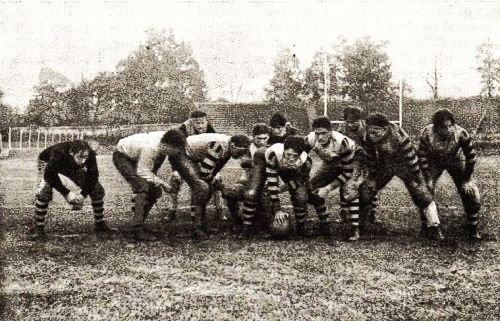
The Inter-city game was played on the Berkeley Oval, a week ago Saturday, between the Berkeley and Pratt Institute teams, as the champions of their respective leagues. Both teams were in first-class condition, and during the first half the spectators were treated to hard, fast football. The game was a remarkably clean one, and the penalties imposed were only for off-side play, using hands, and a forward pass. Pratt kicked off to Bien, who immediately returned the ball to Pratt's thirty-five yard line, where Higgins was downed in his tracks by Hasbrouck. In eight trials Pratt could only advance the ball fifteen yards, Berkeley securing it on downs. Berkeley then sent her backs at Pratt's right end for a gain of seven yards, and then three yards through the centre. The right end was again tried, netting twenty-five yards. Pratt then took a brace, and recovered the ball seven yards from her goal-line. Berkeley's line held well, and her men soon had the ball again in their possession. They found a weak spot between left guard and tackle, and through this hole, in three trials, E. Irwin-Martin was pushed over the line for a touch-down, from which a goal was kicked. The Pratt team rallied after having been scored on, and dashed at Berkeley's line so persistently, and with such good judgment, that in eight minutes they tied the score. In the second half, however, Berkeley's superior condition told, and the final score was rolled up to 16-6.
Berkeley met another team from the Long Island League on Thanksgiving day. She had played St. Paul's twice before this season, and the two schools had broken even. The rubber was a hot contest, full of sharp and snappy work. The score, 16-6, gives no indication of the kind of game put up by the losing team. They excelled Berkeley in team-work, and displayed a beautiful defence. By defeating Trinity the following Saturday, Berkeley closed the championship season, and took the pennant for 1895.
The English High-School eleven expected an easy time with C.M.T.S. team in their championship game two weeks ago. The Cambridge boys, however, gave them the hardest game they have played; 14-8 was the score. Cambridge scored twice on straight play, and English High once on straight play and twice on flukes.
The Graduate.