CHARLES CARLETON COFFIN'S
Reading edition
Fascinating Historical Works.
Mr. Coffin avoids the formality of historical narrative, and presents his material in the shape of personal anecdotes, memorable incidents, and familiar illustrations. He reproduces events in a vivid, picturesque narrative.—N. Y. Tribune.
Mr. Coffin writes interestingly; he uses abundance of incident; his style is pictorial and animated; he takes a sound view of the inner factors of national development and progress; and his pages are plentifully sprinkled with illustrations.—Literary World, Boston.
ABRAHAM LINCOLN.
THE BOYS OF '76.
THE STORY OF LIBERTY.
OLD TIMES IN THE COLONIES.
BUILDING THE NATION.
A History of the Rebellion in Four Volumes:
DRUM-BEAT OF THE NATION.
MARCHING TO VICTORY.
REDEEMING THE REPUBLIC.
FREEDOM TRIUMPHANT.
Nine Volumes. Profusely Illustrated. Square 8vo, Cloth, Ornamental, $3.00 each.
Published by HARPER & BROTHERS, New York.
The Editor will be pleased to answer any question on the subject. Our maps and tours contain much valuable data kindly supplied from the official maps and road-books of the League of American Wheelmen. Recognizing the value of the work being done by the L. A. W. the Editor will be pleased to furnish subscribers with membership blanks and information so far as possible.
Copyright, 1895, by Harper & Brothers.
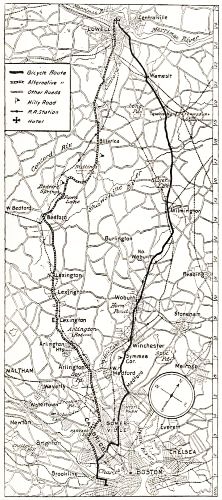
Start at Copley Square through Dartmouth Street to Beacon; turn to left, and follow Beacon to Massachusetts Avenue; there turn to right and cross Harvard Bridge, and again turn to the right at Windsor Street, and cross the electric-car tracks, keeping direct road to Webster Avenue; there turn to the left, and follow to Prospect Street; then turn to right, and go up small hill over railroad, turning to the right at Washington: follow Washington to Medford Street; then turn to left, and take direct road past Central Square and Winter Hill Station, passing Mystic Park on the right, and crossing bridge over Mystic River into Medford. Take High Street to the drinking fountain; then at the fork take Purchase Street, and at Symmes Corner keep to right, and then bear to the left into Winchester. After crossing the square, go over railroad tracks, and keep to right along horse-car tracks to Woburn Common. Roads from Boston to Medford good; from Medford to Winchester fair, rolling country; and from Woburn on, roads good. From Woburn Common take Main Street, following horse-car tracks to railroad crossing, then turn to right to North Woburn. Follow main road over railroad, then keep to left, following railroad to Wilmington Depot. Cross Lawrence branch track over the rise, then keep to the right through the woods, passing Silver Lake, and following telegraph poles. About two miles beyond Tewksbury turn to right, cross the tracks at Wamesit, then keep to the left through Atherton to electric-car tracks, which follow into Lowell. American House is wheelmen's hotel. Distance 28 miles. As a choice in returning: Follow car-tracks towards Billerica; turn to left, and cross the river and turn to right now, keep direct road up long hill, at top of hill turn to right, and follow telegraph poles. Road fair, but hilly.
Follow Spring Street into Bedford; then turn to left and take direct road through North Lexington to Lexington Common. From Lexington follow Massachusetts Avenue. Good roads, considerable down-grade, macadam surface most of the way. You pass through East Lexington, Arlington Heights, Arlington, and still keeping on Massachusetts Avenue to Harvard Square. There keep to the left, following electric-car tracks through Cambridgeport. Cross Harvard Bridge, turn to left at either Beacon or Commonwealth Avenue, and to the right at Dartmouth to Copley Square. There is more or less hard wheeling on this trip, but it abounds in pretty scenery of woodland, lake, etc.
Such a trip as this need not necessarily be made in all its details. It is impossible in this Department to cover all the possible trips in the vicinity of Boston. General directions are therefore taken, and one trip in each direction given.
Any questions in regard to photograph matters will be willingly answered by the Editor of this column, and we should be glad to hear from any of our club who can make helpful suggestions.
FIGURE STUDIES.
Figure studies are the most difficult as well as the most interesting pictures made with a camera, and therefore the prizes are always higher which are offered in this class. To make a good figure study, which shall be a real picture, requires special skill and tact, for though one is constantly seeing charming and original subjects, it is quite another thing to fix them on gelatine plates.
To make a success of figure studies one should begin by selecting a subject, the simpler the better, and make a photograph of it twenty times if necessary, till one is obtained which is satisfactory. The habit of giving up after one or two unsuccessful trials is what makes the work of the average amateur of so little pictorial value. One figure study repeated till it is right makes the taking of all others of the same class easier.
Choose some simple subject—something which you are familiar with in every detail, and know when the picture is correct. Do not try to arrange the folds of the dress or of any drapery which you may use. Lift the drapery and drop it again, and have the subject rise and sit till the folds of both gown and drapery are graceful. If one tries to arrange the lines they are almost sure to look stiff, while if the folds are allowed to fall of themselves they are usually artistic. Only in rare cases should the subject look toward the camera or show the full face. A half or three-quarters view of the features is more artistic, and sometimes if the face is turned almost away from the camera the pose is more effective. This is the case if a picture is being made of a person reading, writing, or drawing.
The amateur living in the country has perhaps the advantage over his co-worker in the city in the choice of subjects for figure studies. Several excellent subjects, appropriate to the season, are just now within the reach of the country amateur. One which would be sure to please is that of a girl coming across the field laden with wood treasures, such as autumn leaves, ferns, mosses, etc. In making such a study care should be taken that the branches and ferns are not massed too heavily.
Another subject becoming more and more rare as steam takes the place of hand labor, is the interior of an old-fashioned cider-mill, with a curly-headed boy sucking cider through a straw thrust into the bung-hole of a cider barrel. Still another country figure study could be made of two or three boys cracking butternuts or hickory nuts under the tree that bore them. In taking such a picture be sure that at least one of the boys has his back to the camera, for unless such is the case the group looks too stiff. Choosing the Christmas turkey is an excellent subject just now, and one easily made.
Homely occupations make good subjects for figure studies. Grandmother darning stockings, Katherine trimming a hat, Ellen mixing bread or baking pies, George chopping or sawing wood, Benny building a bonfire, and like subjects, which will suggest themselves, are easy to make, and are always attractive pictures.
In making figure studies where the objects have to be arranged do not crowd too many into the picture. Try for the best, and do not send anything to the contest of which you can say, "This would have been better if I had—" Make it the very best of its kind.
Sir Knight W. H. Tobey wishes to know when the results of the competition will be published. The successful contestants will be announced in the January number of the Round Table.
Sir Knight Austin O. Olmstead, of Wisconsin, wishes to know how to make enlargements on bromide paper, or, if the directions have been published, to know in what number to find it. Sir Austin will find directions in No. 801, March 5th, 1895.
Sir Knight Ralph E. Cotter asks how to take pictures of sunsets, and also if the negative does not affect the tone of the picture, for, he says, some negatives he can tone a good color and others he cannot. To take pictures of sunsets use a slow non-halation plate, a very small diaphragm, and an instantaneous exposure. Make the exposure when the sun is hidden behind a cloud, but shows light through the breaks in them. There is nothing much prettier in the way of out-door photographs than sunset views. Pictures made from different negatives take different tones, according to the density of the negative. A thin plate will take a tone a sort of slaty gray, while with a good negative showing sharp contrasts almost any color or tone wished may be obtained.
Sir Knight Emile Low sends blue prints of two pictures showing a dark circle in the centre, and asks what is the trouble with his camera. It evidently leaks light, and to find out if such is the case a plate should be put in the holder, the slide drawn, and with the shutter closed expose the camera to strong sunlight. Develop the plate, and if it is fogged examine the bellows for a pin-hole, and look to see if the lens board fits tightly.
FEED THEM PROPERLY
and carefully; reduce the painfully large percentage of infant mortality. Take no chances and make no experiments in this very important matter. The Gail Borden Eagle Brand Condensed Milk has saved thousands of little lives.—[Adv.]