STORIES OF PRESENCE OF MIND.
Reading edition
IN REPORTING THE "VICTORIA" DISASTER.
BY DAVID GRAHAM PHILLIPS.
The newsman at Piccadilly and St. James's Street had his bill of news wares pasted on the pavement. Even he who ran by means of a swift hansom-cab might read the huge black letters. There was but one article on the bill. Black type, three inches long, shouted:
HORRIBLE DISASTER!
H.M.S. "VICTORIA" RAMMED AND SUNK!
FOUR HUNDRED LIVES LOST!
As Fabian Wendell, London correspondent of the New York Intelligence, and his friend Carter, just from New York, were whirled out of St. James's Street into Piccadilly, Wendell's eye caught the announcement. He lifted the trap in the top of the cab and told cabby to pull into the pavement and hail the newsman.
"ALL THE PAPERS," SAID WENDELL.
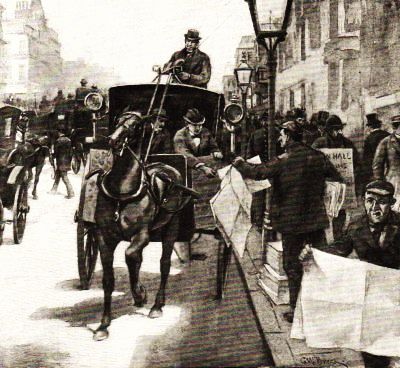
"All the papers," said Wendell, and straightway had the afternoon rainbow—the pink Star, the yellow Globe, the white Pall Mall, the pale gray Standard, and the green Westminster.
"What is the matter?" asked Carter.
"Great news," replied Wendell, opening the Pall Mall, and pointing to a "scare head" half a column long. Under the head-lines was this short despatch:
Tripoli, June 23d.—H.M.S. Camperdown rammed H.M.S. Victoria yesterday five miles out at sea. The Victoria sank at once. Rear-Admiral Tryon, most of his officers, and over three hundred men were lost.
"The Mediterranean fleet," went on Wendell, talking to arrange his thoughts rather than to inform his friend, "has been cruising in the Levant. Victoria was the biggest and most formidable battle-ship in the world. Camperdown is almost as big. Tripoli is on the north coast of Africa—"
"No," interrupted Carter, who was looking at the Standard. "This paper says it is Tripoli, on the coast of Asia Minor."
"That's bad—small place—poor telegraph," Wendell was muttering, his forehead wrinkled so that it suggested sixty rather than twenty-three. Up went the trap in the top of the cab. "Drive to the Eastern Telegraph Company, Old Broad Street. And you get an extra fare if you do it quickly."
"What are you going to do there?" Carter inquired, as the cab began a mad dash down St. James's Street on its way to the City and Old Broad Street.
"Why, a very simple thing. I'm going to try to get a full account of this disaster, and print it in New York before an account is printed in England. Tripoli is miles away from nowhere at all. These English papers are very slow. I propose to show them what American enterprise is."
"But they are sure to be first with such a story as this, about their own navy. You have no correspondent there."
"Neither have they. I have a scheme, and the beauty of it is that even if these English fellows think of it they will dismiss it without a trial as too absurd."
"Then you admit there is practically no chance?"
"Chance? I don't admit that there is such a thing as chance. I know that it is my duty to do something. This is the only thing I can think of. The others will be hopeless and will do nothing."
At the Eastern Telegraph Building Wendell stopped in the office on the first floor long enough to write this despatch:
To the telegraph agent, Tripoli, Syria.—The New York Intelligence will pay the telegraph tolls and £200 ($1000) for two thousand words full describing the Victoria disaster. Send at once to Wendell, London.
Then he went up stairs, straight to the general manager. That important person read the despatch with increasing derision, which he did not take the trouble to conceal.
"The rate from Tripoli to London is a shilling a word," he said. "Two thousand words will cost you a hundred pounds, five hundred dollars. The operator or agent at Tripoli is an ignorant Turk, who, without doubt, knows not a word of English. Tripoli is on the Turkish government lines, and we cannot send the money to him to pay for the despatch. He never heard of the New York Intelligence. You practically ask him to spend a hundred pounds with no prospect of ever seeing it again."
"Very true," said Wendell, and he took the despatch and added to it. "Will start money as soon as despatch is received." Then he gave it back to the manager, saying: "No harm to try. If I fail, I shall be out only the eleven dollars this telegram will cost me. If I win—"
He laughed, and the manager relented. "I'll mark it so that it shall be rushed through, and I'll add my own guarantee," he said, with abrupt courtesy. "As soon as an answer comes, if an answer does come, I'll see that you get it."
Wendell thanked him, and went away with Carter. He spent the rest of the day getting and sending all he could find bearing in any way upon the disaster. All England was waiting for the fuller news. The Admiralty and the Foreign Office were besieged by crowds of those who had relatives or friends in the fleet. But no further news came. The Saturday morning papers had nothing but rumors. Even the long reach of the Times could not get at that obscure Syrian village.
Wendell watched impatiently for the early editions of the Saturday afternoon papers. There was still no story. The whole civilized world was waiting. Carter was despondent over the failure of Wendell's scheme, and Wendell had almost ceased to hope. The Sunday morning papers had nothing. Sunday afternoon came a telegram in an Eastern Telegraph envelope. Wendell's hands trembled as he read:
Tripoli, Syria.—Send soon as can raise money. Old subscriber Intelligence.
Harris.
Wendell laughed hysterically as he gave it to Carter, who was really faint with excitement. "The manager said they don't know the Intelligence in Syria," he laughed, as Carter was reading and rereading. "I wonder what he will think of that?" And he hurried away a cheering telegram to the unknown Harris, who was helping him to beat the world on the news story.
"If Monday morning's papers pass it," he went on, "we're safe. But that's a slim chance."
He waited up until six o'clock Monday morning to see. The only further news was a partial list of the saved, and a formal announcement from the Commander of Camperdown that the disaster had happened. To Wendell this fortune seemed incredible.
Two thousand miles away, Harris, a medical missionary at Tripoli, was in a more agitated state than was Wendell. He was the only English-speaking person in that squalid little Asiatic port. He came from Kentucky, and got his news of America through the weekly edition of the Intelligence, for which he was a subscriber. The day after Wendell sent his despatch he was passing the telegraph office. Abdallah Gazi, the Turkish operator, called him in, and asked him to translate it. As Harris read it, he saw the whole situation.
Abdallah had been the despair of the survivors of the disaster. As he hated the English, he had pretended to be more stupid than he really was. Harris was fired with ambition to help the paper he took, published by his countrymen, in his native land. But to get together the five hundred dollars necessary was no easy thing in that miserably poor village. He gave no heed to the furious Syrian sun; he toiled and wrestled with friends and acquaintances. By Monday afternoon he had the money, and began dictating two thousand English words, letter by letter, to the operator, who spoke only Arabic. It was a long and dreary task, and not until midnight was it done.
The first sheet of the great special, telling the pitiful story of Tryon's mistake, and its horrible result, was in Wendell's hands at five o'clock that Monday afternoon. Thanks to the difference of time, the last sheet reached him at ten o'clock, two hours earlier than the time at which Harris sent it. Wendell had the wires to New York open, and had warned the Intelligence of what was coming. As New York is five hours earlier than London, the editor of the Intelligence was reading the great beat on all the newspapers in the world at half past six o'clock. At seven an extra afternoon edition of the Evening Intelligence was on the streets of New York.
Next morning Wendell slept late. When his man awakened him, he was straightway at the bundle of morning papers. Every great London daily had its first story of the Victoria disaster, in large type, with huge head-lines. The eager British people had the news at last. But the date line of the story was not Tripoli. Every despatch began: "New York, June 26th.—The Intelligence has the following special from Tripoli."
"I wish I had been in the editorial rooms of the great London Times when that special from New York came," said Fabian Wendell.