THE WESTBRIDGE BURGLAR ALARM.
Reading edition
BY WILLIAM DRYSDALE.
"I wonder we didn't think of it long ago. Why, we can sit in our rooms and talk to each other as well as if we were together. The whole outfit won't cost us more than fifteen dollars."
Tom Dailey began to drum telegraphic dots and dashes on the table with the ends of his fingers. He had just unfolded to his two particular chums his plan of connecting all their houses with a telegraph line, and the boys agreed that a telegraph line was precisely the thing they needed.
"I'm ready to begin right away," said Harry Barker. "The sooner we have it working, the better."
"It's very easily learned," Tom continued. "You can learn the alphabet in an hour or two, and after a week's practice you can read the sounder slowly. Our houses stand just right for it, too."
Tom was certainly correct about that. Their houses were in a cluster in the suburbs of Westbridge, two on one side of the broad avenue, and one just across the way, with only about five hundred feet of space between them.
"It would be a grand thing," Joe said, after deliberating a little, "but I don't know whether I can get father to advance me the cash. That canoe about used up my money, and I may have trouble to get any money for a while."
"No, you won't!" Tom exclaimed, very decidedly. "You'll not have any trouble at all to get money for a telegraph line. I've thought that all out. You see, this thing is not just a toy to play with; it's for real use. You know what the worst drawback is to living here half a mile out of town; it's burglars, isn't it? That's what we always have to be looking out for, specially since they broke into your house two years ago, and took all your silverware. And I'd like to know what better burglar alarm we could have than a telegraph line between our houses."
The three families all took kindly to the telegraph idea, for they said that it would be a great convenience to them in asking and answering questions, and would save them many a step. Besides, if a burglar should visit any of the houses it would be such a consolation to know that they could call assistance in a few seconds. Tom and Harry put little tables close by their beds to hold the key and sounder, but Joe had to make other arrangements. His mother was afraid to have the wire so close to his head for fear it might conduct the lightning when there was a thunderstorm, so it was decided that his work-room over the kitchen should also be his telegraph-office. That was the room where he kept his printing-press and his carpenter's bench, and the turning lathe that he had saved up for months to buy.
This work-room was too far from Joe's sleeping-room for him to hear the click of the sounder if the other boys should call him at night; but Harry got his friend the operator to help put up the line, and the operator made an ingenious arrangement by which a little electric bell was rung in the work-room whenever any of the keys were used. By leaving the door open this bell could be heard.
"Ain't it grewh!" Harry clicked off after the boys had been practising a few days, meaning to say "Ain't it great!"
"Biggryf thirg out," Tom ticked in reply, imagining that he had said "Biggest thing out."
But they soon did better than that, and in the course of a week or two they were talking over the wire almost as glibly as though they were in the same room. Their mothers and sisters were delighted with it, for Mrs. Dailey found that without the trouble of going out she could ask Mrs. Barker just how much flour to put in those new ginger-snaps, and the girls made frequent appointments to walk down town together—all by telegraph.
The line was so successful that the boys had to talk with their schoolmates about it, and through them the news reached the reporter of the Westbridge Eagle, and he put a paragraph in the paper about it.
"Our young townsmen Tom Dailey and Harry Barker and Joe Bailey," the Eagle said, "have added materially to the comfort and safety of their respective families by putting up a telegraph line and burglar alarm between their houses. It is a regularly equipped line, with an office in each house. Td is the office call of young Dailey, Hb of Barker, and Jb of Master Bailey. The instruments are in the boys' sleeping-rooms, except Barker's; he uses his workshop for the purpose, and an electric bell gives warning when he is wanted. Burglars will give those three houses a wide berth in the future."
"Give us a wide berth!" Tom exclaimed. "Well, I guess they will! They wouldn't have any chance at all. Father always keeps a revolver in his room, and I have my baseball bat. Now mind, fellows, if we hear a burglar at night, we send an alarm first thing, and the minute we get an alarm we call our fathers. I guess a burglar would soon wish he was somewhere else."
"I have a baseball bat all ready at the head of the bed too," said Harry. "Do you suppose it would kill a man to hit him over the head with it, Tom? I shouldn't like to kill a man, not even a burglar. I guess I'd give him a rap over the shoulders. But I'm afraid father would fire some bullets into him before I had a chance."
"I almost wish we'd have a chance," Joe put in. "But, of course, there won't be any burglars around, now that we're all ready for them."
However, burglars are a little uncertain in their ways, and it is not well to feel too secure. Perhaps it was even while the boys were talking that two rough-looking fellows had their heads together in the back room of a disreputable saloon in Westbridge making plans. One was older than the other, and the younger had a copy of the Westbridge Eagle in his hands, occasionally reading a little here and there. These two fellows were burglars in a small way; and burglars, like other people, get a great deal of information out of the newspapers. When they see that "John Smith and family have gone to the Catskills; the house is closed for the summer," they find it more interesting news than the latest election returns.
"Oh, pshaw!" the younger burglar exclaimed, as his eye fell upon the paragraph about the boys' telegraph line—only he used language better suited to a burglar sitting in a saloon; "those fellows have put up a burglar alarm."
"What, at the three houses!" the other exclaimed. "Let me see;" and he snatched the paper rudely from the younger man's hand. "Oh, my, my, my!" he went on, after he had read the paragraph; "that's the neatest thing I ever saw in my life." And he leaned back in his chair, and chuckled as merrily as if he had been an honest man.
"I don't see anything to laugh about," said the younger. "We've spent over a week getting the lay of the land out there, and now all that labor is lost. We'll have to try somewhere else."
"Will we?" said the older man, chuckling again. "You only think so because you're young at the business. Jest leave this thing to me, my child. I know'd we'd have an easy job out there, but I didn't think they'd take so much trouble to make it easier for us."
The rest of their talk was in too low a tone to be overheard; but about one o'clock the next morning Tom Dailey and Harry Barker were both aroused at the same moment by the furious clicking of their sounders. "Td," "Hb," the instruments were calling, and in a second or two both boys were sending back the answering,
"Ay, ay! Ay, ay!"
"Help! Burglars! Jb," both sounders said at once. The message was repeated, and then all was still. Evidently Joe Bailey had left the key and taken up his baseball bat.
It was quick work for Tom and Harry to arouse their fathers and tell them that there were burglars over at Baileys'. Hasty toilets were made, and the four sallied out, father and son from each house.
"Isn't it lucky we put up that burglar alarm!" Tom whispered to his father as they hastened across the avenue. "Now you see what a lot of use it is. We'll have those burglars just as sure as they're born. You and I can watch one side of the house, while Harry and his father watch the other, and there's no possible way for them to escape."
Tom was suddenly silenced by the ominous click of a revolver. They were in the Bailey grounds now, and Mr. Dailey had caught sight of two forms moving among the shrubbery.
"Stop there!" Mr. Dailey said, in a low but very determined voice, his cocked revolver pointing at the two forms. "Stop there! If you move you're a dead man!"
"It's all right, Dailey," came the reassuring answer. "I'm Barker, and this is Harry with me. We'll capture those burglars over at Baileys' if we're smart about it."
Mr. Barker also had a revolver in his hand, and Harry, like Tom, carried a baseball bat.
"Now I guess they see what use the burglar alarm is," Tom found a chance to whisper to Harry. "But say, we must be careful where we hit them. I don't think we ought really to kill one of them; better strike for their shoulders and arms."
In a minute more Tom and his father were stationed where they could watch the front and one side of the Bailey house, and Harry and his father commanded the rear and the other side. No one could possibly leave the house without being seen.
The strangest thing about it was that there was no light in the house, not a sound to be heard, no sign that anything unusual was going on. After a few minutes the watchers began to feel uneasy about this. Mr. Dailey moved cautiously down toward the other corner.
"Hey, Barker!" he called, in a suppressed voice. "Any signs of a light around there?"
"Not a bit," Mr. Barker replied. "Not a sound inside, either."
"I don't like that," Mr. Dailey said. "There may have been murder as well as robbery. Keep a sharp eye out, and I'll give an alarm at the front door."
Bang! bang! bang! went Mr. Dailey's boot against the front door. No answer. Bang! bang! again.
"Hello!" said Mr. Bailey's voice at the second-story window.
"It's all right, Bailey," Mr. Barker shouted. "We're Barker and Dailey, with the two boys, and we're all armed. You'd better come down and open the door. They can't possibly escape."
"Who can't?" said the voice at the window.
"The burglars," said Mr. Dailey. "They must be still in the house."
"Wait a minute," said the voice at the window. And those outside heard a footstep on the stair, and in a moment the front door was thrown open.
Mr. Bailey had a revolver in his hand when he opened the door, and he was in a great state of excitement, though he had seemed very cool when he was at the window.
"EVERYTHING'S UPSIDE DOWN HERE," HE SAID, HOLDING THE LAMP ABOVE HIS HEAD.
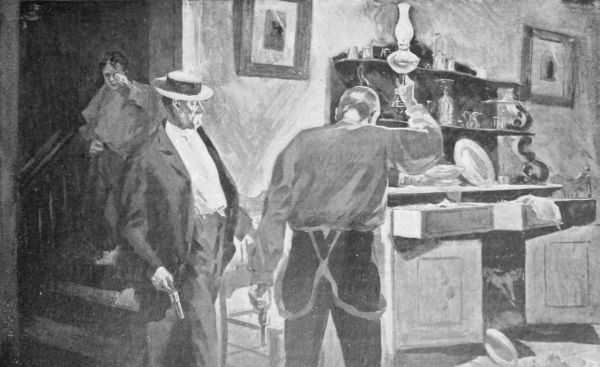
"Everything's upside down here," he said, holding the lamp above his head; "hats and coats all gone from the hat-rack, chairs upset, doors left open. They must have been all through the lower part of the house."
"I'll go into the dining-room with you to see whether they've got the silver," said Mr. Dailey. "They may be in there yet. We have the outside well watched."
The two men found everything in confusion in the dining-room. Burglars had broken spoons and forks that they suspected of being plated, and left the pieces lying on the floor. Buffet drawers had been pulled open and ransacked, and all the valuable silver was gone. So were some fine pieces of cut glass, and other valuable things. Just as the two men were about to extend their search to the kitchen, Joe came down stairs, rubbing his eyes.
"I'm afraid we are too late, Joe," Mr. Dailey said, "but your message brought us over in a hurry."
"My message!" Joe exclaimed, thoroughly awake now. "What message, sir?"
"Why, your message by telegraph, telling us there were burglars in the house."
Joe looked thoroughly bewildered now.
"But I have sent no message, sir!" he replied. "I didn't know there were any burglars in the house, and I've not been near the key to-night."
"How is that!" Mr. Dailey exclaimed; "you have sent no message! A call for help certainly came over the wire. Go up and look at your instruments as quick as you can, Joe, and see whether they've been tampered with."
Joe struck a light and went up to his work-room, and returned in a moment looking more bewildered than ever.
"It's very strange," he said, "but my bell has been disconnected, so I couldn't have heard a call if one had come. I'm sure I left it all right when I went to bed."
"Not strange at all!" Mr. Dailey snapped; and Joe had never heard him speak so sharply. "We're a pack of fools, that's all. There are burglars in my house, at this minute, Bailey, unless I'm very much mistaken, and in Barker's too. I must get home; so must Barker."
The developments of the next ten minutes were highly interesting. Mr. Dailey and Mr. Barker both hurried to their homes, with Tom and Harry, and each found that burglars had been in his house while he was away. In each place the work had been done in the same way, evidently by the same men. Hats and coats were gone, and all the solid silver, and the cut glass, and many other things.
But no burglars were to be found in either place. They had done their work and escaped.
"This is the most mysterious thing I ever saw!" Tom said to his father, after they had searched the house and taken account of their losses. "You say Joe didn't send a call for help, but it certainly came over the wire. And I don't see yet how you knew while we were over at Baileys' that there were burglars in our house."
"Don't you?" There was a lot of sarcasm in Mr. Dailey's tone. "I should think the inventor of a private burglar alarm might see through a little thing like that. One of the burglars knew how to send a message; now do you see?"
"I don't quite understand it even then, sir," Tom answered.
"Oh, it's plain enough," Mr. Dailey explained. "They knew all about your wretched burglar alarm, and the paragraph in the paper told them your signal calls. They robbed Bailey's house first, then disconnected Joe's bell, and sent out the call for help. Of course they knew that we would hurry over, leaving our own houses unprotected. As soon as the call was sent they stepped out and came over and robbed our houses at their leisure, knowing that we had gone to Baileys'. I suppose they're sitting somewhere now laughing at us."
Mr. Dailey was quite right about that. The two burglars were at that moment dividing their plunder in an empty barn, and laughing over their work.
"Give me a private telegraph line when you want to do a job up slick," said the older man, handing out a cut-glass pitcher, "specially when there's a newspaper to tell you the office calls. We don't have such luck as that often."
The Westbridge boys have learned from experience that it is hardly safe to ask Tom or Joe or Harry how he likes telegraphing; and the private burglar alarm has gone out of business.