COBWEB LANE.
Reading edition
BY FRANKLIN MATTHEWS.
The most curious and interesting highway that I know of is Cobweb Lane, and I very much doubt if any of my readers ever heard of it. I am sure, however, that some of them have been in it in the daytime, but strangely enough they have never seen it, for the peculiar reason that Cobweb Lane doesn't exist in the daytime. It only exists at night. It isn't some out-of-the-way and quaint place in London, as, at first thought, its name might indicate, but it is in the most conspicuous place in Greater New York. I'll let you into the secret—I am quite sure it is a secret with me—and tell you where it is and what it is.
Cobweb Lane is nothing more nor less than the promenade on the Brooklyn Bridge. It doesn't exist until after midnight, because not until then do the strands that hang from the big cables resemble the huge cobwebs that have suggested the name Cobweb Lane. The moon has to be in just the right position; the great cities of New York and Brooklyn must have gone to bed and left numerous lights, some in full glare and some turned down; the water in the river below must have a thin veil of mist hanging over it, and then, in the stillness of the night, if you will walk over the bridge you will see Cobweb Lane.
YOU ARE NOW AT THE BEGINNING OF COBWEB LANE.
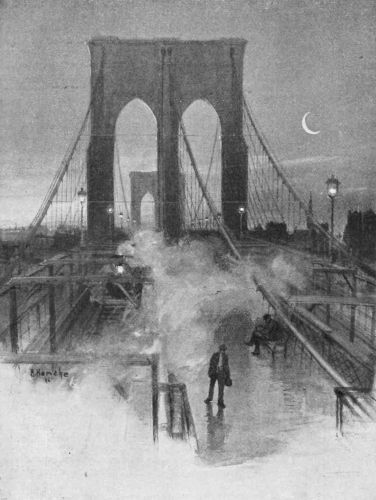
There is East Cobweb Lane and West Cobweb Lane. The first is on the Brooklyn side of the bridge and the other is on the New York side. As you walk out on the promenade and look over the cities and the beautiful harbor, perhaps you soon will turn your eyes to the top of one of the towers as you approach it. You are now at the beginning of Cobweb Lane. The four big cables curve down from the top and hide themselves in some masonry at your feet, and when you look up the narrow spaces between them, as they reach away before you, the eye catches sight of strands of steel rope, woven regularly and gracefully, hanging from the cables and extending to the structure on which you are standing. These strands, when the moon shines just right, partly obscured and lying low in the south, are like the filmy threads of a monster cobweb spun in the sky.
Just as you are entranced with this fairy picture, and are wondering where the big spider must be, you look ahead of you on the promenade, and, as if coming from some hidden passage, you see a cloud of vapor. There is something approaching, surely. You wonder at once if the spider that could have strung this web in the air would have hot breath, and it is not until you hear a noise and are conscious that a train of cars has passed you that you begin to realize that it really isn't a spider chasing along one of the paths of his web after you, in the hope of catching you and making of you a very choice morsel of a fly.
For nearly five years I have been going over the Brooklyn Bridge night and day, and it seems to me that every few days I see something in the arrangement of the details of the structure that I never saw before. It is a constant delight to watch the bridge under the varying conditions that affect it from day to day. One can see, for example, how carefully the wires for the electric lights are strung. They are almost within reach of any person walking across the structure, and yet there is absolutely no danger from them. It is interesting to watch the bracing of the structure, how the big and little stays slope now this way and that, and to note just where they change in their slanting direction. It is also interesting at the dead of night to see the workmen splice one of the car cables, taking out some broken strand and weaving in another.
I always like to see the workmen paint these cables. The men walk along the tracks with pots of red paint in their hands. They have great mitts of lamb's wool on their hands, and they use these for brushes. They dip their hands in the paint, and then run them along the cables until the paint is transferred from the hands to the cable. It is dangerous work, for not only must the workmen guard against falling between the ties to the water below, but they must face the danger of being run over, for every minute a train of cars comes along.
I like to see the care that is taken of the stations. Every Sunday morning at two o'clock the workmen get out a hose and wash the terminals, just as sailors wash the decks of a ship. Once every four years the structure is painted in every part. It is fascinating to see the painters swinging in their chairs far up one of the cables or along the strands that make the cobwebs at night. Every eight months a new flooring has to be laid down on the driveway, and so you see there is something going on constantly on the bridge that is worth watching.
I do not intend to tell anything about the bridge in the way of statistics. The well-known facts as to length and height and cost and power to resist strains may be found in any of the newspaper almanacs. But there is one feature about the bridge that I do not think is well known, and which has interested me greatly. I think it will be news to most persons that up in the towers where the big cables rest there are a series of steel rollers over which the cables pass. Each cable rests in a sort of a cradle as it goes through the top of the towers, and under each of these cradles are forty-three steel rollers, four and a half feet long and three and one-half inches in diameter. It is well known that the heat and cold elongate and contract the cables, and most of those persons who know about these rollers think that they have been placed there to allow the cables to lengthen or shorten themselves according as the weather is hot or cold. They are in error on this matter, however, for the rollers are placed in the towers merely to equalize the strain on the bridge. The contraction and expansion are equal on both sides of a tower, and so there would be no need of them on that account.
If, however, there should be a great weight on one side of the bridge and not on the other, then these rollers come into use. Under these conditions the weight of the cables, and the structure they support, is thrown down the inside of each tower straight to its foundations.
Another thing I like to watch about the bridge is the slip joint exactly in the centre. There are two others of these joints, one between each tower and the land anchorage, but the most interesting one is in the centre. When a train of cars passes, you can see the joint expand and contract three-eighths of an inch, and even when a carriage passes on the roadway you can see it move a little. These slip joints are necessary chiefly because of the heat and cold. In summer the cables are fifteen inches longer between the towers than in the winter. The bridge structure is cut in two in the middle, and an arm is fastened to one of these ends. It slips into an opening in the other end, and moves back and forth as any expansion or contraction occurs. I noticed one day last winter, when the greatest crush in the history of the bridge occurred, and when it was estimated that 2500 tons of human beings were distributed along the bridge at one time, that this slip joint in the middle was drawn out at least fifteen inches because of the unusual weight. As each cable, however, is intended to sustain a weight of 12,000 tons, this great crush was a small matter. Still, the constant motion of the bridge that seems so solid and inflexible is well worth studying.
I am also very fond of watching the structure sway in a high wind. I was talking with one of the guards recently, who had been on the bridge since the day it was opened. He said that early one morning, in the first high wind that came after the opening, he looked over to the New York side and apparently saw one of the biggest chimneys in town bending this way and that, and he stood there transfixed, waiting for it to fall. It didn't fall, although it bent far over, and he thought it must be wonderful mortar that could hold so many bricks together. Suddenly he noticed that the chimney was exactly in a line with one of the vertical strands from the cables, and he saw at once that it was the bridge and not the chimney that was swaying. The guard was unprepared for such a situation. Of course the bridge was moving only a few inches from side to side, but when this man measured by a chimney a mile away it seemed to move as much as the chimney apparently had been moving.
This guard said he had been all through the civil war, and had faced death a hundred times in battle, but he never was so frightened as on this occasion. He actually expected to see the bridge go down at any moment, but he stood at his post until relieved. When he got home later in the morning his wife asked him why he was so pale, and he said that he had to go and lie down for several hours to recover from the shock. Nowadays no one thinks anything of a slight swaying of the bridge in a fierce wind, but to my mind it is one of the most interesting things about the bridge to watch.
Soon after the bridge was opened word came to Chief Engineer Martin that Barnum was going to march his entire herd of elephants, with the famous Jumbo at their head, across the bridge some night. There was no tariff for elephants, and the Barnum agents hoped that the authorities would refuse to allow the herd to pass over. That would give the Barnum people a chance to say that Jumbo was so big that the authorities of the bridge were afraid to let him cross the structure, and the circus people forsaw a splendid advertisement.
Mr. Martin wasn't to be caught napping, and he was on hand when the herd approached. The man in charge offered to pay for crossing, but Mr. Martin said there was no charge for elephants, and that the man could take them over at his own risk. Mr. Martin stipulated that the elephants should be kept at regular intervals. But when the animals got out on the roadway, a train passing over frightened them, and, with Jumbo to lead them, they gathered in a group and trumpeted fiercely. Finally the keepers got them to go on, but they were so timid that they crowded each other all the way over. Mr. Martin ran out to the centre to watch the effect on the slip joint, and found that the weight amounted to nothing. Ever since that day elephants by the hundred would not cause the bridge officials any concern. Mr. Barnum's elephants got over in safety, but there was no Jumbo advertisement to be had out of the Brooklyn Bridge.
Chief Engineer Martin of the bridge once said to me, when I asked him if he could not tell me some of the interesting things about it that usually escaped the ordinary observer:
"There isn't much to be said. The bridge is a very prosaic thing."
I have no doubt it is to Mr. Martin. He concerns himself with abstract mathematical formulas a good deal. He knows about the tangents and sines and cosines and curves and strains and all that, which some of us grown-up people studied about in college, and have been glad to forget in our humdrum lives since. When I asked Mr. Martin, however, if he knew where Cobweb Lane was, he smiled, and said he didn't. He showed in that way that the bridge was a very prosaic thing to him; but I am sure that if you take no thought of mathematics, and look for the beautiful and interesting things about the bridge, you will be convinced that the bridge is not prosaic after all. A visit to Cobweb Lane will prove it.