BUILDING OF MODERN WONDERS.
Reading edition
THE BOOK.
BY KIRK MUNROE.
Although we are apt to speak of the "writing" or the "making" of a book, rather than of its "building," each of these is a distinct operation: and when a book, first written, then made, is finally ready for the reader, it has been built as truly as a house or a ship is built. It has demanded an equal amount of careful planning, skilled labor, and close attention to the thousand details that go to the making of a completed whole. In reading an interesting book how very little we think of this, or realize the amount of time and hard work expended in thus giving us a few hours of pleasure. Most people consider writing to be a very easy method of making a living, and nothing is more common in an author's experience than to have his friends express surprise when he speaks of going to his work.
"Work!" they exclaim. "Surely you do not call it work to occupy a pleasant room at home, and write for hours each day? That's more like play than work. If you want to know what real work is, come with us and see what we have to do."
So every one, except those who know, imagines book-writing to be so easy that most of those who desire to earn a livelihood without very hard work try their hands at it. The girl of brains and education thrown upon her own resources decides to become an author; and, after a desperate struggle, fails because she has no real experiences to draw from. The sea-captain who is too old to follow his chosen profession, but must still make a living, and is brimful of experience and adventures, decides to become an author. When he too meets with failure he blames everybody and everything except himself, and rarely discovers that the reason he cannot become a successful author at his time of life is because he has not been trained to the business, and does not know how to write.
Authorship, or book-writing, is a trade that must be learned the same as any other, and I believe that any boy or girl of average intelligence may be trained to successful authorship if only he or she is willing to work hard enough and long enough at the trade. Even imagination can be cultivated. Of course the literary apprentice must know how to apply the rules of grammar, must practise clearness and conciseness of style, must know how to use books of reference, must have what is known as a liberal education, and, above all, must be possessed of a genuine liking for his chosen calling. After leaving his school or college he should spend at least two years—and four would be better—as a reporter, a private secretary, an amanuensis to some skilled writer, or as assistant editor of some first-class publication that insists upon the use of grammatical English in its columns. During this apprenticeship he may try his hand at sketches, essays, or short stories, and must learn to accept calmly a dozen disappointments with each success.
When the author is ready to write a book his most difficult task is to select a subject that shall be interesting, timely, and not already overdone. It must be one that he can write about from his own experience, or from the experience of others. The latter may be gained from books or from the verbal accounts of those who have been through with what he desires to describe; but a book compiled from other books is apt to be dull and lifeless, while one dealing with a personal experience is almost certain to be interesting. "Mark Twain's" best books are those based upon his own life on the Mississippi, in Western mining camps, or while travelling abroad. The great charm of Miss Alcott's stories lay in the fact that she wrote of her every-day surroundings. The absorbing interest of Captain King's Cadet Days is due to the author's absolute knowledge, from personal experience, of the joys and sorrows, the trials and triumphs, of West Point life. Thus to be a successful writer of books one must have something to say, and must know how to say it. To these qualifications must be added tireless industry, boundless patience, and a determination to succeed in spite of all obstacles.
Let us suppose that our author decides to write a book for boys, and to make it a mining-story. But he has never been down in a mine, nor even seen one. He knows nothing about mines from personal experience. Under these circumstances it is clearly his duty to visit the nearest mining region, and remain there long enough to become familiar with its life, its scenery, and its incidents, before he attempts to describe them. From such a trip he returns to his workshop with a thorough knowledge of what he desires to write about. Before beginning the actual work of writing he must plan his book, decide how many chapters it is to contain, and what shall be their length; lay out, either on paper or in his mind, the general scheme of his story; select a name for his hero, and, if possible, decide upon a title; for it is better to fit a story to a title than to fit a title to a story.
In these preliminaries the author has invested a month or more of time, and has expended a certain amount of money. In other words, he has paid for the stock of goods upon which he hopes to realize a profit. Now he is ready to enter upon the building of his book.
As writing is among the most tiresome and exhausting forms of labor, it should never be allowed to occupy more than eight hours of each day, and the best results are reached in four or five hours, followed by a change of employment, recreation, out-of-door exercise, or complete rest for the remainder of the day. Every book should be written twice, the first draft being made on soft unglazed paper with a No. 2 pencil, while the second is a revised and punctuated copy, written in ink or type-written on sheets of a medium size. The neatness of a manuscript has much to do with its favorable reception at the hands of an editor or a publisher's reader. Some authors do not write at all, but dictate to a stenographer or an amanuensis; but this requires extra practice, and is generally so expensive a method that it can only be adopted by those who have an assured market for their work, or are not obliged to earn a livelihood.
At length our book is written; a fair copy of the original rough draft has been made, and provided with chapter headings, title page, and table of contents. The precious manuscript is put into a box the exact size of its sheets, sent off to a publisher, and, with his occupation gone, the anxious author waits days, weeks, and sometimes months, for news of his venture.
Very few publishers have either the time or inclination for a personal reading of books in manuscript, and for this work they employ skilled readers upon whose judgment they can rely. Some houses thus retain as many as six such readers, and very often a manuscript book must pass through the hands of all these, taking its turn with scores of others, before a decision is reached concerning it. Each reader hands in a written opinion as to its merits and demerits, its chances of success or failure. Sometimes, if these opinions are conflicting, the publisher hands them all, together with the book in question, to a seventh reader—a sort of a court of final appeal—and requests him to write an opinion on the opinions. Even if all the opinions are favorable, the publisher may still refuse to bring out the work in question. There are a hundred good reasons for declining to publish a book, and the manuscript must run the gauntlet of them all. It may be too long or too short, or too similar to something else already in hand. Its principal characters may be too young or too old. It may not be in a certain publisher's peculiar line, or it may contain sentiments of which he does not approve. He may already have accepted as many books as he cares to issue in that year. This one may be interesting but badly written, or it may be beautifully expressed and as dull as dishwater. Thus an endless list of "mays," "ifs," and "buts" present themselves, by any one of which the fate of the book may be influenced. The one question to which they all lead is: "Will it pay? If so, we will publish it; if not, we won't."
Of course publishers and publishers' readers sometimes make mistakes concerning the value of a book, and decline one that, in the hands of another publisher, or brought out at the author's expense, achieves a tremendous success. In fact, there is hardly a popular book about which some tale of this kind is not told.
Our book having escaped the many perils that beset it, and been accepted, the publisher makes the author one of three offers for it. He will buy it outright, publish it subject to royalty, or on shares. If he buys it and its copyright outright, he gives an unknown author for his first book from $100 to $400, rarely more; while offers to well-known and successful authors often run up into the thousands of dollars.
If the agreement is to publish on the royalty plan, the offer to an unknown author will be that of a ten-per-cent. royalty on the retail price of his book after one thousand copies shall have been sold. It costs from $300 to $500 to publish one thousand copies of the ordinary one-dollar book. One hundred or more of these are given to editors or critics for the sake of the advertising contained in such notices as they may write about the book. The remainder are sold in the trade at a 40-per-cent. discount from the retail price. The disposal in this manner of 1000 copies of a book not only pays the cost of its publication, but generally yields a small profit to the publisher.
By getting a one-dollar book for sixty cents, or "forty off," as they say in the trade, the dry-goods stores, who now sell a great many books, and the regular retail booksellers, are able to offer it at 65 or 70 or 75 cents, and still make a profit on it; while at the same time the publisher is obliged, by his agreement with the trade, to charge the full list price for every copy of a book that he sells at retail. For this reason it is generally cheaper to buy a book from a dealer than from the publisher.
If a book is successful enough to run into a second edition or reach its second thousand, which very few first books ever do, then the author begins to receive ten cents for every copy sold. If, however, it fails to pass its first thousand, he receives nothing for his labor, except the advertising of his name gained by the publication of a book. A well-known and popular author whose work is certain to sell, bringing out a book on the royalty plan, receives from 10 to 15 per cent. on every copy sold from the very first.
The copyright life of a book, or the time during which it will pay its author a royalty, is fourteen years, and may be extended, by application, fourteen years longer.
If the publisher and author agree to bring out a book "on shares," it means that they shall share equally all expenses and profits. In any case a long and formidable contract, is drawn up, which both parties must sign before the book can be "put in hand," or enter upon the second stage of its building.
After a publisher has arranged to bring out a book, the questions for him to decide concerning it are: At what time of year shall it appear? Whether or not it shall be illustrated? What shall be its size, its style of type, the weight of its paper, and the form of its binding? How many copies shall be printed? How much money shall be expended in advertising it? etc., etc. Occasionally the author is consulted concerning some of these questions, especially in regard to illustrations, for which he is sometimes requested to furnish photographs; but more often he is not. The publisher, who bears the expense of illustrating the book, generally reserves the right to select the artist for this work as well as to decide upon the number, the style, and the size of the pictures.
There is so much art in the making of a book that by the aid of large type, wide spaces between lines, heavy paper, and broad margins a small manuscript may suffice for a large volume; while by the use of small type set "solid," thin paper, and narrow margins an immense amount of matter may be compressed into very small compass. As a rule the large or medium-sized volumes, especially among those known to the trade as "Juveniles," sell best, for there are many people who in the purchase of books follow the plan of the Chinaman in buying shoes, and select the largest size to be had for the money.
SETTING UP THE BOOK.
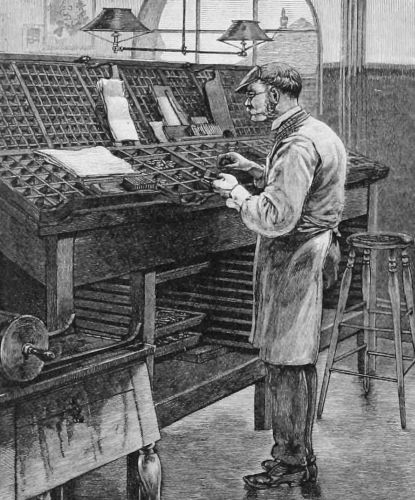
After forming the subject of innumerable consultations between those interested in its success, our manuscript book is finally "put in hand," or sent to the foreman of the composing-room, who scatters its pages here and there among his printers. As soon as half a dozen or ten or twenty sheets have been "set up" or turned into type, a galley-proof is "pulled" and handed to the proof-reader for correction. The galley is a long, narrow, brass-lined frame, in which a column of type is placed. The face of this type is inked with a hand-roller, a long strip of white paper is laid over it, and the whole goes into a hand-press. The printing thus done is not very fine, but it is plenty good enough to enable the keen-eyed proof-reader to detect any errors that have been made. He marks these on the margins of the proof, and hands it back to the compositors, each of whom corrects the mistakes appearing in the portion he has set. There is no more interesting sight in a composing-room than that of a skilled compositor making these corrections, picking out and replacing the little black types, transferring whole lines or paragraphs from one place to another, spacing, leading, punctuating, without dropping a type or making a mistake. The untrained eye can make nothing at all out of the type column, which has the same effect as the mirror reflection of an ordinary page.
After all corrections are thus made, another galley-proof, called a "revise," is pulled. Several copies of this are made, two of which are sent to the author of the book. There is no prouder nor happier moment in the life of an author than when he receives the first proofs of his first book. Never again will they appear so beautiful or so precious, though every author who is interested in his work always enjoys reading the proofs of each new book, no matter how many he may write. His ideas present such a different appearance in type from what they did in manuscript that he hardly recognizes them. His characters have attained such a dignity and reality that he almost needs an introduction to them.
On this galley-proof the author makes such changes and corrections as he pleases, though of course the fewer the better, and then sends one copy back to the composing-room, where all the alterations he has suggested are made in type. The galley columns are now broken into pages of the size previously agreed upon, and a set of page-proofs is pulled and sent to the author for his final revision. He must read this proof very carefully, for this is his last chance to make changes, and whatever passes this time must go into the finished book. When this page-proof returns to the composing-room, and the final corrections are made in the types, they are sent to the foundry. Here stereotypes are made from them in the manner described under the title "The Making of a Great Newspaper" in Vol. XV. of Harper's Young People. For book-printing these type-metal stereotypes are converted into electrotypes by being hung in an acid bath, where, in a very short time, by the action of electricity, they are coated with a thin film of copper.
PRINTING OF THE BOOK IN THE PRESS-ROOM.
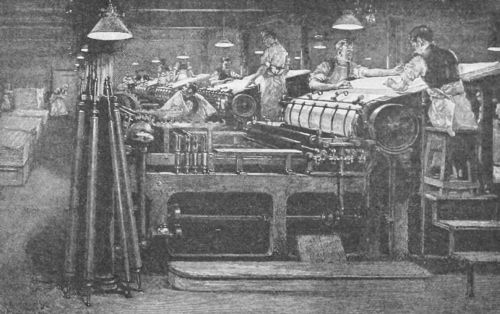
The finished plates are sent down to the basement of the great building, where are the book-presses that will turn out printed sheets of from four to thirty-two pages each, almost as fast as the huge cylinder presses of a newspaper office can turn out newspapers.
On the press the printed pages of our book meet and make the acquaintance of the illustrated or picture pages with which they are henceforth to be so intimately associated. In the building of a book the artist's part must by no means be overlooked, for a well-illustrated book, especially if intended for youthful readers, like the one we are considering, is doubled in value by its pictures. For ordinary books very little engraving or wood-cutting is now done, since by the aid of photography and electricity so many cheap processes for reproducing drawings have been discovered that the slower methods of the engraver are only employed for the very best and finest work. If the picture is to be engraved it is either drawn directly on the wood or transferred to it by photography; while if it is to be reproduced by one of the cheaper processes, it is photographed on a prepared plate of metal, from which the light spaces are eaten out by acids, while the shadows remain untouched. The thin plate is given a substantial wood-backing to preserve its form, and is then ready for use.
STITCHING THE SHEETS.
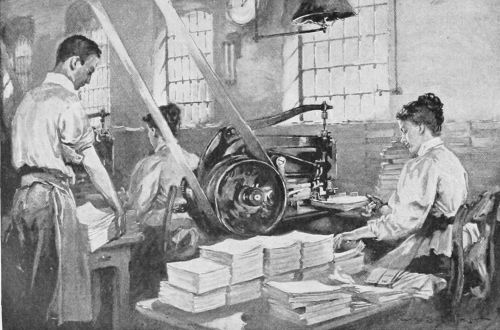
From the press-room the printed sheets are sent to the bindery, where they are folded, once into quartos (4tos), twice into octavos (8vos), three times into sextodecimos (16mos), or into any other size that shall have been agreed upon. Then the sheets are stitched together, pressed, their edges are cut by powerful machine knives, and the whole, finally glued into its cover, is set aside under pressure to dry.
IN THE BINDERY.
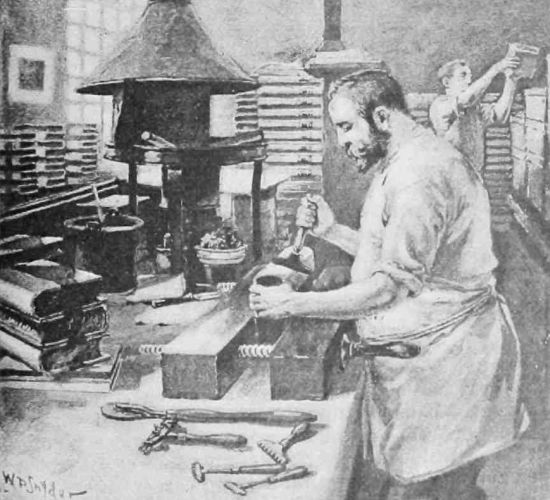
The making of covers is a distinct branch of book-building that gives employment to a great many skilled workmen and workwomen. The most conspicuous of these is the artist who draws the cover design, and suggests its scheme of color—for the sale of a book depends very hugely upon whether or not its cover is attractive. Covers are made of paper, cloth, or leather. Most books are bound in "cloth," as it is called, which means pasteboard, covered with muslin stiffened with sizing, and colored a uniform tint before the design is stamped or printed on it. A book bound in "boards" is enclosed between covers of pasteboard, and one bound in calf or morocco has its heavy pasteboard covers hidden beneath very thin sheets of leather. The inside of covers is often made of "marbled" paper, and one of the most interesting corners of the bindery is that devoted to marbling. Here a bath of gum-tragacanth, looking like a mass of smooth black glue newly melted, has wet colors sprinkled over it from paint-brushes. These are drawn into lines or figures with coarse wooden combs. A dampened sheet of paper is spread over the colored surface, quickly withdrawn thoroughly "marbled," and hung on a line to dry.
In another corner of the room busy girls are applying gilding to covers from packets of gold leaf; while elsewhere dozens of others are doing different and equally interesting things, all belonging to the great trade of book-binding.
At length our book, having passed through all these stages and processes, is pronounced complete, and a date is set for its "publication" or presentation to the public. On the day that it appears half a dozen copies are sent to the author with compliments of the publisher. If the author wishes any more copies of his book to present to his admiring friends, he must buy them and pay for them like any one else.
Thus the building of the book is finished, and it is launched on the stormy sea of literature, to sink or swim according to whether or not it has been constructed of poor material by incapable workmen, or has been well and wisely built.