TOMMY TODDLES
Reading edition
By Albert Lee. Illustrated by Peter S. Newell. Square 16mo, Cloth, Ornamental, $1.25.
A more entertaining collection of nonsense has rarely been penned.—Boston Traveller.
This is primarily a book for boys, but it contains numerous chunks of wisdom for the delectation of older heads.—St. Louis Globe Democrat.
We have not seen anything of the kind more pleasing since "Alice in Wonderland."—N. Y. Press.
The story is intended to be juvenile, but it will appeal to thousands of grown-up juveniles better than to the juveniles themselves.—Boston Daily Advertiser.
This is one of the most charming bits of fairyland writing I have read in a long time. The boys and girls will delight in it, but the old folks, no matter how many years they carry, will find an equal pleasure.... It is a charming little volume.—George H. Hepworth in N. Y. Herald.
OAKLEIGH
A Story for Girls. By Ellen Douglas Deland. Illustrated. Post 8vo, Cloth, Ornamental, $1.25.
A story for girls, charmingly written, and illustrated throughout with pictures dainty enough to please the most fastidious damsel.... The incidents are full of life, the characters are very natural, and the conversations well sustained, so that the story is full of intense interest from beginning to end.—Chicago Inter-Ocean.
By W. J. HENDERSON
Afloat with the Flag. By W. J. Henderson, Author of "Sea Yarns for Boys," etc. Illustrated. Post 8vo, Cloth, Ornamental, $1.25.
Mr. W. J. Henderson's latest sea-story for boys is one of the best we have seen.... The story has been read with eager interest by thousands of Round Table readers, and it will have an additional charm to them and others in its present book form.—Boston Advertiser.
HARPER & BROTHERS, Publishers, New York.
APRIL FOOLS AND APRIL SHOWERS.
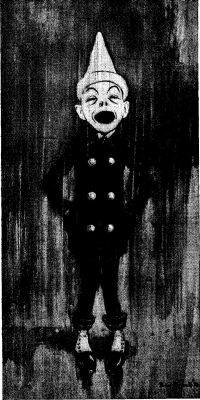
"Oh, I'm an April Fool indeed, and here's the reason why: I left my umbrella at home, supposin' 'twould be dry!"
IT SETTLED THE QUESTION.
The Colonel was the possessor of a fat colored man who was extremely lazy—so much so that everybody in the town had tried to do something to liven him up. They usually abandoned their effort after a trial.
There was quite a gathering at the Colonel's one afternoon, and the question of the lazy colored man came up. Finally one of the gentlemen asked leave to experiment, and to gratify him the Colonel sent for his lazy servant. It was some time before Sam put in an appearance. When he came, the gentleman addressed him thus:
"Sam, as I was coming up the garden path I noticed several snails down near the gate. I want to show these gentlemen some of their peculiarities, so catch one for me, please."
Sam scratched his gray wool and departed.
The Colonel and his friends smoked and chatted for a long while, and still no Sam and no snail.
"Well, that fellow is really lazy," said the gentleman who had sent him on the quest. "Colonel, would you mind sending for him, and see what on earth he is doing?"
The Colonel did so, and Sam entered the room.
"Well," said the gentleman, "did you catch one of those snails?"
"'Deed no, sah," replied Sam; "dey was too powerful quick fo' me. Ise couldn't catch up wid dem!"
That settled the question.
A NEW COUNTRY.
A party of tourists were examining one of the large trees of California. One of the party remarked:
"What a magnificent specimen! Surely it must be the oldest tree in the world!"
An Irishman who was with the party cried out: "Now, faith, how could that be?" and burst out into laughter. "Sure any one knows this is a new country, and how the mischief could that tree be ould?"
A LIGHT BREEZE.
During one of the recent windy days in New York a discussion arose between some gentlemen at dinner about the velocity of wind. Each related a boastful story of his own experiences. One of the party, a hardy Westerner, said he was once riding in a train through Kansas.
"There was what is called out there 'a light breeze' blowing. I had occasion to look out of the window, and the moment I put my head out off went my hat."
"What did you do?" asked one of the party.
"Well, gentlemen, several people told me not to worry, that the breeze was strong enough to take it there. I sort of wondered what they meant, but that hat was handed to me by the station-agent at our next stop, about forty miles from where it blew out of the window. We came along pretty fast, too—I guess about fifty miles an hour. But then eighty miles an hour for wind is called 'a light breeze' in that country, and the hat went by the eighty-mile route."
A HARD MACHINE TO RIDE.
"Papa, what is a bicycle, anyhow?" asked Jack.
"Why, it's a two-wheeled vehicle, the wheels being placed tandem. The word is derived from bi, meaning two, and cyclus, a wheel. If it had one wheel it would be a unicycle."
"I've ridden a unicycle many a time."
"You? Where?"
"In the garden—in the wheelbarrow."
A SMALL BOY'S NOTION.
"Oh, mamma," said little Willie, as he made his first close inspection of a bicycle, "this machine has got rubbers on to keep its wheels from getting wet!"
An Irishman and a Yankee were playing the forfeit game of Questions.
"How does the little ground-squirrel dig his hole and show no dirt at the entrance?" asked the Irishman.
"Give it up," said the Yankee at last.
"Sure, you see, he begins at the other end of the hole," declared Pat triumphantly.
"But how does he get there?" queried the Yankee.
"Oh, that's your question; answer it yourself," said Pat.
A BRAVE OFFICER'S ANSWER.
During Napoleon's campaign in Russia a young officer was very successful in defeating, with a handful of men, a large body of Cossacks who had been skirmishing along the line for some days, doing considerable damage. The officer risked his life in a daring deed of bravery, and Napoleon, hearing of it, sent for him and praised him.
"Sire," said the officer, "I am happy for your praise, but the Cross of the Legion of Honor would make me happier."
"But you are very young," said Napoleon.
"Sire," answered the brave officer, "we do not live long in your regiments."