FREDDY'S FIRST-OF-APRIL RESOLUTIONS.
Reading edition
"One by one our good old customs are going to the wall," Said little Fred, "and pretty soon we'll have none left at all; So I'm going to keep All-Fools' day, just because I think we should Not idly let it lapse into innocuous desuetude. "I'm going to see that father gets a paper one year old; The napkins I am going to pin up tight in every fold; The sugar I shall mix with salt, and see that Bridget bakes Some batter-covered flannel disks to serve for griddle-cakes. "A purse upon the sidewalk then quite unobserved I'll fling, And when folks stoop to pick it up I'll yank it with a string. I've cut a lot of strips of cloth to pin to passers-by, And every pompous man I see I'll make look like a guy. "Beneath a battered ancient 'tile' I'll slyly place a brick To stub the toes of thoughtless men who give a passing kick; I'm going to tell the teacher a new boy has come to school, And when he asks the pupil's name I'll call out 'April Fool!' "I think a little nonsense of this harmless home-made kind Is just as good for growing boys as some that's 'more refined,' Affected by the modern race of little school-boy prigs Who look with scorn on tag and tops and kites and Guinea pigs." H. G. Paine.
BY GASTON V. DRAKE.
X.—FROM JACK TO BOB.
Mountain House, July —, 189-.
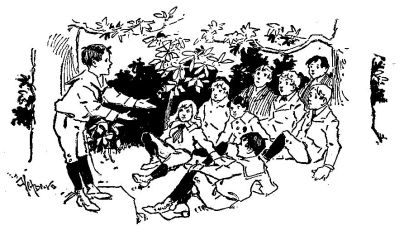
My Dear Bob,—We fellers had that mass-meeting to complain about the eagle-eyed head-waiter that won't let us take all the nuts and raisins we want out of the hotel dining-room, but the proprietor won't discharge him because he doesn't dare to. The trouble is the head-waiter isn't like other head-waiters you meet. Head-waiting isn't his regular business. He's a college man and he pays for his education with what he makes here in the summer-time, and as he's centre rush in his college football team the proprietor's afraid of him. I knew the minute I saw him that he was something of that sort, because his hair reaches down over his collar, and he said something about me in Latin once; and I heard him tell one of his college mates that came through here on a bicycle that the place wasn't perfect. "They haven't any nats or merskeeters," he said, "but it swarms with small boys that's worse."
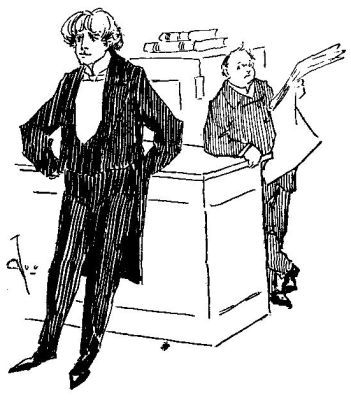
He isn't so bad though when he isn't on duty. He told me a lot about things you learn studying one day when I met him coming down the road. He'd been out taking a little exercize on a bicycle. I had my wheel out too, and we rode along a little ways together, and he asked me if I was going to college. I told him of course I was, and he wanted to know where, and I told him I didn't know, but I thought I'd go to Yale if she didn't stop winning everything there was going. I want to be on the winning side, I said. That's a good idea, he said, everybody ought to want to do that, but of course everybody couldn't, because if everybody was on the winning side nobody'd be on the losing side, which would be a bad thing for the world. He's a queer fellow, the way he looks at things. He said bicycling up hill was always more fun than coasting, because when you got to the top of the hill you were glad it was over, while when you had coasted to the foot of it you were sorry it was all over. It's the same way in football, he said. There's more fun in getting beaten in a stiff game than winning in a walkover. And then he told me to always take a man of my own size.
"Why don't you?" said I. "I'm not a man of your size, but you've been fighting me about those nuts and raisins I take away."
He only laughed when I said that, and then he said he took 'em away from me because he wanted me to be a man of his size some day, which I wouldn't be if I eat so many nuts and raisins, and I guess he's right, and I told him I'd quit. When I got back to the hotel I told that Chicago boy about it, and he said he didn't take any stock in head-waiters, and he wasn't going to quit for ten of 'em, but that night he wished he had, because just to be brave as he put it, he slipped three bananas, two oranges, six bunches of raisins, two handsful of nuts, and a peach into his blouse, but the head-waiter caught him and took him straight to his Pop. His Pop turned him upside down, took him by the heels and gave him a shake, and all the things tumbled out on the floor, so that now he's not allowed to have anything of the kind at all even in the dining-room.
Sandboys likes the head-waiter very much, and says there isn't very much use in boys trying to fool him, because it hadn't been very long since he was a boy himself and he's up to all their tricks, and his game of football is the finest that ever was. One time two years ago when he was in school his team had been forced back almost to the goal line, Sandboys says, when all of a sudden he got the ball and ran half way down the field with it before he was stopped, and then, with both his own and the other eleven sitting on his back he crawled the rest of the way and made a touch-down and won a goal.
"I don't see how that could be though," I said.
"Neither do I," said Sandboys, "but that's what he did."
Unfortunately Sandboys forgot what school it was he went to, and the head-waiter when I asked him about it, only laughed and said Sandboys was a great man.
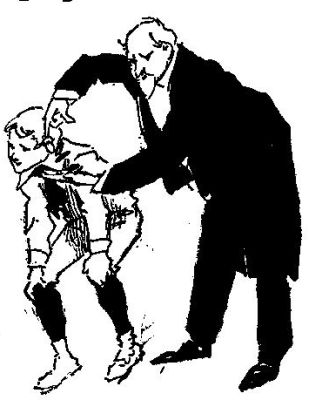
There was a slight-of-hand man here last week doing tricks in the parlor, and I tell you he was fine. He could do anything with anything. He asked if some little boy in the audience wouldn't come up on the platform and let him see if he couldn't find some money in his ears. That made everybody laugh, and I thought I'd go up, but I wish now I hadn't. If I'd only gone outside and shook my head I'd have been ten dollars in, because when I got up on the platform he grabbed hold of my ear and got ten silver dollars out of it. I never was more surprised in my life, and Pop thought he'd be smart and have fun with the man. He got up and said he recognized those ten dollars by the feathers on the eagles on the back of 'em. He said he'd left them under his pillow the night before, and he supposed that they'd slipped into my ear when I climbed over into his bed. The man said all right he could have 'em, and when Pop went up to get 'em they'd disappeared into the piano, and when he went there to get 'em they'd disappeared into Sandboys' pocket, and so on until Pop gave up chasing them, and said the prestidigitter could keep 'em for himself. Everybody thought that was a great joke on Pop, and he got very red, but later on when the man passed his hat around for people to put quarters and dimes in for him, Pop told him there was a four dollar bill in my eye he could have. This made everybody laugh, which put Pop in a better humor, and I saw him give the man two dollars and a half later on.
Besides this there hasn't been anything going on here that's worth writing about. I asked Sandboys to give me some kind of an idea about what to tell you that would be interesting, and he asked me why I didn't tell you about the fourteen-pound pickerel I caught in a lake last week. Why, I said, I didn't catch any fourteen-pound pickerel. What difference does that make? he asked. You can tell him about the one you would have caught if you'd caught it, which I think was rather funny. Somehow or other I'm beginning to believe that Sandboys has lots of things happen to him that never happened, and I'm going to be careful about what I believe. I asked the proprietor about that bear story he told, and the Colonel said he'd never heard of it, and all the satisfaction I could get out of Sandboys later was that the Colonel was like all very prosperous personages. His memory was short.
Give my love to anybody you think would like to have it, and if you meet any Kings or Queens don't forget to talk right up to 'em like a real American.
Yours affectionately,
Jack.
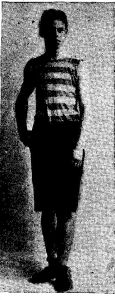
R. W. MOORE.
There was not much record-breaking at the Interscholastic Games in the Madison Square Garden a week ago Saturday night, doubtless on account of the heavy track; but there was good sport and plenty of it, and better in-door games than these have never been seen in New York. Not only did the local schools turn out in full force, entering their strongest teams, but the winners of the recent B.A.A. games came down from Boston, and the leagues of Connecticut, New Jersey, Long Island, and Philadelphia sent some of their best men—men who proved so clever that the New-Yorkers managed to secure only five firsts out of the thirteen events, and but 49 points out of a possible 117. With such an aggregation the games became truly representative of school athletics, in the East at least, and they foreshadow a brilliant success for the National Games next June. If we can get as representative a gathering on that occasion, there need be no fear for the future of the Association.
St. Paul's School has good reason to feel pride in the achievement of her team, for it was as a team that the lads of Garden City won success rather than as individuals. The development of track athletics at St. Paul's during the present year is really worthy of note. At the Long Island League games last May, the Garden City team ranked fourth with 20 points, the winner of the day being Adelphi Academy with 39. At the Inter-City games the week following, St. Paul's held eighth place with 6 points—Barnard leading with 21. At the recent in-door games of the Long Island League in Brooklyn, St. Paul's showed her newly developed strength by ranking third, and her team took the same place at the Berkeley games a week later, Berkeley and Barnard being ahead of her in both instances. But St. Paul's has fewer stars and a better general average than these two New York schools, and for this reason was able to roll up 19 points, and take first place at the New Manhattan Athletic Club games, the athletes from out of town robbing both Berkeley and Barnard of several firsts which they can usually count upon in local contests.
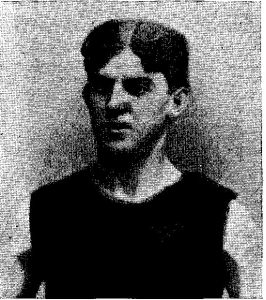
W. S. HIPPLE.
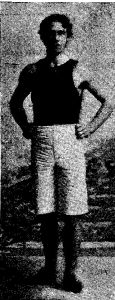
Beers of De La Salle is the only man who scored a double win at the Garden, and he deserves praise for his work. He won his heat in the hurdles in 7-3/5 sec., and then took the final after a hot race with Bien of Berkeley over a course that was far from ideal for hurdling. In the broad jump he displayed the best form of any of the contestants. This may not sound very complimentary to those who saw the display of form that evening, for it was wretched; but Beers's performance gave evidence of his having done systematic work. The box was doubtless responsible for a good deal of the floundering that the jumpers indulged in when they landed, and the runway no doubt had little spring; but neither of these disadvantages can account for some of the marvellous mid-air gyrations that most of them executed in their flights.
Broad-jumping is an event that we seldom have at in-door meets, and the performances in the Garden on this occasion showed very well why this event has to be abandoned. It is impossible, of course, to jump on a board floor. At the N.M.A.C. games the board floor had been covered with a pretty heavy layer of clay and dirt, but as soon as a man landed in the jumping box where this layer had been turned over, he slid, and in nine cases out of ten fell backward. This could not be helped, and was just as great an obstacle for the success of one man as it was for another, and consequently Beers's performance of 19 ft. 2½ in. is most creditable. The N.Y.I.S.A.A. out-door record, made by Pell in 1891, is little better, being 21 feet 5 inches.
N.M.A.C. INTERSCHOLASTIC GAMES, MADISON SQUARE GARDEN, MARCH 28, 1896.
Event.Performance.Winner
50-yard dash (Senior) 6 sec.R. W. Moore, Barnard, N. Y.
50-yard dash (Junior) 5-4/5 sec.W. A. Robinson, St. Paul's, L. I.
220-yard dash 26-1/5 sec.W. M. Robinson, Worcester Academy, Mass.
Quarter-mile run 57-4/5 sec.C. R. Irwin-Martin, Berkeley, N. Y.
Half-mile run 2 m. 12-1/5 sec.W. S. Hipple, Barnard, N. Y.
One-mile run 4 m. 56 sec.E. W. Mills, Berkeley, Boston.
50-yard hurdle (3 ft.) 7-2/5 sec.A. F. Beers, De La Salle, N. Y.
One-mile walk 7 m. 59-2/5 sec.A. L. O'Toole, English High-School, Boston.
Running high jump 5 ft. 7½ in.F. R. Sturtevant, Hartford High-School.
Running broad jump19 ft. 2½ in.A. F. Beers, De La Salle, N. Y.
Pole vault10 ft.R. G. Paulding, Black Hall, Conn.
Putting 12-lb. shot42 ft. 1 in.F. C. Ingalls, Hartford High-School.
Relay race 4 m. 2-1/5 sec.St. Paul's School, L. I.
Points.
St. Paul's19
Berkeley, N. Y.14
De La Salle13
Worcester Academy11
Barnard10
Hartford High10
Boston English High7
Berkeley, Boston5
Black Hall5
Collegiate School3
Packard Institute3
Drisler's3
Brooklyn High3
Pingry's, Elizabeth, N. J.3
Polytechnic Preparatory2
Cutler's2
Newark Academy1
Roman Catholic High, Philadelphia1
Wilson and Kellogg's1
W. M. ROBINSON.
The prettiest performance of the evening, taking everything into consideration, was Mills's running of the mile. Mills was one of the Boston contingent, and at the B.A.A. games the week before he took the 1000-yard run in 2 min. 33 sec. He is a very fast man for long distances, being better at a five-mile event than at one. He is a well-built young athlete, has a beautiful stride, and runs in much better form than any scholastic competitor that has ever appeared in local games. It was plain to see as soon as the race had been started that Mills was to have everything his own way. He contented himself with remaining at the rear of the bunch for the first lap or so, letting others set the pace, and waiting for the crowd to straggle a little before he tried to take the lead. Then he got into his stride, and trotted to the front as if the rest were standing still, and kept on increasing his lead at every lap. It soon became evident that the race was to be merely a contest for second place, but the Boston boy's running was of such a high grade that most of the spectators watched him, and seemed to lose interest in the real struggle, which was practically between Manvel of Pingry's, Turner of Cutler's, and Bedford of Barnard. Manvel had sized up Mills very early in the race, and did not allow himself to be drawn away too fast, but ran consistently for second place. Bedford, however, worked a little too hard in the early stages, and did not even secure a place at the end.
R. G. PAULDING.
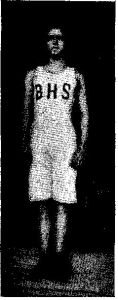
Mills's time was 4 min. 56 sec., and if the track had not been so heavy I feel certain he could have knocked off at least ten seconds. If he had been pushed at all he would have done better still. In the University team race Orton was hard pushed by Grant of Harvard, but his time was only 4 min. 52-3/5 sec., a little over three seconds faster than Mills's time in the mile; and Orton is one of the cracks among American amateurs. It would be interesting to see a race between Mills and Orton.
The heavy track precluded any record-breaking or good time in the sprints. W. M. Robinson, of Worcester Academy, took his heat in the 50-yard dash in 5-4/5 sec. At the B.A.A. games he ran the 40-yard dash in 4-4/5 sec. Moore of Barnard, however, met Robinson in the finals, and his winning time was 6 sec., Robinson being unable to repeat the work he had done in his heat. Another Robinson, he of St. Paul's, in the Junior 50-yard ran his first heat in 6 sec., and then won the final in 5-4/5 sec., doing better according to the summarized record than the Senior winner.
In the half-mile run, Dow, one of the Boston athletes, was considerable of an unknown quantity, but he was not fast enough to defeat Hipple of Barnard. The Bostonian took the pole at the start, and went off with an easy stride, Hipple hanging back in third place; but at the third round the New-Yorker began to catch up, and the race with Dow was neck and neck into the stretch, where Hipple burst ahead and won by several yards. Hall of St. Paul's, who had not been working so hard, then quickly passed Dow, and took second honors. Irwin-Martin of Berkeley had little trouble in his quarter-mile heat, but when it came for the decisive encounter he had to work for his points. He did not get to the front until the last lap, and even then he had to do his best to defeat Van Wagenen of St. Paul's.
A. F. BEERS.
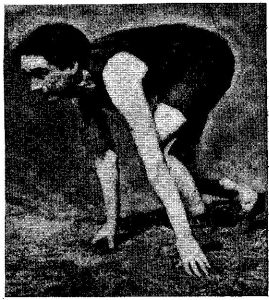
The hurdle races were too short to be interesting, and the performers knocked over the hurdles so consistently that this usually pretty race was a good deal of a failure.
Next to the mile run, the mile walk was as exciting as any of the events of the evening. There was a good field, and in it were two good men—Walker of Berkeley and O'Toole of Boston. O'Toole walked in faultless form, and was content to remain in the middle of the bunch for the first lap; after that he made long strides for the front. Myers kept close to him, and Walker worked hard the entire distance to secure the lead. At the fourth lap the Berkeley lad did get to the front, but O'Toole immediately put on more steam and gained several yards. Ware of Packard Institute did steady work the entire distance, and came in second, with Walker close behind him. If Walker and O'Toole meet at the National I.S.A.A. games in June, it will be a very close contest, with the same advantage of physique in favor of the Bostonian; but both athletes are about equal in form and style.
Of the field events, the pole vault was perhaps the most interesting, narrowing down to a battle between Paulding of Black Hall and Johnson of Worcester. Paulding finally took first honors by clearing the bar at 10 feet. Both men would doubtless have done better if the conditions had been more favorable, the runway being soft and without spring. The shot went to Ingalls of Hartford, who put it 42 feet 1 inch; the broad jump went to Beers, as already stated; and the running high jump also went to Hartford, with Sturtevant, who cleared 5 feet 7½ inches. He is a very promising man.
The relay race was run off in the very excellent time of 4 minutes 2-1/5 seconds. The St. Paul's representative in the first quarter secured the lead, and the Garden City runners thereafter managed to increase their gain on every lap. In the last, Irwin-Martin started in for Berkeley and gained slightly on Hall, the St. Paul's man, but the latter had too great an advantage to be overcome, and five more points went to Garden City.
Two California schools are going to meet in a kind of single combat at an early date. It seems that the school paper of Oakland claimed that Cheek, Rosborough, Jenks, and Dawson could defeat the whole team the Berkeley High-School sent to the last A.A.L. field-meeting. The Berkeley athletes at once called upon the Oaklanders to descend from the house-tops, and sent a challenge for dual games, O.H.-S. to be represented by the four men she had so proudly vaunted, and B.H.-S. to be represented by four of her strongest athletes. The events in this duel will be the same as those at the regular A.A.L. field-meetings, including the relay race, which the four champions of each school are to run. This glorious tournament will doubtless be held on April 18th, and I, for one, should like to see it.
The Secretary of the National Lawn-Tennis Association has announced the dates for this summer's tournaments, and according to his list the Harvard, Yale, Princeton, and Columbia interscholastic tournaments will be held on May 2d. The Interscholastic Championships at Newport are scheduled for August 13th.
The schedule for the interscholastic cricket season in Philadelphia has been revised and definitely arranged as follows: May 6th, Episcopal vs. Penn Charter, Haverford vs. De Lancey; May 13th, Germantown vs. Haverford, De Lancey vs. Penn Charter; May 20th, Germantown vs. Episcopal, Penn Charter vs. Haverford; May 27th, Germantown vs. Penn Charter, De Lancey vs. Episcopal; June 1st, Germantown vs. De Lancey, Haverford vs. Episcopal.
The New England I.S. League took in a number of new schools as members at its recent meeting, and voted to join the National Association. There are now over thirty-five schools in the Boston Association. It ought to be able to send an almost invincible team to the national field-day in June.
The Graduate.
This Department is conducted in the interest of stamp and coin collectors, and the Editor will be pleased to answer any question on these subjects so far as possible. Correspondents should address Editor Stamp Department.
The illustrations of the "local" Confederates in this column excited some interest in the readers of the Round Table, and resulted in the finding of several of the rare and a large number of the common varieties.
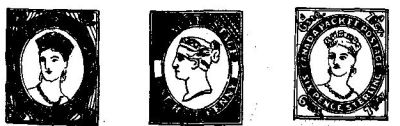
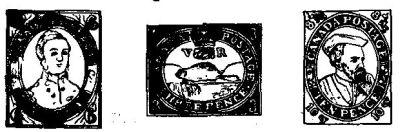
Of late great interest is being paid to the North American British Colonies, and I illustrate the scarce Canada issue used between 1851 and 1859. With the exception of the Threepence they are all scarce, and the "Twelvepence" is one of the rarest stamps. Excluding minor varieties, their values are as follows:
Unused.Used.
3d. red$3$0.25
6d. purple205.00
1/2d. pink63.00
7½d. green1215.00
10d. blue258.00
12d. black400300.00
Varieties on laid paper, and perforated copies are worth still more.
Quite a number of correspondents have called my attention to a difference in the color of the paper used in printing the current issue of U.S. stamps. An examination shows the paper to be the same. The seeming difference arises from the careless wiping of the steel plates during printing.
C. E. M.—No. It is worth bullion only, probably 50c.
A. Subscriber.—1813 cent is worth 35c., 1616 worth 10c.
E. B. Council.—No premium if you wish to sell. You can buy of dealers at about double face value.
G. F. Cohoon.—Canada coins are not collected in the U.S. The other things mentioned are tokens, not coins.
D. L. Delamarter.—I do not know the Weissinger & Bate stamp. The 18 kr. Wurtemburg unperforated is worth about $7.50.
L. K.—The newspaper stamps of 1865 are worth $2 for the blue 5c. with white border, $15 blue border, $6 each for the 10c. and 25c. Reprints are common.
H. Frost.—The coin is a Spanish dollar, worth 50c. Philately is growing stronger every day. The 24c. Treasury is priced $4 used, the 7c. $1.25 used. War Department set about $5 either used or unused.
P. L. Parsons.—The Missouri Defence Bond has no market value.
C. Bethune.—Some of the English colleges at one time issued stamps for postal purposes, but they are not collected in America.
J. D. Corbie.—The coin is Spanish and has no value. Many millions of these old Spanish coins are still in existence.
Alins.—No addresses of dealers are given in this column.
A. A. Krieger, 1531 New Broadway, Louisville, Ky., wants to exchange stamps.
W. K. Dart.—Foreign revenues are worth nothing in this country. The coin has no premium.
L. P.—Your stamp is from the centre row of the sheet, hence has no perforation on one side. No special value. The Philadelphia die has a double line; the Hartford a single line under the word "Postage."
W. F. Meeks.—The 1803 cent can be bought for 15c.
G. H. C.—No premium on the coins.
Sara L. Young.—The New York 5c. black of 1845 is worth $7.50 if in good condition.
D. W. W.—Old albums or catalogues have no value. The 10c. green on buff U.S. envelope, 1853, wide ends, can be bought for $5. Names of dealers, etc., not given in this column.
Philatus.