BOY TROOPERS.
Reading edition
BY RICHARD BARRY.
Illustrated by Instantaneous Flash-light Photographs of "Troop A" Cadets.
he cavalry has always been the most popular branch of army service in song and story, and, beyond doubt, in the mind of the public. To a boy who has a leaning towards military things it has an absolute fascination, and if he likes a horse (and what boy does not?) it is his choice beyond all others.
In New York city there exists a troop of boy cavalry that has been drilling and exercising faithfully, and under such able direction that it may be taken as a model for what a boys' organization of this kind should be. Soldiering means really serious work, whether it is in the service of a State, a country, or merely entered into for the love of it, and a boy who has not the proper spirit cannot long remain a member of "Troop A" Cadets. It is astonishing to find how quickly and how well the boy recruit learns to ride, how much he learns about a horse, and how his muscles and his eye and his self-reliance develop under the drill. The writer has seen riding that no cowboy need be ashamed of done by a boy of fourteen who a year before had never thrown his leg over anything but a Shetland-pony, and many of the young troopers never mounted a horse at all until they first made their appearance in the tan-bark ring of the troop riding-school. If a boy is a "muff," he does not stay at it long; it takes a lad with the "proper stuff" in him, as the riding-master tells you, to stand the thumping and sometimes the falls of the first month's drill. A horse is a very complicated piece of machinery to the novice, and he must be managed by the eye, the whole body, and the mind. He knows when the rider on his back is timid or determined, and he often acts accordingly. Horses have an individuality that bicycles haven't, and the young trooper must learn to govern besides learning merely to guide and "stay on."
But to take in order what a boy cavalryman must learn. In the first place he must be strong and willing, and quick to listen; that is a great thing—listening. He will find out a great deal about himself, and if he has the right stamina and spirit he improves in every way most wonderfully.
DRESS PARADE.
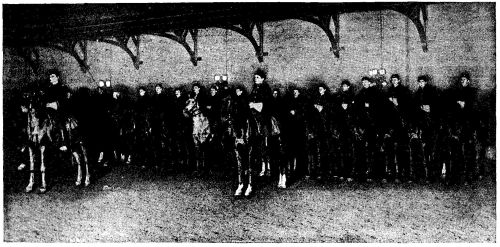
As soon as the recruit has been proposed for membership, which is done in the same way it is done in the National Guard—that is, his name is proposed by two members in good standing, then voted on by a committee, and lastly by the whole troop—as soon as all this is done he takes his first lesson. It is not on horseback—that comes later—but on foot; the setting-up exercise has to be gone through with. This is quite a trial, for it means standing erect, and going through various exercises with the arms, the legs, the whole body; bending over with knees stiff, and touching the ground until he wonders where so many aching muscles come from.
Then he learns the facings and marchings, a good deal like an infantryman. But at last a sabre is put in his hand, and he is taught to use it, standing firm on his out-stretched legs, and making wonderful cuts and points to right and left—"cut at head, cut at body, at infantry, at cavalry," etc., over and over. At first some of his wonderful strokes in strange directions would cleave his horse in two, and others would relieve him of his head or mayhap his tail; but soon he learns the proper positions of all these things, and acts as if he were on horseback. When this has been accomplished he is taught the drill with the carbine, loading and firing, and the manual on foot. The lieutenant in charge of the cadets informed me that boys learn quicker and improve much more rapidly than grown men in all this, and that they seldom remain in the "awkward squad" for any length of time. But now comes the riding, and a great deal more; for the cavalryman must look after his own mount, and be able to saddle and bridle.
The first lesson means much. It is a good thing that grace does not count, for it is hard to be graceful or at ease on a bumping, thumping nag with nothing on his back but a blanket. In a little time one learns to hang on with the knees and balance with the body, and then it looks more like fun—the instructor lets go of the bridle-rein and ceases his everlasting words of advice, and the recruit "goes it alone." When he sits in a saddle after undergoing a long course of tan-bark drill, he feels as comfortable as if he was in a chair, and wonders how he ever thought it hard to do.
IN COLUMN OF FOURS.
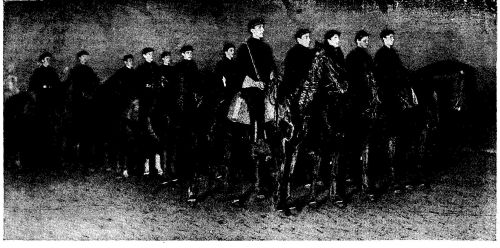
Now comes the drill on horseback at a walk, a trot, and a gallop. If the horse is an old hand he helps the new trooper out amazingly; he seems to understand the orders, and whisks into place and dresses into line promptly as could be wished for.
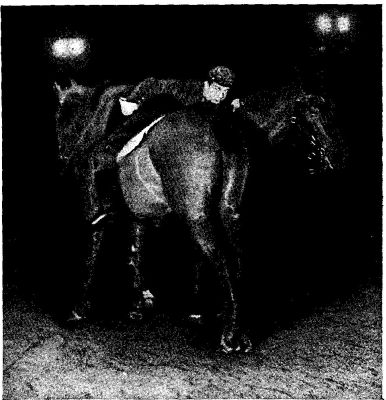
After the trooper gets out of the awkward squad for good and all, the drills become exciting; every meeting is a series of games on horseback; he learns to cut at the ball on the wooden post—"the Turk's head"; he slashes at imaginary enemies afoot and mounted; he learns "tent-pegging," which is riding full tilt down the arena at a wooden peg driven into the ground, which he endeavors to pick up on the point of his sabre, and soon he becomes part of his horse. It is exciting to see three troopers playing the "ribbon chase." One of them has a knot on his right arm, and the other two (they are all mounted without saddles) try to get this ribbon off. It can only be taken off from the left side, and they play tag and manœuvre every which way to get a position. If the one who is "it" is clever, he dodges and doubles, turns and backs, and if he can keep his ribbon for three minutes he wins. But the others push him hard, and here it is where good riding tells. I have seen a little shaver who had to be helped up on to a fifteen-hand horse do some riding that would be credit to a Comanche Indian. They wrestle—these boy troopers—on horseback, and I have seen one leap from his own horse astride that of his opponent, and then succeed in dismounting him. All this brings out the best thing in a boy; it teaches him to be self-reliant and quick in judgment, and it makes his big brother feel proud of him—if he has a big brother.
WRESTLING.
When they grow old enough (most of them are between fifteen and seventeen) they generally get into the troop itself, and their preliminary work puts them on a par with the best of the older troopers.
Of course it costs something to organize and maintain a squadron of mounted men, and the members pay yearly dues which cover the expense of horse hire. Their uniforms they own themselves, and they cost about twelve dollars.
In any good-sized town or city it is perfectly possible for a number of boys, with the help of their fathers, to organize such a troop if they go about it in earnest and work in a systematic way.
First of all a competent instructor must be obtained, and every one should realize that money cannot be judiciously saved in his salary. He should be the best man obtainable after a somewhat extended search. Usually he is an old cavalry officer, or perhaps some cavalry officer who has retired. Such men are to be had after some search, and apart from their knowledge of cavalry movements they are valuable because they take a personal interest in all that has to do with their work.
Having secured the instructor a hall is then necessary, and this is by far the most difficult thing to find of the whole outfit. Few towns and not many cities have any hall the ground-floor of which can be used for horses. If the troop is to be a serious affair, and it is impossible to organize one unless it is to be serious, the cheapest way in such cases is to build a huge shed with the earth for a flooring. Here is a proportionately large expense, and the result is that most cavalry cadet troops will have to be formed under the auspices of National Guard troops, which already have armories for cavalry practice.
Once you have an armory and an instructor, the rest is merely detail. Much objection is made of late to military drill and the encouragement of the love of war. Boy troopers have nothing to do with war. They should not wish to fight, even to grow up to fight some day, except in defense of their country. There is no more question of war in a cadet troop than there is in a bicycle club. It is merely that the discipline, the training, the exercise that are good for boys can be obtained in this healthy, manly way, and cannot be obtained with equal efficiency in any other way.