EXPLORING NEW-FOUND RIVERS.
Reading edition
BY C. C. ADAMS
ome of the leading African explorers have never written a book. They have had other work besides exploration, and have been too busy to write long accounts of their discoveries. A single copy of this paper would hold all that Alexander Delcommune, who has travelled further in the Congo basin than any other explorer, has written about his work. Captain Van Gele, who has had remarkable experiences, and who took the last step in the solution of a great geographical conundrum—the destination of Schweinfurth's "Welle" river—has written very little. But we know what all these men have done. Every new map of Africa that is worth anything differs from all its predecessors, because it contains later and better information. These men have done much to change and improve the maps, and their short reports to geographical and other societies have been very interesting and important.
Foremost among these men is George Grenfell, of the Baptist Missionary Society of England, whose travels in 1884-5 gave us our first knowledge of six of the largest Congo tributaries. Many thousands of black people in the middle Congo basin first learned of the white man when they saw Grenfell pushing up their rivers on his little steamboat. He travelled for over three thousand miles on the Congo and its tributaries, and always as a man of peace, winning the confidence of barbarous tribes by patience and kindness. He never shed a drop of blood nor laid violent hands upon a native. How much better was this policy than to respond with violence to the mistrust and opposition of these frightened and savage peoples.
Mr. Grenfell's steel steamer Peace was built in England, and when she was shipped to the Congo all her plates and pieces of machinery were taken apart and packed into eight hundred loads; for every bit of the vessel had to be carried on the backs of men around two hundred and thirty-five miles of cataracts to Stanley Pool, where the long caravan of black porters arrived without losing a load. Another Congo steamboat was not so fortunate, for its brass fittings were stolen while in transit, and transformed into neck ornaments for native women. It has been said that a pioneer in Africa should be able to build a boat or a house without a nail or a tool. Grenfell seems to be that kind of man. The engineers who had been sent to put the Peace together died of fever; so Grenfell trained natives in the art of riveting, and with their aid he put the eight hundred pieces together. When the Peace was launched there was not a leak. All of the parts had been placed where they belonged. She was seventy feet long, and under her wooden roof were a cabin and cook-room, with an engine amidships. Her twin screws drove her ten miles an hour, and in all respects she was well fitted for her work. So in 1884 Mr. Grenfell and his wife, with a crew of fifteen natives, set out to find favorable points for mission stations on the great unexplored tributaries that stretch away hundreds of miles north and south of the middle Congo.
We cannot describe here all the discoveries Grenfell made. He greatly changed our notions of the extent, direction, and importance of quite a number of rivers, chief among which were the Mobangi and Mongala north of the Congo, and the Bussera, Chuapa, Lulonga, and Lomami south of it. You may easily find these large rivers on the map, and they are Grenfell's greatest contribution to our knowledge of Africa.
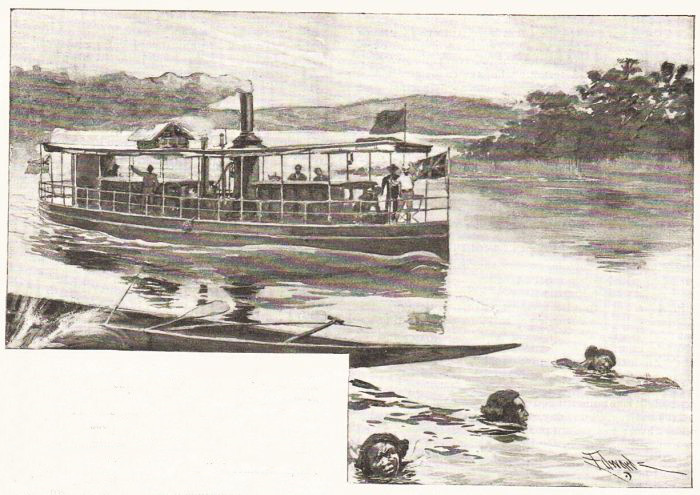
Most of the tribes whom Grenfell met live away from the Congo, and had never heard of the world outside the districts they occupy. We can scarcely imagine the astonishment and even terror which the white man and his puffing river monster inspired as the Peace would suddenly round some river bend and pause at a village front. The natives did not always flee nor offer hostilities at once. Many stood motionless, as if rooted to the spot, with straining eyes, and hands over their wide-open mouths, a common practice among savages when they are greatly surprised. If one fled he was speedily followed by others. If one gathered his wits and began to poise his spear or bend his bow, others followed his example. Once a woman fell in spasms to the ground. One day, on the Ruki River, Grenfell surprised a party of fifty fisherwomen, who took one look at the wheezing Peace, and then sprang shrieking out of their boats, and swam, as a dog does, to the shore. A large crowd of men on an island in the Bussera saw the apparition, and rushed pell-mell for their boats, forgetting their paddles in their fright; and so, with frantic energy, they used their hands as paddles in their flight to the mainland. Grenfell was accompanied by the German explorer Von François on his ascent of some of the southern rivers, and sometimes the natives thought their white visitors came from the spirit world, and called to them, "We fear you because you are white ghosts."
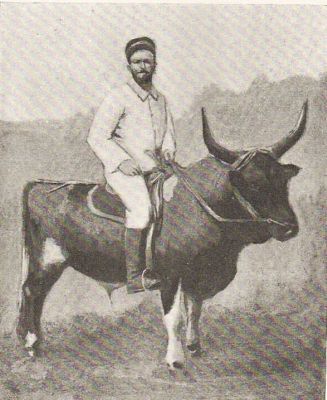
GRENFELL AS HE SOMETIMES TRAVELLED WHEN ON SHORE.
On all such occasions there was nothing to do except to wait for the excitement to subside, very quietly displaying presents of beads, wire, and cloth, while anchored at a distance from the shore. Grenfell's interpreter would strain his lungs with shouting words of soothing and friendship. Sometimes he would cry "Ba, ba, ba," to indicate that he wished to buy goats, and he would exhibit trade goods to pay for them. On some island, in the night, while alarm drums were arousing the country for miles along the banks, Grenfell would kindle fires, and in the bright light display his presents to the best advantage. Once while a howling crowd were bending their bows, the Peace was sent at full speed within a rod of the shore, and a cloth full of beads and cowrie-shells was thrown among them. Before the astounded natives had recovered their wits, the Peace was again in mid-stream beyond the reach of arrows. This set the savages thinking, and they listened quietly when Grenfell shouted that he wished to buy fire-wood. They filled a canoe with wood, and tying to the boat a long rope made of vines, let it drift down stream to the steamer, where the canoe was emptied, and the beads which the explorers placed in it were hauled back to the shore. The ice was broken now, weapons were laid aside, and soon a dozen canoes pushed out from the shore with natives having wood or provisions to sell.
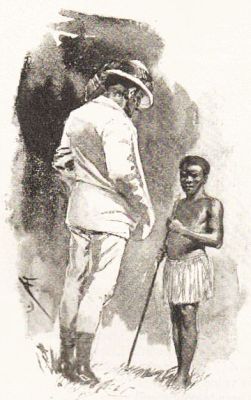
A DWARF OF THE CONGO FOREST.
All of Grenfell's blandishments failed sometimes, and he was fiercely attacked. Only one instance is recorded where he fired a gun, and then it contained only a blank cartridge. He proved the efficacy of unusual noises, for the explosion, reverberating along the forest-lined shores, sent the enemy scampering. A blast from the whistle was sometimes enough to turn pursuing canoes about face. The explorer did everything possible to protect his men, and not one of them was hurt. Wire netting completely covered the open sides of the vessel and caught many flying missiles, while others lodged in the wooden roof. A few natives in one village on the Bussera appeared to have seen or heard of guns, for Grenfell was much surprised when the very friendly people told him that they had intended to attack the vessel until they saw his firearms. One village that had accepted the explorer's presents on his ascent of the river, attacked him on his return because the river had risen meantime, a most uncommon thing at that season, they said, and ample proof that the white man was bad. The explorer found himself in a predicament on the last day he spent upon the Bussera, but Mrs. Grenfell helped him out of it. While the Peace was in shore, a party of warriors rushed to the bank with their weapons all ready to launch. In a moment Mrs. Grenfell had thrown among them a double handful of beads, and while the crowd were scrambling and fighting for the prizes, the Peace reached a safe distance. Usually an hour or two of waiting and conciliatory talk turned foes into friends. Sometimes, however, the alarm drums would notify the villages for miles around that an enemy was coming; and when Grenfell saw a throng of armed warriors waiting for him, and not a woman on the ground, he knew that trouble was brewing.
THE "PEACE" SURPRISING A PARTY OF FISHERWOMEN ON THE RUKI RIVER.
Geographical information imparted by the natives was apt to be wholly incorrect. They had ready answers for all questions, but if they imagined Grenfell would like to hear of a lake a little inland, or five days more of navigation up the river, they would make replies which they thought would please him, regardless of truth. This is a widespread practice among savages. At the same time they were often eager to learn of his discoveries. They would ask him how many days' journey his vessel made above their village, and whether the natives he met dealt in ivory and slaves. Some tribes had not the slightest idea that ivory had any value, and thought it strange that any man should have occasion to buy wood. Some of them had no names for the rivers where they live. They were children of the earth, they said, and if he wished to know the names of the rivers he must ask the children of the water. The southern tributaries—Bussera, Chuapa, and Lulonga—are in the great belt of dense Congo forest, and in the upper reaches of the rivers the big branches form a complete roof over the streams, which are in deep shadow even on the brightest days; and in this roof Grenfell found some of his most persistent enemies. They were the little folks of Africa, the pygmies, who would clamber out on the branches overhanging the streams, and shoot their poisoned arrows into the wooden covering of the vessel.
It was Grenfell who gave us our first positive information of the many dwarfs who live in the forest south of the Congo, though about the same time other explorers discovered them further south. One evening a canoe drew up at some distance from the Peace, and when the interpreter asked the natives who they were they said they were Batwa. This is the name of the dwarfs living in the southern Congo forests, and Grenfell and Von François were overjoyed at the prospect of seeing them. It was now so dark that they could not determine what the canoemen looked like, but in the morning they found near by a cluster of huts inhabited by these little people, and then they knew they were in the land of the pygmies. Grenfell found many dwarfs on the Lomami, Chuapa, and Bussera rivers, and they proved to be the most troublesome and vindictive people with whom he had to deal. His black crew were badly frightened when they heard the dwarfs were near. All their lives they had been told that the dwarfs were most unpleasant people to meet. It was common report that they shot with poisoned arrows, permitted no one to live in their country, and excelled all warriors and hunters in skill with the bow and spear. We shall see later what Grenfell and other explorers have learned about these strange and interesting people, and also about the cannibals who are spread so widely over the Congo basin. Very little was known of the cannibals as long as explorers kept to the main river, but after Grenfell began his work along the tributaries the world soon came to know the appalling extent of this evil.
Nearly all the tribes discovered by Grenfell are cannibals. An interpreter whom he took with him from the Congo was in constant fear of being captured and eaten, and he would never venture ashore except in company with six or eight comrades: "You eat goats and hens," said some natives to Grenfell one day, "because you are rich and able to buy them; but we are poor, and have to eat men, whom we can get for nothing." Under the laws of the Congo State it is now a capital crime to eat human flesh. Wherever the influence of the white man extends, the practice is being discontinued, and some day this stigma upon human nature will disappear from all the parts of Africa where it has so long prevailed.
There are missionary stations now in some parts of the large regions that Grenfell traversed. His peaceful and friendly methods made it easy for other white men to go among the people he brought to light. The natives who sought to kill him are now glad to sell ivory and rubber to traders. His discoveries during fifteen months added about one thousand eight hundred miles to the known navigable waters of the Congo basin. No one except Stanley has surpassed him in the extent and value of his work among the waterways of the second largest river system in the world.