A PLUCKY YOUNG TENDERFOOT.
Reading edition
BY PAUL HULL.
Harry Brown had the cowboy fever, and this is the way that the disease originated. During the early spring Harry's uncle had been a guest with the Brown family for several weeks, during which time the boy had been regaled with stories of wild Western life and adventure until his dreams suggested a panorama of prairie-land, cowboys, a whole menagerie of savage animals, and an endless procession of gayly bedecked and hideously painted Indians galloping furiously across the plains.
Uncle Joel had taken a great fancy to his sister's child, and having a boy of his own about the same age, he proposed to the somewhat startled parents to carry the lad away with him for the summer, and give him an outing on his ranch, where he would have the companionship of his sixteen-year-old cousin Frank, whom he had placed at school in Chicago for the winter, and for whom he intended to call when on his way back to Wyoming.
After considerable pleading and argument, Harry's mother at length allowed herself to be almost persuaded that if he went he would not be converted into a long-haired, swaggering, pistol-shooting citizen, and that hostile bands of redskins were not in the habit of lying in ambush around the ranch for the purpose of scalping its inmates several times a day; so at last she hesitatingly added her consent to that of her husband's.
During the remaining week of Uncle Joel's stay in New York the poor man was subjected by the anxious mother to such a running fire of cross-questioning, and so made to feel the awful responsibility that he was incurring by taking Harry away from his comfortable home, where he was tenderly cared for, to place him among strangers and savage beasts and wild and uncouth cowboys, as well as blood-thirsty Indians, that he would have gladly gone back on his contract, even if it was calculated to cost him a dozen of his best steers.
The time set for the departure arrived, and, being a Saturday, Harry was escorted to the depot by a large delegation of his school-mates, who gazed enviously at their companion striding along at the side of his rich cowboy uncle, who had been elevated into a hero in their minds by reason of the startling tales of Indian adventure in which, according to his nephew's account, he had been a most prominent actor. It is safe to say that Harry's imagination was responsible for the gaudy coloring of some of the stories, and that the rate at which his uncle was reputed to have cleaned out the red men whenever an uprising took place proved conclusively that the savages were either so thick in Wyoming that they interfered with one another's walking, or that they were wise enough not to go upon the warpath very often—otherwise that territory would have been depopulated of its natives long before.
After two days of anticipation, Harry stepped off the train at Chicago to greet a lad whom he had seen on the platform from the car window, and whose resemblance to Uncle Joel permitted no doubt as to his relationship. Frank had been written to some days previous concerning the companion that had been selected for him for the summer, and had been anxious to meet his cousin, so, as he expressed himself to a school-mate, "to size him up and see what stuff he was made out of."
For a moment after Uncle Joel had introduced them, in his bluff but kindly way, the boys held back just a trifle, as though measuring one another according to individual standards; then a mutual smile of pleasure and satisfaction lit up their faces, and they shook hands heartily and walked off arm in arm, to the gratification of Mr. Williams, who heard them exchanging confidences and speculating over the coming vacation.
The ride from the foot of Lake Michigan to the city of Cheyenne was full of novelty and excitement for the Eastern boy, whose previous travelling had never carried him beyond the limits of the Empire State.
On the morning of the day that the train rolled into the capital city of Wyoming, Mr. Williams pointed to a natural and lofty pyramid of rocks situated a few hundred feet away from the track, telling them to take in the situation quickly, as the train would shortly round a curve and hide it from view.
Harry asked his uncle if there was a history connected with the scene, and learning that his suspicious were well founded, begged for the story. Mr. Williams began in the orthodox fashion:
"A long time ago, when I was a young fellow about twenty-three years of ago, I first came out to this part of the country as a member of a railroad surveying party. One awfully hot August afternoon we had worked our stakes along until we reached the big mass of rock that I pointed out to you a few minutes ago. As there was a promise of a thunder shower, according to the big black clouds soaring up out of the northwest, and as we were all knocked up with the heat, our chief gave orders to unhitch the cattle and to camp under the shade of the rocks.
"We had two good guides and Indian-fighters in our outfit, and being in a hostile country, of course they were always on the alert for Indian signs and ambushes. Although we had had several attacks from the hair-lifting individuals, the same had always been made when we were prepared for them, owing to the warning given by our guides. Well, why it was that they were so careless on that day I speak of I cannot say, unless the burning heat of the forenoon had taken away their shrewdness and caution.
"As far as the eye could reach in every direction there was nothing but rolling prairie, except right against our backs, where the bare and ragged rocks went up almost straight into the misty, heat-charged atmosphere. As we intended to remain in camp for the remainder of the day and coming night, sentinels were stationed on the four sides of the rock, and the mules and horses were allowed to crop the parched grass in the vicinity as far as their picket-ropes would allow them to wander, it being intended to drive them within the square of wagons before dark, so as to make them secure against a stampede.
"About four o'clock the storm came sweeping across the prairie, and for about an hour the thunder rolled and cracked and the lightning flashed as it knows how to do in Wyoming; then when it seemed to be dying away, there came a blinding flash of fire in our faces and the most awful crash I ever heard. It stunned us all for a moment, so that when something came pitching down from the rocks just over our heads and fell with a thud on the sodden grass a few feet away, we imagined it to be a piece of the cliff detached by the last concussion. After that the rain ceased and the sun shone out. Then it was that we discovered the thing in front of us to be a Cheyenne warrior. After the first look there was no use in seeking for signs of life in him, for his face was as black as that of a negro's, and one side of him was horribly burned. It didn't take us long to reason that he had been hidden away among the rocks, spying on us, and that the last lightning bolt had been attracted to him by the steel tomahawk in his belt. Well, after that we pulled out on the open prairie and kept a close watch on that pile of rock for the remainder of the afternoon and night, for we didn't know how many more of the heathen there might be in hiding up there; but nothing further happened, and in the morning we said good-by to it with a big feeling of relief."
At Cheyenne, Mr. Williams's foreman and several ranch hands were in waiting with saddle horses for the party. During the two days that the party remained in the city Frank gave Harry some valuable lessons in horsemanship, and after about a week's experience, in which time he became hardened to the saddle, Harry found no greater enjoyment than in galloping about the range on the back of a fiery young horse that his cousin had raised, and which he presented to him "for keeps," as he expressed it.
Now Frank Williams was a kind-hearted young fellow, and during the fortnight that he and Harry had been thrown together a mutual affection had grown between them; but Frank was brimming over with mischief, and he conceived a plan for having a laugh at his "tenderfoot relation," as Harry was called by the cowboys.
The few Indians who appeared in the vicinity of the ranch belonged to a peaceable tribe of Cheyennes, but when the opportunity came Frank intended for the time being to mentally transform these demoralized and decidedly lazy individuals into the most frenzied and blood-thirsty creatures that his imagination was equal to. The cowboys were taken into the secret, and a mysterious visit was made by one of them to the Indian camp, where the chief, who delighted in the high-sounding title of "Dog-with-two-tails," was pleased to dispose of several feathered head-dresses and a quantity of colored pigments for a suspicious-looking black bottle, which the noble savage patted affectionately and stowed away inside his dirty shirt.
Several days after this Frank asked his cousin to take a canter with him to a somewhat remote point of the range where the men were branding the young cattle. As they rode across the undulating prairie, sweet and fresh in the early summer sunshine, Frank explained to his cousin that the Indian outbreaks were always timed to take place when the winter was over. Then he went on to state, with a shade of worry on his face, that although there had been no trouble for some time, it was well to be on guard constantly, for the uprisings generally took place when they were least expected. He kept on in this strain until the branding-place was reached; then Harry became so interested in the round up and sorting of the cattle that he failed to notice several of the cowboys disappearing into the small woods close at hand.
After a time the boys started on their ten-mile ride for home, allowing their horses to jog along easily, while Frank profited by the occasion to further dilate concerning the uncertainty of their savage neighbors, and the recklessness of even riding over the range unless prepared for emergencies.
They had ridden about two miles, when their ears were suddenly saluted with the most infernal series of yells that ever disgraced the human throat. Looking back in the direction of the sound, the boys saw, not more than a quarter of a mile away, coming down on them at top speed, five savages in full war paint and feathers, brandishing their rifles, while they continued to utter such unearthly screams and howls that Harry afterward admitted that his hair developed a tendency to lift his cap clear of his head.
"They've broken out!" yelled Frank. "Spur for home or they'll have our scalps!"
The next instant the two boys were frantically driving their heels into the sides of the speeding horses, while behind them the Indians redoubled their yells and swept furiously along in pursuit.
All of a sudden Harry saw Frank's horse, which was a little in advance, step in a hole, pitch on his knees, and send its rider flying out of the saddle. Harry reined up by the side of his cousin, but Frank never moved or responded to the excited appeal for him to jump up and get on behind.
What was to be done? Back there, only an eighth of a mile away, the redskins were tearing along on their trail, and here, helpless and unconscious, lay his companion.
"I'll never leave him for those fiends to butcher," muttered Harry, pale with fear, but with his teeth set hard and a look of determination on his youthful face. Then he unslung his gun, dismounted from his horse, brought the piece to his shoulder, ran his eye along the barrel until the head of one of the Indians was in line, and pulled the trigger.
THE REPULSE OF THE PRACTICAL JOKERS.
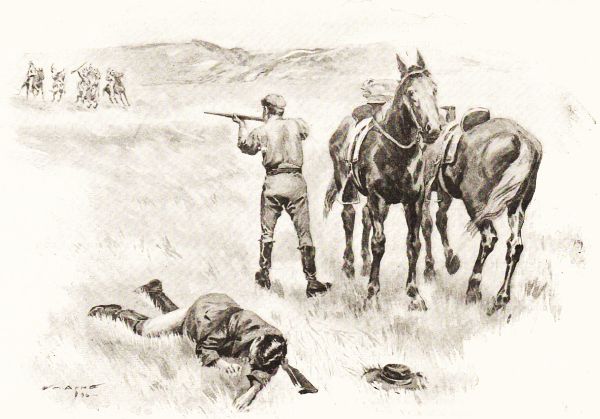
With the report the savages turned their horses and took the back trail, and were soon out of sight.
"The miserable cowards," thought Harry, "to run away from a boy!"
"Harry," said a very shamefaced lad sitting on the ground a few feet away, and rubbing a big lump on the back of his head, "you can put up your gun; there's no danger. I tried to play a joke on you, and the joke came on me. I'm glad that you only had bird-shot in that gun of yours, because you might have killed one of father's cowboys. But I say, Harry, dear old fellow, it was awfully brave of you to stand by me when I was knocked silly by that tumble, and I appreciate it just as much as though it was all real work instead of a joke; and—and—oh! I say Harry, old fellow, don't say anything about it, and if any one ever dares to call you a tenderfoot again when I'm around, why, I'll brand him with the jolliest, biggest iron that we've got on the ranch!"