DRILLING A GREAT ARMY IN WINTER.
Reading edition
The effectiveness of any of the great European standing armies depends, above all things, upon their being able and ready to take the field at a moment's notice. This theory is taught in most of the military schools abroad, and it is an excellent one; but there are many and almost insurmountable difficulties to overcome in putting it into practice. Still, in order to reach the highest efficiency, troops are trained to manœuvre in all weather and at all seasons, especially in France and Germany and Russia. The Russians, having more winter weather, perhaps, than the other nations of Europe, were the first to recognize the value and importance of drills on snow and ice, and have trained their armies to take the field in the depth of winter.
Germany has followed this example, and during the winter months the various corps of her vast army carried on mock warfare in various parts of the empire. Extreme cold is, of course, a great obstacle to the mobilization of troops. It is not always possible to secure lodgings for soldiers in towns and villages, especially in times of peace, when the necessity is not absolute; and the alternative of sleeping in tents, with the snow lying deep on the ground and the thermometer below zero, seems at first thought impracticable. And yet it has been shown, by the recent manœuvres of the German troops, that with dire precautions men suffer no ill effects from this exposure. The tents which have been found to be the most useful are very small, and have proved warmer than the larger ones. The temperature inside the canvas is generally about ten degrees higher than outside, to begin with, and rises when occupied by soldiers. The men are also kept warm by having hot coffee served to them at intervals of two hours throughout the night. The chief object, of course, of winter manœuvres is to accustom soldiers to sleep in tents during severe weather, and to learn to know the conditions which winter campaigning imposes.
A MOCK ASSAULT ON A FORT IN WINTER.
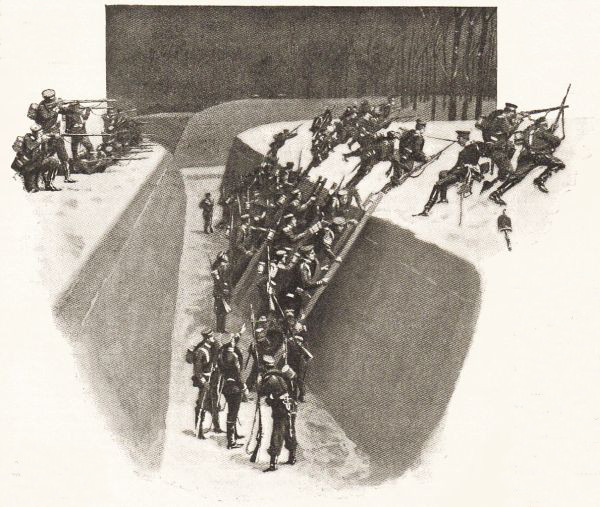
A detachment made up of several battalions of Pioneers and Grenadier Guards was sent across country on a long march during one of these manœuvres, in an attempt to surprise and capture a fortress. The attack was to be made entirely without the aid and support of artillery. The troops arrived before the fortress in the evening, and were immediately ordered to the attack, the plan being to take the place by assault. The bastions and ramparts, of course, were covered with snow, and the water in the moat, if there was any, was frozen hard. They approached as quietly as they could, with the intention of crossing the moat, but before they could get their scaling-ladders into position the garrison had been alarmed by the sentries, and immediately opened fire upon the attacking party. Search-lights were also brought into play to throw their glare into the moat, where the Grenadiers had gathered in order to climb the ramparts. But in spite of this the Guards scaled the inner defences, being protected by the Pioneers, who were drawn up on the other side of the moat, and kept up such a constant fire on the garrison that these troops were unable to prevent the approach of the Grenadiers. As soon as the latter had successfully climbed the ramparts, they in turn opened a hot fire upon the defenders, while the Pioneers crossed the moat behind them. And when the whole attacking force had thus surmounted their greatest obstacle, they made a rush over the inner defences of the fortress and captured it. This is only one of the many kinds of winter manœuvres that the German troops practise. Sometimes whole army corps are sent to capture a city or to take possession of a line of railroad; and if the snows are so heavy that these roads are impassable, the railway corps of the German army can construct a road made of light steel tracks across country over the ice and the drifts. In this way they keep up communication with their base of supplies.