Public Life Of Benjamin Franklin.1 By Jacob Abbott.
Reading edition
Public Life Of Benjamin Franklin.1 By Jacob Abbott.
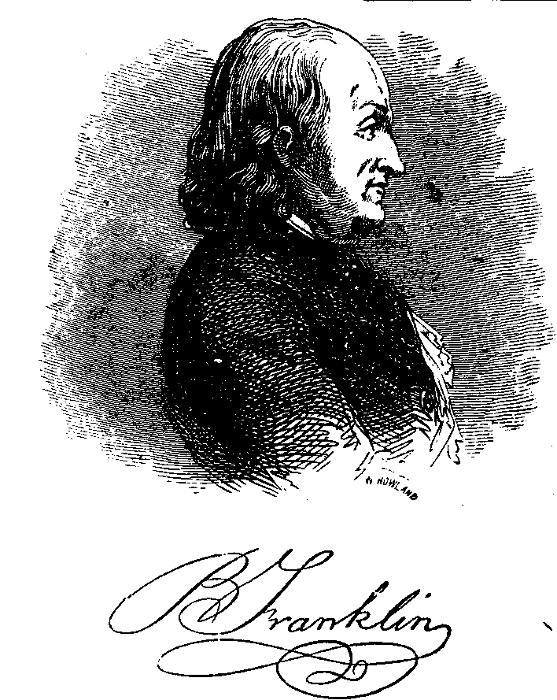
Benjamin Franklin entered upon his career as a public man when very near the middle of the active portion of his life. His history, therefore, naturally divides itself into two equal portions, each entirely distinct from the other. Until the age of about thirty-five he was simply a Philadelphia mechanic, discharging his duties, however, in that capacity so gracefully and with such brilliant success, as to invest industry, and frugality, and all the other plain and unpretending virtues of humble life with a sort of poetic charm which has been the means of commending them in the most effectual manner, to millions of his countrymen. At length, having accomplished in this field a work equal to the labor of any ordinary life-time, he was by a sudden shifting of the scene in the drama of his life, as it were, withdrawn from it, at once and entirely, and ushered into a wholly different sphere. During all the latter half of his life he was almost exclusively a public man. He was brought forward by a peculiar combination of circumstances into a most conspicuous position; a position, which not only made him the object of interest and attention to the whole civilized world, but which also invested him with a controlling power in respect to some of the most important events and transactions of modern times. Thus there lived, as it were, two Benjamin Franklins, Benjamin Franklin the honest Philadelphia printer, who quietly prosecuted his trade during the first part of the eighteenth century, setting an example of industry and thrift which was destined afterward to exert an influence over half the world—and Benjamin Franklin the great American statesman, who flourished in the last part of the same century, and occupied himself in building and securing the foundations of what will perhaps prove the greatest political power that any human combination has ever formed. It is this latter history which is to form the subject of the present article.
It is remarkable that the first functions which Franklin fulfilled in public life were of a military character. When he found that his thrift and prosperity as a citizen, and the integrity and good sense which were so conspicuous in his personal character, were giving him a great ascendency among his fellow men, he naturally began to take an interest in the welfare of the community; and when he first began to turn his attention in earnest to this subject, which was about the year 1743, there were two points which seemed to him to demand attention. One was, the want of a college in Philadelphia; the other, the necessity of some means of defense against foreign invasion. Spain had been for some time at war with England, and now France had joined with Spain in prosecuting the war. The English colonies in America were in imminent danger of being attacked by the French forces. The influence of the Friends was, however, predominant in the colonial legislature, and no vote could be obtained there for any military purposes; though the governor, and a very considerable part of the population, were extremely desirous that suitable preparations for defending the city should be made.
There was thus much diversity of sentiment in the public mind, and many conflicting opinions were expressed in private conversation; but every thing was unsettled, and no one could tell what it was best to undertake to do.
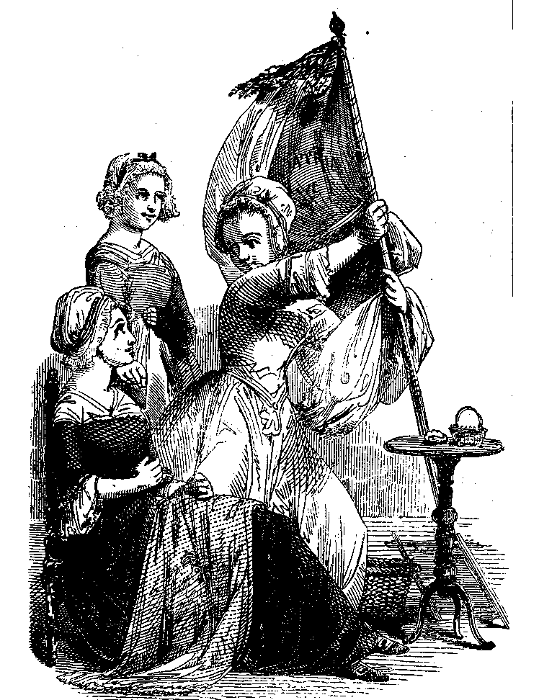
Under these circumstances Franklin wrote and published a pamphlet entitled Plain Truth, placing the defenseless condition of the colony in a strong light, and calling upon the people to take measures for averting the danger. This pamphlet produced a great sensation. A meeting of the citizens was convened. An enrollment of the citizens in voluntary companies was proposed and carried by acclamation. Papers were circulated and large numbers of signatures were [pg 290] obtained. The ladies prepared silken banners, embroidering them with suitable devices and presented these banners to the companies that were formed. In a word, the whole city was filled with military enthusiasm. The number of men that were enrolled as the result of this movement was ten thousand.
Such a case as this is probably wholly without a parallel in the history of the world, when the legislative government of a state being held back by conscientious scruples from adopting military measures for the public defense in a case of imminent danger, the whole community rise voluntarily at the call of a private citizen, to organize and arm themselves under the executive power. There was, it is true, very much in the peculiar circumstances of the occasion to give efficiency to the measures which Franklin adopted, but there are very few men who, even in such circumstances, would have conceived of such a design, or could have accomplished it, if they had made the attempt.
The officers of the Philadelphia regiment, organized from these volunteers, chose Franklin their colonel. He however declined the appointment, considering himself, as he said, not qualified for it. They then appointed another man. Franklin, however, continued to be foremost in all the movements and plans for maturing and carrying into effect the military arrangements that were required.
Among other things, he conceived the idea of constructing a battery on the bank of the river below the town, to defend it from ships that might attempt to come up the river. To construct this battery, and to provide cannon for it, would require a considerable amount of money; and in order to raise the necessary funds, Franklin proposed a public lottery. He considered the emergency of the crisis, as it would seem, a sufficient justification for a resort to such a measure. The lottery was arranged, and the tickets offered for sale. They were taken very fast, for the whole community were deeply interested in the success of the enterprise. The money was thus raised and the battery was erected. The walls of it were made of logs framed together, the space between being filled with earth.
The great difficulty, however, was to obtain cannon for the armament of the battery. The associates succeeded at length in finding a few pieces of old ordnance in Boston which they could buy. These they procured and mounted in their places on the battery. They then sent to England to obtain more; and in the mean time Franklin was dispatched as a commissioner to New York, to attempt to borrow some cannon there, to be used until those which they expected to receive from England should arrive. His application was in the end successful, though the consent of Governor Clinton, to whom the application was made, was gained in a somewhat singular way. “At first,” says Franklin, “he refused us peremptorily; but at dinner with his council, where there was great drinking of Madeira wine, as the custom of the place then was, he softened by degrees, and said he would lend us six. After a few more bumpers he advanced to ten; and at length he very good-naturedly conceded eighteen.”
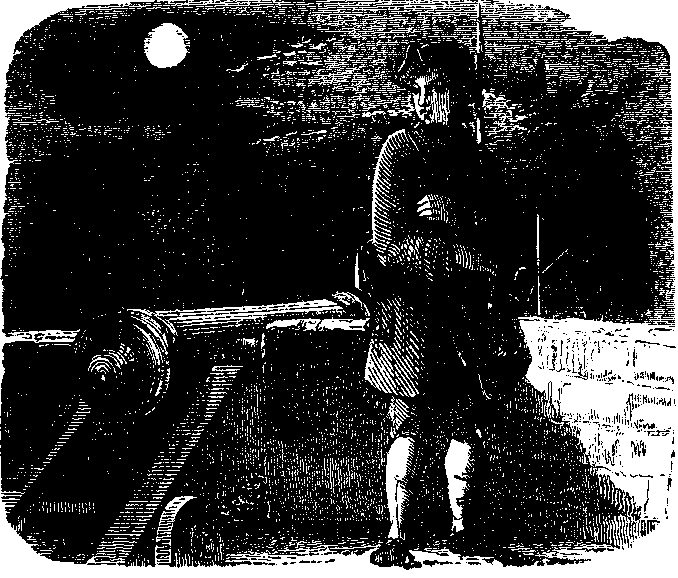
The pieces thus borrowed were eighteen pounders, all in excellent order and well mounted on suitable carriages. They were soon transported to Philadelphia and set up in their places on the battery, where they remained while the war lasted. A company was organized to mount guard there by day and night. Franklin himself was one of this guard, and he regularly performed his duty as a common soldier, in rotation with the rest. In fact, one secret of the great ascendency which he acquired at this time over all those who were in any way connected with him, was the unassuming and unpretending spirit which he manifested. He never sought to appropriate to himself the credit of what he did, but always voluntarily assumed his full share of all labors and sacrifices that were required.
[pg 291]
The members of the society of Friends were very numerous in Philadelphia at this time, and they held a controlling influence in the legislature. And inasmuch as the tenets of their society expressly forbade them to engage in war or war-like operations of any kind, no vote could be obtained in the legislature to provide for any military preparations. The Friends, however, were not disposed to insist so tenaciously upon their views as to be unwilling that others should act as they saw fit. It was even thought that many of them were willing to encourage and promote the measures which Franklin was pursuing for the defense of the province, so far as they could do so without directly violating their professed principles by acting personally in furtherance of them.
Various instances occurred of this tacit acquiescence on the part of the Friends in the defensive preparations which were going forward. It was proposed for example that the fire-company which has already been alluded to, should invest their surplus funds in lottery tickets, for the battery. The Friends would not vote for this measure, but a sufficient number of them absented themselves from the meeting to allow the others to carry it. In the legislature moreover, they would sometimes grant money “for the king's use” the tacit understanding being that the funds were to be employed for military purposes. At one time, before the question of appropriating the surplus funds of the fire company was disposed of, Franklin had an idea—which he proposed to one of his friends—of introducing a resolution at a meeting of the company, for purchasing a fire-engine with the money. “And then,” said he, “we will buy a cannon with it, for no one can deny that that is a fire-engine.”
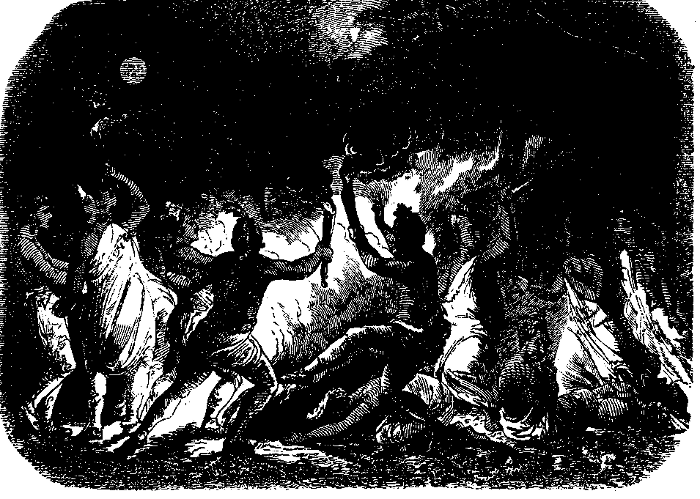
Soon after this Franklin went as a commissioner from the government, to make a treaty with a tribe of Indians at Carlisle, in the interior of Pennsylvania. On the night after the treaty was concluded, a great uproar was heard in the Indian camp, just without the town. The commissioners went to see what was the matter. They found that the Indians had made a great bonfire in the middle of the square around which their tents were pitched, and that all the company, men and women, were around it, shouting, quarreling and fighting. The spectacle of their dark colored bodies, half naked, and seen only by the gloomy light of the fire, running after and beating one another with firebrands, accompanied by the most unearthly yellings, presented a dreadful scene. The frenzy of the people was so great that there was no possibility of restraining it, and the commissioners were obliged to retire and leave the savages to themselves.
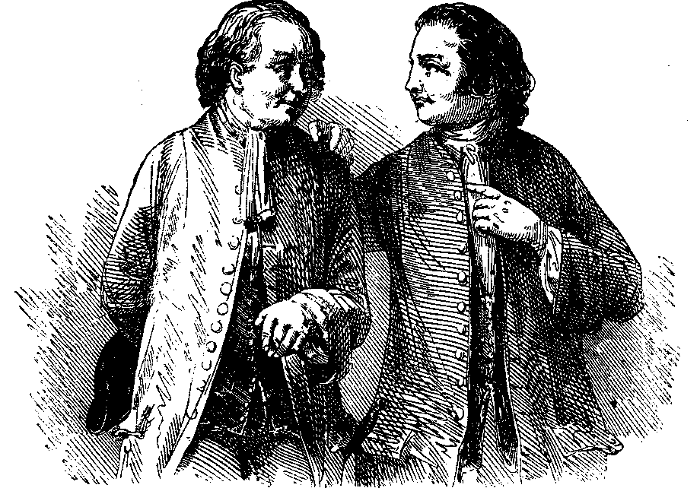
After this Franklin returned to Philadelphia and devoted his attention to a variety of plans for the improvement of the city, in all of which his characteristic ingenuity in devising means for the accomplishment of his plans, and his calm and quiet, but efficient energy in carrying them into effect, were as conspicuous as ever. One of the first enterprises in which he engaged was the founding of a hospital for the reception and cure of sick persons. The institution which he was the means of establishing has since become one of the most prominent and useful institutions of the country. He caused a petition to be prepared and presented to the Assembly, asking for a grant from the public funds in aid of this undertaking. The country members were at first opposed to the plan, thinking that it would mainly benefit the city. In order to diminish [pg 292] this opposition, Franklin framed the petition so as not to ask for a direct and absolute grant of the money that was required, but caused a resolve to be drawn up granting the sum of two thousand pounds from the public treasury on condition that the same sum should previously be raised by private subscription. Many of the members were willing to vote for this, who would not have voted for an unconditional donation; and so the vote was passed without much opposition.
After this the private subscriptions went on very prosperously; for each person who was applied to considered the conditional promise of the Assembly as an additional motive to give, since every man's donation would be doubled by the public grant, if the required amount was made up. This consideration had so powerful an influence that the subscriptions soon exceeded the requisite sum. Thus the hospital was founded.
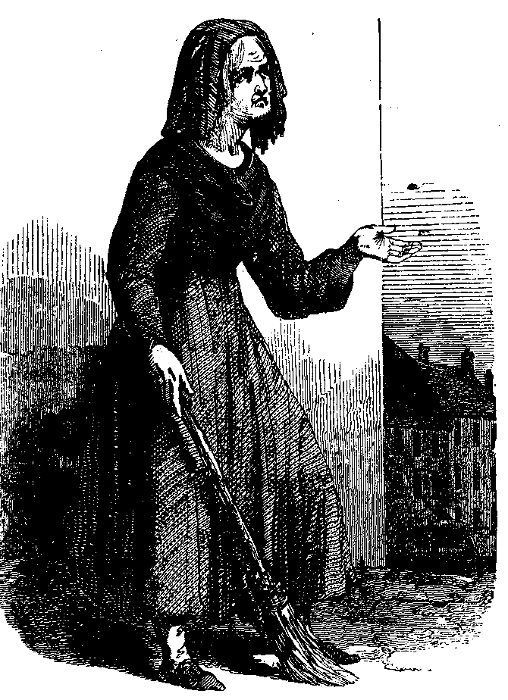
Franklin interested himself also in introducing plans for paving, sweeping and lighting the streets of the city. Before this time the streets had been kept in very bad condition. This was the case, in fact, at that period, in almost all cities—in those of Europe as well as those of America. In connection with this subject Franklin relates an incident that occurred when he was in London, which illustrates very strikingly both the condition of the cities in those days, and the peculiar traits of Franklin's character. It seems that he found one morning at the door of his lodgings a poor woman sweeping the pavement with a birch broom. She appeared very pale and feeble, as if just recovering from a fit of sickness. “I asked her,” says Franklin, “who employed her to sweep there.” “Nobody,” said she, “but I am poor and in distress, and I sweeps before gentlefolks' doors and hopes they will give me something.”
Instead of driving the poor woman away, Franklin set her at work to sweep the whole street clean, saying that when she had done it he would pay her a shilling. She worked diligently all the morning upon the task which Franklin had assigned her, and at noon came for her shilling. This incident, trifling as it might seem, led Franklin to a long train of reflections and calculations in respect to the sweeping of the streets of cities, and to the formation of plans which were afterward adopted with much success.
In the year 1755, Franklin became connected with the famous expedition of General Braddock in the western part of Pennsylvania, which ended so disastrously. A new war had broken out between the French and the English, and the French, who had long held possession of Canada, and had gradually been extending their posts down into the valley of the Mississippi, at length took possession of the point of confluence of the Monongahela and Alleghany rivers, where Pittsburg now stands. Here they built a fort, which they called Fort Du Quesne. From this fort, as the English allege, the French organized bands of Indians from the tribes which lived in the neighborhood, and made predatory incursions into the English colonies, especially into Pennsylvania. The English government accordingly sent General Braddock at the head of a large force, with instructions to march through the woods, take the fort, and thus put an end to these incursions.
General Braddock landed with his troops at a port in Virginia, and thence marched into Maryland on his way to Pennsylvania. He soon found himself in very serious difficulty, however, from being unable to procure wagons for the transportation of the military stores and other baggage which it was necessary to take with the army in going through such a wilderness as lay between him and fort Du Quesne. He had sent all about the country to procure wagons, but few could be obtained.
In the mean time the Assembly at Philadelphia made arrangements for Franklin to go to Maryland to meet General Braddock on his way, and give him any aid which it might be in his power to render. They were the more inclined to do this from the fact that for some time there had been a good deal of disagreement and contention between the colony of Pennsylvania and the government in England, and they had heard that General Braddock was much prejudiced against the Assembly on that account. They accordingly dispatched Franklin as their agent, to proceed to the camp and assure General Braddock of the desire of the Assembly to co-operate with him by every means in their power.
Franklin found when he reached the camp, that the general was in great trouble and perplexity for want of wagons, and he immediately undertook to procure them for him. He accordingly took a commission from the general for this purpose, and went at once to Lancaster, in Pennsylvania, and there issued circulars which he sent to all the farmers in the country, inviting [pg 293] them to bring their wagons to Lancaster, and offering them advantageous terms for the hire of them. These measures were perfectly successful. The wagons came in, in great numbers, and an abundant supply was speedily obtained. This success was owing partly to Franklin's sagacity in knowing exactly where to send for wagons, and what sort of inducements to offer to the farmers to make them willing to bring them out, and partly to the universal respect and confidence that was felt toward him personally, which led the farmers to come forward readily at his call and on his promise, when they would have been suspicious and distrustful of any offers which Braddock could have made them through any of the English officers under his command. A train of one hundred and fifty wagons, and two hundred and fifty carrying horses were very soon on their way to the camp.
Encouraged by the success of these measures, Franklin conceived of another plan to promote the comfort and welfare of Braddock's army. He procured a grant of money from the Assembly to be applied to purchasing stores for the subaltern officers, who, as he had learned, were very scantily supplied with the articles necessary for their comfort. With this money he purchased a supply of such commodities as he judged would be most useful in camp, such as coffee, tea, sugar, biscuit, butter, cheese, hams, &c., and dividing these stores into parcels, so as to make one for each officer in the army, he placed the parcels upon as many horses, and sent them to the camp. The supply intended for each officer made a load for one horse.
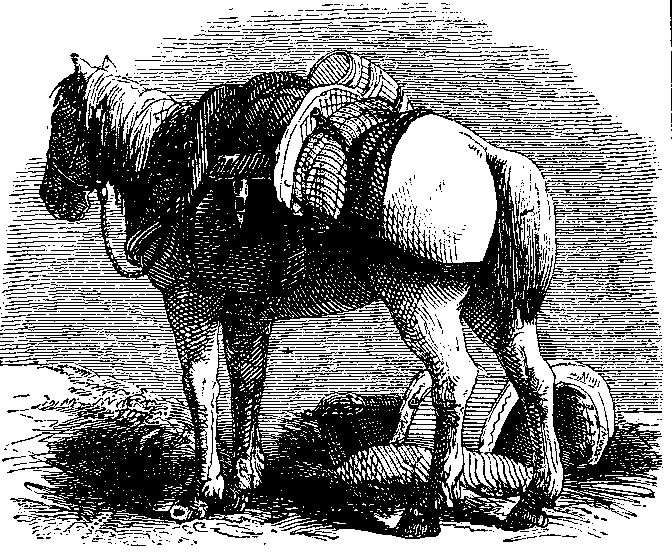
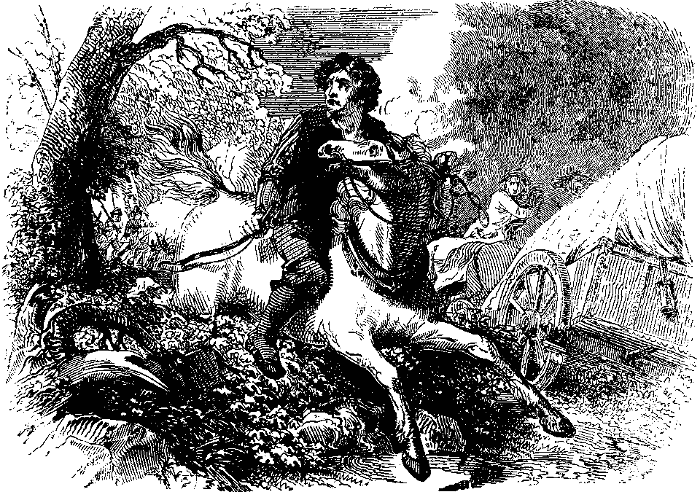
Notwithstanding all these efforts, however, to promote the success of Braddock's expedition, it was destined, as is well known, to come to a very disastrous end. Braddock allowed himself to fall into an ambuscade. Here he was attacked by the Indians with terrible fury. The men stood their ground as long as possible, but finally were seized with a panic and fled in all directions. The wagoners—men who had come from the Philadelphia farms in charge of the wagons that had been furnished in answer to Franklin's call—in making their escape, took each a horse out of his team, and galloped away, and thus the wagons themselves and all the provisions, ammunition, and military stores of every kind, fell into the hands of the enemy. Braddock himself was wounded, nearly half of the troops were killed, and the whole object of the expedition was completely frustrated. The wounded general was conveyed back about forty miles to the rear, and there, a few days afterward, he died.
Of course a feeling of great alarm was awakened throughout Pennsylvania as the tidings of this disaster were spread abroad. Every one was convinced that some efficient measures must at once he adopted to defend the country from the incursions of the French and Indians on the frontier. There was, however, a very serious difficulty in the way of taking such measures.
This difficulty was, an obstinate quarrel which had existed for a long time between the governor and the Assembly. The governor was appointed in England, and he represented the views and the interests of the English proprietors of the colony. The Assembly were elected by the people of the colony, and of course represented their interests and views. Now the proprietors had instructed the governor to insist that their property should not be subject to taxation; and to refuse his assent to all bills for raising money unless the property of the proprietors should be exempted. On the other hand the colonists maintained that the land belonging to the proprietors was as justly subject to taxation as any other property; and they refused to pass any bills for raising money unless the property of the proprietors was included. Thus nothing could be done.
This dispute had already been long protracted and both parties had become somewhat obstinate in their determination to maintain the ground which they had respectively taken. Even now [pg 294] when the country was in this imminent danger, it was some time before either side would yield, while each charged upon the other the responsibility of refusing to provide the means for the defense of the country.
At length, however, a sort of compromise was made. The proprietors offered to contribute a certain sum toward the public defense, and the Assembly consented to receive the contribution in lieu of a tax, and passed a law for raising money, exempting the proprietors' land from being taxed. The sum of sixty thousand pounds was thus raised, and Franklin was appointed one of the commissioners for disposing of the money.
A law was also enacted for organizing and arming a volunteer militia; and while the companies were forming, the governor persuaded Franklin to take command of the force, and proceed at the head of it to the frontier. Franklin was reluctant to undertake this military business, as his whole life had been devoted to entirely different pursuits. He, however, accepted the appointment, and undertook the defense of the frontier.
There was a settlement of Moravians about fifty or sixty miles from Philadelphia, at Bethlehem, which was then upon the frontier. Bethlehem was the principal settlement of the Moravians, but they had several villages besides. One of these villages, named Gnadenhütten, had just been destroyed by the Indians, and the whole settlement was in great alarm. Franklin proceeded to Bethlehem with his force, and having made such arrangements and preparations as seemed necessary there, he obtained some wagons for his stores, and set off on a march to Gnadenhütten. His object was to erect a fort and establish a garrison there.
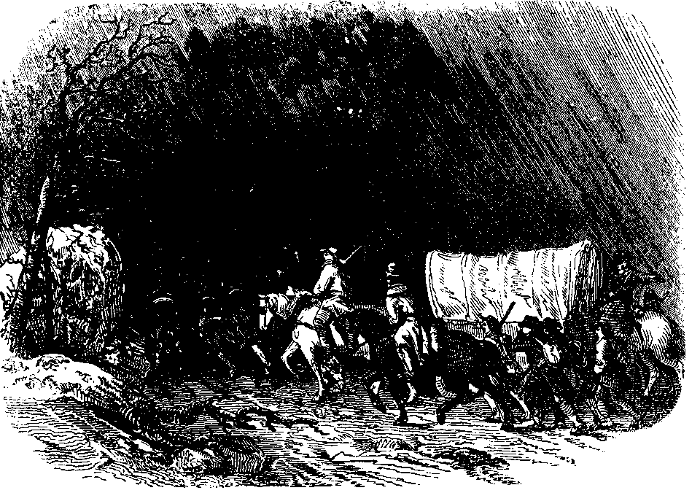
It was in the dead of winter, and before the column had proceeded many miles a violent storm of rain came on, but there were no habitations along the road, and no places of shelter; so the party were obliged to proceed. They went on toiling heavily through the mud and snow.
They were of course in constant danger of an attack from the Indians, and were the more apprehensive of this from the fact that on such a march they were necessarily in a very defenseless condition. Besides, the rain fell so continually and so abundantly that the men could not keep the locks of their muskets dry. They went on, however, in this way for many hours, but at last they came to the house of a solitary German settler, and here they determined to stop for the night. The whole troop crowded into the house and into the barn, where they lay that night huddled together, and “as wet,” Franklin says, “as water could make them.” The next day, however, was fair, and they proceeded on their march in a somewhat more comfortable manner.
They arrived at length at Gnadenhütten, where a most melancholy spectacle awaited them. The village was in ruins. The country people of the neighborhood had attempted to give the bodies of the murdered inhabitants a hurried burial; but they had only half performed their work, and the first duty which devolved on Franklin's soldiers was to complete the interment in a proper manner. The next thing to be thought of was to provide some sort of shelter for the soldiers; for they had no tents, and all the houses had been destroyed.
There was a mill near by, around which were several piles of pine boards which the Indians had not destroyed. Franklin set his troops at work to make huts of these boards, and thus in a short time his whole army was comfortably sheltered. All this was done on the day and evening of their arrival, and on the following morning the whole force was employed in commencing operations upon the fort.
The fort was to be built of palisades, and it was marked out of such a size that the circumference was four hundred and fifty-five feet. This would require four hundred and fifty-five palisades; for the palisades were to be formed of logs, of a foot in diameter upon an average, and eighteen feet long. The palisades were to be obtained from the trees in the neighborhood, and these trees were so tall that each tree would make three palisades. The men had seventy axes in all, and the most skillful and able woodmen in the company were immediately set at work to fell the trees. Franklin says that he was surprised to observe how fast these axmen would cut the trees down; and at length he had the curiosity to look at his watch when two men began to cut at a pine. They brought it down in six minutes; and on measuring it, where they had cut it off, Franklin found the diameter of the tree to be fourteen inches.
While the woodmen were cutting the palisades a large number of other laborers were employed in digging a trench all around the circumference [pg 295] of the fort to receive them. This trench was made about three feet deep, and wide enough to receive the large ends of the palisades. As fast as the palisades were cut they were brought to the spot, by means of the wagon wheels which had been separated from the wagon bodies for this purpose. The palisades were set up, close together, in the trench, and the earth was rammed in around them; thus the inclosure of the fort was soon completed.
A platform was then built all around on the inside, for the men to stand upon to fire through the loop holes which were left in the palisades above. There was one swivel gun, which the men had brought with them in one of the wagons. This gun they mounted in one corner of the fort, and as soon as they had mounted it they fired it, in order, as Franklin said, to let the Indians know, if any were within hearing, that they had such artillery.
There were Indians within hearing it seems; several bands were lurking in the neighborhood, secretly watching the movements of Franklin's command. This was found to be the case a short time after the fort was completed, for when Franklin found his army securely posted he sent out a party of scouts to explore the surrounding country to see if any traces of Indians could be found. These men saw no Indians, but they found certain places on the neighboring hills where it was evident that Indians had been lurking to watch the proceedings of the soldiers in building the fort. Franklin's men were much struck with the ingenious contrivance which the Indians had resorted to, in order to escape being observed while thus watching. As it was in the depth of the winter it was absolutely necessary for them to have a fire, and without some special precaution a fire would have betrayed them, by the light which it would emit at night, or the smoke which would rise from it by day. To avoid this, the Indians, they found, had dug holes in the ground, and made their fires in the bottoms of the holes, using charcoal only for fuel, for this would emit no smoke. They obtained the charcoal from the embers, and brands, and burnt ends of logs, which they found in the woods near by. The soldiers found by the marks on the grass around these holes that the Indians had been accustomed to sit around them upon the edges, with their feet below, near the fire.
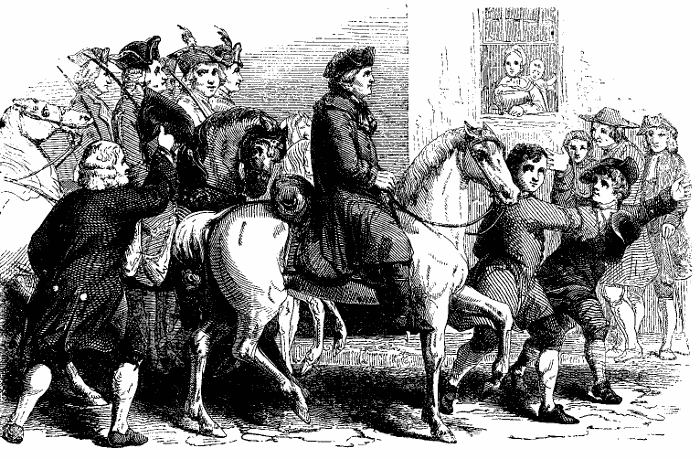
The building and arming of such a fort, and the other military arrangements which Franklin made on the frontier produced such an impression upon the Indians that they gradually withdrew, leaving that part of the country in a tolerably secure condition. Soon after this Franklin was summoned by the governor to return to Philadelphia, as his presence and counsel were required there. He found on his arrival that he had acquired great fame by the success of his military operations. In fact quite a distinguished honor was paid to him, soon after this time, on the occasion of his going to Virginia on some public business. The officers of the regiment resolved to escort him out of the town, on the morning when he was to commence his journey. He knew nothing of this project until just as he was coming forth, when he found the officers at the door, all mounted and dressed in their uniforms. Franklin says that he was a good deal chagrined at their appearing, as he could not avoid their accompanying him, though if he had known it beforehand he should have prevented it.
[pg 296]
While Franklin was thus acquiring some considerable military renown in America, he was becoming quite celebrated as a philosopher on the continent of Europe. It seems that some years before, the library society of Philadelphia had received some articles of electrical apparatus from England, and Franklin had performed certain experiments with them which led him to believe, what had not been known before, that lightning was an electrical phenomenon. He wrote some account of his experiments, and of the views which they had led him to entertain, and sent it to the person from whom the library society had received the apparatus. These papers attracted much attention, and were at length laid before the Royal Society of London, and soon afterward published in the transactions of the Society. In this form they were seen by a distinguished French philosopher, the Count de Buffon, who caused them to be be translated into the French language and published at Paris. By this means the attention of the whole scientific world was called to Franklin's speculations, and as the correctness of his views was fully established by subsequent investigations and experiments, he acquired great renown. He was elected a member of the various scientific societies, and the Royal Society of London sent him a magnificent gold medal.
This medal was brought to America to be delivered to Franklin by a new Governor, Captain Denny, who was about this time appointed over the colony of Pennsylvania. The course of public business had often brought Franklin and the former governor into conflict with each other; for the governor, as has already been said, represented the interests of the English proprietors of the colony, while Franklin espoused very warmly the cause of the people. The governor often sent messages and addresses to the Assembly censuring them for the course of proceeding which they had followed in reference to taxing the proprietors' lands, and the Assembly often appointed Franklin to draw up suitable replies. The new governor seems to have been pleased with having the medal intrusted to his charge, as he intended in commencing his administration, to do all in his power to propitiate Franklin, so as to secure the great influence which the philosopher had now begun to wield in the province, in his favor.
When Governor Denny arrived at Philadelphia and entered upon the duties of his office, he determined on giving a great entertainment to the people of Philadelphia, and to take that occasion for presenting Franklin with his medal. This he accordingly did; and he accompanied the presentation with an appropriate speech, in which he complimented Franklin in a very handsome manner for his scientific attainments, and spoke in flattering terms of the renown which he was acquiring in Europe. After the dinner, he took Franklin aside into a small room, leaving the general company still at the table, and entered into conversation with him in respect to the affairs of the province and the contemplated measures of his administration. He had been advised, he said, by his friends in England, to cultivate a good understanding with Franklin, as a man capable of giving him the best advice, and of contributing most effectually to making his administration easy. He said a great deal about the friendly feeling toward the colony which was entertained by the proprietors, and about the advantage which it would be to all concerned, and to Franklin in particular, if the opposition which had been made to the proprietor's views should be discontinued, and harmony restored between them and the people of the colony.
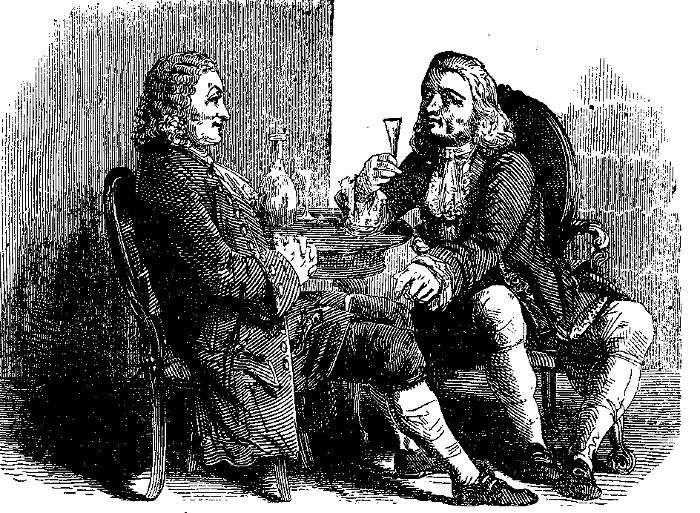
During all this time while the governor was plying his guest with these flatteries and promises, he was offering him wine and drinking his health; for the people at the dinner table, when they found that the governor did not return, [pg 297] sent a decanter of Madeira and some glasses into the room where he and Franklin were sitting. All these civilities and blandishments, however, on the part of the governor seem to have been thrown away. Franklin replied with politeness, but yet in such a manner as to evince a full determination to adhere faithfully to the cause of the colonists, in case any farther encroachments on their rights should be attempted.
In fact the breach between the people of the colony and the proprietors in England soon began to grow wider, under the administration of the new governor, than they had ever been before, until at length it was decided to send Franklin to England to lay a remonstrance and petition against the proceedings of the proprietors, before the king. Franklin accordingly took passage on board of a packet which was to sail from New York.
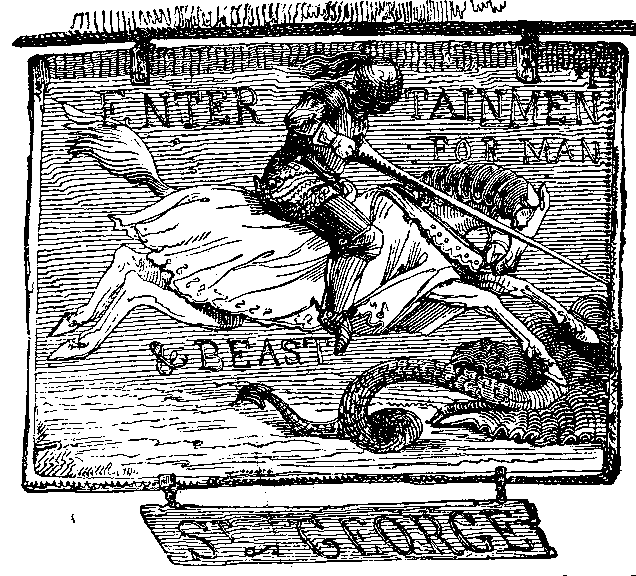
A great many embarrassments and delays, however, supervened before he finally set sail. In the first place, he was detained by certain negotiations which were entered into between Governors Loudoun of New York, and Denny of Philadelphia on the one part, and the Philadelphia Assembly on the other, in a vain attempt to compromise the difficulty, until the packet in which he had taken passage had sailed, carrying with her all the stores which he had laid in for the voyage. Next, he found himself detained week after week in New York by the dilatoriness and perpetual procrastination of Governor Loudoun, who kept back the packets as they came in, one after another, in order to get his dispatches prepared. He was always busy writing letters and dispatches, but they seemed never to be ready; so that it was said of him by some wags that he was like the figure of St. George upon the tavern signs, “who though always on horseback never rides on.”
After being detained in this way several weeks, it was announced that the packets were about to sail, and the passengers were all ordered to go on board. The packets proceeded to Sandy Hook, and there anchored to wait for the governor's final dispatches. Here they were kept waiting day after day for about six weeks, so that at last the passengers' stores were consumed, and they had to obtain a fresh supply; and one of the vessels became so foul with the incrustation of shells and barnacles upon her hull, that she required to be taken into dock and cleaned. At length, however, the fleet sailed, and Franklin, after various adventures, arrived safely one foggy morning at Falmouth in England.
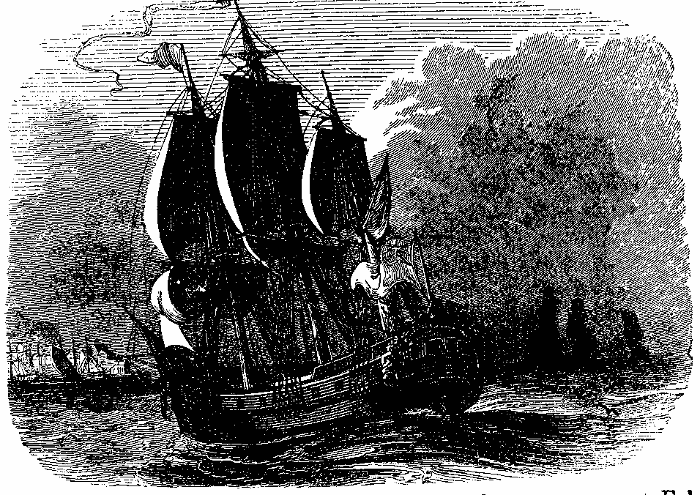
The vessel narrowly escaped shipwreck on the Scilly Islands as they were approaching the town of Falmouth. Although the wind was not violent, the weather was very thick and hazy, and there was a treacherous current drifting them toward the rocks as they attempted to pass by the island and gain the shore. There was a watchman stationed at the bow, whose duty it was to keep a vigilant look-out. This watchman was called to from time to time by an officer on the deck, “Look out well before there,” and he as often answered “Ay, ay;” but he neglected his duty, notwithstanding, being probably half asleep at his station; for suddenly all on deck were alarmed by an outcry, and looking forward they saw the light-house which stood upon the rocks, looming up close before them. The ship was immediately brought round by a kind of manœuvre considered very dangerous in such circumstances, but it was successful in this case, and thus they escaped the impending danger. The passengers were all aware of the peril they were in, and many of them were exceedingly alarmed. In fact, the shipmaster and the seamen considered it a very narrow escape. If the ship had gone upon the rocks, the whole company would probably have perished.
It was Sunday morning and the bells were ringing for church when the passengers landed. Franklin with the others went to church immediately, with hearts full of gratitude to God, as he says, for the deliverance which they had experienced. He then went to his inn and wrote [pg 298] a letter to his family giving them an account of his voyage.
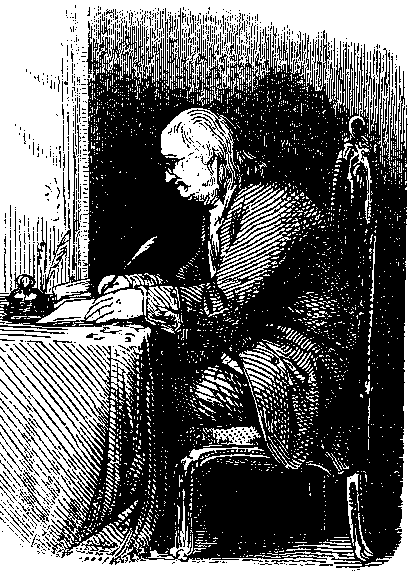
A few days after this he went up to London, and began to devote himself to the business of his agency.
He found, however, that he made very slow progress in accomplishing his object, for the ministry were so much engaged with other affairs, that for a long time he could not obtain a hearing. He however was not idle. He wrote pamphlets and articles in the newspapers; and every thing that he wrote was of so original a character, and so apposite, and was moreover expressed with so much terseness and point, that it attracted great attention and acquired great influence.
In fact, Franklin was distinguished all his life for the genius and originality which he displayed in expressing any sentiments which he wished to inculcate upon mankind. One of the most striking examples of this is the celebrated Parable against persecution of which he is generally considered the author; it is as follows:
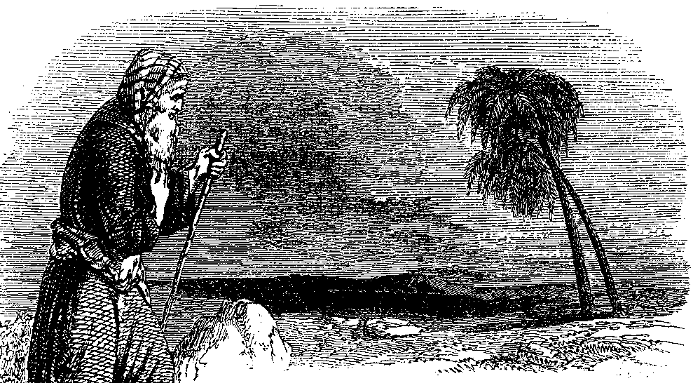
And it came to pass after these things, that Abraham sat in the door of his tent, about the going down of the sun.
2. And behold, a man, bowed with age, came from the way of the wilderness, leaning on a staff.
3. And Abraham arose and met him, and said unto him, “Turn in, I pray thee, and wash thy feet, and tarry all night, and thou shalt arise early on the morrow, and go on thy way.”
4. But the man said, “Nay, for I will abide under this tree.”
5. And Abraham pressed him greatly; so he turned, and they went into the tent, and Abraham baked unleavened bread, and they did eat.
6. And when Abraham saw that the man blessed not God, he said unto him, “Wherefore dost thou not worship the most high God, Creator of heaven and earth?”
7. And the man answered and said, “I do not worship the God thou speakest of, neither do I call upon his name; for I have made to myself a god, which abideth alway in mine house, and provideth me with all things.”
8. And Abraham's zeal was kindled against the man, and he arose and fell upon him, and drove him forth with blows into the wilderness.
9. And at midnight God called unto Abraham, saying, “Abraham, where is the stranger?”
10. And Abraham answered and said, “Lord, he would not worship thee, neither would he call upon thy name; therefore have I driven him out from before my face into the wilderness.”
11. And God said, “Have I borne with him these hundred ninety and eight years, and nourished him, and clothed him, notwithstanding his rebellion against me; and couldst not thou, that art thyself a sinner, bear with him one night?”
This parable, the idea of which Franklin probably obtained from some ancient Persian books, he wrote out and committed to memory, and he used to amuse himself sometimes by opening the Bible, and repeating the parable as if he were reading it from that book; and he found, he said, that very few auditors were sufficiently acquainted with the contents of the sacred volume to suspect the deception.
He often expressed the sentiments which he wished to inculcate, in some unusual and striking form, as in this instance. His conversation assumed somewhat the same character, so that wherever he was, his sayings and doings always attracted great attention.
In respect to this parable on persecution, although it is generally considered as the production of Franklin, it was never really claimed as such by him. In fact, Franklin himself did not publish it. It was published without his knowledge, by a friend of his in Scotland, the celebrated Lord Kames, who inserted it in a volume of his writings, saying it was “furnished to him” by Franklin. Lord Kames resided in Scotland, and Franklin became acquainted with him during a visit which he made to that country in the summer of 1759. Lord Kames became very greatly interested in Franklin's character, and a warm friendship and constant correspondence was kept up between the two philosophers for many years, as long, in fact, as Lord Kames lived; for Franklin was the survivor.
[pg 299]
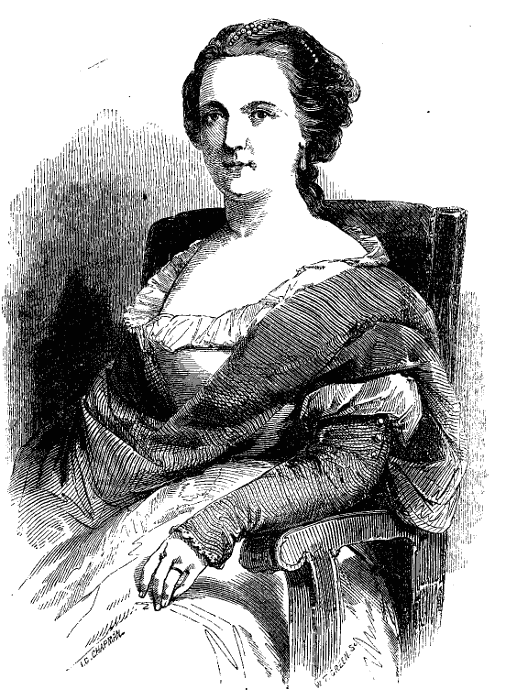
Franklin's residence while he was in London was in Craven-street, near the Strand, at the house of a Mrs. Stevenson. This house is still commemorated in the London Guide Books, among other places of historical interest in the metropolis, on account of its having been the home of the distinguished philosopher so long. Franklin lived on very friendly terms with Mrs. Stevenson and her family, while he remained in her house, and he interested himself in the studies and instruction of her daughter. At the same time he kept up a constant and familiar correspondence with his wife and family at home. One of his sons was with him during his residence in England having accompanied him when he came over. His friends were very desirous that he should send for his wife to come to England too, and more especially his daughter Sally, who was a very attractive and agreeable young lady, just arrived to years of woman-hood. One of Franklin's most intimate friends, Mr. Strahan, a member of Parliament, wrote to Mrs. Franklin very urgently requesting her to come to England with her daughter. Franklin himself, however, seems not to have seconded this proposition very strongly. He knew, in the first place, that his wife had an irresistible repugnance to undertaking a sea voyage, and then he was continually hoping that the long and weary negotiations in which he was engaged would be brought soon to an end, so that he could return himself to his native land.
At length, after an infinite variety of difficulties and delays, the object for which Franklin had been sent to England was in the main accomplished. It was decided that the lands of the proprietors should be taxed as well as the property of the colonists. There were several other measures which he had been desirous of securing, which he found then impracticable. Still his object in the main was accomplished, and the Assembly were well satisfied with what he had done. He accordingly concluded to return to America.
He left England about the end of August, in 1762, in company with ten sail of merchant ships under convoy of a man-of-war. They touched at Madeira on the passage, where they were very kindly received by the inhabitants, and Franklin was very much interested in the observations which he made on the island and its productions. After remaining on the island for a few days, and furnishing the ships with provisions and refreshments of all kinds, the ships sailed again. They proceeded southward until they reached the trade winds, and then westward toward the coast of America. All this time the weather was so favorable, and the water was so smooth, that there were very few days when the passengers could [pg 300] not visit from ship to ship, dining with each other on board the different vessels, which made the time pass very agreeably; “much more so,” as Franklin said, “than when one goes in a single ship, as this was like traveling in a moving village with all one's neighbors about one.”
He arrived at home on the 1st of November, after an absence of between five and six years. He found his wife and daughter well—the latter, as he says, grown to quite a woman, and with many amiable accomplishments, acquired during his absence. He was received too with great distinction by the public authorities and by the people of Philadelphia. The Assembly voted him twelve thousand pounds for his services, and also passed a vote of thanks, to be presented to him in public by the Speaker. His friends came in great numbers to see him and congratulate him on his safe return, so that his house for many days was filled with them. Besides these public and private honors bestowed upon himself, Franklin experienced an additional satisfaction also at this time on account of the distinction to which his son was attaining. His son had been appointed Governor of New Jersey just before his father left England, and he remained behind when his father sailed, in order to be married to a very agreeable West India lady to whom he had proposed himself, with his father's consent and approbation. The young governor and his bride arrived in Philadelphia a few months after Franklin himself came home. Franklin accompanied his son to New Jersey, where he had the pleasure of seeing him warmly welcomed by people of all ranks, and then left him happily established in his government there.
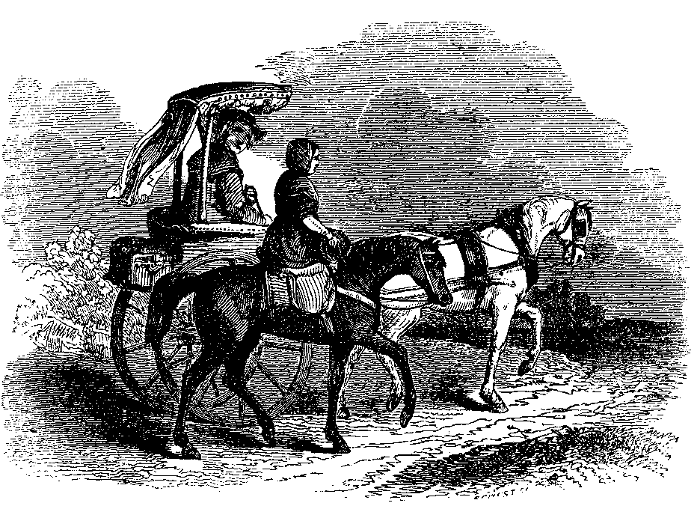
Soon after this Franklin, who still held the office of postmaster for the colonies, turned his attention to the condition of the post-office, and concluded to make a tour of inspection with reference to this business in all the colonies north of Philadelphia. He took his daughter with him on this journey, although it was likely to be a very long and fatiguing one. He traveled in a wagon, accompanied by a saddle horse. His daughter rode on this horse for a considerable part of the journey. At the beginning of it she rode on the horse only occasionally; but, as she became accustomed to the exercise, she found it more and more agreeable, and on the journey home she traveled in this manner nearly all the way from Rhode Island to Philadelphia.
Not long after this time new Indian difficulties occurred on the frontiers, which called for the raising of a new military force to suppress them. A law was accordingly proposed in the Assembly for providing the necessary funds for this purpose by a tax. And now it was found that the question which Franklin had been sent to Europe to arrange, namely, the question of taxing the proprietary lands had not, after all, been so definitely settled as was supposed. The language of the law was this: “The uncultivated lands of the proprietaries shall not be assessed higher than the lowest rate at which any uncultivated lands belonging to the inhabitants shall be assessed;” and on attempting to determine the practical application of this language, it was found to be susceptible of two interpretations. The Assembly understood it to mean that the land of the proprietaries should not be taxed higher than that of any of the inhabitants, of the same quality. Whereas the governor insisted that the meaning must be that none of the proprietaries' land should be taxed any higher than the lowest and poorest belonging to any of the inhabitants. The language of the enactment is, perhaps, susceptible of either construction. It will certainly bear the one which the governor put upon it, and as he insisted, in the most absolute and determined manner, upon his view of the question, the Assembly were at length compelled to yield; for the terrible danger which impended over the colony from the Indians on the frontier would not admit of delay.
The people of the colony, though thus beaten in the contest and forced to submit, were by no means disposed to submit peaceably. On the contrary a very general feeling of indignation and resentment took possession of the community, and at length it was determined to send a petition to the King of Great Britain, praying him to dispossess the proprietaries of the power which they were so obstinately determined on abusing, and to assume the government of the colonies himself, as a prerogative of the crown. The coming to this determination on the part of the colony was not effected without a great deal of debate, and political animosity and contention, for the governor of course had a party on his side, and they exerted themselves to the utmost to prevent the adoption of the petition. It was, however, carried against all opposition. The Speaker of the Assembly [pg 301] however, refused to sign the bill when it was passed, and he resigned his office to avoid the performance of this duty, an act which would of course greatly please the proprietary party. The majority of the Assembly then elected Franklin Speaker, and he at once signed the bill. This proceeding made Franklin specially obnoxious to the proprietary party, and at the next election of members of the Assembly they made every possible effort in Franklin's district to prevent his being chosen. They succeeded. Franklin lost his election by about twenty-five votes out of four thousand. But though the proprietary interest was thus the strongest in Franklin's district, it was found when the new Assembly came together that the party that was opposed to them was in a majority of two-thirds; and in order to rebuke their opponents for the efforts which they had made to defeat Franklin in his district, they immediately passed a vote to send him to England again, as a special messenger, to present the petition which they had voted, to the king.
The animosity and excitement which attended this contest was of course extreme, and the character and the whole political course of Franklin, were assailed by his enemies with all the violence and pertinacity that characterize political contests of this kind at the present day. Franklin, however, bore it all very good-naturedly. Just before he sailed, after he had left Philadelphia to repair to the ship, which was lying some distance down the river, he wrote a very affectionate letter to his daughter to bid her farewell and give her his parting counsels. “You know,” said he, in this letter, “that I have many enemies, all, indeed, on the public account (for I can not recollect that I have in a private capacity given just cause of offense to any one whatever), yet they are enemies, and very bitter ones; and you must expect their enmity will extend in some degree to you, so that your slightest indiscretions will be magnified into crimes, in order the more sensibly to wound and afflict me. It is, therefore, the more necessary for you to be extremely circumspect in all your behavior, that no advantage may be given to their malevolence.” Then followed various counsels relating to her duty to her mother, her general deportment, her studies, and her obligations to the church. The church with which Franklin was connected was of the Episcopal denomination, and he took a great interest in its prosperity; though he manifested the same liberality and public spirit here as in all the other relations that he sustained. At one time, for example, it was proposed by certain members of the congregation to form a sort of colony, and build a new church in another place. A portion of the people opposed this plan as tending to weaken the mother church, but Franklin favored it, thinking that in the end the measure would have a contrary effect from the one they apprehended. He compared it to the swarming of bees, by which, he said, the comfort and prosperity of the old hive was increased, and a new and flourishing colony established to keep the parent stock in countenance. Very few persons, at that period, would have seen either the expediency or the duty of pursuing such a course in respect to the colonization of a portion of a church: though now such views are very extensively entertained by all liberal minded men, and many such colonies are now formed from thriving churches, with the concurrence of all concerned.
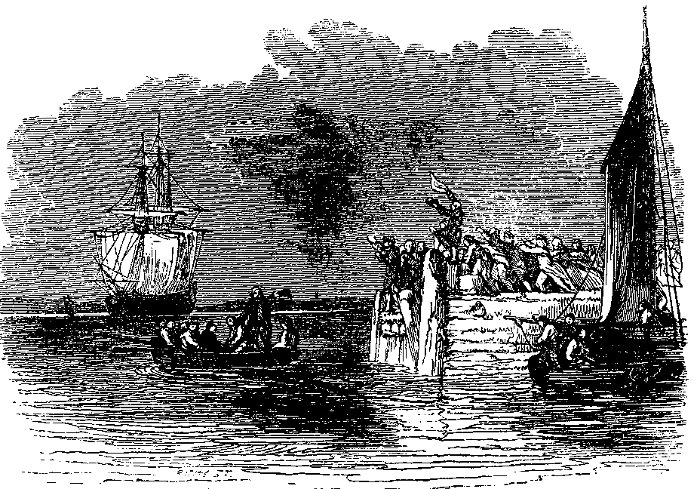
But to return to the voyage. Franklin was to embark on board his ship at Chester, a port situated down the river from Philadelphia, on the confines of the State of Delaware. A cavalcade of three hundred people from Philadelphia accompanied him to Chester, and a great company assembled upon the wharf, when the vessel was about to sail, to take leave of their distinguished countryman and wish him a prosperous voyage. The crowd thus assembled saluted Franklin with acclamations and cheers, as the boat which was to convey him to the vessel slowly moved away from the shore. The day of his sailing was the 7th of November, 1764, about two years after his return from his former visit.
[pg 302]
The voyage across the Atlantic was a prosperous one, notwithstanding that it was so late in the season. Franklin wrote a letter home to give his wife and daughter an account of his voyage, before he left the vessel. On landing he proceeded to London, and went directly to his old landlady's, at Mrs. Stevenson's, in Craven-street, Strand. When the news of his safe arrival reached Philadelphia, the people of the city celebrated the event by ringing the bells, and other modes of public rejoicing. The hostility which had been manifested toward him had operated to make him a greater favorite than ever.
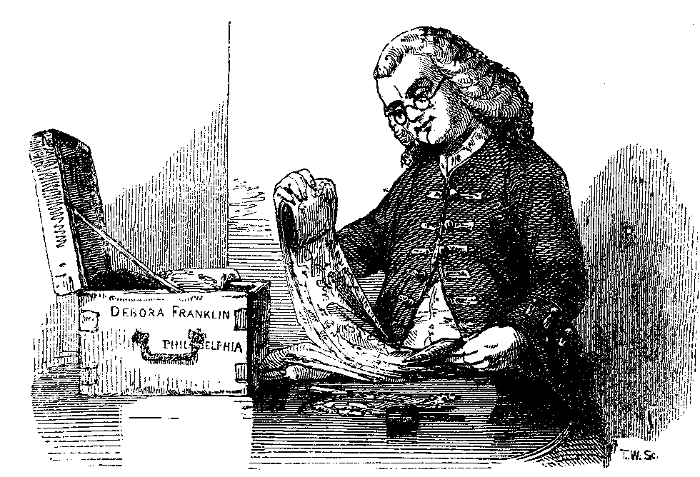
Franklin now began to turn his attention toward the business of his agency. He had not been long in England, however, before difficulties grew up between the colonies and the mother country, which proved to be of a far more serious character than those which had been discussed at Philadelphia. Parliament claimed the right to tax the colonies. The colonies maintained that their own legislatures alone had this right, and a long and obstinate dispute ensued. The English government devised all sorts of expedients to assess the taxes in such a way that the Americans should be compelled to pay them; and the Americans on their part met these attempts by equally ingenious and far more effectual contrivances for evading the payment. For a time the Americans refused to use any British commodities, in order that the people of England might see that by the persisting of the government in their determination to tax the colonies, they would lose a very valuable trade. Franklin joined in this effort, insomuch that for a long time he would not make purchases in England of any articles to send home to his family. At length the difficulty was in some measure compromised. One of the most obnoxious of the acts of Parliament for taxing America was repealed, and then for the first time Franklin purchased and sent home to his wife and daughter quite a trunk full of dresses—silks, satins, and brocade—with gloves, and bottles of lavender water, and other such niceties to fill the corners. He told her, in the letter which he sent with this trunk, that, as the Stamp Act was repealed, he was now willing that she should have a new gown.
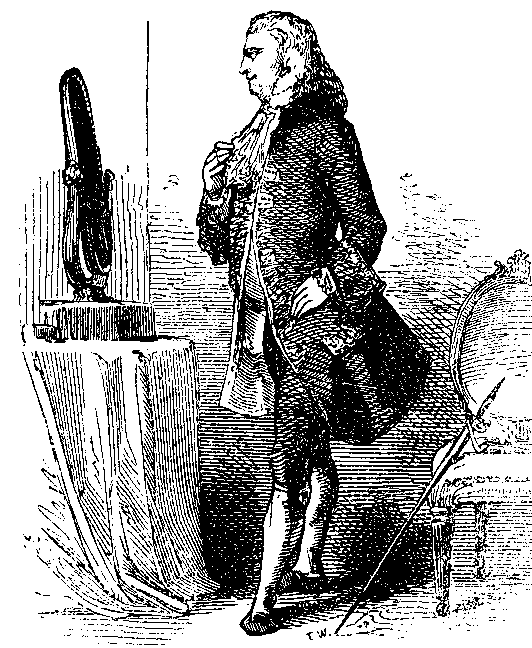
In fact the great philosopher's attention was attracted at this time in some degree to the effect of dress upon his own personal appearance, for on making a visit to Paris, which he did toward the close of 1767, he says that the French tailor and perruquier so transformed him as to make him appear twenty years younger than he really was.
Franklin received a great deal of attention while he was in Paris, and he seems to have enjoyed his visit there very highly. The most distinguished men in the walks of literature and science sought his society, for they all knew well his reputation as a philosopher; and many of them had read his writings and had repeated the experiments which he had made, and which had awakened so deep an interest throughout the whole learned world. Franklin received too, many marks of distinction and honor from the public men of France—especially from those who were connected with the government. It was supposed that they had been watching the progress of the disputes between England and her colonies, and secretly hoping that these disputes might end in an open rupture; for such a rupture they thought would end in weakening the power of their ancient rival. Sympathizing thus with the party in this contest which Franklin represented, they naturally felt a special interest in him. Franklin was presented at court, and received into the most distinguished society in the metropolis.
After a time he returned again to England, but he found when he arrived there that the state of things between the English government and the [pg 303] American colonies was growing worse instead of better. Parliament insisted on its right “to bind the colonies,” as their resolve expressed it, “in all cases whatsoever.” The Americans, on the other hand, were more and more determined to resist such a claim. Parliament adopted measures more and more stringent every day, to compel the colonies to submit. They passed coercive laws; they devised ingenious modes of levying taxes; they sent out troops, and in every possible way strengthened the military position of the government in America. The colonists, on the other hand, began to evince the most determined spirit of hostility to the measures of the mother country. They held great public assemblages; they passed violent resolves; they began to form extensive and formidable combinations for resisting or evading the laws. Thus every thing portended an approaching conflict.
Franklin exerted all his power and influence for a long time in attempting to heal the breach. He wrote pamphlets and articles in the newspapers in England defending, though in a tone of great candor and moderation, the rights of America, and urging the ministry and people of England not to persist in their attempts at coercion. At the same time he wrote letters to America, endeavoring to diminish the violence of the agitation there, in hopes that by keeping back the tide of excitement and passion which was so rapidly rising, some mode of adjustment might be found to terminate the difficulty. All these efforts were, however, in vain. The quarrel grew wider and more hopeless every day.
About this time the administration of the colonial affairs for the English government was committed to a new officer, Lord Hillsborough, who was now made Secretary of State for America; and immediately new negotiations were entered into, and new schemes formed, for settling the dispute. Two or three years thus passed away, but nothing was done. At length Lord Hillsborough seems to have conceived the idea of winning over Franklin's influence to the side of the English government by compliments and flattering attentions. He met him one morning in Dublin, at the house of the Lord-lieutenant of Ireland, where he paid him special civilities, and invited him in the most cordial manner to visit him at his country mansion at Hillsborough, in the north of England. Franklin was then contemplating a journey northward, and in the course of this journey he stopped at Hillsborough. He and his party were received with the greatest attention by his lordship, and detained four days, during which time Franklin was loaded with civilities.
If these attentions were really designed to make Franklin more manageable, as the representative of the colonies in the contest that was going on, they wholly failed of their object; for in the negotiations which followed, Franklin continued as firm and intractable as ever. In fact, not long after this, he came directly into conflict with Lord Hillsborough before the Board of Trade, when a certain measure relating to the colony—one which Lord Hillsborough strongly opposed, and Franklin as strenuously advocated—was in debate. At last after a long contest Franklin gained the day; and this result so changed his lordship's sentiments toward Franklin that for some time he treated him with marked rudeness. At one time Franklin called to pay his respects to Lord Hillsborough on a day when his lordship was holding a levee, and when there were a number of carriages at the door. Franklin's coachman drove up, alighted, and was opening the carriage for Franklin to dismount, when the porter came out, and in the most supercilious and surly manner rebuked the coachman for opening the door of the carriage before he had inquired whether his lordship was at home; and then turning to Franklin he said, “My lord is not at home.”
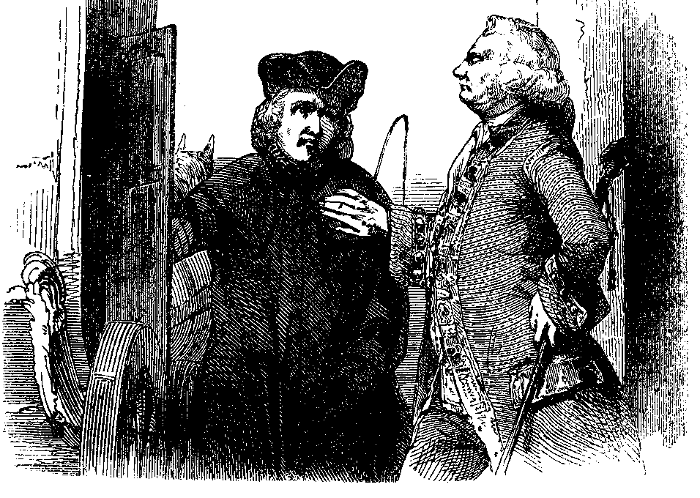
Lord Hillsborough, however, recovered from his resentment after this, in the course of a year; and at length on one occasion his lordship called upon Franklin in his room, and accosted him in a very cordial and friendly manner, as if no difficulty between them had ever occurred.
In the mean time the determination in America to resist the principle of the supremacy of Parliament over the colonies, became more and more extended. A disposition was manifested by the several colonies to combine their efforts for this end, and one after another of them sent out commissions to Franklin to act as their agent, as well as agent for Pennsylvania. Things went on in this way until a certain tragical affair occurred in Boston, known generally in American accounts of these events as the Boston massacre, which greatly increased the popular excitement among the people of the colonies.
[pg 304]
This massacre, as it was called, was the shooting of some persons in a crowd in State-street in Boston, by the British soldiers. It originated thus: A company of boys one day undertook to burn effigies of certain merchants who persisted in importing British goods and secretly selling them, thus taking sides as it were against their countrymen in the contest that was going on. While doing this a man whom they considered a spy and informer came by; and the boys, in some way or other, became involved in a quarrel with him. The man retreated to his house; the boys followed him and threw snow-balls and pieces of ice at the house when he had gone in. The man brought a gun to the window and shot one of the boys dead on the spot.
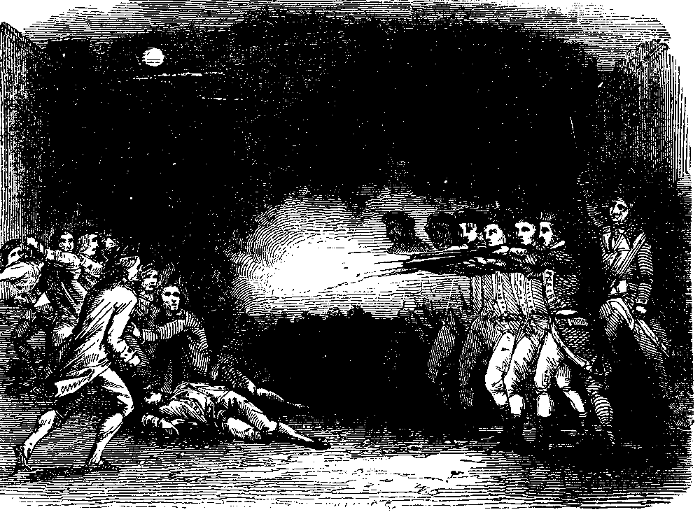
This of course produced a very intense excitement throughout the city. The soldiers naturally took part with those supposed to favor British interests; this exasperated the populace against them, and finally, after various collisions, a case occurred in which the British officer deemed it his duty to order the troops to fire upon a crowd of people that were assembled to taunt and threaten them, and pelt them with ice and snow. They had been led to assemble thus, through some quarrel that had sprung up between a sentinel and one of the young men of the town. In the firing three men were killed outright, and two more were mortally wounded. The killing of these men was called a massacre, and the tidings of it produced a universal and uncontrollable excitement throughout the provinces.
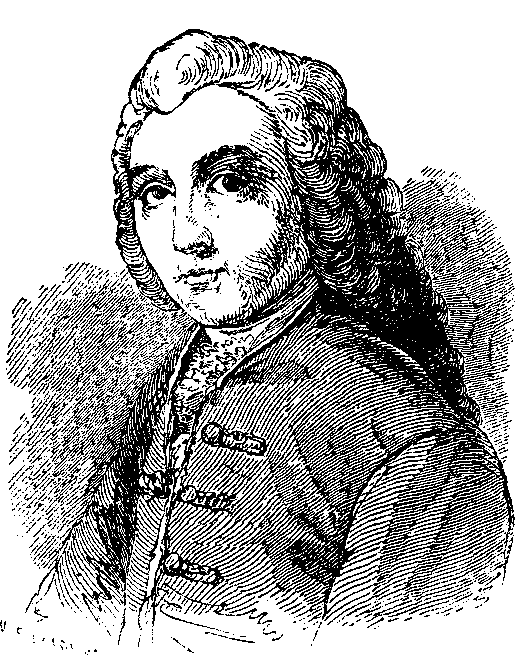
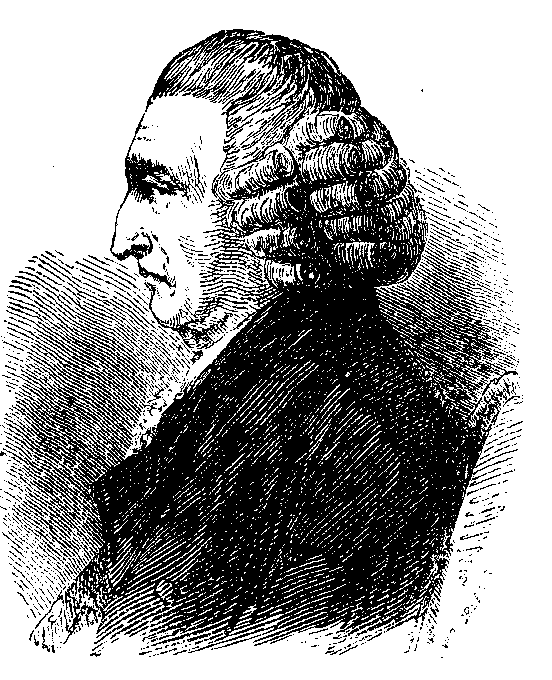
In proportion, however, as the spirit of resistance to British rule manifested itself in America, the determination became more and more firm and decided on the part of the British government not to yield. It is a point of honor with all governments, and especially with monarchical governments, not to give way in the slightest degree to what they call rebellion. There were, however, a few among the British statesmen who foresaw the impossibility of subduing the spirit which was manifesting itself in America, by any force which could be brought to bear upon so distant and determined a population. Lord Chatham was one of these; and he actually brought forward in Parliament, in 1775, just before the revolution broke out, a bill for withdrawing the troops from Boston as the first step toward a conciliatory course of measures. Franklin was present in Parliament, by Chatham's particular request, at the time when this motion was brought forward. In the speech which Lord Chatham made on this occasion, he alluded to Franklin, and spoke of him in the highest terms. The motion was advocated too, by Lord Camden, another of the British peers, [pg 305] who made an able speech in favor of it. On the other hand it was most violently opposed by other speakers, and Franklin himself was assailed by one of them in very severe terms. When the vote came to be taken, it was lost by a large majority; and thus all hope of any thing like a reconciliation disappeared.
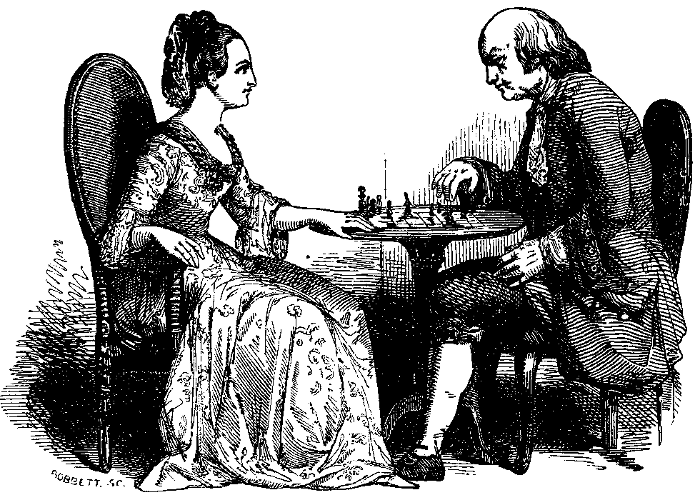
A great variety of ingenious devices were resorted to from time to time to propitiate Franklin, and to secure his influence in America, in favor of some mode of settling the difficulty, which would involve submission on the part of the colonies. He was for example quite celebrated for his skill in playing chess, and at one time he was informed that a certain lady of high rank desired to play chess with him, thinking that she could beat him. He of course acceded to this request and played several games with her. The lady was a sister of Lord Howe, a nobleman who subsequently took a very active and important part in the events of the revolution. It turned out in the end that this plan of playing chess was only a manœuvre to open the way for Franklin's visiting at Mrs. Howe's house, in order that Lord Howe himself might there have the opportunity of conferring with him on American affairs without attracting attention. Various conferences were accordingly held between Franklin and Lord Howe, at this lady's house, and many other similar negotiations were carried on with various other prominent men about this time, but they led to nothing satisfactory. In fact, the object of them all was to bring over Franklin to the British side of the question, and to induce him to exert his almost unlimited influence with the colonies to bring them over. But nothing of this sort could be done.
Ten years had now passed away since Franklin went to England, and it began to appear very obvious that the difficulties in which his mission had originated, could not be settled, but would soon lead to an open rupture between the colonies and the mother country. Franklin of course concluded that for him to remain any longer in England would be of no avail. He had hitherto exerted all his power to promote a settlement of the dispute, and had endeavored to calm the excitement of the people at home, and restrain them from the adoption of any rash or hasty measures. He now, however, gave up all hope of a peaceable settlement of the question, and returned to America prepared to do what lay in his power to aid his countrymen in the approaching struggle.
It was in May, 1775, that Franklin arrived in Philadelphia, just about the time that open hostilities were commenced between the colonies and the mother country. Though he was now quite advanced in age, being about seventy years old, he found himself called to the discharge of the most responsible and arduous duties. A Continental Congress had been summoned—to consist of delegates from all the colonies. Franklin was elected, on the next day after his arrival, as a member of this body, and he entered at once upon the discharge of the duties which his position brought upon him, and prosecuted them in the most efficient manner. In all the measures which were adopted by Congress for organizing and arming the country, he took a very prominent and conspicuous part. In fact so high was the estimation in which he was held, on account of his wisdom and experience, and the far-reaching sagacity which characterized all his doings, that men were not willing to allow any important business to be transacted without his concurrence; and at length, notwithstanding his advanced age, for he was now, as has been said, about seventy years old, they proposed to send him as a commissioner into Canada.
The province of Canada had not hitherto evinced a disposition to take part with the other colonies in the contest which had been coming on, and now Congress, thinking it desirable to secure the co-operation of that colony if possible, decided on sending a commission there to confer with the people, and endeavor to induce them to join the general confederation. Franklin was appointed at the head of this commission. He readily consented to accept the appointment, though for a man of his years the journey, long as it was, and leading through such a wilderness as then intervened, was a very formidable undertaking. So few were the facilities for traveling in those days that it required five or six weeks to make the journey. The commissioners left Philadelphia on the 20th of March, and did not reach Montreal until near the end of April. In fact after commencing the journey, and finding how fatiguing and how protracted it was likely to be, Franklin felt some doubt whether he should ever live to return; and when he reached Saratoga [pg 306] he wrote to a friend, saying that he began to apprehend that he had undertaken a fatigue which at his time of life might prove too much for him; and so he had taken paper, he said, to write to a few friends by way of farewell.
He did, however, safely return, after a time, though unfortunately the mission proved unsuccessful. The Canadians were not disposed to join the confederation.
At length early in the spring of 1776 the leading statesmen of America came to the conclusion that the end of the contest in which they were engaged must be the absolute and final separation of the colonies from the mother country, and the establishment of an independent government for America. When this was resolved upon, a committee of five members of Congress, namely Jefferson, Adams, Franklin, Sherman, and Livingston, were appointed a committee to prepare a declaration of independence. The original resolution, on the basis of which the appointment of this committee was made, was as follows:
“Resolved, That these united colonies are and of right ought to be free and independent states, and that all political connection between them and Great Britain is, and of right ought to be totally dissolved.”
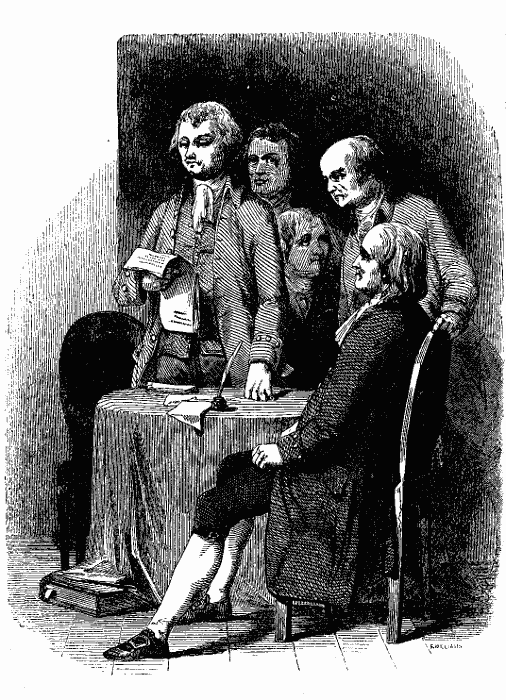
This resolution was first proposed and debated on the 8th of June. Some of the provinces were however found to be not quite prepared for such a measure, and so the debate was adjourned. The vote was finally taken on the 1st of July, and carried by a majority of nine out of thirteen colonies. Pennsylvania and South Carolina were against it; Delaware was divided; and New York did not vote, on account of some informality in the instructions of her delegates.
In the mean time the committee had proceeded to the work of drawing up the declaration of independence. Jefferson was appointed to write the document, and he, when he had prepared his draft, read it in committee meeting for the consideration of the other members. The committee approved the draft substantially as Jefferson had written it, and it was accordingly reported to Congress and was adopted by the vote of all the colonies.
For by the time that the final and decisive vote was to be taken, the delegates from all the colonies had received fresh instructions from their constituents, or fresh intelligence in respect to the state of public sentiment in the communities which they represented, so that at last the concurrence of the colonies was unanimous in the act of separation; and all the members present on the 4th of July, the day on which the declaration was passed, excepting one, signed the paper; thus making themselves individually and personally responsible for it, under the awful pains and penalties of treason.
[pg 307]
In connection with these discussions in relations to the declaration of independence, a curious instance is preserved of the tone of good humor and pleasantry which always marked the intercourse which Franklin held with others, even in cases where interests of the most momentous importance were concerned. When Jefferson had read his draft in the presence of the committee, the several members had various suggestions to make, and amendments to propose, as is usual in such cases; while the author, as is also equally usual, was very sensitive to these criticisms, and was unwilling to consent to any changing of his work. At length Jefferson appearing to be quite annoyed by the changes proposed, Franklin consoled him by saying that his case was not quite so bad, after all, as that of John Thompson, the hatter. “He wrote a sign,” said Franklin, “to be put up over his door, which read thus, ‘John Thompson makes and sells hats for ready money.’ On showing his work to his friends they one and all began to amend it. The first proposed to strike out ‘for ready money,’ since it was obvious, he said, that if a hatter sold hats at all he would be glad to sell them for ready money. Another thought the words ‘makes and sells hats,’ superfluous—that idea being conveyed in the word ‘hatter;’ and finally a third proposed to expunge the ‘hatter,’ and put the figure of a hat after the name, instead, which he said would be equally well understood, and be more striking. Thus the composition was reduced from ‘John Thompson, hatter, makes and sells hats for ready money,’ to simply ‘John Thompson,’ with the figure of a hat subjoined.” The whole story was perhaps fabricated by Franklin on the spot, for the occasion. It answered its purpose, however, perfectly. Jefferson laughed, and his good-humor was restored.
In the mean time during the summer of 1776 the hostile operations which had been commenced between the new government and the parent state were prosecuted on both sides with great vigor. Great Britain however did not yet give up all hope of persuading the revolted provinces to return. The English government sent out Lord Howe with instructions to communicate with the leading men in America and endeavor to effect some accommodation of the difficulty. When Lord Howe arrived in this country he attempted to open communications with the Americans through Franklin, but insuperable difficulties were encountered at the outset. Lord Howe could only treat with the American authorities as private persons in a state of rebellion, and the offers he made were offers of pardon. The American government indignantly rejected all such propositions. In a letter which he wrote in reply to Lord Howe Franklin says, “Directing pardons to be offered to the colonies, who are the very parties injured, expresses indeed that opinion of our ignorance, baseness, and insensibility, which your uninformed and proud nation has long been pleased to entertain of us: but it can have no other effect than that of increasing our resentment.” Of course all hope of an accommodation was soon abandoned, and both parties began to give their whole attention to the means for a vigorous prosecution of the war.
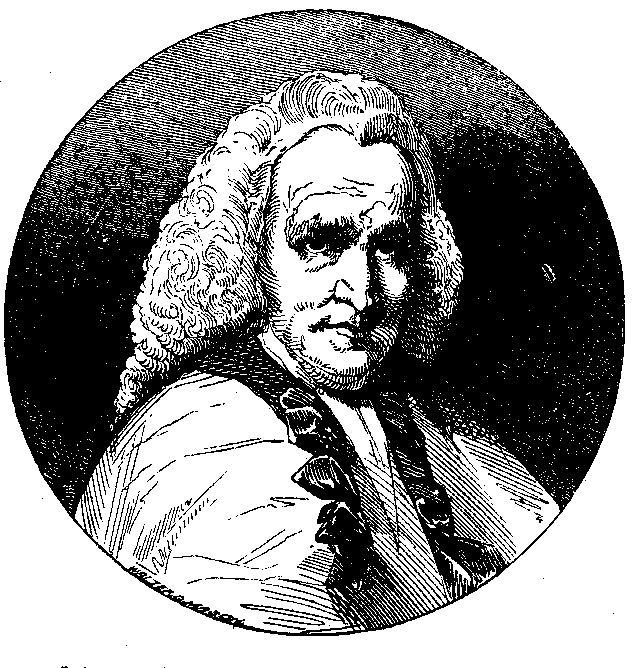
The American government soon turned their thoughts to the subject of forming some foreign alliance to help them in the impending struggle; and they presently proposed to send Franklin to France to attempt to open a negotiation for this purpose with the government of that country. Franklin was now very far advanced in life and his age and infirmities would naturally have prompted him to desire repose—but he did not decline the duty to which he was thus called; and all aged men should learn from his example that they are not to consider the work of life as ended, so long as any available health and strength remain.
Franklin arrived in Paris in the middle of winter in 1776. He traveled on this expedition wholly as a private person, his appointment as commissioner to the court of France having been kept a profound secret, for obvious reasons. He however, immediately entered into private negotiations with the French ministry, and though he found the French government disposed to afford the Americans such indirect aid as could be secretly rendered, they were not yet willing to form any alliance with them, or to take any open ground in their favor. While this state of things continued, Franklin, of course, and his brother commissioners could not be admitted to the French court; but though they were all the time in secret communication with the government, they assumed the position at Paris of private gentlemen residing at the great capital for their pleasure.
Notwithstanding his being thus apparently in private life, Franklin was a very conspicuous object of public attention at Paris. His name and fame had been so long before the world, and his character and manners were invested with so singular a charm, that he was universally known and admired; all ranks and classes of people were full of enthusiasm for the venerable American philosopher. Pictures, busts, and medallions of the illustrious Franklin were met on every hand. He was received into the very highest [pg 308] society, being welcomed by all circles with the greatest cordiality and interest.
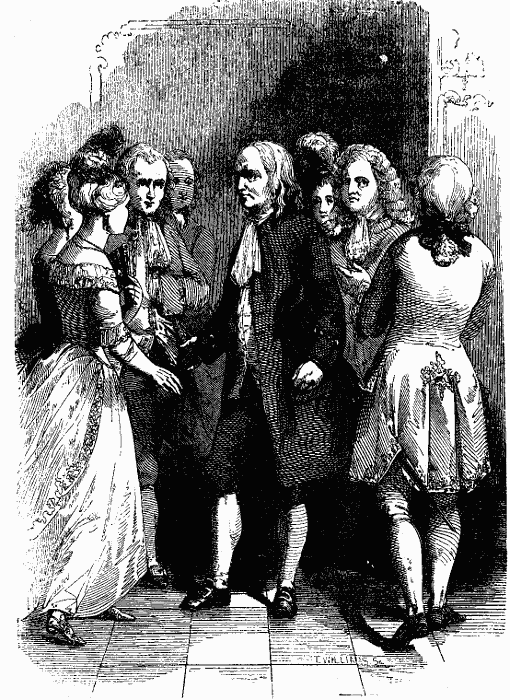
At length, after the lapse of about a year, the progress of the Americans in making good their defense against the armies of the mother country was so decided, that it began to appear very probable that the independence of the country would be maintained, and the French government deemed that it would be safe for them to enter into treaties of commerce and friendship with the new state. This was accordingly done in February, 1778, though it necessarily involved the consequence of a war with England.
When these treaties were at length signed, Franklin and the two other commissioners were formally presented at court, where they were received by the French monarch as the acknowledged representatives of an independent and sovereign power, now for the first time taking her place among the nations of the earth. This was an event in the life of Franklin of the highest interest and importance, since the open negotiations of the American government by France made the success of the country, in its effort to achieve its independence, almost certain, and thus it was the seal and consummation of all that he had been so laboriously toiling to accomplish for fifty years. For we may safely say that the great end and aim of Franklin's life, the one object which he kept constantly in view, and to which all his efforts tended from the beginning to the end of his public career, was the security of popular rights and popular liberty against the encroachments of aristocratic prerogative and power; and the establishment of the independence of these United States, which he saw thus happily settled at last, sealed and secured this object for half the world.
As soon as the event of the acknowledgment of the independence of the United States of America, by the French government transpired, the whole subject of the conflict between the late colonies and the mother country assumed a new aspect before mankind. The British government became now more desirous than ever to contrive some means of settling the dispute without entirely losing so important a portion of their ancient dominion. A great many applications were made to Franklin, by the secret agents of the British government, with a view of drawing off the Americans from their alliance with the French, and making a separate peace with them. Franklin, however, would listen to no such proposals, but on the contrary, made them all known to the French government.
Another consequence of the recognition of American independence was that a large number of young French gentlemen desired to proceed to America and join the army there. Many of them applied to Franklin for commissions—more in fact than could possibly be received. Among [pg 309] those who were successful was the Marquis de La Fayette, then a young man, who came to this country with letters of recommendation from Franklin, and who afterward distinguished himself so highly in the war.
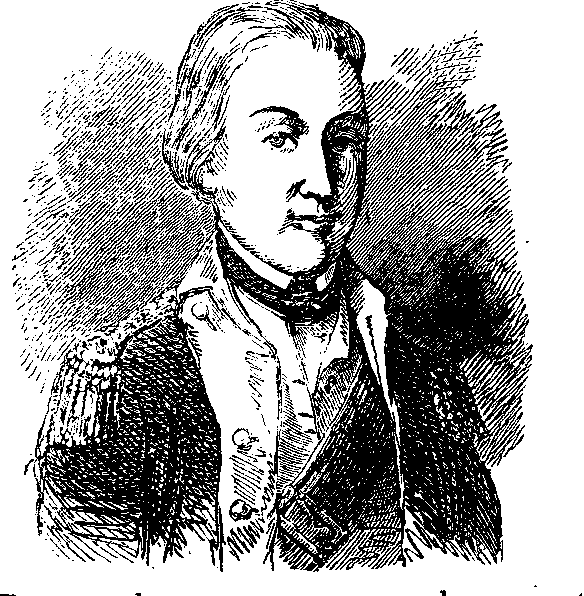
After this, Franklin remained in France for several years, at first as commissioner, and afterward as minister plenipotentiary of the government at the French court, during all which time the most arduous and the most responsible public duties devolved upon him. He concluded most important negotiations with other foreign powers. He received of the French government and transmitted to America vast sums of money to be used in the prosecution of the war. He conferred with various other commissioners and embassadors who were sent out from time to time from the government at home. In a word, there devolved upon him day by day, an uninterrupted succession of duties of the most arduous and responsible character.
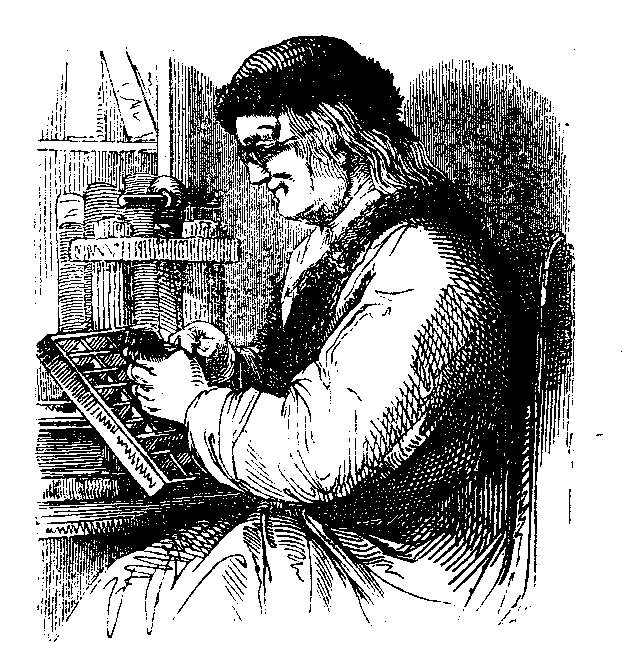
It is a curious illustration of the manner in which the tastes and habits of early life come back in old age, that Franklin was accustomed at this time, for recreation, to amuse himself with a little printing office, which he caused to be arranged at his lodgings—on a small scale it is true—but sufficiently complete to enable him to live his youth over again, as it were, in bringing back old associations and thoughts to his mind by giving himself up to his ancient occupations. The things that he printed in this little office were all trifles, as he called them, and were only intended for the amusement of his friends; but the work of producing them gave him great pleasure.
The time at length arrived when England began to conclude that it would be best for her to give up the attempt to reduce her revolted colonies to subjection again; and negotiations for peace were commenced at Paris, at first indirectly and informally, and afterward in a more open and decided manner. In these negotiations Franklin of course took a very prominent part. In fact the conclusion and signing of the great treaty of peace between Great Britain and the United States, by which the independence of this nation was finally and fully acknowledged, was the last crowning act of Franklin's official career. The treaty was signed in 1783, and thus the work of the great statesman's life was ended. His public life, in fact, began and ended with the beginning and the end of that great protracted struggle by which the American nation was ushered into being. His history is then simply the history of the establishment of American independence; and when this work was achieved his duty was done.
Soon after the peace was made, Franklin prepared to take leave of France, in order to return to his native land. He had contemplated a tour over the continent before going back to America, but the increasing infirmities of age prevented the realization of this plan. When the time arrived for leaving Paris, almost all the rank, fashion, and wealth of the city gathered around him to bid him farewell. He was borne in the queen's palanquin to Havre, and accompanied on the journey by numerous friends. From Havre he crossed the channel to Southampton, and there took passage in the London packet for Philadelphia.
The voyage occupied a period of forty-eight days, at the end of which time the ship anchored just below Philadelphia. The health-officer of the port went on board, and finding no sickness gave the passengers leave to land. The passengers accordingly left the ship in a boat, and landed at the Market-street wharf, where crowds of people were assembled, who received Franklin with loud acclamations, and accompanied him through the streets, with cheers and rejoicings, to his door.
In a word, the great philosopher and statesman, on his return to his native land, received the welcome he deserved, and spent the short period that still remained to him on earth, surrounded by his countrymen and friends, the object of universal respect and veneration. But great as was the veneration which was felt for his name and memory then, it is greater now, and it will be greater and greater still, at the end of every succeeding century, as long as any written records of our country's early history remain.
[pg 310]