Napoleon Bonaparte.2 The Syrian Expedition. By John S. C. Abbott. (continued 2)
Reading edition
The first gray of the morning was just appearing in the East, when the Turkish army was aroused by the tramp of the French columns, and by a shower of bomb-shells falling in the midst of their intrenchments. One of the most terrible battles recorded in history then ensued. The awful genius of Napoleon never shone forth more fearfully than on that bloody day. He stood upon a gentle eminence, calm, silent, unperturbed, pitiless, and guided, with resistless skill, the carnage. The onslaught of the French was like that of wolves. The Turks were driven like deer before them. Every man remembered that in that bay the proud fleet of France had perished. Every man felt that the kings of Europe had banded for the destruction of the French Republic. Every man exulted in the thought that there were but six thousand French Republicans to hurl themselves upon England, Russia, and Turkey combined, nearly twenty thousand strong. The Turks, perplexed and confounded by the skill and fury of the assault, were driven in upon each other in horrible confusion. The French, trained to load and fire with a rapidity which seemed miraculous, poured in upon them a perfect hurricane of bullets, balls, and shells. They were torn to pieces, mown down, bayoneted, and trampled under iron hoofs. In utter consternation, thousands of them plunged into [pg 328] the sea, horsemen and footmen, and struggled in the waves, in the insane attempt to swim to the ships, three miles distant from the shore. With terrible calmness of energy Napoleon opened upon the drowning host the tornado of his batteries, and the water was swept with grape-shot as by a hail-storm. The Turks were on the point of a peninsula. Escape by land was impossible. They would not ask for quarter. The silent and proud spirit of Napoleon was inflamed with the resolve to achieve a victory which should reclaim the name of Aboukir to the arms of France. Murat redeemed his pledge. Plunging with his cavalry into the densest throng of the enemy, he spurred his fiery steed, reckless of peril, to the very centre of the Turkish camp, where stood Mustapha Pacha, surrounded by his staff. The proud Turk had barely time to discharge a pistol at his audacious foe, which slightly wounded Murat, ere the dripping sabre of the French general severed half of his hand from the wrist. Thus wounded, the leader of the Turkish army was immediately captured, and sent in triumph to Napoleon. As Napoleon received his illustrious prisoner, magnanimously desiring to soothe the bitterness of his utter discomfiture, he courteously said, “I will take care to inform the Sultan of the courage you have displayed in this battle, though it has been your misfortune to lose it.” “Thou mayst save thyself that trouble,” the proud Turk haughtily replied. “My master knows me better than thou canst.”
Before 4 o'clock in the afternoon, the whole Turkish army was destroyed. Hardly an individual escaped. About two thousand prisoners were taken in the fort. All the rest perished, either drowned in the sea, or slain upon the land. Sir Sydney Smith, who had chosen the position occupied by the Turkish army, with the utmost [pg 329] difficulty avoided capture. In the midst of the terrible scene of tumult and death, the Commodore succeeded in getting on board a boat, and was rowed to his ships. More than twelve thousand corpses of the turbaned Turks were floating in the bay of Aboukir, beneath whose crimsoned waves, but a few months before, almost an equal number of the French had sunk in death. Such utter destruction of an army is perhaps unexampled in the annals of war. If God frowned upon France in the naval battle of Aboukir, He as signally frowned upon her foes in this terrific conflict on the land.
The cloudless sun descended peacefully, in the evening, beneath the blue waves of the Mediterranean. Napoleon stood at the door of his tent, calmly contemplating the scene, from whence all his foes had thus suddenly and utterly vanished. Just then Kleber arrived, with his division of two thousand men, for whom Napoleon had not waited. The distinguished soldier, who had long been an ardent admirer of Napoleon, was overwhelmed with amazement in contemplating the magnitude of the victory. In his enthusiasm he threw his arms around the neck of his adored chieftain, exclaiming, “Let me embrace you, my General, you are great as the universe.”
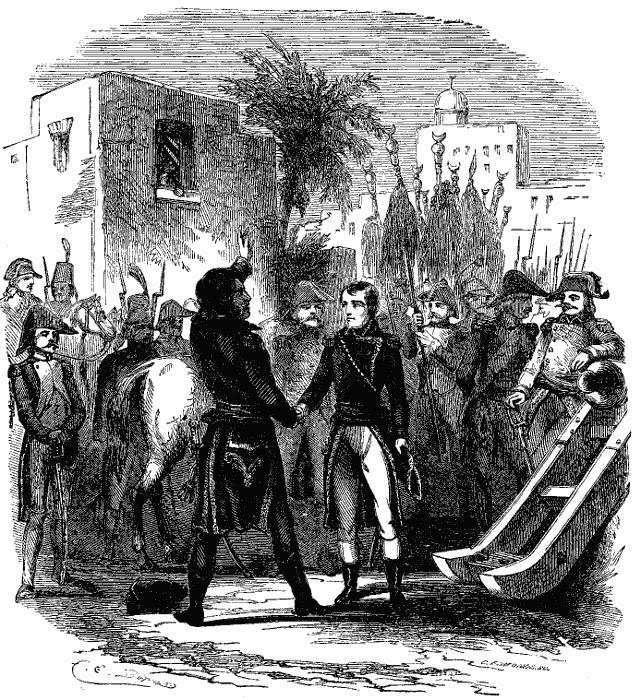
Egypt was now quiet. Not a foe remained to be encountered. No immediate attack, from any quarter, was to be feared. Nothing remained to be done but to carry on the routine of the administration of the infant colony. These duties required no especial genius, and could be very creditably performed by any respectable governor.
It was, however, but a barren victory which Napoleon had obtained, at such an enormous expenditure of suffering and of life. It was in vain for the isolated army, cut off, by the destruction of its fleet, from all intercourse with Europe, to think of the invasion of India. The French troops had exactly “caught the Tartar.” Egypt was of no possible avail as a colony, with the Mediterranean crowded with hostile English, and Russian, and Turkish cruisers. For the same reason, it was impossible for the army to leave those shores and return to France. Thus the victorious French, in the midst of all their triumphs, found that they had built up for themselves prison walls from which, though they could repel their enemies, there was no escape. The sovereignty of Egypt alone was too petty an affair to satisfy the boundless ambition of Napoleon. Destiny, he thought, deciding against an Empire in the East, was only guiding him back to an Empire in the West.
For ten months Napoleon had now received no certain intelligence respecting Europe. Sir Sydney Smith, either in the exercise of the spirit of gentlemanly courtesy, or enjoying a malicious pleasure in communicating to his victor tidings of disaster upon disaster falling upon France, sent to him a file of newspapers full of the most humiliating intelligence. The hostile fleet, leaving its whole army of eighteen thousand men, buried in the sands, or beneath the waves, weighed anchor and disappeared.
Napoleon spent the whole night, with intense interest, examining those papers. He learned that France was in a state of indescribable confusion; that the imbecile government of the Directory, resorting to the most absurd measures, was despised and disregarded; that plots and counter-plots, conspiracies and assassinations filled the land. He learned, to his astonishment, that France was again involved in war with monarchical Europe; that the Austrians had invaded Italy anew, and driven the French over the Alps; and that the banded armies of the European kings were crowding upon the frontiers of the distracted republic. “Ah!” he exclaimed to Bourrienne, “my forebodings have not deceived me. The fools have lost Italy. All the fruit of our victories has disappeared. I must leave Egypt. We must return to France immediately, and, if possible, repair these disasters, and save France from destruction.”
It was a signal peculiarity in the mind of Napoleon that his decisions appeared to be instinctive [pg 330] rather than deliberative. With the rapidity of the lightning's flash his mind contemplated all the considerations upon each side of a question, and instantaneously came to the result. These judgments, apparently so hasty, combined all the wisdom which others obtain by the slow and painful process of weeks of deliberation and uncertainty. Thus in the midst of the innumerable combinations of the field of battle, he never suffered from a moment of perplexity; he never hesitated between this plan and that plan, but instantaneously, and without the slightest misgivings, decided upon that very course, to which the most slow and mature deliberation would have guided him. This instinctive promptness of correct decision was one great secret of his mighty power. It pertained alike to every subject with which the human mind could be conversant. The promptness of his decision was only equaled by the energy of his execution. He therefore accomplished in hours that which would have engrossed the energies of other minds for days.
Thus, in the present case, he decided, upon the moment, to return to France. The details of his return, as to the disposition to be made of the army, the manner in which he would attempt to evade the British cruisers, and the individuals he would take with him, were all immediately settled in his mind. He called Bourrienne, Berthier, and Gantheaume before him, and informed them of his decision, enjoining upon them the most perfect secrecy, lest intelligence of his preparations should be communicated to the allied fleet. He ordered Gantheaume immediately to get ready for sea two frigates from the harbor of Alexandria, and two small vessels, with provisions for four hundred men for two months. Napoleon then returned with the army to Cairo. He arrived there on the 10th of August, and again, as a resistless conqueror, entered the city. He prevented any suspicion of his projected departure, from arising among the soldiers, by planning an expedition to explore Upper Egypt.
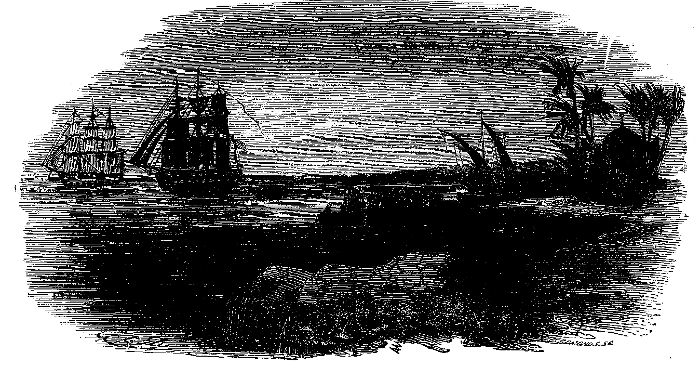
One morning he announced his intention of going down the Nile, to spend a few days in examining the Delta. He took with him a small retinue, and striking across the desert, proceeded with the utmost celerity to Alexandria, where they arrived on the 22d of August. Concealed by the shades of the evening of the same day, he left the town, with eight selected companions, and escorted by a few of his faithful guards. Silently and rapidly they rode to a solitary part of the bay, the party wondering what this movement could mean. Here they discovered, dimly in the distance, two frigates riding at anchor, and some fishing-boats near the shore, apparently waiting to receive them. Then Napoleon announced to his companions that their destination was France. The joy of the company was inconceivable. The horses were left upon the beach, to find their way back to Alexandria. The victorious fugitives crowded into the boats, and were rowed out, in the dim and silent night, to the frigates. The sails were immediately spread, and before the light of morning dawned, the low and sandy outline of the Egyptian shore had disappeared beneath the horizon of the sea.