Napoleon Bonaparte.2 The Syrian Expedition. By John S. C. Abbott.
Reading edition
Napoleon Bonaparte.2 The Syrian Expedition. By John S. C. Abbott.
Though, after the Battle of the Pyramids, Napoleon was the undisputed master of Egypt, still much was to be accomplished in pursuing the desperate remnants of the Mamelukes, and in preparing to resist the overwhelming forces which it was to be expected that England and Turkey would send against him. Mourad Bey had retreated with a few thousand of his horsemen into Upper Egypt. Napoleon dispatched General Desaix, with two thousand men, to pursue him. After several terribly bloody conflicts, Desaix took possession of all of Upper Egypt as far as the cataracts. Imbibing the humane and politic sentiments of Napoleon, he became widely renowned and beloved for his justice and his clemency. A large party of scientific men accompanied the military division, examining every object of interest, and taking accurate drawings of those sphinxes, obelisks, temples, and sepulchral monuments, which, in solitary grandeur, have withstood the ravages of four thousand years. To the present hour, the Egyptians remember with affection, the mild and merciful, yet efficient government of Desaix. They were never weary with contrasting it with the despotism of the Turks.
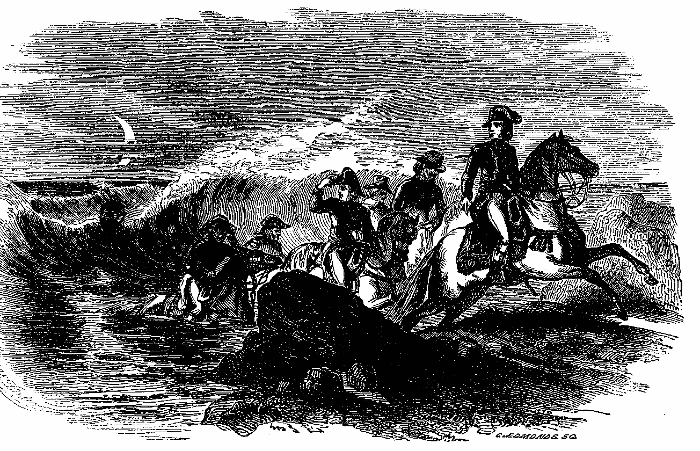
In the mean time Napoleon, in person, made an expedition to Suez, to inspect the proposed route of a canal to connect the waters of the Mediterranean with the Red Sea. With indefatigable activity of mind he gave orders for the construction of new works to fortify the harbor of Suez, and commenced the formation of an infant marine. One day, with quite a retinue, he made an excursion to that identical point of the Red Sea which, as tradition reports, the children of Israel crossed three thousand years ago. The tide was out, and he passed over to the Asiatic shore upon extended flats. Various objects of interest engrossed his attention until late in the afternoon, when he commenced his return. The twilight faded away, and darkness came rapidly on. The party lost their path, and, as they were wandering, bewildered among the sands, the rapidly returning tide surrounded them. The darkness of the night increased, and the horses floundered deeper and deeper in the rising waves The water reached the girths of the saddles, and dashed upon the feet of the riders, and destruction seemed inevitable. From this perilous position Napoleon extricated himself, by that presence of mind, and promptness of decision, which seemed never to fail him. It was an awful hour and an awful scene. And yet, amidst the darkness and the rising waves of apparently a shoreless ocean, the spirit of Napoleon was as unperturbed as if he were reposing in slippered ease upon his sofa. He collected his escort around him, in concentric circles, each horseman facing outward, and ranged in several rows. He then ordered them to advance, each in a straight line. When the horse of the leader of one of these columns lost his foothold, and began to swim, the column drew back, and followed in the direction of another column, which had not yet lost the firm ground. The radii, thus thrown out in every direction, were thus successively withdrawn, till all were following in the direction of one column, which had a stable footing. Thus escape was effected. The horses did not reach the shore until midnight, when they were wading breast deep in the swelling waves. The tide [pg 311] rises on that part of the coast to the height of twenty-two feet. “Had I perished in that manner, like Pharaoh,” said Napoleon, “it would have furnished all the preachers of Christendom with a magnificent text against me.”
England, animated in the highest degree by the great victory of Aboukir, now redoubled her exertions to concentrate all the armies of Europe upon Republican France. Napoleon had been very solicitous to avoid a rupture with the Grand Seignor at Constantinople. The Mamelukes who had revolted against his authority had soothed the pride of the Ottoman Porte, and purchased peace by paying tribute. Napoleon proposed to continue the tribute, that the revenues of the Turkish Empire might not be diminished by the transfer of the sovereignty of Egypt from the oppressive Mamelukes to better hands. The Sultan was not sorry to see the Mamelukes punished, but he looked with much jealousy upon the movements of a victorious European army so near his throne. The destruction of the French fleet deprived Napoleon of his ascendency in the Levant, and gave the preponderance to England. The agents of the British government succeeded in rousing Turkey to arms, to recover a province which the Mamelukes had wrested from her, before Napoleon took it from the Mamelukes. Russia also, with her barbaric legions, was roused by the eloquence of England, to rush upon the French Republic in this day of disaster. Her troops crowded down from the north to ally themselves with the turbaned Turk, for the extermination of the French in Egypt. Old enmities were forgotten, as Christians and Mussulmans grasped hands in friendship, forgetting all other animosities in their common hatred and dread of Republicanism. The Russian fleet crowded down from the Black Sea, through the Bosphorus, to the Golden Horn, where, amidst the thunders of artillery, and the acclamations of the hundreds of thousands who throng the streets of Constantinople, Pera, and Scutari, it was received into the embrace of the Turkish squadron. It was indeed a gorgeous spectacle as, beneath the unclouded splendor of a September sun, this majestic armament swept through the beautiful scenery of the Hellespont. The shores of Europe and Asia, separated by this classic strait, were lined with admiring spectators, as the crescent and the cross, in friendly blending, fluttered together in the breeze. The combined squadron emerged into the Mediterranean, to co-operate with the victorious fleet of England, which was now the undisputed mistress of the sea. Religious animosities the most inveterate, and national antipathies the most violent were reconciled by the pressure of a still stronger hostility to those principles of popular liberty which threatened to overthrow the despotism both of the Sultan and the Czar. The Grand Seignor had assembled an army of twenty thousand men at Rhodes. They were to be conveyed by the combined fleet to the shores of Egypt, and there effect a landing under cover of its guns. Another vast army was assembled in Syria, to march down upon the French by way of the desert, and attack them simultaneously with the forces sent by the fleet. England, and the emissaries of the Bourbons, with vast sums of money accumulated from the European monarchies, were actively co-operating upon the Syrian coast, by landing munitions of war, and by supplying able military engineers. The British Government was also accumulating a vast army in India, to be conveyed by transports up the Red Sea, and to fall upon the French in their rear. England also succeeded in forming a new coalition with Austria, Sardinia, Naples, and other minor European states to drive the French out of Italy, and with countless numbers to invade the territory of France. Thus it would be in vain for the Directory to attempt even to send succors to their absent general. And it was not doubted that Napoleon, thus assailed in diverse quarters by overpowering numbers, would fall an easy prey to his foes. Thus suddenly and portentously peril frowned upon France from every quarter.
Mourad Bey, animated by this prospect of the overthrow of his victorious foes, formed a widespread conspiracy, embracing all the friends of the Mamelukes and of the Turks. Every Frenchman was doomed to death, as in one hour, all over the land, the conspirators, with scimitar and poniard, should fall upon their unsuspecting foes. In this dark day of accumulating disaster the genius of Napoleon blazed forth with new and terrible brilliance.
But few troops were at the time in Cairo, for no apprehension of danger was cherished, and the French were scattered over Egypt, engaged in all plans of utility. At five o'clock on the morning of the 21st of October, Napoleon was awoke from sleep by the announcement that the city was in revolt, that mounted Bedouin Arabs were crowding in at the gates, that several officers and many soldiers were already assassinated. He ordered an aid immediately to take a number of the Guard, and quell the insurrection. But a few moments passed ere one of them returned covered with blood, and informed him that all the rest were slain. It was an hour of fearful peril. Calmly, fearlessly, mercilessly did Napoleon encounter it. Immediately mounting his horse, accompanied by a body of his faithful Guards, he proceeded to every threatened point. Instantly the presence of Napoleon was felt. A perfect storm of grape-shot, cannon-balls, and bomb-shells swept the streets with unintermitted and terrible destruction. Blood flowed in torrents. The insurgents, in dismay, fled to the most populous quarter of the city. Napoleon followed them with their doom, as calm as destiny. From the windows and the roofs the insurgents fought with desperation. The buildings were immediately enveloped in flames. They fled into the streets only to be hewn down with sabres and mown down with grape-shot. Multitudes, bleeding and breathless with consternation, sought refuge in the mosques. The mosques were battered down and set on fire, and the [pg 312] wretched inmates perished miserably. The calm yet terrible energy with which Napoleon annihilated “the murderers of the French,” sent a thrill of dismay through Egypt. A large body of Turks, who had surprised and assassinated a party of the French, intrenched themselves in a small village. Their doom was sealed. The next day a long line of asses, heavily laden with sacks, was seen entering the gates of Cairo. The mysterious procession proceeded to the public square. The sacks were opened, and the ghastly, gory heads of the assassins were rolled upon the pavements. The city gazed upon the spectacle with horror. “Such,” said Napoleon, sternly, “is the doom of murderers.” This language of energetic action was awfully eloquent. It was heard and heeded. It accomplished the purpose for which it was uttered. Neither Turk nor Arab ventured again to raise the dagger against Napoleon. Egypt felt the spell of the mighty conqueror, and stood still, while he gathered his strength to encounter England, and Russia, and Turkey in their combined power. What comment shall be made upon this horrible transaction. It was the stern necessity of diabolical war. “My soldiers,” said Napoleon, “are my children.” The lives of thirty thousand Frenchmen were in his keeping. Mercy to the barbaric and insurgent Turks would have been counted weakness, and the bones of Napoleon and of his army would soon have whitened the sands of the desert. War is a wholesale system of brutality and carnage. The most revolting, execrable details are essential to its vigorous execution. Bomb-shells can not be thrown affectionately. Charges of cavalry can not be made with a meek and lowly spirit. Red-hot shot, falling into the beleagured city, will not turn from the cradle of the infant, or from the couch of the dying maiden. These horrible scenes must continue to be enacted till the nations of the earth shall learn war no more.
Early in January, Napoleon received intelligence that the vanguard of the Syrian army, with a formidable artillery train, and vast military stores, which had been furnished from the English ships, had invaded Egypt, on the borders of the great Syrian desert, and had captured El Arish. He immediately resolved to anticipate the movement of his enemies, to cross the desert with the rapidity of the wind, to fall upon the enemy unawares, and thus to cut up this formidable army before it could be strengthened by the co-operation of the host assembled at Rhodes.
Napoleon intended to rally around his standard the Druses of Mount Lebanon, and all the Christian tribes of Syria, who were anxiously awaiting his approach, and having established friendly relations with the Ottoman Porte, to march, with an army of an hundred thousand auxiliaries, upon the Indus, and drive the English out of India. As England was the undisputed mistress of the sea, this was the only point where Republican France could assail its unrelenting foe. The imagination of Napoleon was lost in contemplating the visions of power and of empire thus rising before him.
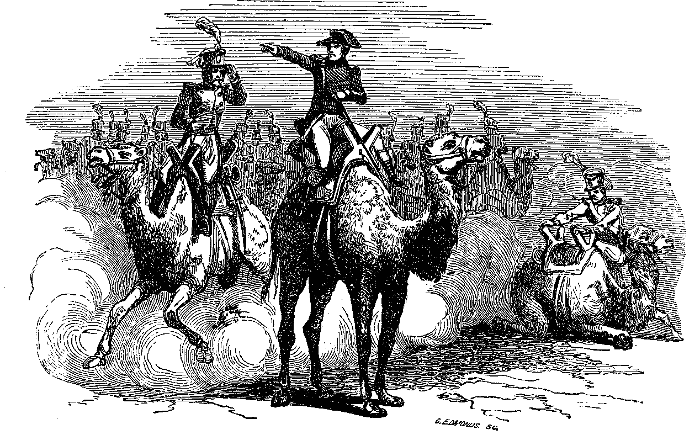
For such an enterprise the ambitious general, with an army of but ten thousand men, commenced his march over the desert, one hundred and fifty miles broad, which separates Africa from Asia. The Pacha of Syria, called Achmet the Butcher, from his merciless ferocity, was execrated by the Syrians. Napoleon had received delegations from the Christian tribes entreating him to come for their deliverance from the most intolerable oppression, and assuring him of their readiness to join his standard. The English, to divert the attention of Napoleon from his project upon Syria, commenced the bombardment of Alexandria. He understood the object of the unavailing attack, and treated it with disdain. He raised a regiment of entirely a new [pg 313] kind, called the dromedary regiment. Two men, seated back to back, were mounted on each dromedary; and such was the strength and endurance of these animals, that they could thus travel ninety miles without food, water, or rest. This regiment was formed to give chase to the Arab robbers who, in fierce banditti bands, were the scourge of Egypt. The marauders were held in terror by the destruction with which they were overwhelmed by these swift avengers. Napoleon himself rode upon a dromedary. The conveyance of an army of ten thousand men, with horses and artillery, across such an apparently interminable waste of shifting sand, was attended with inconceivable suffering. To allay the despair of the soldiers, Napoleon, ever calm and unagitated in the contemplation of any catastrophe however dreadful, soon dismounted, and waded through the burning sands by the side of the soldiers, sharing the deprivations and the toils of the humblest private in the ranks. Five days were occupied in traversing this forlorn waste. Water was carried for the troops in skins. At times portions of the army, almost perishing with thirst, surrendered themselves to despair. The presence of Napoleon, however, invariably reanimated hope and courage. The soldiers were ashamed to complain when they saw their youthful leader, pale and slender, and with health seriously impaired, toiling along by their side, sharing cheerfully all their privations and fatigues. The heat of these glowing deserts, beneath the fierce glare of a cloudless sun, was almost intolerable. At one time, when nearly suffocated by the intense heat, while passing by some ruins, a common soldier yielded to Napoleon the fragments of a pillar, in whose refreshing shadow he contrived, for a few moments, to shield his head. “And this,” said Napoleon, “was no trifling concession.” At another time a party of the troops got lost among the sand hills and nearly perished. Napoleon took some Arabs on dromedaries, and hastened in pursuit of them. When found they were nearly dead from thirst, fatigue, and despair. Some of the younger soldiers, in their frenzy, had broken their muskets and thrown them away. The sight of their beloved general revived their hopes, and inspired them with new life. Napoleon informed them that provisions and water were at hand. “But,” said he, “if relief had been longer delayed, would that have excused your murmurings and loss of courage? No! soldiers, learn to die with honor.”
After a march of five days they arrived before El Arish, one of those small, strongly fortified military towns, deformed by every aspect of poverty and wretchedness, with which iron despotism has filled the once fertile plains of Syria. El Arish was within the boundaries of Egypt. It had been captured by the Turks, and they had accumulated there immense magazines of military stores. It was the hour of midnight when Napoleon arrived beneath its walls. The Turks, not dreaming that a foe was near, were roused from sleep by the storm of balls and shells, shaking the walls and crushing down through the roofs of their dwellings. They sprang to their guns, and, behind the ramparts of stone, fought with their accustomed bravery. But after a short and bloody conflict, they were compelled to retire, and effected a disorderly retreat. The garrison, in the citadel, consisting of nearly two thousand men, were taken prisoners. Napoleon was not a little embarrassed in deciding what to do with these men. He had but ten thousand soldiers with whom to encounter the whole power of the Ottoman Porte, aided by the fleets of England and Russia. Famine was in his camp, and it was with difficulty that he could obtain daily rations for his troops. He could not keep these prisoners with him. They would eat the bread for which his army was hungering; they would demand a strong guard to keep them from insurrection; and the French army was already so disproportionate to the number of its foes, that not an individual could be spared from active service. They would surely take occasion, in the perilous moments of the day of battle, to rise in revolt, and thus, perhaps, effect the total destruction of the French army. Consequently, to retain them in the camp was an idea not to be entertained for a moment. To disarm them, and dismiss them upon their word of honor no longer to serve against the French, appeared almost equally perilous. There was no sense of honor in the heart of the barbarian Turk. The very idea of keeping faith with infidels they laughed to scorn. They would immediately join the nearest division of the Turkish army, and thus swell the already multitudinous ranks of the foe, and even if they did not secure the final defeat of Napoleon, they would certainly cost him the lives of many of his soldiers. He could not supply them with food, neither could he spare an escort to conduct them across the desert to Egypt. To shoot them in cold blood was revolting to humanity. Napoleon, however, generously resolved to give them their liberty, taking their pledge that they would no longer serve against him; and in order to help them keep their word, he sent a division of the army to escort them, one day's march, toward Bagdad, whither they promised to go. But no sooner had the escort commenced its return to the army, than these men, between one and two thousand in number, turned also, and made a straight path for their feet to the fortress of Jaffa, laughing at the simplicity of their outwitted foe. But Napoleon was not a man to be laughed at. This merriment soon died away in fearful wailings. Here they joined the marshaled hosts of Achmet the Butcher. The bloody pacha armed them anew, and placed them in his foremost ranks, again to pour a shower of bullets upon the little band headed by Napoleon. El Arish is in Egypt, eighteen miles from the granite pillars which mark the confines of Asia and Africa. Napoleon now continued his march through a dry, barren, and thirsty land. After having traversed a dreary desert of an hundred and fifty miles, the whole aspect of the country began rapidly to change. The soldiers were delighted to see the wreaths of vapor gathering in [pg 314] the hitherto glowing and cloudless skies. Green and flowery valleys, groves of olive-trees, and wood-covered hills, rose, like a vision of enchantment, before the eye, so long weary of gazing upon shifting sands and barren rocks. Napoleon often alluded to his passage across the desert, remarking that the scene was ever peculiarly gratifying to his mind. “I never passed the desert,” said he, “without experiencing very powerful emotions. It was the image of immensity to my thoughts. It displayed no limits. It had neither beginning nor end. It was an ocean for the foot of man.” As they approached the mountains of Syria, clouds began to darken the sky, and when a few drops of rain descended, a phenomenon which they had not witnessed for many months, the joy of the soldiers was exuberant. A murmur of delight ran through the army, and a curious spectacle was presented, as, with shouts of joy and peals of laughter, the soldiers, in a body, threw back their heads and opened their mouths, to catch the grateful drops upon their dry and thirsty lips.
But when dark night came on, and, with saturated clothing, they threw themselves down, in the drenching rain, for their night's bivouac, they remembered with pleasure the star-spangled firmament and the dry sands of cloudless, rainless Egypt. The march of a few days brought them to Gaza. Here they encountered another division of the Turkish army. Though headed by the ferocious Achmet himself, the Turks were, in an hour, dispersed before the resistless onset of the French, and all the military stores, which had been collected in the place, fell into the hands of the conqueror. But perils were now rapidly accumulating around the adventurous band. England, with her invincible fleet, was landing men, and munitions of war and artillery, and European engineers, to arrest the progress of the audacious and indefatigable victor. The combined squadrons of Turkey and Russia, also, were hovering along the coast, to prevent any possible supplies from being forwarded to Napoleon from Alexandria. Thirty thousand Turks, infantry and horsemen, were marshaled at Damascus. Twenty thousand were at Rhodes. Through all the ravines of Syria, the turbaned Musselmans, with gleaming sabres, were crowding down to swell the hostile ranks, already sufficiently numerous to render Napoleon's destruction apparently certain. Still unintimidated, Napoleon pressed on, with the utmost celerity, into the midst of his foes. On the 3d of March, twenty-three days after leaving Cairo, he arrived at Jaffa, the ancient Joppa. This place, strongly garrisoned, was surrounded by a massive wall flanked by towers. Napoleon had no heavy battering train, for such ponderous machines could not be dragged across the desert. He had ordered some pieces to be forwarded to him from Alexandria, by small vessels, which could coast near the shore. But they had been intercepted and taken by the vigilance of the English cruisers. Not an hour, however, was to be lost. From every point in the circumference of the circle, of which his little band was the centre, the foe was hurrying to meet him. The sea was whitened with their fleets, and the tramp of their dense columns shook the land. His only hope was, by rapidity of action, to defeat the separate divisions before all should unite. With his light artillery he battered a breach in the walls, and then, to save the effusion of blood, sent a summons to the commander to surrender. The barbarian Turk, regardless of the rules of civilized warfare, cut off the head of the unfortunate messenger, and raised the ghastly, gory trophy, upon a pole, from one of the towers. This was his bloody defiance and his threat. The enraged soldiers, with extraordinary intrepidity, rushed in at the breach and took sanguinary vengeance. The French suffered very severely, and the carnage, on both sides, was awful. Nothing could restrain the fury of the assailants, enraged at the wanton murder of their comrade. For many hours a scene of horror was exhibited in the streets of Jaffa, which could hardly have been surpassed had the conflict raged between fiends in the world of woe. Earth has never presented a spectacle more horrible than that of a city taken by assault. The vilest and the most abandoned of mankind invariably crowd into the ranks of an army. Imagination shrinks appalled from the contemplation of the rush of ten thousand demons, infuriated and inflamed, into the dwellings of a crowded city.
Napoleon, shocked at the outrages which were perpetrated, sent two of his aids to appease the fury of the soldiers, and to stop the massacre. Proceeding upon this message of mercy, they advanced to a large building where a portion of the garrison had taken refuge. The soldiers were shooting them as they appeared at the windows, battering the doors with cannon-balls, and setting fire to the edifice, that all might be consumed together. The Turks fought with the energies of despair. These were the men who had capitulated at El Arish, and who had violated their parole. They now offered to surrender again, if their lives might be spared. The aids, with much difficulty, rescued them from the rage of the maddened soldiers, and they were conducted, some two thousand in number, as prisoners into the French camp. Napoleon was walking in front of his tent, when he saw this multitude of men approaching. The whole dreadfulness of the dilemma in which he was placed flashed upon him instantaneously. His countenance fell, and in tones of deep grief he exclaimed, “What do they wish me to do with these men? Have I food for them—ships to convey them to Egypt or France? Why have they served me thus?” The aids excused themselves for taking them prisoners, by pleading that he had ordered them to go and stop the carnage. “Yes!” Napoleon replied sadly, “as to women, children, and old men, all the peaceable inhabitants, but not with respect to armed soldiers. It was your duty to die, rather than bring these unfortunate creatures to me. What do you want me to do with them?”
[pg 315]
A council of war was immediately held in the tent of Napoleon, to decide upon their fate. Long did the council deliberate, and, finally, it adjourned without coming to any conclusion. The next day the council was again convened. All the generals of division were summoned to attend. For many anxious hours they deliberated, sincerely desirous of discovering any measures by which they might save the lives of the unfortunate prisoners. The murmurs of the French soldiers were loud and threatening. They complained bitterly of having their scanty rations given to the prisoners; of having men again liberated who had already broken their pledge of honor, and had caused the death of many of their comrades. General Bon represented that the discontent was so deep and general, that unless something were expeditiously done, a serious revolt in the army was to be apprehended. Still the council adjourned, and the third day arrived without their being able to come to any conclusion favorable to the lives of these unfortunate men. Napoleon watched the ocean with intense solicitude, hoping against hope that some French vessel might appear, to relieve him of the fearful burden. But the evil went on increasing. The murmurs grew louder. The peril of the army was real and imminent, and, by the delay, was already seriously magnified. It was impossible longer to keep the prisoners in the camp. If set at liberty, it was only contributing so many more troops to swell the ranks of Achmet the Butcher, and thus, perhaps, to insure the total discomfiture and destruction of the French army. The Turks spared no prisoners. All who fell into their hands perished by horrible torture. The council at last unanimously decided that the men must be put to death. Napoleon, with extreme reluctance, signed the fatal order. The melancholy troop, in the silence of despair, were led, firmly fettered, to the sand hills, on the sea-coast, where they were divided into small squares, and mown down by successive discharges of musketry. The dreadful scene was soon over, and they were all silent in death. The pyramid of their bones still remains in the desert, a frightful memorial of the horrors of war.
As this transaction has ever been deemed the darkest blot upon the character of Napoleon, it seems but fair to give his defense in his own words: “I ordered,” said Napoleon at St. Helena, “about a thousand or twelve hundred to be shot. Among the garrison at Jaffa a number of Turkish troops were discovered, whom I had taken a short time before at El Arish, and sent to Bagdad, on their parole not to be found in arms against me for a year. I had caused them to be escorted thirty-six miles, on their way to Bagdad, by a division of my army. But, instead of proceeding to Bagdad, they threw themselves into Jaffa, defended it to the last, and cost me the lives of many of my brave troops. Moreover, before I attacked the town I sent them a flag of truce. Immediately after, we saw the head of the bearer elevated on a pole over the wall. Now, if I had spared them again, and sent them away on their parole, they would directly have gone to Acre, and have played over, for the second time, the same scene that they had done at Jaffa. In justice to the lives of my soldiers, as every general ought to consider himself as their father, and them as his children, I could not allow this. To leave as a guard a portion of my army, already reduced in number in consequence of the breach of faith of those wretches, was impossible. Indeed, to have acted otherwise than as I did, would probably have caused the destruction of my whole army. I, therefore, availing myself of the rights of war, which authorize the putting to death prisoners taken under such circumstances, independent of the right given to me by having taken the city by assault, and that of retaliation on the Turks, ordered that the prisoners, who, in defiance of their capitulation, had been found bearing arms against me, should be selected out and shot. The rest, amounting to a considerable number, were spared. I would do the same thing again to-morrow, and so would Wellington, or any general commanding an army under similar circumstances.” Whatever judgment posterity may pronounce upon this transaction, no one can see in it any indication of an innate love of cruelty in Napoleon. He regarded the transaction as one of the stern necessities of war. The whole system is one of unmitigated horror. Bomb-shells are thrown into cities to explode in the chambers of maidens and in the cradles of infants, and the incidental destruction of innocence and helplessness is disregarded. The execrable ferocity of the details of war are essential to the system. To say that Napoleon ought not to have shot these prisoners, is simply to say that he ought to have relinquished the contest, to have surrendered himself and his army to the tender mercies of the Turk; and to allow England, and Austria, and Russia, to force back upon the disenthralled French nation the detested reign of the Bourbons. England was bombarding the cities of France, to compel a proud nation to re-enthrone a discarded and hated king. The French, in self-defense, were endeavoring to repel their powerful foe, by marching to India, England's only vulnerable point. Surely, the responsibility of this war rests with the assailants, and not with the assailed. There was a powerful party in the British Parliament and throughout the nation, the friends of reform and of popular liberty, who sympathized entirely with the French in this conflict, and who earnestly protested against a war which they deemed impolitic and unjust. But the king and the nobles prevailed, and as the French would not meekly submit to their demands, the world was deluged with blood. “Nothing was easier,” says Alison, “than to have disarmed the captives and sent them away.” The remark is unworthy of the eloquent and distinguished historian. It is simply affirming that France should have yielded the conflict, and submitted to British dictation. It would have been far more in accordance with the spirit of the events to have said, “Nothing was easier than for England to allow France to choose her own [pg 316] form of government.” But had this been done, the throne of England's king, and the castles of her nobles might have been overturned by the earthquake of revolution. Alas, for man!
Bourrienne, the rejected secretary of Napoleon, who became the enemy of his former benefactor, and who, as the minister and flatterer of Louis XVIII., recorded with caustic bitterness the career of the great rival of the European kings, thus closes his narrative of this transaction: “I have related the truth; the whole truth. I assisted at all the conferences and deliberations, though, of course, without possessing any deliberative voice. But I must in candor declare, that had I possessed a right of voting, my voice would have been for death. The result of the deliberations, and the circumstances of the army, would have constrained me to this. War, unfortunately, offers instances, by no means rare, in which an immutable law, of all times and common to all nations, has decreed that private interests shall succumb to the paramount good of the public, and that humanity itself shall be forgotten. It is for posterity to judge whether such was the terrible position of Bonaparte. I have a firm conviction that it was. And this is strengthened by the fact, that the opinion of the members of the council was unanimous upon the subject, and that the order was issued upon their decision. I owe it also to truth to state, that Napoleon yielded only at the last extremity, and was, perhaps, one of those who witnessed the massacre with the deepest sorrow.” Even Sir Walter Scott, who, unfortunately, allowed his Tory predilections to dim the truth of his unstudied yet classic page, while affirming that “this bloody deed must always remain a deep stain upon the character of Napoleon,” is constrained to admit, “yet we do not view it as the indulgence of an innate love of cruelty; for nothing in Bonaparte's history shows the existence of that vice; and there are many things which intimate his disposition to have been naturally humane.”
Napoleon now prepared to march upon Acre, the most important military post in Syria. Behind its strong ramparts Achmet the Butcher had gathered all his troops and military stores, determined upon the most desperate resistance. Colonel Philippeaux, an emissary of the Bourbons, and a former school-mate of Napoleon, contributed all the skill of an accomplished French engineer in arming the fortifications and conducting the defense. Achmet immediately sent intelligence of the approaching attack to Sir Sydney Smith, who was cruising in the Levant with an English fleet. He immediately sailed for Acre, with two ships of the line and several smaller vessels, and proudly entered the harbor two days before the French made their appearance, strengthening Achmet with an abundant supply of engineers, artillerymen, and ammunition. Most unfortunately for Napoleon, Sir Sydney, just before he entered the harbor, captured the flotilla, dispatched from Alexandria with the siege equipage, as it was cautiously creeping around the headlands of Carmel. The whole battering train, amounting to forty-four heavy guns, he immediately mounted upon the ramparts, and manned them with English soldiers. This was an irreparable loss to Napoleon, but with undiminished zeal the besiegers, with very slender means, advanced their works. Napoleon now sent an officer with a letter to Achmet, offering to treat for peace “Why,” said he, in this, “should I deprive an old man, whom I do not know, of a few years of life? What signify a few leagues more, added to the countries I have conquered? Since God has given victory into my hands, I will, like him, be forgiving and merciful, not only toward the people, but toward their rulers also.” The barbarian Turk, regardless of the flag of truce, cut off the head of this messenger, though Napoleon had taken the precaution to send a Turkish prisoner with the flag, and raised the ghastly trophy upon a pole, over his battlements, in savage defiance. The decapitated body he sewed up in a sack, and threw it into the sea. Napoleon then issued a proclamation to the people of Syria: “I am come into Syria,” said he, “to drive out the Mamelukes and the army of the Pacha. What right had Achmet to send his troops to attack me in Egypt? He has provoked me to war. I have brought it to him. But it is not on you, inhabitants, that I intend to inflict its horrors. Remain quiet in your homes. Let those who have abandoned them through fear return again. I will grant to every one the property which he possesses. It is my wish that the Cadis continue their functions as usual, and dispense justice; that religion, in particular, be protected and revered, and that the mosques should continue to be frequented by all faithful Mussulmans. It is from God that all good things come; it is he who gives the victory. The example of what has occurred at Gaza and Jaffa ought to teach you that if I am terrible to my enemies, I am kind to my friends, and, above all, benevolent and merciful to the poor.”
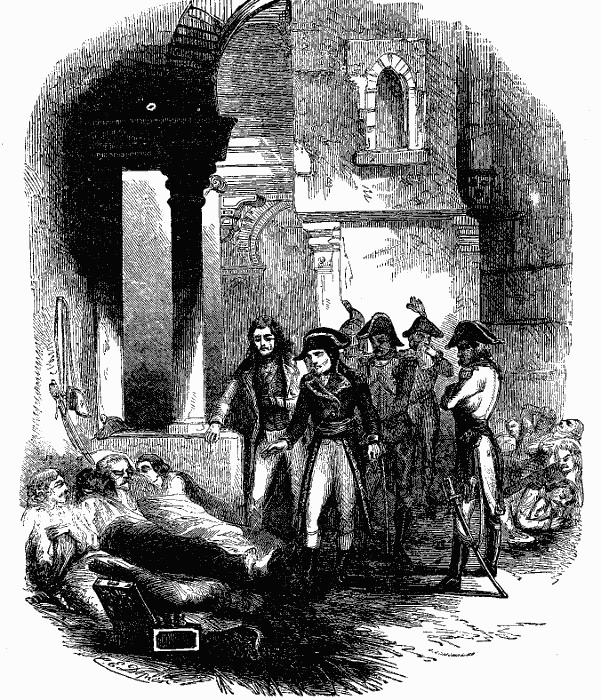
The plague, that most dreadful scourge of the East, now broke out in the army. It was a new form of danger, and created a fearful panic. The soldiers refused to approach their sick comrades, and even the physicians, terrified in view of the fearful contagion, abandoned the sufferers to die unaided. Napoleon immediately entered the hospitals, sat down by the cots of the sick soldiers, took their fevered hands in his own, even pressed their bleeding tumors, and spoke to them words of encouragement and hope. The dying soldiers looked upon their heroic and sympathizing friend with eyes moistened with gratitude, and blessed him. Their courage was reanimated and thus they gained new strength to throw off the dreadful disease. “You are right,” said a grenadier, upon whom the plague had made such ravages, that he could hardly move a limb; “your grenadiers were not made to die in a hospital.” The physicians, shamed by the heroism of Napoleon, returned to their duty. The soldiers, animated by the example of their chief, no longer refused to administer to the wants of their suffering comrades, and thus the progress of the infection in [pg 317] the army was materially arrested. One of the physicians reproached Napoleon for his imprudence, in exposing himself to such fearful peril. He coolly replied, “It is but my duty. I am the commander-in-chief.”
Napoleon now pressed the siege of Acre. It was the only fortress in Syria which could stop him. Its subjugation would make him the undisputed master of Syria. Napoleon had already formed an alliance with the Druses and other Christian tribes, who had taken refuge from the extortions of the Turks, among the mountains of Lebanon, and they only awaited the capture of Acre to join his standard in a body, and to throw off the intolerable yoke of Moslem despotism. Delegations of their leading men frequently appeared in the tent of Napoleon, and their prayers were fervently ascending for the success of the French arms. That in this conflict Napoleon was contending on the side of human liberty, and the allies for the support of despotism, is undeniable. The Turks were not idle. By vast exertions they had roused the whole Mussulman population to march, in the name of the Prophet, for the destruction of the “Christian dogs.” An enormous army was marshaled, and was on its way for the relief of the beleagured city. Damascus had furnished its thousands. The scattered remnants of the fierce Mamelukes, and the mounted Bedouins of the desert, had congregated, to rush, with resistless numbers, upon their bold antagonist.
Napoleon had been engaged for ten days in an almost incessant assault upon the works of Acre, when the approach of the great Turkish army was announced. It consisted of about thirty [pg 318] thousand troops, twelve thousand of whom were the fiercest and best-trained horsemen in the world. Napoleon had but eight thousand effective men with which to encounter the well-trained army of Europeans and Turks within the walls of Acre, and the numerous host rushing to its rescue. He acted with his usual promptitude. Leaving two thousand men to protect the works and cover the siege, he boldly advanced with but six thousand men, to encounter the thirty thousand already exulting in his speedy and sure destruction. Kleber was sent forward with an advance-guard of three thousand men. Napoleon followed soon after, with three thousand more. As Kleber, with his little band, defiled from a narrow valley at the foot of Mount Tabor, he entered upon an extended plain. It was early in the morning of the sixteenth of April. The unclouded sun was just rising over the hills of Palestine, and revealed to his view the whole embattled Turkish host spread out before him. The eye was dazzled with the magnificent spectacle, as proud banners and plumes, and gaudy turbans and glittering steel, and all the barbaric martial pomp of the East was reflected by the rays of the brilliant morning. Twelve thousand horsemen, decorated with the most gorgeous trappings of military show, and mounted on the fleetest Arabian chargers, were prancing and curveting in all directions. A loud and exultant shout of vengeance and joy, rising like the roar of the ocean, burst from the Turkish ranks, as soon as they perceived their victims enter the plain. The French, too proud and self-confident to retreat before any superiority in numbers, had barely time to form themselves into one of Napoleon's impregnable squares, when the whole cavalcade of horsemen, with gleaming sabres and hideous yells, and like the sweep of the wind, came rushing down upon them. Every man in the French squares knew that his life depended upon his immobility; and each one stood, shoulder to shoulder with his comrades, like a rock. It is impossible to drive a horse upon the point of a bayonet. He has an instinct of self-preservation which no power of the spur can overcome. He can be driven to the bayonet's point, but if the bayonet remains firm he will rear and plunge, and wheel, in defiance of all the efforts of his rider to force his breast against it. As the immense mass came thundering down upon the square, it was received by volcanic bursts of fire from the French veterans, and horse and riders rolled together in the dust. Chevaux-de-frise of bayonets, presented from every side of this living, flaming citadel, prevented the possibility of piercing the square. For six long hours this little band sustained the dreadful and unequal conflict. The artillery of the enemy plowed their ranks in vain. In vain the horsemen made reiterated charges on every side. The French, by the tremendous fire incessantly pouring from their ranks, soon formed around them a rampart of dead men and horses. Behind this horrible abattis, they bid stern defiance to the utmost fury of their enemies. Seven long hours passed away while the battle raged with unabated ferocity. The mid-day sun was now blazing upon the exhausted band. Their ammunition was nearly expended. Notwithstanding the enormous slaughter they had made, their foes seemed undiminished in number. A conflict so unequal could not much longer continue. The French were calling to their aid a noble despair, expecting there to perish, but resolved, to a man, to sell their lives most dearly.
Matters were in this state, when at one o'clock Napoleon, with three thousand men, arrived on the heights which overlooked the field of battle. The field was covered with a countless multitude, swaying to and fro in the most horrible clamor and confusion. They were canopied with thick volumes of smoke, which almost concealed the combatants from view. Napoleon could only distinguish the French by the regular and unintermitted volleys which issued from their ranks, presenting one steady spot, incessantly emitting lightning flashes, in the midst of the moving multitude with which it was surrounded. With that instinctive judgment which enabled him, with the rapidity of lightning, to adopt the most important decisions, Napoleon instantly took his resolution. He formed his little band into two squares, and advanced in such a manner as to compose, with the square of Kleber, a triangle inclosing the Turks. Thus, with unparalleled audacity, with six thousand men he undertook to surround thirty thousand of as fierce and desperate soldiers as the world has ever seen. Cautiously and silently the two squares hurried on to the relief of their friends, giving no sign of approach, till they were just ready to plunge upon the plains. Suddenly the loud report of a cannon upon the hills startled with joyful surprise the weary heroes. They recognized instantly the voice of Napoleon rushing to their rescue. One wild shout of almost delirious joy burst from the ranks. “It is Bonaparte! It is Bonaparte!” That name operated as a talisman upon every heart. Tears of emotion dimmed the eyes of those scarred and bleeding veterans, as, disdaining longer to act upon the defensive, they grasped their weapons with nervous energy, and made a desperate onset upon their multitudinous foes. The Turks were assailed by a murderous fire instantaneously discharged from the three points of this triangle. Discouraged by the indomitable resolution with which they had been repulsed, and bewildered by the triple assault, they broke and fled. The mighty host, like ocean waves, swept across the plain, when suddenly it was encountered by one of the fresh squares, and in refluent surges rolled back in frightful disorder. A scene of horror now ensued utterly unimaginable. The Turks were cut off from retreat in every direction. The enormous mass of infantry, horse, artillery, and baggage, was driven in upon itself, in wild and horrible confusion. From the French squares there flashed one incessant sheet of flame. Peal after peal, the artillery thundered in a continuous roar. These thoroughly-drilled veterans fired with a rapidity and a precision which seemed to the [pg 319] Turks supernatural. An incessant storm of cannon-balls, grape-shot, and bullets pierced the motley mass, and the bayonets of the French dripped with blood.
Murat was there, with his proud cavalry—Murat, whom Napoleon has described as in battle probably the bravest man in the world. Of majestic frame, dressed in the extreme of military ostentation, and mounted upon the most powerful of Arabian chargers, he towered, proudly eminent, above all his band. With the utmost enthusiasm he charged into the swollen tide of turbaned heads and flashing scimitars. As his strong horse reared and plunged in the midst of the sabre strokes falling swiftly on every side around him, his white plume, which ever led to victory, gleamed like a banner over the tumultuous throng. It is almost an inexplicable development of human nature to hear Murat exclaim, “In the hottest of this terrible fight, I thought of Christ, and of his transfiguration upon this very spot, two thousand years ago, and the reflection inspired me with ten-fold courage and strength.” The fiend-like disposition created by these horrible scenes, is illustrated by the conduct of a French soldier on this occasion. He was dying of a frightful wound. Still he crawled to a mangled Mameluke, even more feeble than himself, also in the agonies of death, and, seizing him by the throat, tried to strangle him. “How can you,” exclaimed a French officer, to the human tiger, “in your condition, be guilty of such an act?” “You speak much at your ease,” the man replied, “you who are unhurt; but I, while I am dying, must reap some enjoyment while I can.”
The victory was complete. The Turkish army was not merely conquered, it was destroyed. As that day's sun, vailed in smoke, solemnly descended, like a ball of fire, behind the hills of Lebanon, the whole majestic array, assembled for the invasion of Egypt, and who had boasted that they were “innumerable as the sands of the sea or as the stars of heaven,” had disappeared to be seen no more. The Turkish camp, with four hundred camels and an immense booty, fell into the hands of the victors.
This signal victory was achieved by a small division of Napoleon's army, of but six thousand men, in a pitched battle, on an open field. Such exploits history can not record without amazement. The ostensible and avowed object of Napoleon's march into Syria was now accomplished. Napoleon returned again to Acre, to prosecute with new vigor its siege, for, though the great army, marshaled for his destruction, was annihilated, he had other plans, infinitely more majestic, revolving in his capacious mind. One evening he was standing with his secretary upon the mount which still bears the name of Richard Cœur de Lion, contemplating the smouldering scene of blood and ruin around him, when, after a few moments of silent thought, he exclaimed, “Yes, Bourrienne, that miserable fort has cost me dear. But matters have gone too far not to make a last effort. The fate of the East depends upon the capture of Acre. That is the key of Constantinople or of India. If we succeed in taking this paltry town, I shall obtain the treasures of the Pacha, and arms for three hundred thousand men. I will then raise and arm the whole population of Syria, already so exasperated by the cruelty of Achmet, and for whose fall all classes daily supplicate Heaven. I shall advance on Damascus and Aleppo. I will recruit my army, as I advance, by enlisting all the discontented. I will announce to the people the breaking of their chains and the abolition of the tyrannical governments of the Pachas. The Druses wait but for the fall of Acre, to declare themselves. I am already offered the keys of Damascus. My armed masses will penetrate to Constantinople, and the Mussulman dominion will be overturned. I shall found in the East a new and mighty empire, which will fix my position with posterity.”
With these visions animating his mind, and having fully persuaded himself that he was the child of destiny, he prosecuted, with all possible vigor, the siege of Acre. But English and Russian and Turkish fleets were in that harbor. English generals, and French engineers, and European and Turkish soldiers, stood, side by side, behind those formidable ramparts, to resist the utmost endeavors of their assailants, with equal vigor, science, and fearlessness. No pen can describe the desperate conflicts and the scenes of carnage which ensued. Day after day, night after night, and week after week, the horrible slaughter, without intermission, continued. The French succeeded in transporting, by means of their cruisers, from Alexandria, a few pieces of heavy artillery, and the walls of Acre were reduced to a pile of blackened ruins. The streets were plowed up, and the houses blown down by bomb-shells. Bleeding forms, blackened with smoke, and with clothing burnt and tattered, rushed upon each other, with dripping sabres and bayonets, and with hideous yells which rose even above the incessant thunders of the cannonade. The noise, the uproar, the flash of guns, the enveloping cloud of sulphurous smoke converting the day into hideous night, and the unintermitted flashes of musketry and artillery, transforming night into lurid and portentous day, the forms of the combatants, gliding like spectres, with demoniacal fury through the darkness, the blast of trumpets, the shout of onset, the shriek of death, presented a scene which no tongue can tell nor imagination conceive. There was no time to bury the dead, and the putrefaction of hundreds of corpses under that burning sun added appalling horrors. To the pure spirits of a happier world, in the sweet companionship of celestial mansions, loving and blessing each other, it must have appeared a spectacle worthy of pandemonium. And yet the human heart is so wicked, that it can often, forgetting the atrocity of such a scene, find a strange pleasure in the contemplation of its energy and its heroism. We are indeed a fallen race.
There were occasional lulls in this awful storm, during which each party would be rousing its [pg 320] energies for more terrible collision. The besiegers burrowed mines deep under the foundations of walls and towers, and with the explosion of hundreds of barrels of gunpowder, opened volcanic craters, blowing men and rocks into hideous ruin. In the midst of the shower of destruction darkening the skies, the assailants rushed, with sabres and dripping bayonets, to the assault. The onset, on the part of the French, was as furious and desperate as mortal man is capable of making. The repulse was equally determined and fearless.
Sir Sydney Smith conducted the defense, with the combined English and Turkish troops. He displayed consummate skill, and unconquerable firmness, and availed himself of every weapon of effective warfare. Conscious of the earnest desire of the French soldiers to return to France, and of the despair with which the army had been oppressed when the fleet was destroyed, and thus all hope of return was cut off, he circulated a proclamation among them, offering to convey safely to France every soldier who would desert from the standard of Napoleon. This proclamation, in large numbers, was thrown from the ramparts to the French troops. A more tempting offer could not have been presented, and yet so strong was the attachment of the soldiers for their chief, that it is not known that a single individual availed himself of the privilege. Napoleon issued a counter proclamation to his army, in which he asserted that the English commodore had actually gone mad. This so provoked Sir Sydney, that he sent a challenge to Napoleon to meet him in single combat. The young general proudly replied, “If Sir Sydney will send Marlborough from his grave, to meet me, I will think of it. In the mean time, if the gallant commodore wishes to display his personal prowess, I will neutralize a few yards of the beach, and send a tall grenadier, with whom he can run a tilt.”
In the progress of the siege, Gen. Caffarelli was struck by a ball and mortally wounded. For eighteen days he lingered in extreme pain, and then died. Napoleon was strongly attached to him, and during all the period, twice every day, made a visit to his couch of suffering. So great was his influence over the patient, that though the wounded general was frequently delirious, no sooner was the name of Napoleon announced, than he became perfectly collected, and conversed coherently.
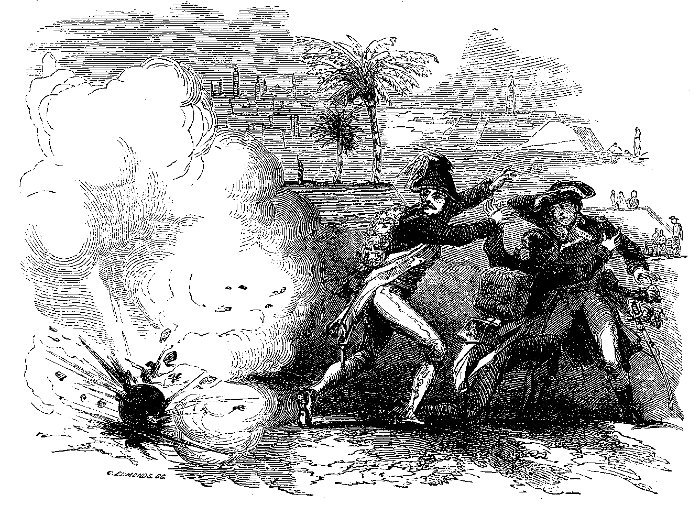
The most affecting proofs were frequently given of the entire devotion of the troops to Napoleon. One day, while giving some directions in the trenches, a shell, with its fuse fiercely burning, fell at his feet. Two grenadiers, perceiving his danger, instantly rushed toward him, encircled him in their arms, and completely shielded every part of his body with their own. The shell exploded, blowing a hole in the earth sufficiently large to bury a cart and two horses. All three were tumbled into the excavation, and covered with stones and sand. One of the men was rather severely wounded; Napoleon escaped with but a few slight bruises. He immediately elevated both of these heroes to the rank of officers.
“Never yet, I believe,” said Napoleon, “has there been such devotion shown by soldiers to their general, as mine have manifested for me. At Arcola, Colonel Muiron threw himself before me, covered my body with his own, and received the [pg 321] blow which was intended for me. He fell at my feet, and his blood spouted up in my face. In all my misfortunes never has the soldier been wanting in fidelity—never has man been served more faithfully by his troops. With the last drop of blood gushing out of their veins, they exclaimed, Vive Napoleon.”
The siege had now continued for sixty days. Napoleon had lost nearly three thousand men, by the sword and the plague. The hospitals were full of the sick and the wounded. Still, Napoleon remitted not his efforts. “Victory,” said he, “belongs to the most persevering.” Napoleon had now expended all his cannon-balls. By a singular expedient he obtained a fresh supply. A party of soldiers was sent upon the beach, and set to work, apparently throwing up a rampart for the erection of a battery. Sir Sydney immediately approached with the English ships, and poured in upon them broadside after broadside from all his tiers. The soldiers, who perfectly comprehended the joke, convulsed with laughter, ran and collected the balls as they rolled over the sand. Napoleon ordered a dollar to be paid to the soldiers for each ball thus obtained. When this supply was exhausted, a few horsemen or wagons were sent out upon the beach, as if engaged in some important movement, when the English commodore would again approach and present them, from his plethoric magazines, with another liberal supply. Thus for a long time Napoleon replenished his exhausted stores.
One afternoon in May, a fleet of thirty sail of the line was descried in the distant horizon, approaching Acre. All eyes were instantly turned in that direction. The sight awakened intense anxiety in the hearts of both besiegers and besieged. The French hoped that they were French ships conveying to them succors from Alexandria or from France. The besieged flattered themselves that they were friendly sails, bringing to them such aid as would enable them effectually to repulse their terrible foes. The English cruisers immediately stood out of the bay to reconnoitre the unknown fleet. Great was the disappointment of the French when they saw the two squadrons unite, and the crescent of the Turk, and the pennant of England, in friendly blending, approach the bay together. The Turkish fleet brought a reinforcement of twelve thousand men, with an abundant supply of military stores. Napoleon's only hope was to capture the place before the disembarkation of these reinforcements. Calculating that the landing could not be effected in less than six hours, he resolved upon an immediate assault. In the deepening twilight, a black and massy column, issued from the trenches, and advanced, with the firm and silent steps of utter desperation, to the breach. The besieged knowing that, if they could hold out but a few hours longer, deliverance was certain, were animated to the most determined resistance. A horrible scene of slaughter ensued. The troops, from the ships, in the utmost haste, were embarked in the boats, and were pulling, as rapidly as possible, across the bay, to aid their failing friends. Sir Sydney himself headed the crews of the ships, and led them armed with pikes to the breach. The assailants gained the summit of the heap of stones into which the wall had been battered, and even forced their way into the garden of the pacha. But a perfect swarm of janizaries suddenly poured in upon them, with the keen sabre in one hand, and the dagger in the other, and in a few moments they were all reduced to headless trunks. The Turks gave no quarter. The remorseless Butcher sat in the court-yard of his palace, paying a liberal reward for the gory head of every infidel which was laid at his feet. He smiled upon the ghastly trophies heaped up in piles around him. The chivalric Sir Sydney must at times have felt not a little abashed in contemplating the deeds of his allies. He was, however, fighting to arrest the progress of free institutions, and the scimitar of the Turk was a fitting instrument to be employed in such a service. In promotion of the same object, but a few years before, the “tomahawk and scalping-knife of the savage” had been called into requisition, to deluge the borders of our own land with blood. Napoleon was contending to wrest from the hand of Achmet the Butcher, his bloody scimitar. Sir Sydney, with the united despots of Turkey and of Russia, was struggling to help him retain it.
Sir Sydney also issued a proclamation to the Druses, and other Christian tribes of Syria, urging them to trust to the faith of a “Christian knight,” rather than to that of an “unprincipled renegado.” But the “Christian knight,” in the hour of victory, forgot the poor Druses, and they were left, without even one word of sympathy, to bleed, during ages whose limits can not yet be seen, beneath the dripping yataghan of the Moslem. Column after column of the French advanced to the assault, but all were repulsed with dreadful slaughter. Every hour the strength of the enemy was increasing. Every hour the forces of Napoleon were melting away, before the awful storm sweeping from the battlements. In these terrific conflicts, where immense masses were contending hand to hand, it was found that the scimitar of the Turk was a far more efficient weapon of destruction than the bayonet of the European.
Success was now hopeless. Sadly Napoleon made preparations to relinquish the enterprise. He knew that a formidable Turkish army, aided by the fleets of England and Russia, was soon to be conveyed from Rhodes to Egypt. Not an hour longer could he delay his return to meet it. Had not Napoleon been crippled by the loss of his fleet at Aboukir, victory at Acre would have been attained without any difficulty. The imagination is bewildered in contemplating the results which might have ensued. Even without the aid of the fleet, but for the indomitable activity, courage, and energy of Sir Sydney Smith, Acre would have fallen, and the bloody reign of the Butcher would have come to an end. This destruction of Napoleon's magnificent anticipations [pg 322] of Oriental conquest must have been a bitter disappointment. It was the termination of the most sanguine hope of his life. And it was a lofty ambition in the heart of a young man of twenty-six, to break the chains which bound the countless millions of Asia, in the most degrading slavery, and to create a boundless empire such as earth had never before seen, which should develop all the physical, intellectual, and social energies of man.
History can record with unerring truth the deeds of man and his avowed designs. The attempt to delineate the conflicting motives, which stimulate the heart of a frail mortal, are hazardous. Even the most lowly Christian finds unworthy motives mingling with his best actions. Napoleon was not a Christian. He had learned no lessons in the school of Christ. Did he merely wish to aggrandize himself, to create and perpetuate his own renown, by being the greatest and the best monarch earth has ever known? This is not a Christian spirit. But it is not like the spirit which demonized the heart of Nero, which stimulated the lust of Henry the Eighth, which fired the bosom of Alexander with his invincible phalanxes, and which urged Tamerlane, with his mounted hordes, to the field of blood. Our Saviour was entirely regardless of self in his endeavors to bless mankind. Even Washington, who though one of the best of mortals, must be contemplated at an infinite distance from the Son of God, seemed to forget himself in his love for his country. That absence of regard for self can not be so distinctly seen in Napoleon. He wished to be the great benefactor of the world, elevating the condition and rousing the energies of man, not that he might obtain wealth and live in splendor, not that he might revel in voluptuous indulgences, but apparently that his own name might be embalmed in glory. This is not a holy motive. Neither is it degrading and dishonorable. We hate the mercenary despot. We despise the voluptuary. But history can not justly consign Napoleon either to hatred or to contempt. Had Christian motives impelled him, making all due allowance for human frailty, he might have been regarded as a saint. Now he is but a hero.
The ambitious conqueror who invades a peaceful land, and with fire and blood subjugates a timid and helpless people, that he may bow their necks to the yoke of slavery, that he may doom them to ignorance and degradation, that he may extort from them their treasures by the energies of the dungeon, the scimetar, and the bastinado, consigning the millions to mud hovels, penury, and misery, that he and his haughty parasites may revel in voluptuousness and splendor, deserves the execrations of the world. Such were the rulers of the Orient. But we can not with equal severity condemn the ambition of him, who marches not to forge chains, but to break them; not to establish despotism, but to assail despotic usurpers; not to degrade and impoverish the people, but to ennoble, and to elevate, and to enrich them; not to extort from the scanty earnings of the poor the means of living in licentiousness and all luxurious indulgence, but to endure all toil, all hardship, all deprivation cheerfully, that the lethargic nations may be roused to enterprise, to industry, and to thrift. Such was the ambition of Napoleon. Surely it was lofty. But far more lofty is that ambition of which Christ is the great exemplar, which can bury self entirely in oblivion.
Twenty years after the discomfiture at Acre, Napoleon, when imprisoned upon the Rock of St. Helena, alluded to these dreams of his early life. “Acre once taken,” said he; “the French army would have flown to Aleppo and Damascus. In the twinkling of an eye it would have been on the Euphrates. The Christians of Syria, the Druses, the Christians of Armenia, would have joined it. The whole population of the East would have been agitated.” Some one said, he would have soon been reinforced by one hundred thousand men. “Say rather, six hundred thousand,” Napoleon replied. “Who can calculate what would have happened! I would have reached Constantinople and the Indies—I would have changed the face of the world.”
The manner in which Napoleon bore this disappointment most strikingly illustrates the truth of his own remarkable assertion. “Nature seems to have calculated that I should endure great reverses. She has given me a mind of marble. Thunder can not ruffle it. The shaft merely glides along.” Even his most intimate friends could discern no indications of discontent. He seemed to feel that it was not his destiny to found an empire in the East, and, acquiescing without a murmur, he turned his attention to other enterprises. “That man,” said he, with perfect good-nature, speaking of Sir Sydney Smith, “made me miss my destiny.” Napoleon ever manifested the most singular magnanimity in recognizing the good qualities of his enemies. He indulged in no feelings of exasperation toward Sir Sydney, notwithstanding his agency in frustrating the most cherished plan of his life.—Wurmser, with whom he engaged in such terrible conflicts in Italy, he declared to be a brave and magnanimous foe; and, in the hour of triumph, treated him with a degree of delicacy and generosity which could not have been surpassed had his vanquished antagonist been his intimate friend. Of Prince Charles, with whom he fought repeated and most desperate battles in his march upon Vienna, he remarked, “He is a good man, which includes every thing when said of a prince. He is incapable of a dishonorable action.” And even of his eccentric and versatile antagonist at Acre, Napoleon says, with great impartiality and accuracy of judgment, “Sir Sydney Smith is a brave officer. He displayed considerable ability in the treaty for the evacuation of Egypt by the French. He also manifested great honor in sending immediately to Kleber the refusal of Lord Keith to ratify the treaty, which saved the French army. If he had kept it a secret for seven or eight days longer, Cairo would have been given up to the Turks, and the French army would have been obliged to surrender to the English. [pg 323] He also displayed great humanity and honor in all his proceedings toward the French who fell into his hands. He is active, intelligent, intriguing, and indefatigable; but I believe that he is half crazy. The chief cause of the failure at Acre was, that he took all my battering train, which was on board several small vessels. Had it not been for that I should have taken Acre in spite of him. He behaved very bravely. He sent me, by means of a flag of truce, a lieutenant or midshipman, with a letter containing a challenge to me, to meet him in some place he pointed out, in order to fight a duel. I laughed at this, and sent him back an intimation that when he brought Marlborough to fight me, I would meet him. Notwithstanding this, I like the character of the man. He has certain good qualities, and, as an old enemy, I should like to see him.”
A minute dissector of human nature may discern, in this singular candor, a destitution of earnestness of principle. The heart is incapable of this indifference, when it cherishes a profound conviction of right and wrong. It is undoubtedly true that Napoleon encountered his foes upon the field of battle, with very much the same feeling with which he would meet an opponent in a game of chess. These wars were fierce conflicts between the kings and the people; and Napoleon was not angry with the kings for defending strongly their own cause. There were of course moments of irritation, but his prevailing feeling was that his foes were to be conquered, not condemned. At one time he expressed much surprise in perceiving that Alexander of Russia had allowed feelings of personal hostility to enter into the conflict. A chess-player could not have manifested more unaffected wonder, in finding his opponent in a rage at the check of his king. Napoleon does not appear often to have acted from a deep sense of moral obligation. His justice, generosity, and magnanimity were rather the instinctive impulses of a noble nature, than the result of a profound conviction of duty. We see but few indications, in the life of Napoleon, of tenderness of conscience. That faculty needs a kind of culture which Napoleon never enjoyed.
He also cherished the conviction that his opponents were urged on by the same destiny by which he believed himself to be impelled. “I am well taught,” said Dryfesdale, “and strong in the belief, that man does naught of himself. He is but the foam upon the billow, which rises, bubbles, and bursts, not by its own efforts, but by the mightier impulse of fate, which urges him.” The doctrine called destiny by Napoleon, and philosophical necessity by Priestley, and divine decrees by Calvin, assuming in each mind characteristic modifications, indicated by the name which each assigned to it, is a doctrine which often nerves to the most heroic and virtuous endeavors, and which is also capable of the most awful perversion.
Napoleon was an inveterate enemy to dueling, and strongly prohibited it in the army. One evening in Egypt, at a convivial party, General Lanusse spoke sarcastically respecting the condition of the army. Junot, understanding his remarks to reflect upon Napoleon, whom he almost worshiped, was instantly in a flame, and stigmatized Lanusse as a traitor. Lanusse retorted by calling Junot a scoundrel. Instantly swords were drawn, and all were upon their feet, for such words demanded blood. “Hearken,” said Junot, sternly, “I called you a traitor; I do not think that you are one. You called me a scoundrel; you know that I am not such. But we must fight. One of us must die. I hate you, for you have abused the man whom I love and admire, as much as I do God, if not more.” It was a dark night. The whole party, by the light of torches, proceeded to the bottom of the garden which sloped to the Nile, when the two half inebriated generals cut at each other with their swords, until the head of Lanusse was laid open, and the bowels of Junot almost protruded from a frightful wound. When Napoleon, the next morning, heard of the occurrence, he was exceedingly indignant. “What?” exclaimed he, “are they determined to cut each other's throats? Must they go into the midst of the reeds of the Nile to dispute it with the crocodiles? Have they not enough, then, with the Arabs, the plague, and the Mamelukes? You deserve, Monsieur Junot,” said he, as if his aid were present before him, “you richly deserve, as soon as you get well, to be put under arrest for a month.”
In preparation for abandoning the siege of Acre, Napoleon issued the following proclamation to his troops. “Soldiers! You have traversed the desert which separates Asia from Africa, with the rapidity of an Arab force. The army, which was on its march to invade Egypt, is destroyed. You have taken its general, its field artillery, camels, and baggage. You have captured all the fortified posts, which secure the wells of the desert. You have dispersed, at Mount Tabor, those swarms of brigands, collected from all parts of Asia, hoping to share the plunder of Egypt. The thirty ships, which, twelve days since, you saw enter the port of Acre, were destined for an attack upon Alexandria. But you compelled them to hasten to the relief of Acre. Several of their standards will contribute to adorn your triumphal entry into Egypt. After having maintained the war, with a handful of men, during three months, in the heart of Syria, taken forty pieces of cannon, fifty stands of colors, six thousand prisoners, and captured or destroyed the fortifications of Gaza, Jaffa, and Acre, we prepare to return to Egypt, where, by a threatened invasion, our presence is imperiously demanded. A few days longer might give you the hope of taking the Pacha in his palace. But at this season the castle of Acre is not worth the loss of three days, nor the loss of those brave soldiers who would consequently fall, and who are necessary for more essential services. Soldiers! we have yet a toilsome and a perilous task to perform. After having, by this campaign, secured ourselves from attacks from the eastward, it will perhaps be necessary to repel efforts which may be made from the west.”
[pg 324]
On the 20th of May, Napoleon, for the first time in his life, relinquished an enterprise unaccomplished. An incessant fire was kept up in the trenches till the last moment, while the baggage, the sick, and the field artillery were silently defiling to the rear, so that the Turks had no suspicion that the besiegers were about to abandon their works. Napoleon left three thousand of his troops, slain or dead of the plague, buried in the sands of Acre. He had accomplished the ostensible and avowed object of his expedition. He had utterly destroyed the vast assemblages formed in Syria for the invasion of Egypt, and had rendered the enemy, in that quarter, incapable of acting against him. Acre had been overwhelmed by his fire, and was now reduced to a heap of ruins. Those vague and brilliant dreams of conquest in the East, which he secretly cherished, had not been revealed to the soldiers. They simply knew that they had triumphantly accomplished the object announced to them, in the destruction of the great Turkish army. Elated with the pride of conquerors, they prepared to return, with the utmost celerity, to encounter another army, assembled at Rhodes, which was soon to be landed, by the hostile fleet, upon some part of the shores of Egypt. Thus, while Napoleon was frustrated in the accomplishment of his undivulged but most majestic plans, he still appeared to the world an invincible conqueror.
There were, in the hospitals, twelve hundred sick and wounded. These were to be conveyed on horses and on litters. Napoleon relinquished his own horse for the wounded, and toiled along through the burning sands with the humblest soldiers on foot. The Druses and other tribes, hostile to the Porte, were in a state of great dismay when they learned that the French were retiring. They knew that they must encounter terrible vengeance at the hands of Achmet the Butcher. The victory of the allies riveted upon them anew their chains, and a wail, which would have caused the ear of Christendom to tingle, ascended from terrified villages, as fathers and mothers and children cowered beneath the storm of vengeance which fell upon them, from the hands of the merciless Turk. But England was too far away for the shrieks to be heard in her pious dwellings.
At Jaffa, among the multitude of the sick, there were seven found near to death. They were dying of the plague, and could not be removed. Napoleon himself fearlessly went into the plague hospital, passed through all its wards, and spoke words of sympathy and encouragement to the sufferers. The eyes of the dying were turned to him, and followed his steps, with indescribable affection, as he passed from cot to cot. The seven who were in such a condition that their removal was impossible, Napoleon for some time contemplated with most tender solicitude. He could not endure the thought of leaving them to be taken by the Turks; for the Turks tortured to death every prisoner who fell into their hands. He at last suggested to the physician the expediency of administering to them an opium pill, which would expedite, by a few hours, their death, and thus save them from the hands of their cruel foe. The physician gave the highly admired reply, “My profession is to cure, not to kill.” Napoleon reflected a moment in silence, and said no more upon the subject, but left a rear-guard of five hundred men to protect them, until the last should have expired. For this suggestion Napoleon has been most severely censured. However much it may indicate mistaken views of Christian duty, it certainly does not indicate a cruel disposition. It was his tenderness of heart, and his love for his soldiers, which led to the proposal. An unfeeling monster would not have troubled himself about these few valueless and dying men; but, without a thought, would have left them to their fate. In reference to the severity with which this transaction has been condemned, Napoleon remarked at St. Helena, “I do not think that it would have been a crime had opium been administered to them. On the contrary, I think it would have been a virtue. To leave a few unfortunate men, who could not recover, in order that they might be massacred by the Turks with the most dreadful tortures, as was their custom, would, I think, have been cruelty. A general ought to act with his soldiers, as he would wish should be done to himself. Now would not any man, under similar circumstances, who had his senses, have preferred dying easily, a few hours sooner, rather than expire under the tortures of those barbarians? If my own son, and I believe I love my son as well as any father does his child, were in a similar situation with these men, I would advise it to be done. And if so situated myself, I would insist upon it, if I had sense enough and strength enough to demand it. However, affairs were not so pressing as to prevent me from leaving a party to take care of them, which was done. If I had thought such a measure as that of giving opium necessary, I would have called a council of war, have stated the necessity of it, and have published it in the order of the day. It should have been no secret. Do you think, if I had been capable of secretly poisoning my soldiers, as doing a necessary action secretly would give it the appearance of a crime, or of such barbarities as driving my carriage over the dead, and the still bleeding bodies of the wounded, that my troops would have fought for me with an enthusiasm and affection without a parallel? No, no! I never should have done so a second time. Some would have shot me in passing. Even some of the wounded, who had sufficient strength left to pull a trigger, would have dispatched me. I never committed a crime in all my political career. At my last hour I can assert that. Had I done so, I should not have been here now. I should have dispatched the Bourbons. It only rested with me to give my consent, and they would have ceased to live. I have, however, often thought since on this point of morals, and, I believe, if thoroughly considered, it is always better to suffer a man to terminate his destiny, be it what it may. I judged so afterward in the case of my friend Duroc, who, when [pg 325] his bowels were falling out before my eyes, repeatedly cried to me to have him put out of his misery. I said to him ‘I pity you, my friend, but there is no remedy, it is necessary to suffer to the last.’ ”
Sir Robert Wilson recorded, that the merciless and blood-thirsty monster Napoleon, poisoned at Jaffa five hundred and eighty of his sick and wounded soldiers, merely to relieve himself of the encumbrance of taking care of them. The statement was circulated, and believed throughout Europe and America. And thousands still judge of Napoleon through the influence of such assertions. Sir Robert was afterward convinced of his error, and became the friend of Napoleon. When some one was speaking, in terms of indignation, of the author of the atrocious libel, Napoleon replied, “You know but little of men and of the passions by which they are actuated. What leads you to imagine that Sir Robert is not a man of enthusiasm and of violent passions, who wrote what he then believed to be true? He may have been misinformed and deceived, and may now be sorry for it. He may be as sincere now in wishing us well as he formerly was in seeking to injure us.” Again he said, “The fact is that I not only never committed any crime, but I never even thought of doing so. I have always marched with the opinions of five or six millions of men. In spite of all the libels, I have no fear whatever respecting my fame. Posterity will do me justice. The truth will be known, and the good which I have done will be compared with the faults which I have committed. I am not uneasy as to the result.”
Baron Larrey was the chief of the medical staff. “Larrey,” said Napoleon to O'Meara, “was the most honest man, and the best friend to the soldier whom I ever knew. Indefatigable in his exertions for the wounded, he was seen on the field of battle, immediately after an action, accompanied by a train of young surgeons, endeavoring to discover if any signs of life remained in the bodies. He scarcely allowed a moment of repose to his assistants, and kept them ever at their posts. He tormented the generals, and disturbed them out of their beds at night, whenever he wanted accommodations or assistance for the sick or wounded. They were all afraid of him, as they knew that if his wishes were not complied with, he would immediately come and make a complaint to me.” Larrey, on his return to Europe, published a medical work, which he dedicated to Napoleon as a tribute due to him for the care which he always took of the sick and wounded soldiers. Assulini, another eminent physician, records, “Napoleon, great in every emergence, braved on several occasions the danger of contagion. I have seen him in the hospitals at Jaffa, inspecting the wards, and talking familiarly with the soldiers attacked by the plague. This heroic example allayed the fears of the army, cheered the spirits of the sick, and encouraged the hospital attendants, whom the progress of the disease and the fear of contagion had considerably alarmed.”
The march over the burning desert was long and painful, and many of the sick and wounded perished. The sufferings of the army were inconceivable. Twelve hundred persons, faint with disease, or agonized with broken bones or ghastly wounds, were borne along, over the rough and weary way, on horseback. Many were so exhausted with debility and pain that they were tied to the saddles, and were thus hurried onward, with limbs freshly amputated and with bones shivered to splinters. The path of the army was marked by the bodies of the dead, which were dropped by the way-side. There were not horses enough for the sick and the wounded, though Napoleon and all his generals marched on foot. The artillery pieces were left among the sand hills, that the horses might be used for the relief of the sufferers. Many of the wounded were necessarily abandoned to perish by the way-side. Many who could not obtain a horse, knowing the horrible death by torture which awaited them, should they fall into the hands of the Turks, hobbled along with bleeding wounds in intolerable agony. With most affecting earnestness, though unavailingly, they implored their comrades to help them. Misery destroys humanity. Each one thought only of himself. Seldom have the demoralizing influences and the horrors of war been more signally displayed than in this march of twenty-five days. Napoleon was deeply moved by the spectacle of misery around him. One day as he was toiling along through the sands, at the head of a column, with the blazing sun of Syria pouring down upon his unprotected head, with the sick, the wounded, and the dying, all around him, he saw an officer, in perfect health, riding on horseback, refusing to surrender his saddle to the sick. The indignation of Napoleon was so aroused, that by one blow from the hilt of his sword he laid the officer prostrate upon the earth, and then helped a wounded soldier into his saddle. The deed was greeted with a shout of acclamation from the ranks. The “recording angel in heaven's chancery” will blot out the record of such violence with a tear.
The historian has no right to draw the vail over the revolting horrors of war. Though he may wish to preserve his pages from the repulsive recital, justice to humanity demands that the barbarism, the crime, and the cruelty of war should be faithfully portrayed. The soldiers refused to render the slightest assistance to the sick or the wounded. They feared that every one who was not well was attacked by the plague. These poor dying sufferers were not only objects of horror, but also of derision. The soldiers burst into immoderate fits of laughter in looking upon the convulsive efforts which the dying made to rise from the sands upon which they had fallen. “He has made up his account,” said one. “He will not get on far,” said another. And when the exhausted wretch fell to rise no more, they exclaimed, with perfect indifference, “His lodging is secured.” The troops were harassed upon their march by hordes of mounted [pg 326] Arabs, ever prowling around them. To protect themselves from assault, and to avenge attacks, they fired villages, and burned the fields of grain, and with bestial fury pursued shrieking maids and matrons. Such deeds almost invariably attend the progress of an army, for an army is ever the resort and the congenial home of the moral dregs of creation. Napoleon must at times have been horror-stricken in contemplating the infernal instrumentality which he was using for the accomplishment of his purposes. The only excuse which can be offered for him is, that it was then as now, the prevalent conviction of the world that war, with all its inevitable abominations, is a necessary evil. The soldiers were glad to be fired upon from a house, for it furnished them with an excuse for rushing in, and perpetrating deeds of atrocious violence in its secret chambers.
Those infected by the plague accompanied the army at some distance from the main body. Their encampment was always separated from the bivouacs of the troops, and was with terror avoided by those soldiers who, without the tremor of a nerve, could storm a battery. Napoleon, however, always pitched his tent by their side. Every night he visited them to see if their wants were attended to. And every morning he was present, with parental kindness, to see them file off at the moment of departure. Such tenderness, at the hands of one who was filling the world with his renown, won the hearts of the soldiers. He merited their love. Even to the present day the scarred and mutilated victims of these wars, still lingering in the Hotel des Invalides at Paris, will flame with enthusiastic admiration at the very mention of the name of Napoleon. There is no man, living or dead, who at the present moment is the object of such enthusiastic love as Napoleon Bonaparte. And they who knew him the best love him the most.
One day, on their return, an Arab tribe came to meet him, to show their respect and to offer their services as guides. The son of the chief of the tribe, a little boy about twelve years of age, was mounted on a dromedary, riding by the side of Napoleon, and chatting with great familiarity. “Sultan Kebir,” said the young Arab to Napoleon, “I could give you good advice, now that you are returning to Cairo.” “Well! speak, my friend,” said Napoleon; “if your advice is good I will follow it.” “I will tell you what I would do, were I in your place,” the young chief rejoined. “As soon as I got to Cairo, I would send for the richest slave-merchant in the market, and I would choose twenty of the prettiest women for myself. I would then send for the richest jewelers, and would make them give me up a good share of their stock. I would then do the same with all the other merchants. For what is the use of reigning, or being powerful, if not to acquire riches?” “But, my friend,” replied Napoleon, “suppose it were more noble to preserve these things for others?” The young barbarian was quite perplexed in endeavoring to comprehend ambition so lofty, intellectual, and refined. “He was, however,” said Napoleon, “very promising for an Arab. He was lively and courageous, and led his troops with dignity and order. He is perhaps destined one day or other, to carry his advice into execution in the market-place of Cairo.”
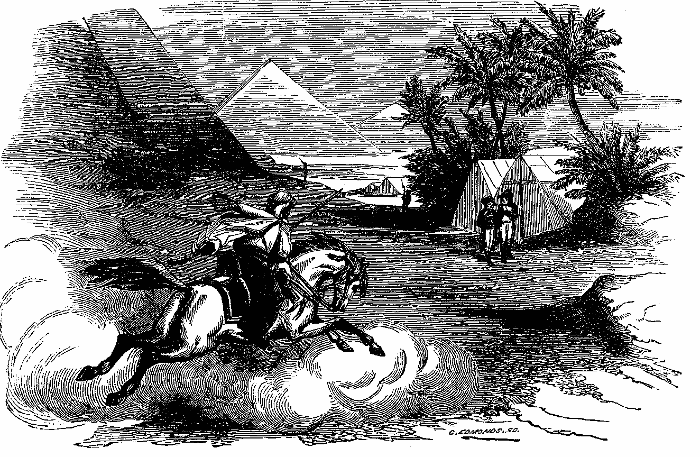
At length Napoleon arrived at Cairo, after an absence of three months. With great pomp and triumph he entered the city. He found, on his return to Egypt, that deep discontent pervaded the army. The soldiers had now been absent from France for a year. For six months they had heard no news whatever from home, as not [pg 327] a single French vessel had been able to cross the Mediterranean. Napoleon, finding his plans frustrated for establishing an empire which should overshadow all the East, began to turn his thoughts again to France. He knew, however, that there was another Turkish army collected at Rhodes, prepared, in co-operation with the fleets of Russia and England, to make a descent on Egypt. He could not think of leaving the army until that formidable foe was disposed of. He knew not when or where the landing would be attempted, and could only wait.
One evening, in July, he was walking with a friend in the environs of Cairo, beneath the shadow of the Pyramids, when an Arab horseman was seen, enveloped in a cloud of dust, rapidly approaching him over the desert. He brought dispatches from Alexandria, informing Napoleon that a powerful fleet had appeared in the Bay of Aboukir, that eighteen thousand Turks had landed, fierce and fearless soldiers, each armed with musket, pistol, and sabre; that their artillery was numerous, and well served by British officers; that the combined English, Russian, and Turkish fleets supported the armament in the bay; that Mourad Bey, with a numerous body of Mameluke cavalry, was crossing the desert from Upper Egypt to join the invaders; that the village of Aboukir had been taken by the Turks, the garrison cut to pieces, and the citadel compelled to capitulate. Thus the storm burst upon Egypt.
Napoleon immediately retired to his tent, where he remained till 3 o'clock the next morning, dictating orders for the instant advance of the troops; and for the conduct of those who were to remain in Cairo, and at the other military stations. At 4 o'clock in the morning he was on horseback, and the army in full march. The French troops were necessarily so scattered—some in Upper Egypt, eight hundred miles above Cairo, some upon the borders of the desert to prevent incursions from Syria, some at Alexandria—that Napoleon could take with him but eight thousand men. By night and by day, through smothering dust and burning sands, and beneath the rays of an almost blistering sun, his troops, hungry and thirsty, with iron sinews, almost rushed along, accomplishing one of those extraordinary marches which filled the world with wonder. In seven days he reached the Bay of Aboukir.
It was the hour of midnight, on the 25th of July, 1799, when Napoleon, with six thousand men, arrived within sight of the strongly intrenched camp of the Turks. They had thrown up intrenchments among the sand-hills on the shore of the bay. He ascended an eminence and carefully examined the position of his sleeping foes. By the bright moonlight he saw the vast fleet of the allies riding at anchor in the offing, and his practiced eye could count the mighty host, of infantry and artillery and horsemen, slumbering before him. He knew that the Turks were awaiting the arrival of the formidable Mameluke cavalry from Egypt, and for still greater reinforcements, of men and munitions of war, from Acre, and other parts of Syria. Kleber, with a division of two thousand of the army, had not yet arrived. Napoleon resolved immediately to attack his foes, though they were eighteen thousand strong. It was indeed an unequal conflict. These janizaries were the most fierce, merciless, and indomitable of men; and their energies were directed by English officers and by French engineers. Just one year before, Napoleon with his army had landed upon that beach. Where the allied fleet now rode so proudly, the French fleet had been utterly destroyed. The bosom of Napoleon burned with the desire to avenge this disaster. As Napoleon stood silently contemplating the scene, Murat by his side, he foresaw the long results depending upon the issue of the conflict. Utter defeat would be to him utter ruin. A partial victory would but prolong the conflict, and render it impossible for him, without dishonor, to abandon Egypt and return to France. The entire destruction of his foes would enable him, with the renown of an invincible conqueror, to leave the army in safety and embark for Paris, where he doubted not that, in the tumult of the unsettled times, avenues of glory would be opened before him. So strongly was he impressed with the great destinies for which he believed himself to be created, that, turning to Murat, he said, “This battle will decide the fate of the world.” The distinguished cavalry commander, unable to appreciate the grandeur of Napoleon's thoughts, replied, “At least of this army. But every French soldier feels now that he must conquer or die. And be assured, if ever infantry were charged to the teeth by cavalry, the Turks shall be to-morrow so charged by mine.”